

What if the strongest clue to a potential multi-bagger isn’t a hot stock tip, but a business whose fundamentals are improving before market excitement catches up? If you’re researching how to find multi-bagger stocks early, the challenge is separating genuine growth potential from noisy signals, crowded “winner” lists, and valuations that may already price in success.
A repeatable process can help. This article explains how to screen for long-term business potential, test the evidence behind growth, and weigh upside against valuation, execution, and downside risk. Use screens and alerts to prioritize candidates, then apply your own judgment. No indicator guarantees a particular outcome.
The research process moves from identifying promising companies to checking whether their performance and prospects support the thesis. AI-powered stock discovery, smart watchlists, and real-time alerts can help surface and organize ideas for further due diligence. They’re research tools, not predictors of future winners. The goal is to build a clearer shortlist and investigate it systematically.
Key Takeaways
- “Multi-bagger” describes past returns. Assess future potential without treating it as predictable.
- Review revenue growth, margins, cash generation, and balance-sheet resilience across multiple reporting periods.
- Evaluate valuation alongside business quality and growth. No single financial ratio can determine whether a stock is attractive.
- Use a repeatable process: set criteria, screen candidates, test evidence, document your thesis, and monitor for changes.
- Use discovery tools and alerts to prioritize research, not to replace due diligence or judgment.
What Does It Mean to Find a Potential Multi-Bagger Stock Early?
A multi-bagger is an investment that rises to a multiple of its original value. A two-bagger doubles; a five-bagger reaches five times its starting value. The term describes an outcome visible in hindsight, not a label investors can reliably assign in advance. The Multibagger stock entry provides background on the term, but a historical example can’t establish that another company will follow the same path.
Quotable definition: A multi-bagger is a stock that has delivered a multiple of its original value. Before that result occurs, investors can assess only a potential thesis and its uncertainties. This distinction matters. A company may have attractive products or fast growth and still fail to generate strong shareholder returns. Business progress and investment performance are related, but they aren’t interchangeable.
Realized returns depend on more than a company’s growth. The holding period affects how long compounding has to work. Dividends can add to total return, while share issuance can dilute each existing shareholder’s ownership. Entry valuation also matters: paying a high price can limit returns even if the business expands, while a lower starting valuation may leave more room for future gains. The outcome depends on the security, purchase price, and time horizon.
Why early discovery is different from predicting a winner
Early discovery means noticing evidence that a business may be improving before that case is widely recognized. It doesn’t mean knowing how the market will eventually value the company. Treat each promising stock as a research candidate, not a confirmed winner. This distinction helps prevent a compelling story from becoming assumed certainty.
Beware of survivorship bias. Lists of celebrated winners highlight companies that succeeded, while often leaving out businesses that stalled, failed, or no longer fit the original thesis. Looking only at survivors can make a strategy seem more reliable than it was. A sound process asks what evidence would have ruled out an investment at the time, not just what seems obvious after a stock has soared.
What a credible multi-bagger thesis needs
A forward-looking thesis should connect three elements: durable demand, a business model that can scale, and room for future growth. Test that logic against company disclosures and financial trends across reporting periods. A persuasive market narrative is a starting question, not proof. Look for evidence that customers are buying, the business can serve demand economically, and results support the stated growth story.
Also consider what could break the thesis. Competition may weaken pricing; costs or financing needs may constrain expansion; new shares may dilute ownership. Speculative small caps can carry substantial uncertainty, and concentrated positions can magnify the impact if an idea goes wrong. These risks don’t automatically disqualify a candidate, but they belong alongside potential upside. That’s the practical foundation of how to find multi-bagger stocks early: investigate what could work and define what would prove the case wrong.
How to Assess Business Quality and Long-Term Growth Potential
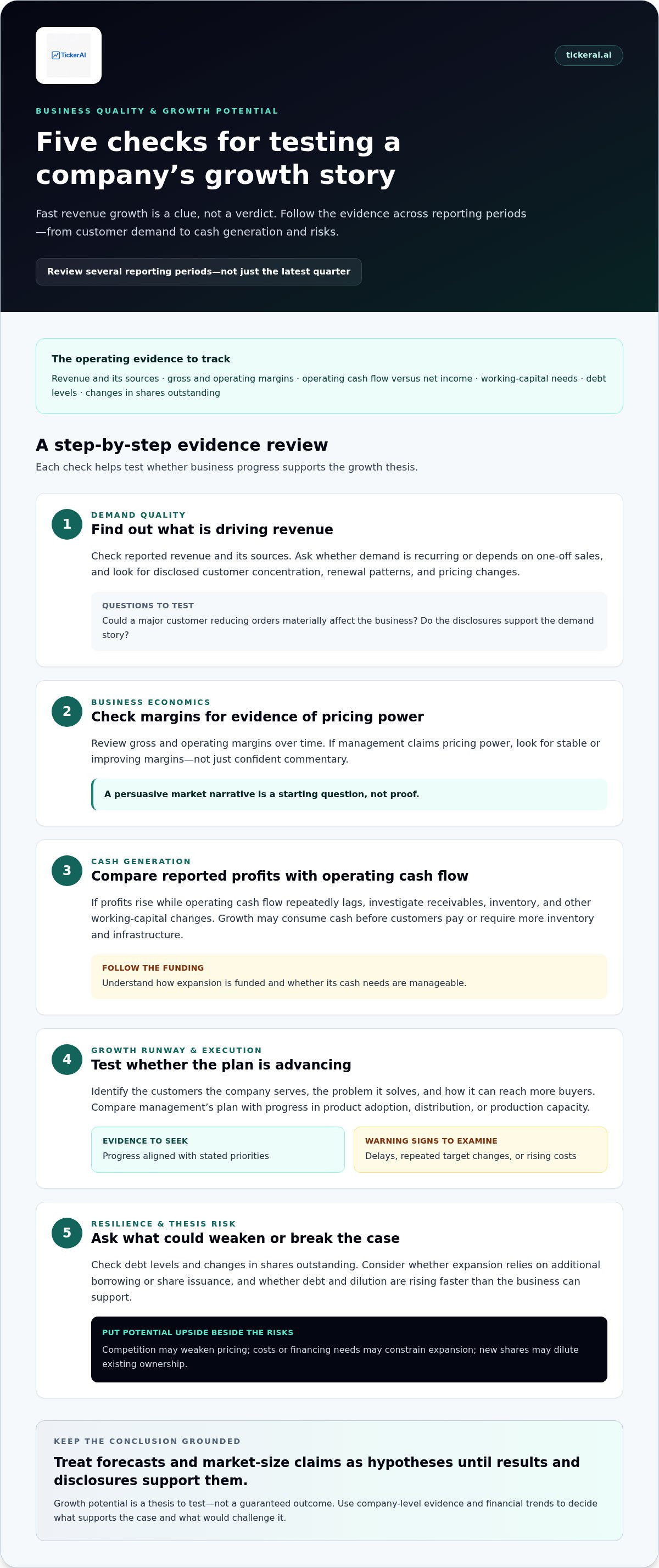
Fast revenue growth is a clue, not a verdict. Test whether the company can turn demand into durable earnings and cash while maintaining a balance sheet that can support its next stage of growth. Review several reporting periods, not just the latest quarter. One strong result may reflect timing, a one-off contract, or a temporary market tailwind.
Operating evidence checklist: Track reported revenue and its sources, gross and operating margins, operating cash flow versus net income, working-capital needs, debt levels, and changes in shares outstanding. Treat management forecasts and market-size claims as hypotheses until results and disclosures support them.
Look for durable business economics, not a fast-growing headline
Start with revenue quality. Is demand recurring or dependent on one-off sales? Does the company disclose customer concentration, renewal patterns, or pricing changes? A business with a few major customers may be more exposed if one reduces orders. If management claims pricing power, look for evidence in stable or improving margins, not just confident commentary.
Next, compare earnings with cash generation. If reported profits rise while operating cash flow repeatedly lags, investigate receivables, inventory, and other working-capital changes. Growth can consume cash before customers pay, or require larger inventories and infrastructure. That may be manageable, but the funding source matters. Check whether expansion relies on additional borrowing or share issuance, and whether debt and dilution are rising faster than the business can support.
Test the company’s growth runway and execution
A large market alone doesn’t establish a credible runway. Identify the customers the company serves, the problem it solves, and how it can reach more buyers. Then compare the plan with execution: are product adoption, distribution, or production capacity advancing in line with management’s stated priorities? Delays, repeated target changes, or rising costs can weaken the case even when the sector is growing.
Sector context helps frame these questions, but it shouldn’t replace company-level evidence. A thematic investment research framework can help organize industry drivers, competitive pressures, and potential beneficiaries. For a broader overview of business and growth factors, see How to Find Multibagger Stocks, then verify each candidate against its own filings and financial trends.
To make how to find multi-bagger stocks early a repeatable research task, separate measurable results from claims in your notes:
- Measured: Reported sales, margins, cash flow, debt, working capital, and share-count changes.
- Claimed: Projected market share, expected adoption, future margins, and planned capacity.
- Test: Record what future disclosure would support or contradict each claim.
AI-powered stock opportunity discovery can help surface and organize research candidates. Use it to prioritize your review, not as a substitute for checking business fundamentals.
How to Compare Valuation, Growth, and Risk Before Investing
A strong business can still be an unattractive investment if its share price already assumes years of exceptional growth. Assess growth quality and valuation together: ask what the current price appears to require, then compare those expectations with the company’s results and risks. A low multiple isn’t protection either. Shares can look inexpensive as earnings weaken, debt rises, or a business loses customers.
How to interpret common screening metrics in context
Metrics are clues, not verdicts. The price-to-earnings ratio (P/E) compares share price with earnings, but can mislead when profits are unusually high, depressed, or negative. Price-to-book (P/B) compares market value with recorded net assets, but its usefulness varies by asset mix and business model. Return ratios can signal efficient use of capital, yet may be influenced by leverage or a shrinking equity base. Growth and profitability measures also leave out durability, cash needs, and competitive pressure.
Compare each measure with the company’s own history and relevant peers, accounting for differences in business economics. A capital-intensive manufacturer and an asset-light software firm shouldn’t be judged by one universal cutoff. Use screening thresholds to narrow the field, then investigate why a metric stands out. Quantitative investing methods can help structure comparisons, but each signal still needs business context and judgment.
| Evidence | Possible caution | Follow-up question |
|---|---|---|
| Revenue and earnings growth with stable margins | Growth depends on one customer or temporary conditions | What supports repeat demand? |
| Low valuation relative to the company’s history | Expectations may be low because fundamentals are deteriorating | Are sales, margins, or cash flow weakening? |
| Strong return ratios | Leverage or a reduced equity base may inflate returns | How do debt and operating performance affect the ratio? |
| Rapid expansion | Working-capital needs, debt, or share issuance are rising | Can growth be funded without undermining shareholder value? |
Separate upside scenarios from downside exposure
Build a base case and a downside case from explicit operating assumptions, not from a target share price alone. In the base case, state what revenue growth, margins, and funding needs must look like for the thesis to hold. In the downside case, consider slower adoption, weaker pricing, higher costs, or delayed execution. You’re testing how sensitive the thesis is, not predicting an exact outcome.
Then identify what could invalidate the case: customer concentration, rising debt, dilution, or missed execution milestones. Ask whether the valuation leaves room for setbacks and what new evidence would change your view. That discipline is central to how to find multi-bagger stocks early without confusing possible upside with a dependable outcome. A cheap-looking stock can become cheaper if the underlying business keeps deteriorating.
How to Build a Repeatable Multi-Bagger Research Process
A screen is a starting point, not a verdict. To make research consistent, use the same sequence for each candidate and record why it advances or gets rejected. This creates a process you can review, rather than a collection of impressions shaped by whichever stock is attracting attention.
- Define your criteria. Set the business, growth, financial-quality, and valuation conditions you want to investigate. Make them specific enough to apply consistently, while allowing for differences between industries.
- Screen candidates. Use filters to reduce a broad market universe to a manageable research list. Save the date and criteria used so you can understand why a company first appeared.
- Inspect the evidence. Review company filings, earnings materials, and other primary disclosures. Check whether reported growth, margins, cash generation, debt, share count, and valuation support the initial signal. Reject a candidate when the evidence contradicts the thesis. Don’t keep relaxing your criteria just to make a preferred company qualify.
- Document the thesis. Write down what needs to happen for the investment case to work, what could undermine it, and what you need to see before acting. Record assumptions about entry valuation and business performance, along with key risks and disconfirming evidence.
- Monitor and review. Add candidates to a watchlist, then revisit them when company disclosures or defined review triggers warrant attention. A price alert is a prompt to check the facts, not a buy instruction.
Turn a screen result into a research candidate
Screening can prioritize companies for deeper analysis, but it can’t explain why a metric looks attractive. A low valuation, for example, might reflect a temporary market reaction or deteriorating fundamentals. Trace the signal back to reported results. If cash generation weakens while growth depends on rising debt or dilution, record the conflict instead of treating the screen as confirmation.
For each candidate, keep a concise research record: the original screen signal, sources reviewed, assumptions, unresolved questions, and the reason for keeping or removing it. This makes the next review faster and helps distinguish a genuine change in the business from a change in your expectations.
Monitor the thesis without chasing every price move
Separate operating milestones from share-price volatility. Track material developments, such as customer losses, margin deterioration, new share issuance, or a delay that breaks an assumption in your thesis. Set review triggers in advance, then update your record when a trigger occurs. A research log also helps you assess whether your process was sound, even when chance affected an investment’s outcome.
For a broader look at using automation to scale market research, explore automated stock market analysis. TickerAI’s stock opportunity discovery, watchlists, and alerts help organize candidates for your own due diligence. The AI stock opportunity discovery page describes how the service can support a more structured research workflow.
How TickerAI Can Support Early Stock Opportunity Discovery
Finding promising companies takes more than scanning for a rising share price. TickerAI supports the discovery stage with AI-powered stock opportunity discovery, smart watchlists, real-time alerts, and long-term investment ideas. Use these features to surface and prioritize candidates for further research, not to predict which companies will become multi-baggers. A signal is a reason to investigate, not proof of an outcome.
Use AI discovery to prioritize research, not replace it
Once a candidate appears, put it through the same due diligence as any other idea. Review company disclosures and financial trends. Check whether revenue growth, margins, cash generation, balance-sheet resilience, and valuation support the initial signal. If the evidence conflicts with the thesis, document the gap or remove the company from consideration. Automated scanning can help filter a broad universe, but it can’t make your investment decision or remove uncertainty.
Smart watchlists and real-time alerts help keep candidates organized as market information changes. An alert can prompt you to review new information or revisit a thesis assumption. It isn’t a buy instruction, and a price move alone doesn’t show that business prospects have improved. Use the alert to return to your research record and assess what has actually changed.
- Discover: Surface potential candidates for a closer look.
- Organize: Keep research ideas together on watchlists.
- Review: Use alerts as prompts to check relevant developments.
- Evaluate: Verify the evidence and decide independently whether the thesis still holds.
TickerAI’s curated ideas support research and discovery. They aren’t personalized financial advice, and the platform doesn’t execute trades. Keep responsibility for evaluating evidence, risks, and suitability with your own decision process.
Choose a discovery workflow that fits your time horizon
Different time horizons call for different review questions. TickerAI provides swing trade setups as well as long-term investment ideas. For long-term research, focus on whether business performance and the growth thesis remain supported over time. For a swing setup, review the relevant market context and your own trading criteria. An idea designed for one time horizon shouldn’t be assumed to fit another.
Before using a discovery tool, decide what fits your objectives, constraints, and risk tolerance. Consider how clearly it presents ideas, how you’ll verify them, and how you’ll track your reasoning after adding a candidate to your watchlist. A guide to evaluating AI stock discovery services can help you compare transparency and workflow fit without mistaking automation for certainty.
To put this research workflow into practice, explore TickerAI stock discovery and use surfaced opportunities as a starting point for your own due diligence.
Make Your Next Research Decision More Deliberate
The search for exceptional long-term returns rewards preparation, not certainty. Instead of asking whether a company will become a multi-bagger, ask what evidence would strengthen its growth case, what could undermine it, and what you need to learn next. This turns how to find multi-bagger stocks early from a hunt for predictions into a research habit you can refine over time.
Choose one candidate and write down the key assumptions behind your interest before looking for more ideas. Revisit those assumptions as new information emerges. A thesis that changes with the evidence is more useful than a confident story that never gets tested. The goal isn’t to eliminate risk, but to make your reasoning visible, consistent, and easier to challenge.
TickerAI can help structure the discovery stage as you build that habit. Explore TickerAI stock discovery to support your next round of research. Start with a clear question, follow the evidence, and keep improving your process.
Frequently Asked Questions
Is a multi-bagger stock always a small-cap company?
No. Smaller companies may have more room to expand, but a small market capitalization doesn’t prove that a business is well-run or has a viable growth path. Larger companies can also compound substantially if they keep growing. Compare a company with relevant businesses in its industry and consider whether its opportunity is large enough to support expansion. Market capitalization is one point of context, not a shortcut for judging quality or future returns.
Can a stock become a multi-bagger if it already has a high valuation?
Yes, but a high starting valuation can leave less room for share-price gains if expectations are already ambitious. Exceptional earnings or cash-flow growth may support further appreciation, but the outcome depends on whether results meet or exceed what investors anticipate. For example, compare a scenario where growth slows with one where it accelerates. A strong company can still be a poor fit at a price that assumes near-perfect execution.
How long does it usually take for a stock to become a multi-bagger?
There’s no standard timeline, and some stocks never deliver that return. Business growth, market sentiment, valuation changes, and the price paid all shape the outcome. Rather than setting a deadline, define what progress would support your thesis, such as sustained customer adoption or improving unit economics. Review those signals as new information arrives. A calendar target alone can encourage holding a weakening idea or abandoning a sound thesis too soon.
Is a low P/E ratio necessary to find a potential multi-bagger?
No. A low price-to-earnings ratio can help assess some profitable companies, but it’s less informative when earnings are temporarily depressed, unusually high, or not yet established. A low multiple may also reflect falling demand or shrinking margins. Compare the ratio with the company’s own past results and suitable peers, then check whether cash generation and operating conditions support the earnings figure. Don’t treat a low P/E as proof of value.
Can dividends contribute to a multi-bagger investment return?
Yes. Dividends can add to total investment return, particularly if reinvested, but they’re separate from a rise in share price. Be clear about which measure you’re comparing: price appreciation alone or total return including distributions. A dividend isn’t guaranteed to continue, and paying one doesn’t necessarily signal a healthy business. For a fair comparison, use the same treatment of dividends, fees, taxes, and share dilution across each investment.
Can AI identify multi-bagger stocks before they rise?
AI can scan market information, organize candidates, and surface ideas for further investigation, but it can’t confirm that a stock will deliver a particular return. If you’re researching how to find multi-bagger stocks early, treat an AI-generated candidate as a prompt to verify company disclosures, operating results, valuation, and risks. TickerAI offers automated opportunity discovery, smart watchlists, real-time alerts, and curated swing trade setups and long-term ideas. These support research, not personalized advice or guaranteed outcomes.


