

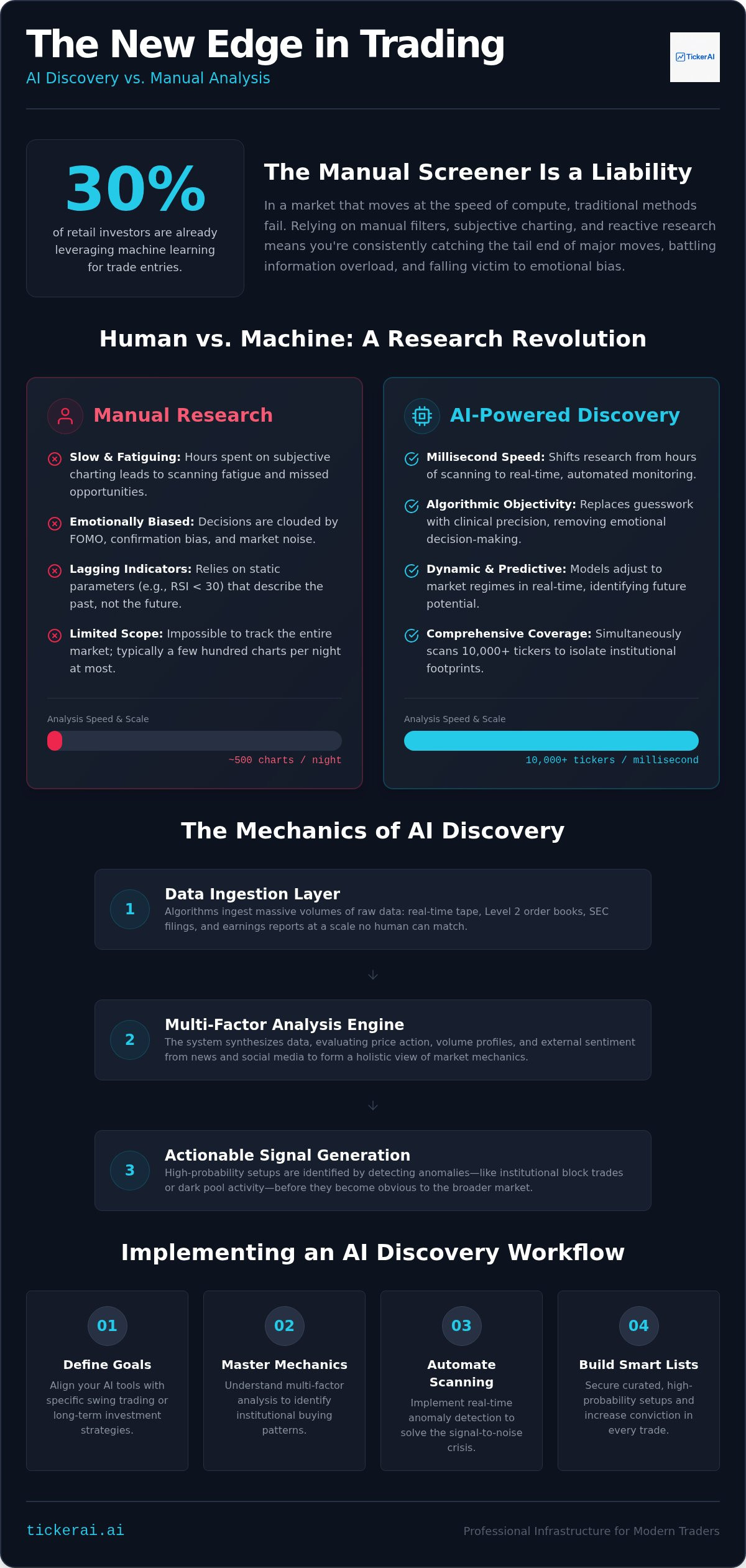
The manual stock screener is no longer a professional tool; it's a liability in a market that moves at the speed of compute. With approximately 30% of retail investors now leveraging machine learning to dictate their entries, the window for manual AI stock opportunity discovery has effectively closed for those relying on traditional filters. You're likely feeling the friction of the 24/7 news cycle. It's an environment where information overload often leads to paralysis. Manual charting limitations mean you're consistently catching the tail end of major moves rather than leading them.
We agree that emotional bias and scanning fatigue are the primary enemies of consistent alpha. This guide will teach you how to master the mechanics of AI-driven discovery to identify high-probability swing trades and long-term setups before the broader market reacts. You'll learn to build a repeatable, automated workflow that reduces time spent on manual charting and increases conviction in every setup. We will break down the transition from manual monitoring to systematic, algorithmic market scanning. It is time to replace manual guesswork with clinical precision.
Key Takeaways
- Replace manual scanning with real-time anomaly detection to solve the 2026 signal-to-noise crisis.
- Master the mechanics of multi-factor analysis to optimize your AI stock opportunity discovery and identify institutional buying patterns.
- Shift from hours of subjective charting to millisecond-speed algorithmic objectivity. This removes FOMO and emotional bias from your decision-making.
- Implement a structured 4-step framework to build smart watchlists. These tools align with your specific swing or long-term goals.
- Leverage professional infrastructure like TickerAI Full-Access to automate the discovery cycle and secure curated, high-probability setups.
The Evolution of Market Intelligence: Why Manual Scanning Fails in 2026
Market intelligence has transitioned from a research luxury to a high-speed survival requirement. In the current landscape, AI stock opportunity discovery functions as a real-time anomaly detection system rather than a simple filter. It scans the noise of 10,000+ tickers simultaneously to isolate institutional footprints before retail volume even registers. Human analysts, limited by cognitive load and manual charting speeds, cannot compete with this level of computational throughput. The "Signal-to-Noise" crisis is real. The volume of data generated by modern exchanges has outpaced human processing capacity by orders of magnitude.
Relying on reactive research is a recipe for catching the tail end of a move. Proactive, automated monitoring allows traders to detect subtle shifts in accumulation and distribution patterns. By the time a stock appears on a standard "Top Gainers" list, the institutional entry is often complete. High-speed discovery identifies these setups while the risk-to-reward ratio is still skewed in the trader's favor. This is the core of algorithmic trading logic applied to opportunity identification. It is about finding the outlier before it becomes obvious to the crowd.
The Limitations of Traditional Stock Screeners
Traditional screeners rely on static parameters. They look for fixed criteria like "Price > 200-day Moving Average" or "RSI < 30." These are lagging indicators that describe where a stock has been, not where it is going. AI learning models are dynamic. They adjust to changing market regimes in real time. Manual data entry and chart flipping introduce significant lag. If you are scanning 500 charts a night, you are already behind the machine that scanned 5,000 in a millisecond. Manual research also invites confirmation bias. Traders frequently look for data that supports their existing thesis rather than objectively analyzing the tape.
The 2026 Market Environment
Volatility is the defining characteristic of the 2026 market. Macro shifts happen in minutes. High-speed intelligence is no longer optional for those seeking alpha. Implementing automated stock market analysis has become a prerequisite for professional participants. Without it, you are effectively trading with a blindfold against entities using high-resolution radar. Efficiency isn't just about saving time. It's about the quality of the AI stock opportunity discovery process itself. Professional intelligence platforms prioritize data based on probability, ensuring your attention stays focused on high-conviction setups.
The Mechanics of AI Discovery: How Algorithms Identify Alpha
Discovery architecture is built on multi-layered data ingestion. AI stock opportunity discovery is not a singular event; it's a continuous process of data synthesis. High-speed algorithms don't just look at a chart. They simultaneously evaluate price action, volume profiles, and external sentiment data to form a holistic view of market mechanics. This multi-factor approach allows the system to isolate institutional footprints that remain invisible to standard technical indicators. When a block trade hits the tape or a dark pool position is initiated, the machine detects the anomaly instantly.
Pattern recognition has evolved beyond basic shapes. Modern systems identify high-probability swing trade setups by comparing current volatility regimes against years of historical backtesting. This isn't about finding a "head and shoulders" pattern. It's about identifying the specific confluence of liquidity and momentum that precedes a breakout. By automating this recognition, traders can focus on execution rather than spending hours on manual scanning. Professional participants use automated market intelligence to maintain this high-speed edge.
Data Input Layers for Modern AI
The first layer of discovery is raw data processing. Algorithms ingest real-time tape and Level 2 data at a scale no human can match. This includes monitoring the bid-ask spread for signs of aggressive accumulation. Sentiment analysis adds another dimension by quantifying social and news-driven momentum in milliseconds. The system also monitors fundamental triggers, such as earnings revisions or SEC filings, to identify catalysts before they are priced into the equity. These layers ensure that the discovery is grounded in both technical and contextual reality.
Filtering for Actionable Ideas
Effective discovery requires aggressive filtering. The machine must discard "fake" breakouts and low-liquidity traps that often snare retail traders. By analyzing historical probability, the AI prioritizes setups with the highest potential risk-to-reward ratios. It acts as a clinical filter, removing the noise of low-conviction moves. Understanding how to interpret AI stock signals is critical during this phase. It ensures that the trader doesn't overtrade on every minor alert, but rather waits for the signals that align with institutional-grade setups.
Organizing these opportunities is the final step. Smart Watchlists automatically categorize tickers into thematic groups, such as "High-Momentum Tech" or "Undervalued Energy." This organization allows for a streamlined workflow where the trader only interacts with pre-qualified ideas. It's a proactive scouting system that stays "on" even when you are off the desk. This systematic approach transforms a chaotic market into a prioritized list of actionable intelligence.
Human vs. Machine: Comparing Research Methodologies
Manual research is a bottleneck in a high-frequency environment. While a dedicated analyst might review fifty charts in an evening, a machine processes the entire investable universe in milliseconds. This disparity in speed fundamentally changes the nature of AI stock opportunity discovery. It's no longer about who works the hardest; it's about who has the most efficient filter. Human researchers are prone to fatigue, leading to "analysis paralysis" or overlooked data points during late-night sessions. Machines don't blink. They maintain a 24/7 scanning rhythm that identifies setups the moment they materialize.
Objectivity is the machine’s greatest asset. Human traders are biologically wired for FOMO and emotional attachment. We often hold a losing position because of sunk-cost bias or chase a rally out of greed. Algorithmic discovery operates with clinical precision. It evaluates a setup based on data, not hope. If the criteria for a high-probability swing trade aren't met, the machine discards the ticker instantly. This level of emotional detachment is nearly impossible for manual researchers to replicate over long periods. It ensures that your watchlist contains only high-conviction ideas.
The Hybrid Approach: Augmenting Human Decision-Making
The most effective professionals don't replace themselves with AI; they augment their capabilities. Think of the machine as a tireless high-tech scout and the trader as the commander. The scout identifies the terrain and highlights potential targets. The commander makes the final executive decision. Understanding what is quantitative investing is essential here. This methodology, once reserved for hedge funds, is now accessible to individual traders. It allows you to apply rigorous, data-driven logic to your discovery process without needing a team of data scientists.
Cost-Benefit Analysis of AI Subscriptions
Time is the most expensive resource in trading. Calculate the hours spent per week on manual charting and compare that to the cost of a professional intelligence subscription. For most active traders, the time saved exceeds the subscription value within the first few days of the month. Beyond time, the primary ROI comes from the "bad" trades you don't take. Algorithmic filtering prevents entries into low-probability traps that human bias might otherwise justify. Preventing a single significant loss often pays for an entire year of professional-grade AI stock opportunity discovery tools. It is a calculated investment in clarity and execution speed.
Implementing an AI Discovery Workflow: A 4-Step Framework
Professional discovery is not a passive activity. It requires a structured environment where data is converted into action. To optimize your AI stock opportunity discovery, you must move beyond looking at random alerts. A repeatable framework ensures that you aren't just finding stocks, but finding the right stocks for your specific strategy. This four-step process bridges the gap between raw algorithmic output and professional execution.
- Step 1: Define Your Horizon. High-speed discovery tools allow you to toggle between swing trade momentum and long-term structural setups. Don't scan for both simultaneously. Different horizons require different volatility thresholds and volume profiles.
- Step 2: Configure Smart Watchlists. Use dynamic buckets to organize opportunities. Instead of one massive list, segment by sector, relative strength, or thematic catalysts. This allows the AI to prioritize the most relevant tickers for the current market regime.
- Step 3: Establish a Verification Checklist. AI identifies the anomaly; you verify the context. Check for upcoming earnings, sector tailwinds, or Level 2 order flow. A signal is a suggestion, not a mandate.
- Step 4: Integrate Risk Management. Every discovery must have a pre-defined exit. Use the AI to identify logical stop-loss levels based on historical volatility. If the discovery doesn't fit your risk parameters, discard it immediately.
Configuring Your Alert Environment
The goal is to filter for high-conviction signals while ignoring the noise of a volatile market. Set up real-time notifications specifically for momentum breakouts that occur on high relative volume. This prevents alert fatigue. You want to be notified when institutional footprints are undeniable, not every time a stock moves 1%. Precision in your alert settings is the difference between a productive morning and a day lost to distractions. You can automate your discovery workflow to focus only on the highest probability setups.
The Discipline of Discovery
The greatest risk in automated scanning is chasing every alert that hits your screen. Discovery provides the edge, but discipline secures the profit. This is where using AI to remove emotion from trading becomes your primary competitive advantage. By sticking to a systematic verification process, you avoid the FOMO-driven entries that plague retail participants. Long-term profitability is built on the trades you reject. A disciplined workflow transforms discovery from a chaotic hunt into a clinical operation.
TickerAI Full-Access: Scaling Your Edge with Professional Infrastructure
The effectiveness of your AI stock opportunity discovery depends on the quality of your underlying infrastructure. TickerAI Full-Access and Pro tiers are engineered to automate the discovery cycle, converting raw market data into institutional-grade intelligence. While manual scanning relies on individual effort, TickerAI operates as a tireless, high-tech scout. It continuously scans thousands of tickers to isolate curated swing trade setups and long-term investment ideas. This shift from manual searching to systematic, alert-driven discovery allows you to focus exclusively on decision-making and execution.
Active professionals require clinical precision. The Pro subscription provides advanced tools for high-volume traders who need millisecond-level alerts on momentum shifts. For those focused on a balanced approach, the Full-Access tier delivers high-probability setups that align with the systematic frameworks used by top-tier analysts. You're no longer hunting for trades; you're managing a pipeline of pre-qualified opportunities. This professional infrastructure removes the burden of raw data processing, ensuring your attention stays on the setups with the highest conviction.
Why TickerAI is the Professional Choice
Professional participants value action-oriented data over market hype. TickerAI’s interface is designed for speed and clarity, removing the visual clutter found in consumer-grade platforms. This clinical approach ensures that every data point serves a specific technical purpose. It empowers users to find thematic investment opportunities with AI, such as emerging technology cycles or structural energy shifts, before they become mainstream narratives. It's about spotting the trend while the risk profile remains favorable.
Getting Started with Systematic Discovery
The transition to systematic discovery begins with selecting the tier that matches your trading frequency. High-volume traders should prioritize the TickerAI Pro subscription to maintain their competitive edge in fast-moving volatility regimes. Active swing traders will find the TickerAI Full-Access subscription ideal for identifying multi-day momentum moves with high relative volume. Both tiers provide the smart watchlists and real-time alerts necessary to remove emotional bias from your workflow. Stop wasting hours on manual charting. Secure your professional market intelligence today and scale your AI stock opportunity discovery with the speed of 2026 technology.
Securing Your Edge in the 2026 Market
The transition from manual monitoring to systematic AI stock opportunity discovery is no longer a choice for the professional participant; it's a requirement for survival. As established, the 2026 market environment demands a clinical approach to filtering noise and identifying institutional footprints before they're priced in. By implementing a structured 4-step workflow, you transform high-speed data into actionable intelligence. You move from chasing the crowd to leading it with calculated precision.
Success depends on your ability to leverage professional-grade infrastructure that works while you focus on execution. Relying on real-time algorithmic alerts and curated swing trade setups ensures you remain focused on high-conviction ideas while removing the drag of emotional bias. It's about achieving clinical, noise-free market intelligence that scales with your ambition. The tools are ready and the data is live. Your next move is to integrate this speed into your daily routine to maintain a consistent edge.
Start your AI-driven discovery journey with TickerAI Full-Access and secure your position at the forefront of the market. It's time to trade with the speed and clarity that modern technology provides.
Frequently Asked Questions
What is AI stock opportunity discovery?
AI stock opportunity discovery is a systematic process using high-speed algorithms to scan the entire market for real-time anomalies. Unlike manual screening, it identifies institutional footprints and momentum shifts across 10,000+ tickers simultaneously. This approach allows traders to detect high-potential setups before they are widely recognized by the broader market. It functions as a tireless assistant, filtering the signal from the noise with clinical precision to find actionable alpha.
How does AI find stocks before they breakout?
Algorithms identify breakouts by analyzing a confluence of factors including unusual volume profiles, dark pool activity, and real-time sentiment shifts. By processing Level 2 data and tape speed, the AI detects accumulation patterns that precede price surges. It compares current volatility regimes against years of historical data to isolate specific conditions that historically lead to expansion. This predictive scanning identifies institutional entries before retail volume causes a significant price breakout.
Is AI stock discovery better than manual technical analysis?
AI stock opportunity discovery offers superior speed and objectivity compared to manual technical analysis. While a human might review fifty charts in an evening, an algorithm scans the entire investable universe in milliseconds. This removes the emotional bias and fatigue that often lead to missed setups or poor entries. However, the most effective strategy often involves using AI as a high-tech scout to highlight opportunities, while the trader makes the final executive decision.
Can retail investors use the same tools as institutional hedge funds?
Retail investors in 2026 have unprecedented access to institutional-grade technology. Platforms like TickerAI provide the same high-speed scanning and multi-agent systems once reserved for hedge funds. These tools democratize market intelligence, allowing individuals to compete on a level playing field. You can now leverage automated anomaly detection and smart watchlists to find alpha without needing a team of data scientists or expensive private infrastructure. High-level intelligence is now accessible.
How do real-time alerts help with swing trading?
Real-time alerts are critical for swing trading because they notify you of momentum shifts as they occur. Catching a move early preserves the risk-to-reward ratio and prevents chasing. These alerts function as a proactive monitoring system, ensuring you don't miss a setup because you weren't looking at the screen. By receiving notifications when institutional buying patterns emerge, you can execute entries with higher conviction and precision during market hours.
What is the difference between TickerAI Full-Access and Pro tiers?
TickerAI Full-Access is designed for active swing traders and long-term investors seeking curated setups and smart watchlists. It provides a comprehensive discovery cycle for thematic opportunities. The Pro tier is built for high-volume traders who require more advanced tools and millisecond-level precision in their alerts. While both tiers offer automated scanning, the Pro subscription targets professionals who need higher-frequency intelligence to navigate the most volatile market regimes with clinical accuracy.
Does TickerAI provide personal financial advice?
TickerAI does not provide personal financial advisory services. The platform is an intelligence and discovery tool designed to provide data-driven insights and automated market scanning. All setups and alerts are generated by algorithmic analysis and are intended to assist your research process. Users are responsible for their own investment decisions and execution. We provide the information and the filters; the final decision-making remains entirely with the human trader.
How do I avoid overtrading when using an AI alert service?
Avoiding overtrading requires a disciplined signal verification checklist. You shouldn't enter every alert the algorithm generates. Instead, treat alerts as suggestions that require additional context, such as sector strength or upcoming earnings. Integrating discovery into a strict risk management plan ensures you only take trades that fit your pre-defined criteria. AI removes the emotion from discovery, but you must maintain the discipline to reject low-conviction setups consistently.


