

A swing-trade portfolio needs more than a list of promising stocks. Managing a portfolio of swing trades means planning entries, exits, and position sizes across trades held for more than a day, often for days or weeks. Stops define when a trade thesis has failed, while profit targets set an exit plan before market moves put pressure on the decision.
It’s easy to focus on the next setup and overlook how open trades fit together. Portfolio management also means considering overlapping exposure, diversification, and how shorter-term positions sit alongside long-term investments. This guide explains swing trading, how to use stops and targets consistently, and how to spread exposure across sectors and strategies. It also looks at how swing trades can fit within a broader investment portfolio, so you can assess each position as part of the whole, not in isolation.
Key Takeaways
- Set your risk limits, available capital, and time commitment before choosing swing trades to manage.
- Plan a stop and profit target before entry, then size each position around the amount you’re prepared to risk.
- Look beyond individual tickers: overlapping sector exposure can concentrate risk across several open trades.
- Give swing trades and long-term investments distinct roles so short-term decisions don’t dictate your broader portfolio.
1. What is swing trading?
Swing trading seeks gains from price moves that last at least one day and sometimes several weeks. Traders use charts to identify a setup, enter a position, then exit when the setup changes or a stop is triggered. Unlike day trading, swing trades remain open overnight, so the plan must account for price changes outside regular market hours.
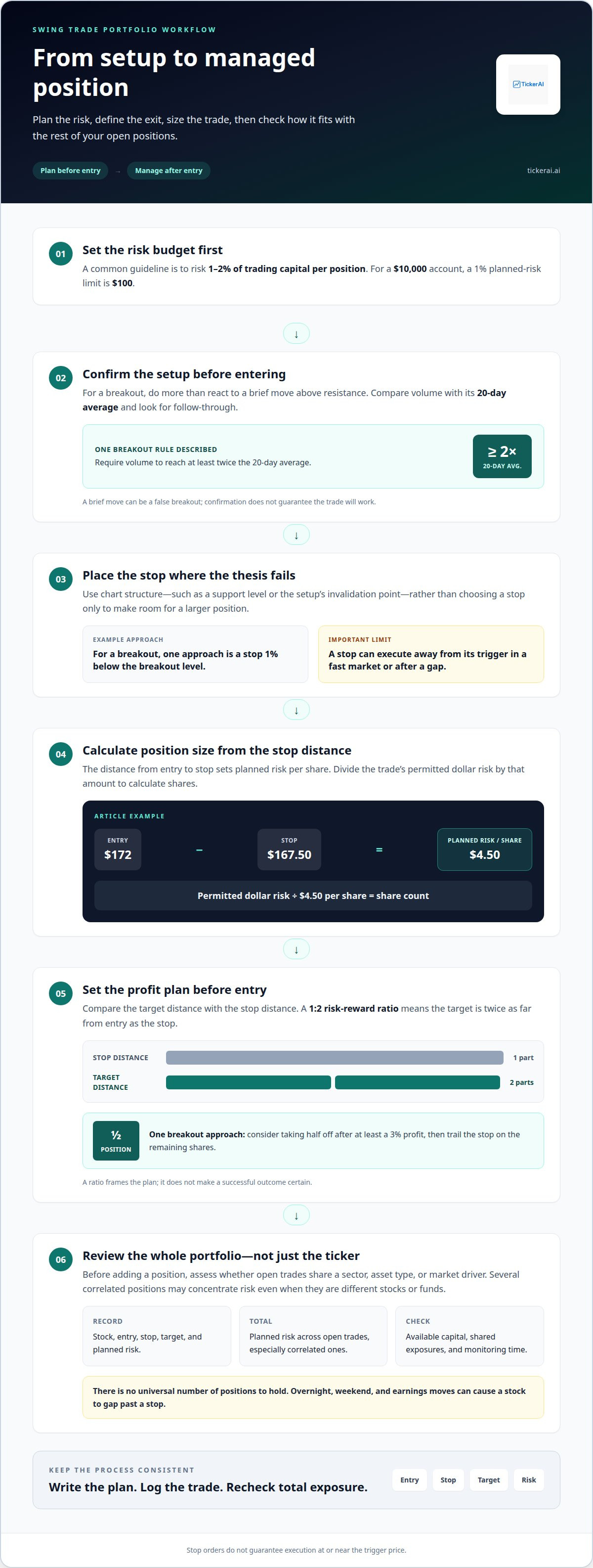
Start by matching risk to your tolerance, available capital, and time. FINRA advises considering what share of total investment funds to allocate before frequent trading. A common risk guideline is 1-2% of trading capital per position. For a $10,000 account, a 1% limit means $100 of planned risk.
Breakouts need confirmation, not just a brief move above resistance. Compare trading volume with its 20-day average and look for follow-through on the charts. False breakouts can occur, so look for confirmation rather than relying on a brief move above resistance. A defined exit level helps limit planned exposure if price reverses, though a stop order may execute away from its trigger during a fast move.
Multiple positions call for a portfolio-level view. Record each stock, entry, stop, target, and planned risk, then total the risk across open trades. There’s no universal number of positions to hold. A practical limit depends on total planned risk, correlated exposures, available capital, and the time you can spend monitoring trades.
Overnight, weekend, and earnings events can move stocks before trading resumes. A stop cannot guarantee an exit at its trigger price if a stock gaps past it. Before holding through an earnings release, decide whether the setup justifies taking that event risk. Don’t size a position based only on its potential gain.
For U.S. taxes, realized swing-trading gains may affect your tax bill. Treatment depends on applicable tax rules and your circumstances. Keep records of purchase and sale dates, proceeds, and realized gains or losses to support accurate reporting.
Common portfolio mistakes include risking too much on one trade, treating correlated stocks as diversification, and entering before a breakout is confirmed. A written risk limit and trade log make these errors easier to spot. Assess total exposure before adding a position, not just that trade’s individual risk.
2. Stop-losses and take-profit orders
A stop-loss defines the price at which a trade’s thesis no longer holds. Set it from the chart structure, such as below a support level, rather than choosing a distance solely to permit a larger position. For a breakout, one approach places the stop 1% below the breakout level. The right placement depends on the setup and its invalidation point.
Position size follows the distance between entry and stop. If a share entry is $172 and the stop is $167.50, planned risk is $4.50 per share. Divide the trade’s permitted dollar risk by that amount to calculate shares. This connects stop planning to portfolio risk management, instead of treating the stop as a standalone order.
A stop order becomes active when its trigger price is reached, but execution at or near that price isn’t guaranteed. A sharp gap or fast market can produce a different fill. Factor in overnight and earnings exposure when deciding whether to hold a position. A stop cannot remove every source of risk.
Set a profit target before entering. Compare its distance with the stop distance: a 1:2 risk-reward ratio means the target is twice as far from entry as the stop. This ratio frames the trade; it doesn’t make a successful outcome certain. For a breakout trade, one approach is to consider taking half off after at least a 3% profit, then trail the stop on the remaining shares.
Discipline matters after entry. Don’t widen a stop just to avoid booking a loss; reassess only if the original setup changes and your plan allows it. A trailing exit can move upward as a winning position advances, protecting some open profit while leaving room for further gains. Trading education and a written log help you assess whether your exit rules serve your strategy.
Before acting on new setups, review swing trade ideas alongside your preset stop and target criteria.
3. Diversifying across sectors, asset classes, and strategies
Five stock positions don’t automatically create diversification. If they follow the same sector or market theme, one broad selloff can pressure all five. Managing a portfolio of swing trades means assessing each position alongside its shared drivers. Review sector, asset type, and market sensitivity, then total the planned risk of correlated open trades. This reveals concentrations that individual trade reviews can miss.
Spread exposure across sectors and instruments only when each position fits your plan. Stocks and exchange-traded funds (ETFs) may respond differently to market conditions, but several funds can hold similar assets. Check underlying exposures, not just ticker symbols. This broader view helps distinguish genuine diversification from multiple positions that depend on the same market move.
Range strategies use support and resistance levels. A trader might buy near the lower band of a well-defined price channel, then plan to exit near the upper band. The strategy aims to buy short-term weakness and sell short-term strength. It relies on price respecting the channel; a decisive break can invalidate the pattern.
Breakout strategies enter after price clears resistance, while pullback strategies wait for a retreat toward a prior breakout level or trend area. One breakout rule requires volume of at least twice the 20-day average. Trend-following strategies instead use direction indicators, such as the 20-day, 50-day, and 200-day moving averages. Compare how each method responds to changing volatility and momentum before combining strategies.
Choose a strategy by defining its entry, exit, and invalidation rules before testing. Run one method in a simulator for 100 trades, recording setup type, market conditions, and outcomes consistently. Compare range, breakout, pullback, and trend-following patterns. Managing a portfolio of swing trades benefits from understanding how each strategy behaves, though simulated results can’t reproduce every live-market condition or execution outcome.
4. Balancing swing trades with long-term investments
Swing trading and long-term investing serve different portfolio roles. A swing position follows a shorter-term price movement and has a defined exit. A long-term holding is based on a broader investment thesis, so a temporary technical reversal doesn’t automatically call for a sale. Keeping these decisions separate helps prevent a short-term target from dictating the fate of a long-term position.
Set a capital boundary before entering trades. One guideline is to keep no more than 10%-15% of an account in swing trades at the same time. Treat this as a limit on short-term allocation, not a target to fill. The appropriate allocation depends on your risk tolerance, liquidity needs, and ability to monitor open positions. Keep the remainder aligned with your long-term investment plan.
Use different review criteria for each part of your portfolio. For a swing trade, review the setup, stop, target, and whether price still follows the expected pattern. For a long-term holding, assess whether its investment thesis remains intact. Technical weakness may matter to a short-term trade, while a long-term decision may also depend on the company’s business outlook and your portfolio objectives.
Track performance in a trade journal. Record each position’s entry and exit, planned risk, result, strategy, and reason for closing. Review the log regularly, keeping swing-trade outcomes separate from long-term holdings. This helps show whether results came from the planned method or from changing decisions mid-trade. Compare performance with the original target and note recurring errors, such as exiting early or holding after a setup fails.
Long-term positions can be built over time rather than through one entry. One approach is scaling into a position over 3-6 months, which spreads purchases across that period. Keep its rationale distinct from short-term movements. For a structured next step, explore long-term investment ideas alongside your swing-trade plan.
TickerAI: Swing Trade Setups
TickerAI combines Swing Trade Setups with AI Stock Opportunity Discovery for traders scanning for potential market movements. Its Smart Watchlist & Alerts can help organize tickers and surface updates, while Long-Term Investment Ideas address the portfolio’s longer horizon.
Use these offerings as research inputs, not substitutes for your own risk limits. Assess each setup against your entry criteria, stop, target, sector exposure, and available capital. For example, a signal that conflicts with your planned maximum risk may not fit your portfolio, even if its chart pattern looks compelling. Keep long-term ideas distinct from trades based on a short-term technical setup.
If you want additional ideas to assess alongside your existing plan, explore TickerAI’s swing-trade and investment research. Contact TickerAI to learn more.
Put Your Portfolio Process Into Practice
Turn your portfolio rules into a repeatable review process. Each new position should fit your broader allocation and have a clear reason for entry. Each review should help you decide whether the original thesis still applies, rather than prompting a reaction to every market fluctuation.
Managing a portfolio of swing trades becomes more deliberate when you assess new opportunities alongside existing exposure. TickerAI offers AI Stock Opportunity Discovery, Swing Trade Setups, and Smart Watchlist & Alerts to support your research workflow. Use this information to evaluate candidates against your entry criteria, risk limits, and portfolio objectives.
Keep your decisions your own. Research tools can help organize opportunities, but your plan should determine whether a trade belongs in your portfolio. Consistency comes from applying the same review process, recording outcomes, and refining your rules based on what your records show.
Contact TickerAI to discuss your portfolio and explore research tools for your process. Take the next step with a clear plan and disciplined decisions.
Frequently Asked Questions
What is swing trading?
Swing trading aims to capture price movements over more than one trading day, rather than closing every position on the same day. A trader might enter a stock after a confirmed move and hold it while the setup remains valid. The key distinction is the holding period and planned exit, not whether the trader uses technical analysis, fundamental context, or both.
How much money do you need to swing trade?
There’s no single account amount that suits every swing trader. For U.S. beginners, one suggested starting range is $2,000 to $5,000, with more capital allowing greater flexibility in position sizing and diversification. Treat that as a practical guideline, not a target to reach by borrowing. The amount that fits depends on your risk limits and the positions your strategy requires.
How much capital should you allocate to each swing trade?
Separate the amount invested in a position from the amount you could lose if its stop is reached. A common guideline is to risk no more than 1-2% of total trading capital on one trade. FINRA also advises considering what share of total investment funds to allocate to frequent trading. Keep the planned loss within your limit, then size the position around its stop distance.
How do you calculate position size and risk per trade?
Divide your maximum planned loss by the per-share distance between entry and stop. For example, risking $1,000 with a stop $5 below entry allows a position of 200 shares before costs. The calculation estimates planned risk, not a guaranteed maximum loss. A gap through the stop or execution slippage can increase the realized loss, so include open-trade exposure in your review.
How do you set stop-loss and take-profit levels for swing trades?
Place the stop where the setup would be invalidated, such as below a support level for a long trade. Then set a target using a level the chart supports and compare the target distance with the stop distance. For instance, a 1:2 risk-reward plan aims for potential profit twice the planned risk. Reassess if price action changes the original setup.
How do commissions, spreads, and overnight gaps affect swing trades?
Commissions and the bid-ask spread reduce net returns, especially when frequent entries and exits leave little room for price movement. Include these trading costs when evaluating a setup. Overnight gaps add another risk: news or earnings can move a stock past its stop before trading resumes. The resulting execution may differ from the stop price, meaning planned risk can understate the actual loss.


