

Most traders treat AI stock signals like a magic button, but the clinical reality is different. These tools are discovery engines, not execution mandates. If you're struggling with the 24/7 market noise of 2026, you aren't alone. Information overload leads directly to analysis paralysis. It's hard to trust a "black box" when the SEC is actively cracking down on "AI washing" and misleading performance claims. You need a tool that functions as a high-speed intelligence partner, not a vague promise of easy wealth.
This guide helps you establish realistic expectations for AI stock signals by moving beyond the marketing hype. You'll learn to build a systematic, data-driven discovery process that scales with your portfolio. We'll show you how to transition from manual chart hunting to a streamlined workflow. The goal is simple: lower your emotional stress during trade entry and identify momentum breakouts with professional precision. By treating AI as a sophisticated filter rather than a crystal ball, you can finally focus on high-level decision-making instead of endless data mining.
Key Takeaways
- Learn why AI functions as a discovery engine for high-probability setups rather than a crystal ball for future price certainty.
- Shift your focus from vanity win rates to the Profit Factor metric to establish realistic expectations for AI stock signals.
- Discover how multi-factor analysis and anomaly detection identify institutional flow through automated smart watchlists.
- Implement a two-step hybrid workflow that combines high-speed automated discovery with rigorous human rule-based validation.
- Reduce analysis paralysis by delegating the heavy lifting of market scanning to a proactive, data-driven intelligence partner.
The "Magic Button" Fallacy: Why AI Signals Aren’t Crystal Balls
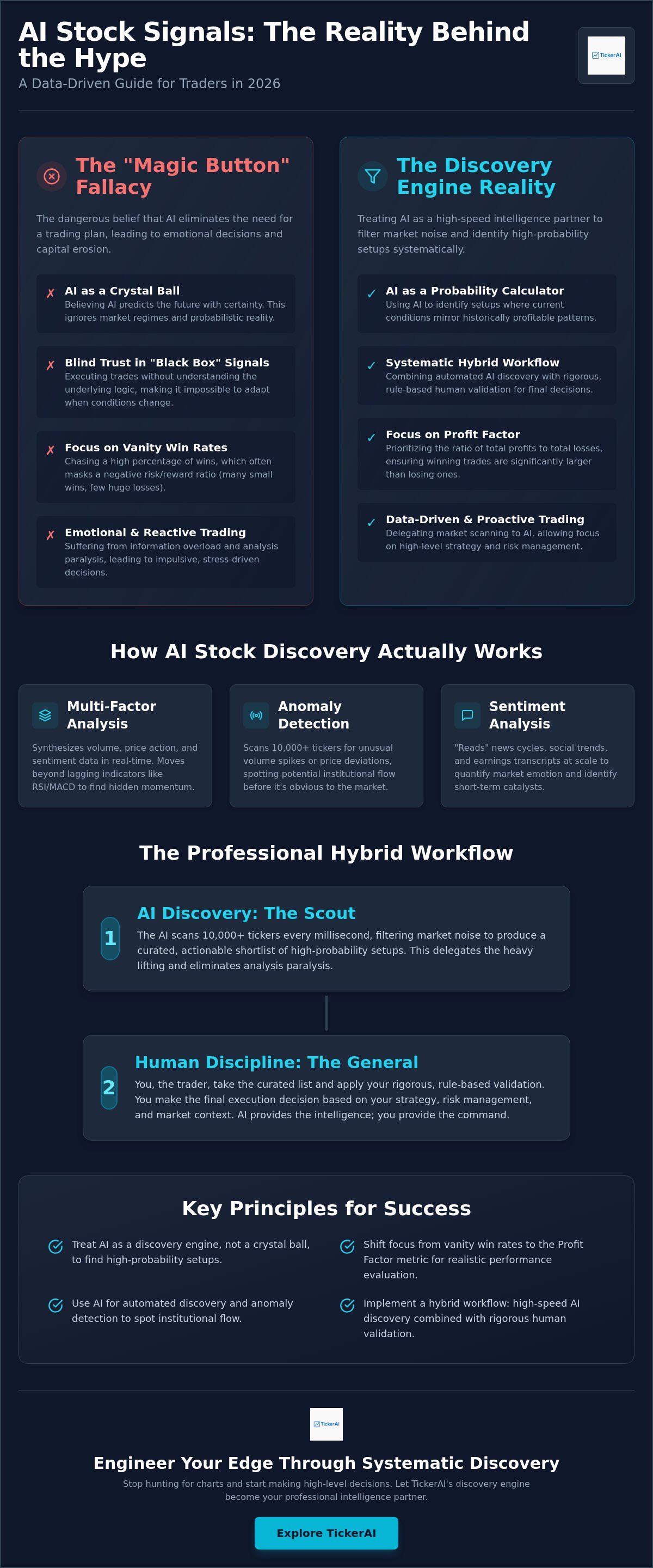
Many traders enter 2026 looking for a shortcut. They fall for the "Magic Button" fallacy. This is the dangerous belief that artificial intelligence eliminates the need for a comprehensive trading plan. It's a mistake that leads to rapid capital erosion. AI doesn't predict the future; it calculates probabilities. It identifies high-probability setups by scanning massive datasets of historical patterns. These patterns suggest what might happen based on what has happened. They aren't guarantees. Understanding this distinction is the foundation of realistic expectations for AI stock signals.
The core technology behind these signals is Algorithmic trading. This involves using complex mathematical models to identify opportunities at speeds impossible for humans. However, "predictive" hype often masks "probabilistic" reality. A signal is just a data point. It represents a moment where current market conditions mirror a historically profitable setup. Relying on "black box" signals without understanding the underlying logic is a recipe for ruin. If you don't know why a signal was generated, you won't know when the market environment has shifted enough to make that signal obsolete.
The Reality of Market Regimes
AI signals are highly sensitive to market regimes. A system might show a high win rate during a steady bull run but struggle when volatility spikes. Range-bound markets require entirely different logic than trending ones. A 70% win rate in 2025 doesn't guarantee the same results in 2026. Effective traders maintain "regime awareness." They use AI to detect shifts in market structure. This allows them to adjust risk parameters before a drawdown occurs. Establishing realistic expectations for AI stock signals means viewing the tool as a high-speed filter that requires constant context.
AI as a Scout, Not a General
Think of AI as your scout, not your general. A scout's job is to survey the terrain and report back with intelligence. The general makes the final call on the attack. In modern markets, discovery speed is the only sustainable edge. Human eyes can't track every movement across thousands of stocks. AI discovery is the automated filtering of 10,000+ tickers into a curated shortlist. You remain the decision-maker. You execute the strategy. The AI ensures you're looking at the right opportunities at the right time.
How AI Stock Discovery Actually Works in 2026
The true power of AI in 2026 isn't found in a crystal ball. It's found in the engine room. Modern discovery relies on multi-factor analysis. It synthesizes volume, price action, and sentiment in real-time to identify high-probability setups. This is the foundation of realistic expectations for AI stock signals. You aren't buying a prediction of the future. You're buying a sophisticated filter for the present. This technology moves you away from manual charting and toward automated pattern recognition at a scale no human can match.
Smart Watchlists and real-time alerts are the frontline of this discovery process. They leverage anomaly detection to spot institutional flow before it becomes obvious to the broader market. While most retail traders squint at static screens, AI scans the entire market every millisecond. It looks for unusual volume spikes or price deviations that signal a potential breakout. This speed is your primary edge. It turns a chaotic environment of 10,000+ tickers into a curated, actionable shortlist of opportunities.
Anomaly Detection vs. Standard Indicators
Standard tools like RSI or MACD are no longer enough for a competitive edge. They are reactive and lagging. Every basic retail scanner uses them, meaning their signals are often "priced in" by the time you see them. AI identifies hidden momentum that hasn't yet registered on basic oscillators. It looks for subtle shifts in order flow and price velocity that precede a major move. The clinical precision of TickerAI’s opportunity discovery engine provides a professional-grade advantage. It eliminates the slow, manual guesswork inherent in traditional technical analysis.
Sentiment Analysis and Alternative Data
Market emotion is now a quantifiable metric. AI "reads" news cycles, social trends, and earnings transcripts at scale. It converts unstructured data into actionable scores that reflect the market's psychological state. There is a direct link between these sentiment spikes and high-probability short-term swing trade setups. By using an AI stock discovery platform, you can see the logic behind a price move before the headlines hit the tape. This level of insight is why serious participants are moving toward systematic opportunity discovery as their primary workflow. It replaces analysis paralysis with a streamlined, data-driven discovery process that actually scales.
Win Rates vs. Profit Factors: The Math of Realistic Expectations
Retail traders often obsess over "Win Rate." It is a vanity metric. In the professional environment of 2026, a high win rate is meaningless if your average loss exceeds your average gain. Algorithmic sets rely on the Law of Large Numbers. This means the validity of a system only emerges over hundreds of trades, not a lucky week. To establish realistic expectations for AI stock signals, you must pivot your focus toward the Profit Factor. This is the clinical calculation of Gross Profits divided by Gross Losses. A system that wins only 40% of the time can be immensely profitable if the winners are three times the size of the losers.
Historical win proofs are frequently weaponized by low-tier providers. They often suffer from survivorship bias. This occurs when a service highlights only the signals that reached their price targets while scrubbing failed setups from the record. True systematic discovery requires transparency. You need to see the "all-in" data, including the stop-outs. Professional-grade discovery engines don't hide from losses. They manage them. Profit Factor is the primary indicator of a sustainable systematic approach.
The Hype vs. Reality Comparison
Understanding the gap between marketing claims and institutional reality is vital for long-term survival. Most retail-facing platforms promise "guaranteed" returns that defy market mechanics. Professionals look for an edge that provides a repeatable statistical advantage.
| Metric | Retail Hype | Professional Reality |
|---|---|---|
| Target Win Rate | 95% - 100% | 55% - 65% |
| Reward/Risk Ratio | Unstated / Negative | 2:1 or Higher |
| Equity Curve | Straight line up | Stair-step with pullbacks |
| Drawdown Profile | "Zero" | 10% - 20% Expected |
Managing Drawdowns in AI Systems
Drawdown is the peak-to-trough decline in your account equity. It is an inevitable reality of any quantitative system. Setting realistic expectations for AI stock signals means preparing for the inevitable five-trade losing streak. Even highly rated systems, such as those reported by SignalWhisper with a 73% win rate in early 2026, experience clusters of losses. These clusters often occur during market regime shifts when the underlying logic is recalibrating.
Discipline is your only defense against these periods. When the AI identifies a setup, it is your job to ensure your position sizing aligns with your risk tolerance. Over-leveraging a "high-probability" signal is a common path to ruin. If you are currently evaluating an AI stock picking service, look for their maximum historical drawdown. A system that hasn't been tested by a 15% correction isn't a proven system; it's just a lucky one. Focus on the math of the Profit Factor to ensure your discovery process remains scalable and objective.
The Hybrid Workflow: AI Discovery + Human Discipline
Success in 2026 requires a high-speed intelligence partner, but the final execution remains a human responsibility. Relying solely on an algorithm without a validation layer is a strategic failure. A professional workflow bridges the gap between raw data and disciplined execution. This hybrid approach is the only way to maintain realistic expectations for AI stock signals while scaling your portfolio. It moves you from a reactive posture to a proactive, methodical one. You provide the discipline; the AI provides the data.
The systematic process follows five distinct phases to ensure consistency:
- Discovery Phase: You receive an automated AI alert based on multi-factor anomaly detection and institutional flow.
- Validation Phase: You verify the setup against your personal rule-based system to ensure it aligns with your specific risk profile.
- Risk Phase: You calculate the exact position size based on the technical stop-loss distance, ensuring no single trade compromises your capital.
- Review Phase: You execute the trade and immediately log the entry logic in a journal to track the system's performance over time.
- Management Phase: You let the AI monitor the position for exit signals or trailing stop adjustments in real-time.
Eliminating FOMO through Process
Fear of missing out is the primary driver of retail ruin. Systematic discovery tools remove the psychological need to chase parabolic moves. You don't need to stress over a missed entry when the engine is constantly identifying new setups. Trusting the automated scan provides mental clarity. Missing one trade is irrelevant when the AI finds 50 more high-probability opportunities. If you are looking for a swing trade setup finder, prioritize platforms that emphasize discovery over static signals.
Risk Management: Stops and Profit Targets
Every AI-generated signal requires a pre-defined exit plan. Trading without a stop-loss is gambling. Professional traders use Smart Watchlist & Alerts to manage trailing stops dynamically. This allows you to lock in profits as the trade develops without constant manual intervention. Following the data removes the emotional urge to exit too early or hold a loser too long. It's about clinical execution. To build a more resilient portfolio, you can start your systematic discovery journey with a platform designed for professional precision.
TickerAI: Engineering Your Edge Through Systematic Discovery
TickerAI functions as your high-speed scout in a market that never sleeps. It filters the chaos of 10,000+ tickers to deliver high-probability setups directly to your dashboard. This isn't about chasing "black box" magic. It's about clinical precision. By providing transparent logic behind every alert, TickerAI helps you maintain realistic expectations for AI stock signals. You see the data, you understand the setup, and you make the final call. This transparency is vital in a 2026 regulatory environment where the SEC is actively scrutinizing "AI washing" and unsubstantiated performance claims.
The platform offers two primary paths for serious traders. The TickerAI Pro Subscription provides essential discovery tools for those focused on swing trade setups and smart watchlist management. For professionals requiring the highest level of market intelligence, the TickerAI Full-Access Subscription delivers the complete suite of opportunity discovery and long-term investment ideas. Both tiers are engineered to replace manual guesswork with a repeatable, data-driven discovery process that actually scales with your capital.
Discovery at Scale
Manual scanning is a legacy process. In the high-volatility environment of 2026, opportunities appear and vanish in minutes. TickerAI’s engine monitors price action, volume anomalies, and institutional flow across thousands of equities simultaneously. It does the heavy lifting so you can focus on execution. Real-time market alerts ensure you're notified the moment a setup aligns with your criteria. This level of automated stock market analysis is no longer a luxury; it's a requirement for anyone looking to compete with institutional-grade algorithms.
Ready to Scale Your Intelligence?
The 2026 edge is defined by two factors: speed and discipline. AI provides the speed. You provide the discipline. Moving from manual guessing to systematic discovery reduces analysis paralysis and lowers the emotional friction of trade entry. You aren't just buying signals; you're investing in a sophisticated intelligence partner that is always "on," scanning for your next move while you focus on the bigger picture. It's time to move beyond the hype and start using a tool designed for the clinical reality of modern markets. Explore TickerAI Subscription Plans to secure your discovery edge today.
Master the Systematic Discovery Edge
Success in 2026 demands a shift from chasing hype to executing a data driven process. You now understand that AI is a high speed scout, not a crystal ball. By focusing on the profit factor rather than vanity win rates, you establish realistic expectations for AI stock signals. This clinical approach ensures your strategy remains scalable even during market regime shifts. It moves you away from the "magic button" fallacy and toward a professional hybrid workflow.
Integrating automated scanning with human validation creates a formidable trading framework. It eliminates analysis paralysis and keeps you focused on high probability setups. TickerAI provides the tools needed to bridge this gap through real time AI powered market alerts and curated swing trade setups. Use smart watchlists for systematic discovery to stop guessing and start executing with precision. The market moves fast, but with the right intelligence partner, you can navigate volatility with calculated confidence.
Discover Algorithmic Alpha with TickerAI
Frequently Asked Questions
Is AI stock trading better than manual trading?
AI discovery is superior to manual trading when it comes to speed, scale, and the elimination of emotional bias. It scans thousands of tickers every millisecond to identify anomalies that human eyes would miss. However, the most effective strategy is a hybrid approach. AI acts as a high-speed scout to find opportunities, while the human trader provides the final validation and disciplined execution based on their specific risk profile.
What is a realistic win rate for AI stock signals?
A realistic win rate for professional grade systems typically ranges between 55% and 65%. While some platforms report higher rates during specific test periods, such as the 73% win rate noted by SignalWhisper in early 2026, these figures fluctuate with market regimes. You must maintain realistic expectations for AI stock signals by focusing on the profit factor and risk to reward ratios rather than win rate alone.
Can I rely solely on AI alerts for my trading decisions?
No, relying exclusively on alerts without a validation layer is a high risk strategy. AI identifies high probability setups based on historical patterns, but it cannot account for your personal risk tolerance or account size. Every alert requires a human review phase to ensure the technical setup aligns with your rule based system. Treat AI as a data filter that prioritizes information for your final decision.
How does TickerAI filter out market noise?
TickerAI leverages multi factor analysis and institutional flow detection to isolate actionable momentum from random price fluctuations. It ignores lagging retail indicators like basic RSI or MACD in favor of real time anomaly detection and sentiment analysis. This clinical precision ensures that your smart watchlists only contain tickers with significant order flow or structural shifts. It effectively turns a chaotic market into a curated shortlist of setups.
Do I need to be a professional trader to use AI signals?
You don't need professional status, but you do need a baseline understanding of market mechanics and risk management. AI signals significantly lower the barrier to entry by handling the heavy lifting of market discovery. However, the user must still calculate position sizes and honor stop losses. It is a tool designed for serious participants who value efficiency and data driven decision making over manual guesswork.
What happens if an AI signal is wrong?
Losses are a standard part of any quantitative trading system. When a signal fails to reach its target, your pre defined stop loss acts as the primary defense for your capital. Professional systems are designed to manage clusters of losses through disciplined position sizing. Setting realistic expectations for AI stock signals means accepting that no algorithm is right 100% of the time; the goal is long term profitability through a positive profit factor.
How often does TickerAI send out new swing trade setups?
TickerAI provides real time alerts whenever market conditions trigger the underlying discovery logic. The frequency of these alerts depends entirely on market volatility and current regime shifts. During high momentum periods, discovery is frequent. In range bound or stagnant markets, the system prioritizes quality over quantity to prevent overtrading. This ensures you only receive alerts for setups with a high statistical probability of success.
Can AI help with long-term investment ideas as well as swing trades?
Yes, AI engines are highly effective at identifying long term trends by analyzing fundamental data and alternative datasets at scale. While many traders use it for short term momentum, the same multi factor analysis can spot undervalued assets or emerging sectors before they hit the mainstream news. TickerAI offers specific tiers for both swing trade setups and long term investment ideas to support various portfolio horizons.


