

A clear headline can still be a poor trading signal. The dangers of trading on news headlines begin when urgency replaces analysis: a rushed entry may follow a move the market has already priced in, while the headline leaves out expectations or important details from the underlying report. Even when the news seems decisive, volatile conditions can widen spreads and make it harder to enter or exit near the price you intended.
It’s understandable to fear missing a fast move. But speed alone doesn’t make a trade sound, and the first market reaction isn’t always the lasting one. A catalyst can prompt investigation without providing a complete reason to buy or sell.
This article explains how news-driven volatility can distort prices, why positive headlines may not lift a stock, and how execution risks can affect a trade. You’ll also find a repeatable checklist for checking the source, market expectations, and price action before acting. The goal is to separate the headline from the thesis, then assess whether the opportunity fits a defined plan and risk limits.
Key Takeaways
- The dangers of trading on news headlines include acting on incomplete information and misreading how a report compares with market expectations.
- Check the original source, publication time, confirmed facts, and remaining uncertainties before interpreting a headline as a signal.
- Separate information, interpretation, execution, and behavioral risks to assess what could affect a news-driven trade.
- Use predefined risk rules to guide your decision instead of letting urgency or fear of missing out set the terms.
- Use systematic stock discovery and watchlists to organize ideas for further research, not as automatic buy or sell instructions.
What Are the Dangers of Trading on News Headlines?
A headline appears to explain a sudden price move, and acting can feel practical: the news is fresh, the stock is moving, and waiting may seem like missing an opportunity. But a brief summary isn’t the same as understanding what happened or how the market may respond. The dangers of trading on news headlines often start when a clear-sounding update is treated as enough evidence to enter a trade.
Headline-driven trading means making a decision primarily from a short news summary instead of checking the original information, its context, and what the market may already expect. News can move prices, but a headline alone can’t establish whether a stock will rise or fall, or whether a trade has a sound entry, exit, and risk plan.
A news catalyst is an event worth investigating; a trading thesis explains why a position may make sense, what could invalidate it, and how its risk will be managed. That distinction matters because company news and scheduled economic releases arrive with different timing and context.
How breaking company news differs from scheduled economic data
Company news may arrive unexpectedly. An earnings report, guidance update, or corporate announcement can contain new information about one business, but the headline may appear before readers have reviewed the full release. Sources, timing, and available details can vary, so confirm what the company announced and when.
Macroeconomic events, such as Federal Reserve decisions, CPI releases, and employment data, are scheduled. Traders may know when a release is due and form expectations beforehand. The market response depends not only on the reported figure or decision, but also on how it compares with those expectations and what it may imply. In either case, identify the event and its context before interpreting the price move.
Why a true headline can still mislead traders
A headline can be accurate yet incomplete. It may omit conditions, caveats, or details elsewhere in the announcement. For example, a summary saying earnings rose doesn’t necessarily show whether results met expectations or what management said about future performance. Read the underlying release before treating the summary as a signal.
Timing matters, too. By the time a headline reaches you, investors may already have reacted to earlier reporting, expectations, or positioning. The Efficient-market hypothesis offers a theoretical lens for this challenge: if information is reflected in prices, reacting after it becomes public may not provide an advantage. That doesn’t mean every headline is unreliable or every move is fully priced in. It means verified facts, market expectations, and execution conditions deserve more weight than the headline alone.
Why News Headlines Move Stock Prices: Why the First Reaction Can Mislead
A stock’s response to news isn’t a simple verdict on whether a headline sounds positive or negative. Markets react to new information relative to what investors already expected. News impact depends partly on what the market expected before the announcement.
That gap between expectation and reality helps explain why apparently favorable news can be followed by a price decline, or negative news by a rally. Investors may have positioned ahead of an event, and consensus expectations may already be reflected in the price. After the announcement, traders reassess the outlook, compare interpretations, and adjust positions. The first move can capture rapid repricing, but it can also reflect uncertainty as participants digest the details.
Behavior plays a role, too. Investors can overreact to news, pushing an initial response beyond what later analysis supports. A quick move signals changing market conditions, not proof that the move will continue or reverse. This uncertainty is central to the dangers of trading on news headlines.
What priced-in expectations mean for a news trade
Consensus expectations are the market’s broad view of what a company or economic release is likely to report. They’re estimates, not the reported result itself. If a company reports higher earnings, for example, the number may still be close to what investors anticipated. That can leave little new information to support additional buying. If results differ from expectations, the market may reassess, but consensus data alone can’t reliably determine the direction or scale of the response.
How volatility, liquidity, spreads, and slippage affect execution
Volatility describes the pace and scale of price movement. Around an event, prices may shift quickly as orders respond to new information and interpretations. As a result, the displayed quote may be a poor guide to the price available when an order reaches the market.
The spread is the difference between the quoted buy price and quoted sell price. When it widens, the gap between those prices grows, which can raise the cost of entering or exiting compared with a tighter spread. Slippage occurs when an order executes at a different price than intended. It may happen in fast-moving conditions, but its size and direction aren’t guaranteed.
Use price action as context, not as an instruction to chase. A structured stock discovery process, including AI-powered stock opportunity discovery, can help organize ideas for further research without turning a market move into an automatic trade signal.
The Main Risks of Trading on Headlines: From Overreaction to Poor Execution
Being first to react doesn’t automatically create an advantage. A fast entry based on an unverified or misunderstood update can leave you with less context and worse execution than a more deliberate decision. After a headline-driven move, the price can reverse, continue, or become choppy. None of those paths is inevitable.
Direction, execution quality, and risk exposure are separate questions. A trader can interpret a headline correctly and still face poor execution or take on more risk than planned. The dangers of trading on news headlines become clearer when you separate the risks:
| Risk | What can go wrong | What to check |
|---|---|---|
| Information | A summary may omit context or repeat speculation as fact. | Source, original release, and publication time. |
| Interpretation | A true detail may be framed without conditions that change its significance. | Full disclosure and what the update actually confirms. |
| Execution | Thin liquidity, wider spreads, and rapid moves can make actual entry or exit prices uncertain. | Current quotes, order type, and whether the setup remains viable. |
| Behavioral | Urgency, FOMO, or confirmation bias can crowd out a balanced review. | Predefined entry, exit, and risk rules. |
Information gaps, rumors, and headline framing
Distinguish a verified company or agency release from commentary, speculation, or a social repost. A headline may spotlight one detail while the full disclosure adds conditions that alter its meaning. Research covered by Yale on how fake news sways markets describes how deceptive articles can prompt temporary stock-price movements. Before drawing conclusions, find the original release and note when it was published.
FOMO, confirmation bias, and fast-moving execution
Urgency narrows attention. Seeing a price jump can prompt a chase entry after much of the initial move has already occurred. Confirmation bias adds another filter: traders may seek details that support their first interpretation while overlooking conflicting information. Pause to test the thesis, not just reinforce it.
Execution adds another layer of uncertainty. Lower liquidity can make it harder to trade at displayed prices. Wider spreads increase the gap between quoted buy and sell prices, while slippage means an order may fill at a different price than intended. Account for those conditions when deciding whether a trade still fits your plan. Smart watchlists and structured stock discovery tools can help organize ideas for research without turning alerts into instructions to trade.
How to Evaluate a Market Headline Before Making a Trading Decision
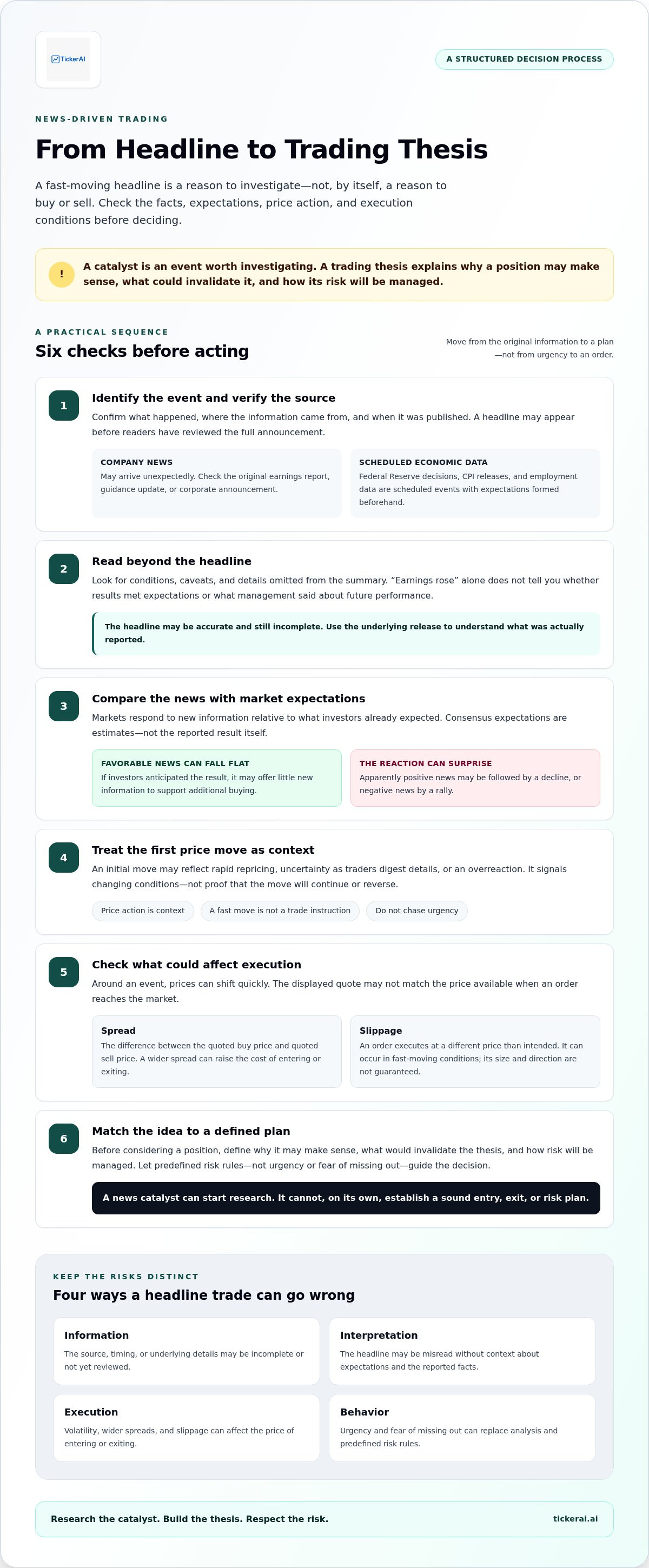
A repeatable process helps separate a verified catalyst from a rushed interpretation. Use this checklist to organize the facts, assess trading conditions, and test a potential setup against your own rules. The dangers of trading on news headlines often grow when traders skip these checks because a price is moving quickly.
- Start with the original source. Trace the headline to a primary company filing, investor-relations release, or official economic data source. Treat push notifications, commentary, and social-media posts as pointers, not substitutes for the source.
- Read the relevant details. Review the full release or report, including conditions and caveats that a short summary may leave out. Identify what’s confirmed and what remains uncertain.
- Check publication timing. Note when the information first appeared. Determine whether it’s new, an update, or a follow-up to earlier reporting. An old development resurfacing may not represent a fresh catalyst.
- Compare the news with expectations. For a company report or scheduled data release, identify what the market broadly anticipated and how the reported details compare. Expectations can be incomplete or inaccurate, so treat them as context rather than a forecast.
- Assess the market response. Review relevant price action and volume, then check the current spread and liquidity. No single indicator confirms a thesis. Fast movement may reflect changing expectations or uncertainty, and it can affect the prices available for an order.
- Define the trade before entering. Specify the rationale, potential entry and exit conditions, what would invalidate the idea, and the risk you’re willing to take. A rule-based trading plan can help keep those decisions consistent rather than reactive.
- Decide against your predefined risk rules. If the information is unclear, execution conditions are unsuitable, or the setup falls outside your plan, don’t force a trade. If it fits, make the decision based on your analysis and risk limits, not the urgency of the headline.
This checklist supports analysis. It doesn’t predict price direction or guarantee an outcome. Its purpose is to make the reasoning visible before you act. Systematic stock research can also help organize potential opportunities beyond a single news alert.
Use AI stock discovery tools to surface ideas for further research, then apply your own validation and risk rules.
Replace Headline-Chasing with Structured Stock Discovery
News can reveal a catalyst, but it’s only one input in a research process. Before treating a company as an opportunity, consider the full context, validate the information, and decide whether the idea fits your own risk rules. This helps address the dangers of trading on news headlines by replacing split-second reactions with an organized review.
Systematic stock discovery and smart watchlists can help keep that process focused. Rather than monitoring every headline, organize companies or setups for continued research. An alert is a prompt to review an idea, not an instruction to buy or sell. The decision still depends on the underlying information, market conditions, and your independent judgment.
Use watchlists and alerts to monitor ideas, not chase every headline
A focused watchlist gives potential opportunities a place in your research workflow. When an alert draws your attention to a stock or market event, use it to revisit the analysis: What changed? Is the information confirmed? Does the idea still fit your criteria? If the answer isn’t clear, an alert alone isn’t a reason to act.
Alerts don’t guarantee a particular price move or profitable result. They help surface information for review. Keep your entry, exit, and risk decisions separate from the notification itself.
Where AI-powered discovery fits in a disciplined research process
Automated scanning can surface candidates to investigate, reducing reliance on isolated headlines or manual tracking of every update. TickerAI brings together AI stock opportunity discovery, smart watchlists and real-time alerts, curated swing trade setups, and long-term investment ideas as research inputs. Each still needs validation against the catalyst, broader market context, and your personal risk rules.
When interpreting AI stock signals, treat a signal as a starting point for analysis, not a conclusion. Check what it reflects, look for relevant context, and decide independently whether the opportunity suits your approach. Structured discovery can organize the search; it can’t remove uncertainty or replace judgment.
Explore TickerAI stock discovery and market alerts to organize ideas for further research.
Make Your Next News-Driven Decision More Deliberate
The dangers of trading on news headlines often come from treating a catalyst as a complete thesis. A headline may leave out context, and even accurate news can be interpreted differently depending on market expectations. Before acting, verify the original source, identify what’s confirmed and uncertain, review market conditions, and test the idea against predefined risk rules.
Then shift from chasing each update to organizing candidates for further research. AI-powered market scanning, smart watchlists, and real-time alerts can help surface and track ideas. Curated swing trade setups and long-term investment ideas offer additional research inputs, but none replace independent judgment or guarantee an outcome.
Explore TickerAI stock discovery and market alerts to bring more structure to your research process. Stay curious, stay disciplined, and let evidence, not urgency, guide your next decision.
Frequently Asked Questions
Can you trade stocks based on news headlines alone?
You can, but a headline alone rarely provides enough context for a well-considered decision. The dangers of trading on news headlines include reacting to incomplete information, overlooking what investors expected, and entering during volatile conditions. Check the original source, the full report, relevant price action, and trading conditions first. Then decide whether the idea fits your predefined entry, exit, and risk rules. Sometimes the disciplined choice is to wait or pass.
Why do stocks sometimes fall after positive news?
A stock may fall after favorable news if investors expected even better results or had already bought in anticipation. The market responds to new information relative to expectations, not simply to whether a headline sounds positive. For example, earnings growth may be good news, yet fail to meet expectations or come with cautious guidance. The response can also reflect other market factors, so a headline’s tone alone doesn’t determine price direction.
What are the biggest risks of trading during breaking news?
Key risks include incomplete or misleading summaries, misinterpreting what the news means, emotional decisions, and uncertain execution. Rapid price moves can widen spreads and increase the likelihood of slippage, meaning an order may fill at a different price than intended. A move might reverse, continue, or fluctuate; there’s no guaranteed pattern. Separate information risk from execution and exposure, then check whether the setup still fits your plan.
How can traders verify whether a stock market headline is reliable?
Trace the headline to a primary source, such as a company filing, investor-relations release, or official economic data release. Read the relevant details rather than relying on a notification, repost, or commentary. Check when it was published and whether it’s new, updated, or a follow-up to earlier information. Record what’s confirmed and what remains uncertain. Reliable sourcing improves the quality of your analysis, but it can’t predict the market’s response.
Do stock prices move before news is released?
Yes, prices can move before an official announcement as investors adjust positions based on expectations, earlier information, or broader market conditions. Scheduled events may draw attention in advance, while company shares can move for reasons unrelated to an upcoming headline. A price move alone doesn’t prove that someone knows the news in advance. Check the event timing and available context, and avoid treating unusual activity as confirmation of a particular outcome.
Can a stop-loss order prevent losses during news volatility?
No. A stop-loss can help carry out a risk plan, but it can’t guarantee a specific exit price or prevent all losses. During fast markets, a stop-market order may execute at a different price than its trigger, while a stop-limit order may not execute if the market moves past its limit. Order mechanics vary, so understand how your order works and account for execution uncertainty when setting position risk.
How can AI stock alerts help traders avoid chasing headlines?
AI stock alerts can surface stocks or market developments for review, giving you a structured prompt to investigate instead of reacting to every headline. TickerAI offers AI-powered stock opportunity discovery, smart watchlists, real-time alerts, curated swing trade setups, and long-term investment ideas. Treat these as research inputs, not buy or sell instructions. Verify the catalyst, assess market context, and apply your own risk rules before deciding whether to act.


