
With 403 million terabytes of data generated every single day, the modern trader's biggest enemy isn't a lack of information. It's the sheer weight of it. More data. Less clarity. Even as retail trading volume hit record highs in May 2026, many participants found their performance lagging due to systemic inefficiency. You've likely felt the hesitation of a missed entry because you were busy cross-referencing a fifth technical indicator. This state of stock market information overload isn't just a mental burden. It's a performance killer. It leads to analysis paralysis and drained conviction when you should be executing with precision.
You aren't alone in feeling that more data should equal better results. However, in 2026, the competitive edge belongs to those who filter fastest. This article reveals why excessive research causes you to second-guess established plans and how to transition from data-hoarding to high-conviction execution. We'll outline a streamlined research workflow designed to reduce your screen time without sacrificing performance. It's time to stop scanning and start deciding.
Key Takeaways
- Understand why absolute certainty is a myth. More data points often decrease execution speed without increasing trade probability.
- Mitigate decision fatigue. Learn to identify "The Hesitation Gap" to stop missing profitable momentum breakouts.
- Master the transition from data-hoarding to high-conviction execution by overcoming stock market information overload.
- Adopt a rule-based entry system. Use time-boxed research windows to prevent rabbit holes and maintain trading discipline.
- Leverage AI as a sophisticated filter. Shift from manual scanning to automated discovery of high-potential movements.
The Myth of Absolute Certainty: Why More Data Leads to Worse Trades
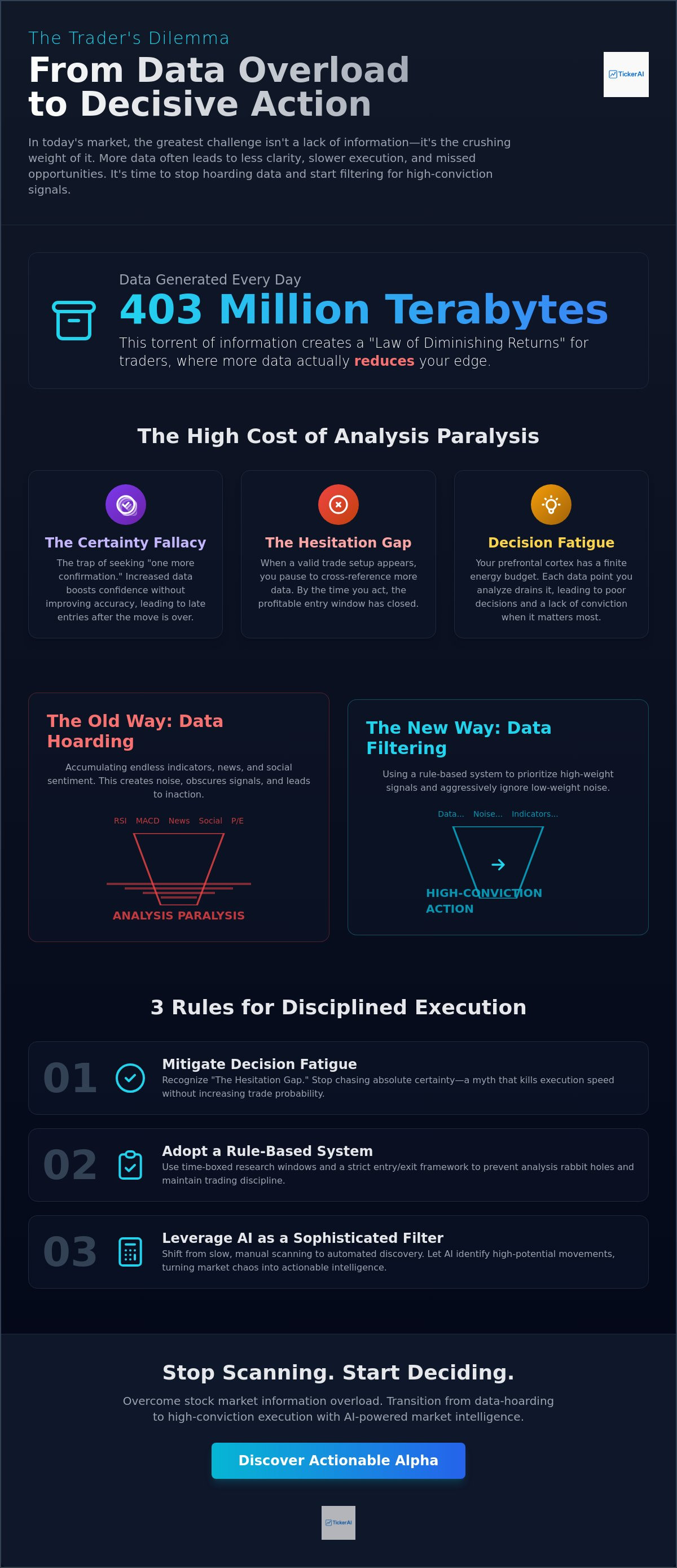
In 2026, the volume of financial data is staggering. The world generates 403 million terabytes of information daily. For a trader, this translates into a 24/7 stream of algorithmic news, real-time social sentiment, and granular technical metrics. It's easy to assume that more data leads to better outcomes. This is a dangerous misconception. More inputs. Less clarity. Slower execution.
The phenomenon of information overload occurs when the input exceeds your processing capacity. In the context of the markets, this manifests as a "Law of Diminishing Returns." Beyond a specific threshold, every additional data point actually reduces your edge. It increases the noise, obscures the signal, and triggers hesitation. This stock market information overload is a performance killer. It replaces clinical execution with frantic scanning.
Success requires a shift from raw data to actionable intelligence. Raw data is just noise; it's a social media rumor or a non-predictive macro opinion. Actionable intelligence is filtered data that aligns specifically with your trading rules. It's the difference between watching a chaotic ticker tape and receiving a high-conviction alert. You don't need more data. You need better filters.
The Certainty Fallacy in Modern Trading
Traders often fall into the trap of seeking "one more confirmation." You wait for the RSI to align, then the MACD, then a social sentiment spike, then a news headline. By the time all indicators flash green, the move is over. This is the Certainty Fallacy. It's a cognitive bias where increased data volume boosts your confidence without increasing your accuracy. More data doesn't provide certainty; it provides the illusion of it. The Certainty Fallacy is the psychological drive to eliminate risk through excessive data collection, which ultimately results in late entries and missed alpha.
Data Hoarding vs. Data Filtering
Research can be a form of productive procrastination. It feels like work, but it lacks execution. Data hoarding is the act of accumulating tickers and indicators without a clear rejection framework. Professional desks don't work this way. They prioritize high-weight signals over low-weight noise. They know the tipping point where new information begins to degrade decision quality. Once you hit that point, additional research becomes a liability. It causes mental exhaustion and erodes the conviction needed to pull the trigger. Effective trading isn't about knowing everything. It's about knowing exactly what to ignore.
The Cognitive Cost of Analysis Paralysis in the Stock Market
Decision fatigue is not a theoretical concept. It is a physiological reality. Your 10th trade idea of the day is statistically your worst. The reason is simple. The prefrontal cortex has a finite energy budget. Every ticker you scan, every news headline you parse, and every technical indicator you cross-reference drains that budget. In the high-velocity environment of 2026, stock market information overload acts as a direct tax on your profitability. It depletes the mental reserves required for cold, calculated execution.
Research into the Consequences of Securities Regulation highlights how excessive data can impair investor decision-making. When the brain is overwhelmed, it defaults to heuristics or inaction. This manifests as "The Hesitation Gap." You see a momentum breakout. Your rules signal an entry. But you pause. You check one more social sentiment feed. By the time you look back, the price has moved 2% without you. You didn't lack information. You lacked the cognitive bandwidth to act on it. Human brains are not evolved for raw market throughput. We process sequentially. The market operates in parallel. Without tools to filter the noise, you are fighting an uphill battle against your own biology.
The Anatomy of a Missed Entry
Analysis paralysis follows a predictable loop. It starts with a valid trade setup. Instead of executing, the trader enters a "validation spiral," seeking more data to confirm the bias. This creates hesitation. Once the entry window closes, FOMO (Fear of Missing Out) triggers a desperate search for a replacement trade. This restarts the research cycle with even less mental energy. Identifying your personal "threshold of paralysis" is critical. If your research takes longer than the trade duration itself, your workflow is broken. Overload leads to hesitation. Hesitation leads to missed alpha.
Decision Fatigue and Risk Management
Cognitive exhaustion erodes discipline. When you are mentally drained, you are more likely to ignore stop-loss rules or take profits prematurely just to end the stress of monitoring. There is a direct link between high cognitive load and emotional trading decisions. Rationality requires energy. Trading based on algorithmic signals reduces the cognitive tax on the trader, allowing the machine to handle the heavy lifting of data processing while the human focuses on high-level strategy and risk oversight. Efficient trading requires a rested mind.
Signal vs. Noise: Why Your Research Workflow is Likely Broken
Trading is an exercise in data discrimination. To survive 2026 market volatility, you must distinguish between signal and noise. Signal is data that directly impacts your specific trading rules. It's the volume spike preceding a breakout or the institutional flow hitting the tape. Noise is interesting but non-predictive information. Macro opinions, "talking head" forecasts, and general economic sentiment often fall into this category. While these inputs feel important, they rarely provide an edge for tactical execution. Stock market information overload thrives when you fail to separate the two.
Most traders operate on a "Garbage In, Garbage Out" model. They spend hours consuming content that has zero predictive value for their specific strategy. For example, 90% of financial news is irrelevant to a swing trade setup finder. If a news item doesn't trigger a specific entry or exit rule, it's noise. Processing it only serves to cloud your judgment and delay your reaction time. Efficiency requires a ruthless rejection of non-actionable data.
The Signal-to-Noise Ratio (SNR) in Trading
Your personal Signal-to-Noise Ratio (SNR) is a metric of your research efficiency. Calculate it by dividing your profitable outcomes by your total research hours. If you're spending 20 hours a week on research for a single trade, your SNR is dangerously low. You're likely consuming "Toxic Noise." This includes unverified social media hype and non-data-driven speculation. These sources don't just waste time; they actively degrade your discipline by introducing emotional bias. Curated, data-centric feeds are the only way to combat stock market information overload. High SNR traders focus on a handful of high-weight signals and ignore the rest.
Manual Charting: The Ultimate Time Sink?
Spending four hours every night drawing support and resistance lines is a relic of an analog era. Manual charting is prone to human error and subjective bias. You see what you want to see. This process consumes massive amounts of mental capital that should be reserved for execution. Transitioning to automated stock market analysis preserves your cognitive reserves. It allows you to move from being a "Chart Drawer" to a "Strategic Decision Maker." Machines can scan thousands of tickers for specific patterns in seconds. Your job is to evaluate the resulting high-potential movements and manage the risk. Stop doing the heavy lifting that software handles better, faster, and more accurately.
3 Rules for Eliminating Information Overload and Restoring Discipline
Discipline in 2026 is not about willpower. It is about architecture. You cannot out-think 403 million terabytes of daily data. You must out-filter it. To combat stock market information overload, you need a rigid operational framework that dictates when to look, what to see, and when to act. These three rules transform a chaotic research process into a high-speed intelligence pipeline.
- Rule 1: Adopt a Rule-Based Entry System. Move from "I think" to "If X + Y, then Z." Logic must precede execution. If the price breaks the 20-day EMA on 1.5x average relative volume, you enter. No exceptions. No news-based second-guessing.
- Rule 2: Implement Time-Boxed Research Windows. Set a hard limit. Spend 30 minutes on post-market scanning and 15 minutes on pre-market validation. Rabbit holes are alpha killers. Once the timer expires, the research phase is closed.
- Rule 3: Use Negative Filtering. Decide what you will NOT look at. If you are a swing trader, intraday 1-minute fluctuations are noise. If you are a value investor, social media sentiment spikes are irrelevant. Define your "No-Fly List" to keep your cognitive environment clean.
These rules break the emotional feedback loop of FOMO and regret. When you follow a system, a missed trade is simply a data point, not a failure. You stop chasing "one more confirmation" and start executing on statistical probability. High-conviction trading requires a narrow focus. Eliminate the noise and automate your discovery today.
Building Your Rule-Based Framework
A framework only works if you trust it. Trust comes from validation. Define specific technical and fundamental criteria that force an entry regardless of the current media narrative. Use AI tools for long-term investors to backtest these rules against historical data. Seeing the math work over 1,000 simulated trades provides the mental fortitude to stick to the plan during live market volatility. Trust the process. The individual trade outcome is secondary to the system's long-term expectancy.
The Power of the "No-Fly List"
Successful traders are master ignorers. Create a list of data points to ignore based on your strategy. This might include general macro opinions, unverified "leaks," or price action that doesn't hit your alert triggers. Curate a "Smart Watchlist" that only pings you when a high-conviction trigger is hit. This proactive scouting approach ensures you only spend mental energy on actionable opportunities. Stock market information overload is a choice. Discipline is the refusal to participate in the chaos.
Scaling Intelligence: How AI Filters Market Chaos into Actionable Alpha
AI is often mischaracterized as just another data stream. In a market generating 403 million terabytes of data daily, adding more information is counterproductive. The true value of artificial intelligence in 2026 lies in its capacity to act as a sophisticated filter. It doesn't just provide data. It rejects it. By automating the detection of specific technical patterns and institutional flows, AI solves the fundamental problem of stock market information overload. It expands your limited attention span by processing millions of variables in milliseconds. It transforms a chaotic environment into a structured workflow.
The TickerAI approach shifts the trader's role from a "Data Hunter" to an "Opportunity Validator." Instead of spending hours scanning heatmaps and fragmented news feeds, you receive a refined list of high-potential movements. The machine handles the exhaustive, low-value work of brute-force scanning. Your job is to apply high-level strategic oversight. You validate the setup, check the risk-to-reward ratio, and execute. This is scaling intelligence. It's about moving from manual labor to executive decision-making. You stop fighting the volume of data and start leveraging the speed of its rejection.
TickerAI: The Proactive Scout
Real-time market scanning detects momentum breakouts before the noise reaches mainstream news cycles. While retail traders are busy reacting to headlines, AI-driven discovery identifies the underlying volume and price action that precedes the move. This proactive approach is essential in a market where retail trading volume hit record highs in May 2026. TickerAI Pro filters 10,000+ data points into 3-5 actionable ideas. This precision reduces research time significantly. You no longer need to monitor thousands of tickers manually. You only need to monitor the alerts that meet your specific criteria for swing trade setups. Proactive scouting replaces reactive chasing. It ensures you are positioned before the "Hesitation Gap" even forms.
Winning Back Your Time and Mental Edge
Automated alerts offer a tangible ROI: more trades executed with less cognitive effort. By offloading the monitoring phase to a tireless, high-speed intelligence partner, you preserve the mental capital required for execution. TickerAI Full-Access provides the institutional-grade tools and smart watchlists once reserved for hedge funds. This accessibility levels the playing field for serious participants. You can now discover high-potential movements with TickerAI alerts today and reclaim your edge. Real-time alerts eliminate the need for constant screen time. You trade when the signal appears, not when you happen to be looking. Don't compete with the data. Filter it. Win back your time without sacrificing your performance.
Reclaim Your Edge: From Data Hunter to Execution Expert
The transition from data-hoarding to high-conviction execution requires a fundamental shift in your research architecture. We've established that more data often leads to late entries and cognitive fatigue. Success in the 2026 market isn't about how much information you can consume. It's about how much noise you can reject. By implementing rule-based frameworks and time-boxed research, you protect your mental capital for the only action that generates alpha: execution.
TickerAI provides the institutional-grade filtration necessary to survive this high-velocity environment. Our AI-powered anomaly detection scans 10,000+ tickers 24/7, delivering curated swing trade setups directly to your dashboard. This proactive scout approach eliminates the mental drain of manual scanning. You don't need more data. You need stock market information overload to be a solved problem. Use technology to expand your limited attention and refine your focus.
Stop the scroll and start executing; join TickerAI for AI-driven stock discovery.
Trade with clinical precision. Your time is far too valuable to waste on the noise.
Frequently Asked Questions
What exactly is analysis paralysis in the stock market?
Analysis paralysis is the inability to execute a trade due to over-processing data. It often manifests as the "Hesitation Gap" where a trader seeks one more confirmation while the price moves away. This psychological loop replaces clinical execution with endless research. It's usually driven by a desire for absolute certainty in a probabilistic environment. You stop being a trader and start being a data hoarder.
How does information overload affect stock prices and volume?
Information overload often leads to lower trading volume as participants hesitate to commit capital. While retail investors added 302 billion dollars to U.S. stocks in 2025, individual decision accuracy frequently deteriorates under high cognitive load. Overload also increases estimation risk. This causes price volatility to spike when reactionary traders mistake "noise" for "signal" during fast-moving market events.
Can too much technical analysis actually hurt my trading performance?
Yes, excessive technical analysis creates "indicator soup" where conflicting signals prevent execution. If you cross-reference too many metrics, you'll eventually find a reason not to take every trade. This degrades performance by increasing the time-to-entry and decreasing conviction. Professional desks prioritize two or three high-weight technical signals over dozens of low-weight oscillators to maintain a high-speed intelligence edge.
How do I know if I am suffering from information overload?
Common symptoms include missing profitable entries due to hesitation and second-guessing established plans when new noise appears. You might feel mental exhaustion from monitoring too many tickers or spend four hours on research for a trade that lasts ten minutes. If your research time is disproportionate to your trade outcome, you are likely suffering from stock market information overload.
What is the best way to filter out market noise in 2026?
The most effective method is adopting a "Negative Filtering" strategy. Decide exactly which data points you'll ignore before the market opens. Use automated scouting tools to scan thousands of tickers for specific rule-based triggers. This proactive approach ensures you only spend mental energy on actionable alpha rather than general macro opinions or unverified social media hype. Filtering is your primary competitive advantage.
Is it possible to trade successfully without watching the news 24/7?
It's not only possible; it's often more profitable. Most financial news is non-predictive and serves as "Toxic Noise" that triggers emotional responses. Successful traders focus on price action and institutional flow rather than speculative headlines. By ignoring the 24/7 news cycle, you reduce decision fatigue and maintain the clinical precision required for long-term consistency. You trade the chart, not the chatter.
How does an AI stock alert service help with analysis paralysis?
An AI service acts as a sophisticated filter that expands your limited attention span. By scanning 10,000+ tickers 24/7, it identifies high-potential movements and delivers them as curated alerts. This removes the "Data Hunter" burden from the trader. You transition to an "Opportunity Validator" role, which directly combats stock market information overload by presenting only the most relevant, rule-based setups.
What are the first steps to building a rule-based trading system?
Start by defining two or three objective criteria for entry, such as a specific volume spike or a moving average crossover. Write these rules down as "If X + Y, then Z" statements to remove subjectivity. Once defined, backtest these rules against historical data to build statistical confidence. Trusting a validated process is the only way to eliminate the emotional feedback loop of FOMO and regret.


