

More market signals don’t automatically lead to better decisions. TickerAI offers AI-powered stock opportunity discovery, but speed and volume matter only if the results fit your research process. This TickerAI review looks at the platform’s discovery tools without assuming that AI-generated ideas can predict what a stock will do next.
If you’re short on time, sorting through alerts and screening opportunities can feel like another full-time job. Unclear plan differences can also make it harder to judge whether a subscription is worth considering. This review examines TickerAI’s stated features, subscription tiers, potential fit, and limitations to help you make a more informed decision.
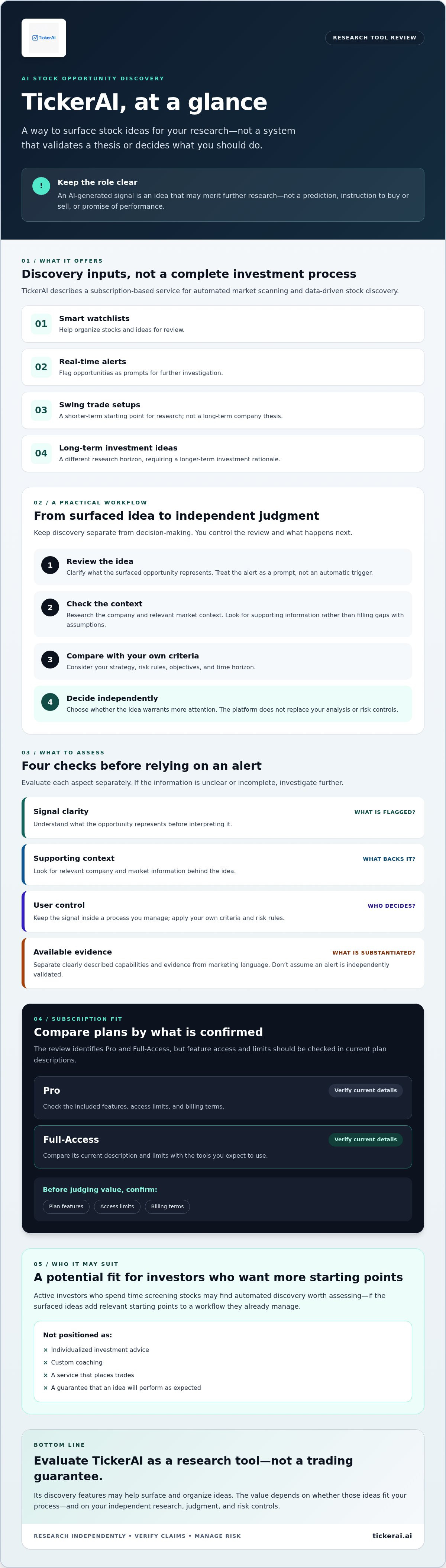
We’ll look at how smart watchlists, alerts, swing trade setups, and long-term investment ideas may support an independently managed workflow. We’ll also consider what to verify about plan features and billing before subscribing. Keep performance claims in perspective: TickerAI describes its output as information for research, not financial advice or a reliable prediction. An alert can point to an opportunity, but it can’t replace your own analysis.
Key Takeaways
- This TickerAI review assesses the platform as a stock-research discovery tool, not a system that validates a thesis or makes decisions for you.
- Use a structured workflow: investigate an idea’s context, compare it with your own criteria, and decide independently what to do next.
- Assess signal clarity, supporting context, user control, and available evidence separately before relying on an alert.
- Compare the Pro and Full-Access subscriptions using current plan descriptions, limits, and billing terms before choosing a tier.
- TickerAI may suit investors seeking a way to surface ideas, but independent research and risk controls remain essential.
TickerAI review: What the platform does and what it does not do
This TickerAI review considers four practical questions: Does the platform help surface stock ideas? How might its stated tools fit into an investor’s workflow? What information is available about the service? And where do users need to do their own work? TickerAI is a subscription-based service for AI stock opportunity discovery. Its stated outputs include smart watchlists, real-time alerts, swing trade setups, and long-term investment ideas.
That makes it a research input, not a complete investment process. Automated systems can help process market information, but finding an idea is different from deciding whether it fits your objectives or risk limits. For broader background on algorithm-based approaches to markets, see Algorithmic trading. TickerAI’s discovery tools shouldn’t be confused with personal financial advice, brokerage execution, or a promise that an idea will perform as expected.
What does TickerAI provide to subscribers?
TickerAI describes its service as automated market scanning and data-driven stock discovery. Smart watchlists and alerts can help users track ideas, while swing trade setups and long-term investment ideas offer different starting points for further research. Treat each AI-generated idea as a prompt to investigate, not as a validated thesis or instruction to trade. Features, access limits, and differences between subscription tiers can change, so check the current plan descriptions before assuming a specific tool is included in Pro or Full-Access.
Who may find a TickerAI review useful?
Active investors who spend time screening stocks may want to assess whether automated discovery could help organize their flow of ideas. The potential fit depends on what happens after an idea appears: users still need to examine relevant company and market context, apply their own criteria, and follow their risk rules. A tool that surfaces opportunities can’t replace that independent process.
If you’re looking for individualized investment advice, custom coaching, or a service that places trades, TickerAI isn’t positioned to provide those services. The more useful question is whether its discovery outputs add relevant starting points to a workflow you already manage. Evaluate the signal, verify the supporting information, and make decisions independently.
How TickerAI’s discovery workflow can support stock research
A useful workflow keeps discovery separate from decision-making. An alert or surfaced idea can direct your attention, but it doesn’t confirm that a stock fits your strategy, validate an investment thesis, or place a trade. A practical sequence is to review the idea, check its context, compare it with your own criteria, and decide independently whether it warrants further attention.
An AI-generated stock signal is a system-identified idea that may merit further research, not a prediction or instruction to buy or sell. Smart watchlists and alerts can help organize symbols and flag opportunities for review. They’re most useful when they fit into a process you control, rather than becoming automatic triggers for action.
From market scan to independent review
Start by asking what the surfaced opportunity represents and what information supports it. Research the company and relevant market context, then compare the idea with your strategy, risk rules, and time horizon. If a signal doesn’t provide enough detail to answer those questions, investigate further rather than filling the gaps with assumptions. For a more detailed approach, see how to interpret AI stock signals.
Transparency matters too. Check how the platform describes its AI-generated outputs and what evidence it provides for its claims. The SEC’s action involving misleading AI claims offers context for regulatory scrutiny of AI claims. It’s a reminder to distinguish clearly stated platform capabilities from marketing language, without assuming that an alert has been independently validated.
Where swing setups and long-term ideas differ
Swing trade setups and long-term investment ideas point to different research horizons. A setup framed around a shorter-term opportunity shouldn’t be treated as a long-term company thesis. The next research questions will differ too: a shorter-term setup may prompt you to examine its market context, while a long-term idea calls for research suited to a longer investment rationale. Neither label removes the need to assess risk independently.
Use the idea type to guide your next research step, not to skip it. The swing trade setup finder guide offers additional criteria for evaluating setups. If you’re assessing whether these discovery tools fit your process, you can also review TickerAI’s discovery tools, then check current feature descriptions before relying on any plan-specific details.
TickerAI review criteria: Signals, transparency, and limitations
A useful evaluation separates what a platform does from what its outputs might achieve. TickerAI’s stated functions include stock opportunity discovery, watchlists, alerts, swing trade setups, and long-term investment ideas. These are product functions to verify against current plan descriptions. Claims about signal accuracy or investment performance need separate evidence. An AI alert is not proof of a profitable trade.
Use four distinct checks when reviewing an idea. The goal is to determine whether it offers a sound starting point for independent follow-up, not to treat its appearance in an alert as validation.
| Review area | What to check | Useful question |
|---|---|---|
| Clarity | Is the idea described plainly, with its purpose clear? | Can you explain what prompted your interest? |
| Context | Is there enough information to investigate the company and relevant market conditions? | What would you need to verify independently? |
| User control | Can you decide how to monitor, research, or disregard the idea? | Does the alert inform your process without dictating action? |
| Evidence | Are performance or methodology claims explained and supported? | Can you identify the measurement period and basis for the claim? |
How to assess an AI stock alert
Check whether an alert provides enough context to guide a next research step. If it names an opportunity but leaves you unsure what to investigate, it may have limited value in your workflow. Treat historical results cautiously: look for the full set of outcomes, the measurement period, and a clear explanation of how results were assessed. The guide to tracking stock alert subscription performance offers a framework for examining evidence rather than relying on selected examples.
What TickerAI cannot replace
Even a well-presented research idea carries uncertainty. Markets can move against an investor, and losses remain possible. TickerAI provides discovery tools, not personal financial advice or trade execution. Its outputs can’t establish whether an investment is suitable for your circumstances, guarantee an outcome, or replace due diligence. Keep your final assessment tied to your own research, risk limits, and decision process.
In this TickerAI review, the practical test is whether each idea offers enough clarity and context to support your independent follow-up. If important details or evidence are missing, pause and verify them before giving the signal weight.
TickerAI plans and fit: How to decide whether a subscription suits you
Plan selection should follow your workflow, not the assumption that a higher tier automatically means a better fit. Compare TickerAI Pro and Full-Access against the tools you’ll actually use, the research horizon you follow, and the amount of opportunity discovery you need. Then confirm the live plan details before subscribing. Features, access limits, billing, and cancellation terms can change.
Full-Access vs Pro: What should a buyer verify?
The available information confirms both subscription names, but doesn’t establish a complete current feature-by-feature comparison. Use the official plan descriptions to fill in the gaps instead of assuming a feature belongs to either tier.
| What to compare | TickerAI Pro | TickerAI Full-Access |
|---|---|---|
| Included discovery tools | Confirm on the current plan page | Confirm on the current plan page |
| Watchlists, alerts, and access limits | Check included tools and limits | Check included tools and limits |
| Idea types and research horizon | Verify which ideas are included | Verify which ideas are included |
| Billing and cancellation terms | Review before subscribing | Review before subscribing |
Don’t infer plan access from a feature mentioned elsewhere on the site. Confirm exactly what’s included, whether usage limits apply, and how billing and cancellation work at the point of purchase. As of September 2026, paid pricing isn’t publicly listed on the main product website, so check the applicable checkout or subscription information for current terms.
Who may benefit, and who may not
A subscription may suit investors who want structured stock discovery to complement an established research process. Consider how many ideas you typically review, whether you focus on swing setups or long-term ideas, and whether watchlists or alerts would help you organize follow-up. The value depends on using those outputs, not simply receiving them. You’ll still need to assess ideas independently and apply your own risk rules.
It’s likely a mismatch if you expect guaranteed returns, individualized financial advice, or automatic trade execution. TickerAI’s discovery tools don’t replace due diligence or determine whether an investment suits your circumstances. For a wider checklist to assess providers, read this guide to evaluating an AI stock picking service.
Use this TickerAI review as a prompt to verify the details that matter to your workflow. If the current plan descriptions align with your research needs, explore TickerAI subscription options and review the terms before choosing.
TickerAI review verdict: A research tool to evaluate, not a trading guarantee
The verdict is conditional: TickerAI may be useful if its discovery tools help you find and organize ideas that you’ll investigate independently. Its stated features include watchlists, alerts, swing trade setups, and long-term investment ideas. That range may suit investors who want discovery support across different research horizons. It doesn’t establish signal quality or guarantee investment results.
The key question is whether the current plan details and available information are clear enough for you to judge the service’s fit. If feature limits, methodology, or performance evidence aren’t clear, treat them as unknowns to verify, not advantages to assume. A strong research workflow still depends on your own analysis and risk boundaries.
A concise TickerAI pros-and-cons summary
- Potential advantage: TickerAI brings opportunity discovery, smart watchlists, alerts, and ideas for different research horizons into one service.
- Limitation: surfaced ideas still need independent assessment; users remain responsible for decisions and risk controls.
- Verify before relying: confirm which tools each plan includes, what limits apply, and what evidence supports any methodology or performance claims.
Next steps before choosing a plan
Use this checklist before subscribing:
- Match the confirmed features of Pro or Full-Access to your actual research workflow.
- Review current access limits, billing terms, and cancellation conditions.
- Check what the platform explains about its signals and how any historical results are measured.
- Set personal risk boundaries, and decide how you’ll verify an idea before acting on it.
Market outcomes are uncertain, even when an idea appears compelling. If you expect individualized advice, automatic execution, or assured returns, this service isn’t designed to meet that expectation. If you want to assess whether its discovery tools fit your process, explore current TickerAI information and verify the plan details before deciding. A subscription can provide research inputs, but it can’t remove investment risk.
Make your next step with a clear research plan
This TickerAI review highlights a practical distinction: the platform can help surface and organize stock ideas, but it can’t validate an investment thesis or guarantee an outcome. Its stated features include smart watchlists and real-time alerts, alongside swing trade setups and long-term investment ideas. Whether those tools are useful depends on how well they fit your research workflow.
Before choosing a subscription, confirm current plan features, limits, and billing terms. Consider whether the alerts provide enough context for independent follow-up, and keep your own research and risk rules at the center of every decision. An opportunity signal is a starting point, not a substitute for judgment.
Ready to assess the tools against your process? Explore TickerAI’s stock discovery tools and review the current details before deciding. A measured approach can help you make a more informed choice.
Frequently Asked Questions
Is TickerAI worth it for stock research?
TickerAI may be useful if you want AI-powered stock discovery to complement your existing research process. Smart watchlists and real-time alerts can help organize ideas, while swing trade setups and long-term investment ideas offer different starting points for investigation. Whether it’s worth subscribing depends on the current plan details and how well the tools fit your workflow. You’ll still need to verify ideas independently and manage investment risk.
What does TickerAI do?
TickerAI provides AI-powered stock opportunity discovery through subscription plans. Its stated features include smart watchlists, real-time alerts, curated swing trade setups, and long-term investment ideas. These tools can help surface and organize stocks for further research. They don’t establish that an idea is suitable for you or likely to succeed. Check current plan descriptions to confirm which features are included in each subscription and what access limits apply.
Does TickerAI provide financial advice or execute trades?
No. TickerAI provides stock research discovery, not personal financial advice, custom coaching, or brokerage execution. Its alerts and ideas are informational inputs for your own analysis. For example, a surfaced stock may prompt you to review company information and market context, but you make any investment decision independently. If you need personalized advice or a service to place trades, you’ll need to look for a provider that offers those services.
What is the difference between TickerAI Pro and Full-Access?
TickerAI offers both Pro and Full-Access subscriptions, but check the current plan descriptions for an accurate feature-by-feature comparison. Don’t assume a particular alert, watchlist tool, idea type, or access limit belongs to one tier unless the live plan information says so. Before subscribing, compare included features, usage limits, billing terms, and cancellation conditions. These details can help you judge which plan, if either, matches your research habits.
Can TickerAI alerts predict which stocks will go up?
No alert can establish that a stock will rise. TickerAI alerts are intended to support opportunity discovery, not provide reliable predictions or assure investment outcomes. A signal may direct your attention to a stock, but prices can move in either direction and losses are possible. Treat an alert as a cue to investigate further. Review the idea’s context, compare it with your own criteria, and make decisions independently.
How should I evaluate TickerAI’s stock ideas?
Start by checking whether an idea gives you enough context for independent research. Review relevant company and market information, then compare the opportunity with your investment strategy, time horizon, and risk boundaries. If TickerAI or any provider makes claims about methodology or historical performance, look for clear supporting evidence and the period measured. In this TickerAI review, the key distinction is between an idea that prompts useful research and evidence that validates a decision.
Does TickerAI place trades for subscribers?
No. TickerAI doesn’t provide brokerage execution, so its discovery tools and alerts don’t place orders on a subscriber’s behalf. If you decide to act on an idea, you’ll need to make that decision independently and use a separate brokerage service to execute any trade. Keep research, decision-making, and order placement distinct. An alert can help identify something to examine, but it isn’t an instruction to trade.


