

A swing trade can go wrong before you place the order. The common mistakes in swing trading often begin with a rushed entry, such as chasing a headline or late-moving momentum without checking whether the setup still fits your plan. The problem isn’t always the chart. It may be the decision process around it.
It’s easy to feel confident before entry, then change your risk limit or exit plan once the market moves. When indicators, alerts, and headlines pile up, a valid setup can be hard to distinguish from noise. These challenges are familiar, but you can review your decisions and make them more consistent.
This guide covers nine recurring swing-trading errors and offers practical checks for your entry, position risk, exit criteria, and post-trade review. It also explains how to treat market signals and discovery tools as inputs for independent analysis, not automatic instructions or guarantees. The goal is a clearer process, not a promise that every trade will work.
Key Takeaways
- Trace errors across screening, setup evaluation, execution, and review to identify where your process needs attention.
- Check whether an extended move and the broader market or sector context support an entry, rather than relying on a chart signal alone.
- Recognize that a promising setup can still fail, and size positions according to your planned invalidation level and account risk.
- Use a five-step screen, validate, plan, monitor, and review checklist to make decisions more consistent without trying to predict every outcome.
- Reduce common mistakes in swing trading by using discovery tools to organize candidates for independent review, not as trade instructions.
Common mistakes in swing trading start before the trade is open
Swing trading involves holding a position across multiple sessions to capture a price move, rather than closing it within the same trading day. The extra time gives a trade room to develop, but it also creates more decision points. Common mistakes in swing trading can begin during screening, setup evaluation, execution, or review, well before a position is closed.
A losing trade doesn’t automatically mean the process was flawed. A trade that followed a clear plan can still lose, while a profitable trade can still result from an impulsive entry. Judge the decision by what you knew and planned at the time, not by the outcome alone.
A swing-trading mistake is a repeatable deviation from a defined process at a screening, entry, risk, exit, or review decision. This definition shifts attention from a single result to patterns you can identify and correct.
Mistake 1: Entering without a defined setup
A headline or sudden price spike can draw your attention to a stock, but neither gives you a testable reason to enter. Without a setup, it’s easy to chase momentum and invent a rationale afterward. Ask yourself: would this trade still make sense if you hadn’t already bought it?
Before entry, record four items:
- Thesis: Why might the price move?
- Trigger: What observable condition would prompt an entry?
- Invalidation: What would show that the trade idea is no longer valid?
- Timeframe: How long do you expect the setup to take to develop?
If you can’t state these in advance, pause. A written plan helps you distinguish a deliberate setup from a convincing story assembled after the move.
Mistake 2: Treating every market signal as confirmation
Indicators summarize selected market data. They don’t independently confirm what price will do next. For example, volume can show participation, price structure can reveal recent swings, and a moving average can summarize prices over a chosen period. Each can add context, but none is a guarantee or a universal entry rule.
Look for agreement between your setup and relevant evidence, while also checking for evidence that could contradict your thesis. If a signal conflicts with your plan, investigate instead of adding indicators until one appears to support the trade. For a closer look at using algorithmic outputs as research inputs, read how to interpret AI stock signals. The goal is informed review, not outsourcing the decision.
Setup and timing mistakes that weaken swing-trade decisions
A chart can look compelling and still offer a poor entry. Timing affects the relationship between the planned entry, the invalidation point, and the potential reward. These common mistakes in swing trading often happen when traders focus on a stock’s recent move but skip the context that makes a setup meaningful.
Mistake 3: Chasing price instead of evaluating the setup
A predefined entry condition gives you a reference point. For example, you might plan to enter only if price clears a level and holds it, then reassess if that condition doesn’t occur. Reacting after a sharp run is different: the price may already be far from the level that made the trade attractive.
That can change the trade’s geometry. If the invalidation point stays the same while the entry moves higher, the distance to potential loss may grow and the room to a planned target may shrink. A fast move can also lead to slippage, meaning your fill differs from the price you expected. Neither outcome is automatic, but both can make the actual trade differ from the original plan.
Record the planned entry and its rationale before placing an order. If you deviate, note the new price, what changed, and whether the revised risk and reward still fit your rules. Don’t treat a missed entry as a reason to chase.
Mistake 4: Ignoring catalysts and market context
Scheduled events can alter volatility and create gap risk, where a stock opens substantially above or below its prior close. Before entry, check the earnings date and material company announcements using current, reliable sources. Confirm dates instead of relying on an old note or an unverified calendar. Event timing can affect whether a setup still fits your holding period and risk plan.
Then zoom out. Consider whether the sector is strengthening or weakening and whether broad-market conditions support or challenge the chart idea. These factors provide context, not standalone buy or sell signals. Fidelity’s guide discusses the practical role of liquidity and actively traded stocks when evaluating swing trades.
A setup needs context to explain why it matters, a trigger to define when to act, and an invalidation point to show when the idea no longer holds. Keep all three visible during your review. For a broader research workflow, consider automated stock market analysis. Discovery tools can help organize candidates, but a watchlist or alert from TickerAI’s stock discovery tools is an input for your own assessment, not a trade instruction.
Risk and execution errors: the objection that a good setup is enough
A promising setup can strengthen the logic behind a trade, but it can’t remove market risk or guarantee a result. Position size and execution affect how much a move against the trade could affect your account. That’s why risk planning belongs before entry, not after the price starts moving.
Mistake 5: Sizing positions without accounting for risk
Position size connects three choices: the amount you’re prepared to risk, your entry price, and the level that would invalidate the trade idea. The wider the distance between entry and that level, the fewer shares fit within the same planned loss amount.
Hypothetical illustration, not financial advice: Suppose a trader sets a $100 risk limit for a trade, plans to enter at $50, and identifies $48 as the invalidation level. The $2-per-share distance implies a maximum of 50 shares before considering transaction costs or execution differences. If the planned entry or invalidation level changes, recalculate the share count instead of carrying it over unchanged.
This calculation estimates intended risk, not a guaranteed maximum loss. Also check existing positions: two stocks in the same sector, or otherwise exposed to similar market drivers, may lose value together. Review total exposure, not just the risk assigned to each trade in isolation. No single position-size formula or risk threshold fits every trader or account.
Mistake 6: Moving exits because the trade feels uncomfortable
A planned adjustment responds to a defined change in the trade thesis. An impulsive adjustment changes the exit simply to avoid realizing a loss. That can leave you holding a position after your original reasoning no longer applies.
Write down the conditions that would justify changing an exit before the trade is open. If those conditions occur, record what changed and why. If discomfort is the only reason, pause and compare the decision with your original plan.
A stop order can help structure an exit, but it doesn’t promise a specific execution price. In a fast market, or after a gap through the stop level, the eventual fill may differ from the stop price. Order type and market conditions matter, so understand how your broker handles the order before relying on it. Factor that uncertainty into your plan, and don’t treat a stop as a guarantee against losses.
These common mistakes in swing trading often share a root cause: the trader defines the setup but leaves risk and execution rules vague. A complete plan accounts for the entry, invalidation level, position size, and circumstances that would justify an exit adjustment.
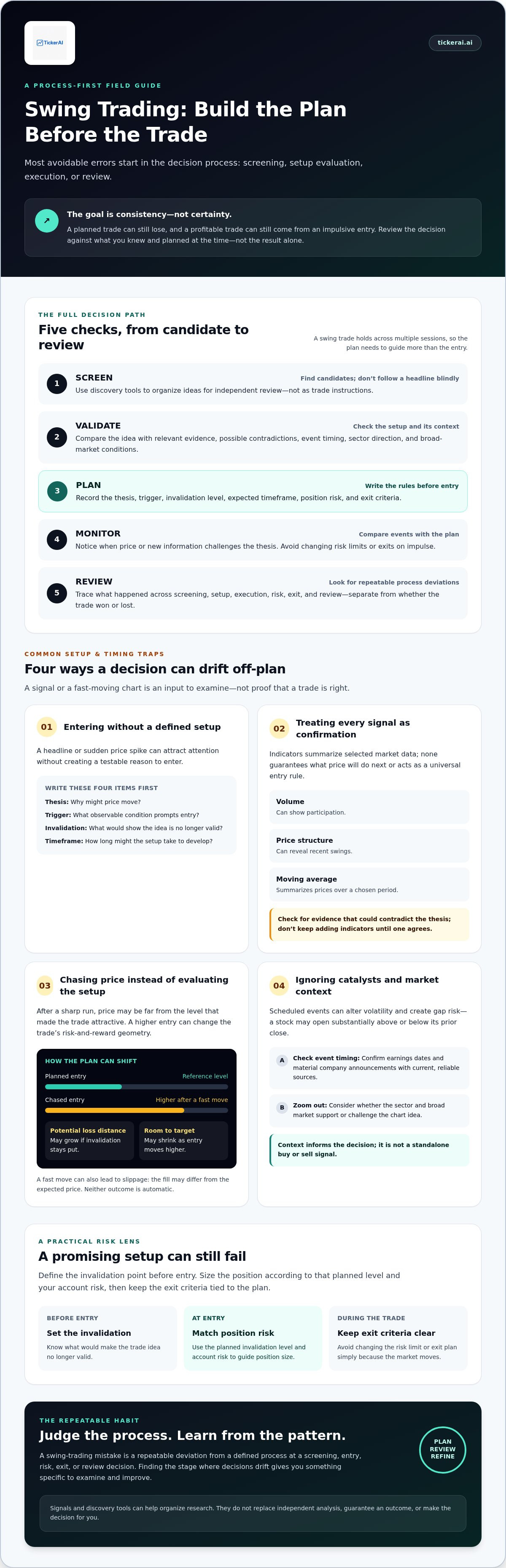
A repeatable checklist for finding and correcting swing-trading mistakes
A checklist turns common mistakes in swing trading into specific decisions you can test. Use the same sequence for every candidate, whether you find it through manual screening or a discovery tool. The goal is to make your process more consistent, not to predict whether the next trade will win.
- Screen: Filter for candidates that meet your stated criteria instead of reacting to whatever is moving.
- Validate: Check whether the setup, price structure, timeframe, and relevant market context support the thesis.
- Plan: Define the intended entry, invalidation point, exit approach, and position-sizing rationale before acting.
- Monitor: Compare new information and price action with your plan. Record meaningful changes instead of adjusting on impulse.
- Review: After exit, compare what happened with what you planned and note any deviations for later analysis.
Before entry: test the setup and define the risk
Check whether the candidate meets your written setup criteria and suits your intended holding timeframe. Review the catalyst calendar, then record the thesis, intended entry, planned exit, invalidation point, and reason for the position size. Before placing an order, identify the conditions that would cancel the trade, such as a failed trigger or a change that undermines the thesis. If those conditions are already present, skip the setup rather than rationalizing an exception.
A simple trade log makes each decision traceable. Capture the setup rationale and planned levels before entry. Afterward, add the actual entry and exit details, any changes, and the outcome. This makes it easier to see whether a deviation came from new evidence or an emotional reaction.
After exit: review process, not just profit or loss
Compare your actions with the original plan. Did you wait for the trigger? Did you change an exit, and if so, what evidence prompted the change? Note the result, but don’t use profit or loss as a substitute for assessing your process.
Reviewing decisions across a meaningful sample is more informative than judging one trade. A single outcome may reflect ordinary uncertainty, while repeated deviations can reveal a habit worth correcting. Group trades by setup or error type, then look for recurring patterns before changing your rules. For help structuring written criteria, see a repeatable trading plan.
To organize candidates for this review process, explore TickerAI’s swing-trade discovery tools. Treat any surfaced setup or alert as a research input, then apply your own checklist before making a decision.
Use swing-trade discovery tools without outsourcing your judgment
Manual scanning gives you direct control over every filter, but reviewing a large group of stocks and tracking changing candidates can take time. Automated discovery can help surface and organize ideas. Neither approach determines whether a trade is right for you. Common mistakes in swing trading still apply when a candidate comes from software: an alert can draw your attention, but it can’t replace your review.
What automated discovery can and cannot do
AI stock opportunity discovery, curated swing-trade setups, smart watchlists, and real-time alerts can help structure your research. A watchlist keeps selected candidates together; an alert can prompt you to revisit one when a condition changes; and a curated setup can provide a starting point for analysis. These tools support discovery, not certainty.
Before acting on an alert, verify the underlying information, check the broader context, and apply your own entry and risk criteria. Signals can be incomplete, mistimed, or irrelevant to your holding period. TickerAI doesn’t provide personal financial advice or execute brokerage trades, and its discovery tools don’t guarantee accuracy or profitable outcomes. Explore TickerAI's AI-powered stock discovery as a research input, not an instruction to trade.
Choose a research workflow that fits your process
Evaluate a tool against the work you actually need to do. If you already screen efficiently, a high volume of alerts may add noise instead of value. If tracking candidates is the bottleneck, watchlist organization may matter more. If you need to assess ideas consistently, check whether the setup details give you enough information to perform your own review.
- Alert volume: Can you review the notifications without losing focus on your criteria?
- Watchlist organization: Does it help you track candidates and the conditions you’re monitoring?
- Setup detail: Is there enough context to verify the idea independently?
Compare a tool’s available features and methodology with your existing process before choosing it. Subscription features can differ, so check what’s currently included in each plan rather than assuming the plans offer the same capabilities. This guide to choosing a swing trade setup finder offers another framework for evaluating workflow fit. The right discovery tool for your process can help focus your research while leaving the decision, and responsibility for it, with you.
Make your next swing-trade decision more deliberate
Common mistakes in swing trading are often process failures, not proof that a single trade was doomed. A rushed entry, unclear risk plan, or exit changed on impulse can weaken a decision at any stage. Use a consistent screen, validate the setup, plan the risk, monitor against your criteria, and review decisions across multiple trades. The goal is better discipline, not certainty about what the market will do.
Discovery tools can make research easier to organize, but your judgment stays central. TickerAI offers AI-curated swing-trade setups, smart watchlists, and real-time alerts through its Full-Access and Pro subscription tiers. Check current feature details and treat any surfaced idea as a prompt for independent review, not a guarantee or instruction to trade.
Explore TickerAI's AI-powered stock discovery and see whether its research tools fit your workflow. Keep refining your process, one clear decision at a time.
Frequently Asked Questions
What are the most common mistakes in swing trading?
Common mistakes in swing trading include entering without a defined setup, chasing an extended price move, overlooking market context, and treating indicators or alerts as confirmation. Traders can also misjudge position size, move exits impulsively, or skip a consistent review. These errors can occur at different stages, from screening a candidate to assessing a completed trade. A written process makes recurring deviations easier to spot and address.
Why do swing traders lose money even when their analysis is correct?
Correct analysis doesn’t guarantee a profitable trade because price can move unexpectedly, and execution may differ from the plan. A trader might identify the direction correctly but enter too late, take a position that’s too large, or exit before the anticipated move develops. Gaps, volatility, and changing market conditions can also affect results. Review the entry, risk, and exit decisions separately from whether the original thesis proved right.
How do I avoid chasing stocks when swing trading?
Define your entry condition before the stock reaches it, and decide in advance what would invalidate the setup. If price moves sharply before your trigger occurs, reassess the entry, stop level, and potential reward instead of assuming the original plan still fits. Record the price you intended to enter and why you’d accept any deviation. If the updated trade no longer meets your criteria, wait for another setup.
Should swing traders use stop-loss orders?
A stop order can help carry out a planned exit when a specified price is reached, but it can’t guarantee a fill at that price. In fast markets or after a price gap, execution may occur at a different level. Consider how the order works through your brokerage and how the planned exit fits the trade thesis. A stop is a risk-management tool, not a guarantee against loss or a substitute for position sizing.
How much of my account should I risk on a swing trade?
There’s no single risk amount that suits every trader or account. Estimate intended risk by comparing your entry with the level that would invalidate the trade, then size the position according to the loss you’re prepared to accept if price reaches that level. Account for possible execution differences and review related positions for overlapping exposure. This calculation can guide planning, but it can’t cap losses under every market condition.
Can AI alerts prevent common swing-trading mistakes?
AI alerts can help organize research and draw attention to candidates or changing conditions, but they can’t prevent mistakes on their own. Verify the information, assess relevant market context, and apply your own setup and risk criteria before acting. Alerts are prompts for review, not predictions, guarantees, or trade instructions. Tools such as smart watchlists and curated swing-trade setups can support discovery, while decisions remain your responsibility.
How do I know whether my swing-trading process is improving?
Track whether you follow your written criteria, including the setup rationale, entry, planned exit, position-sizing reasoning, and any changes made during the trade. Review these records across a meaningful sample instead of drawing conclusions from one result. Look for repeated patterns, such as frequent late entries or unexplained exit changes. Improvement means more consistent, explainable decisions; it doesn’t mean every trade must be profitable.


