

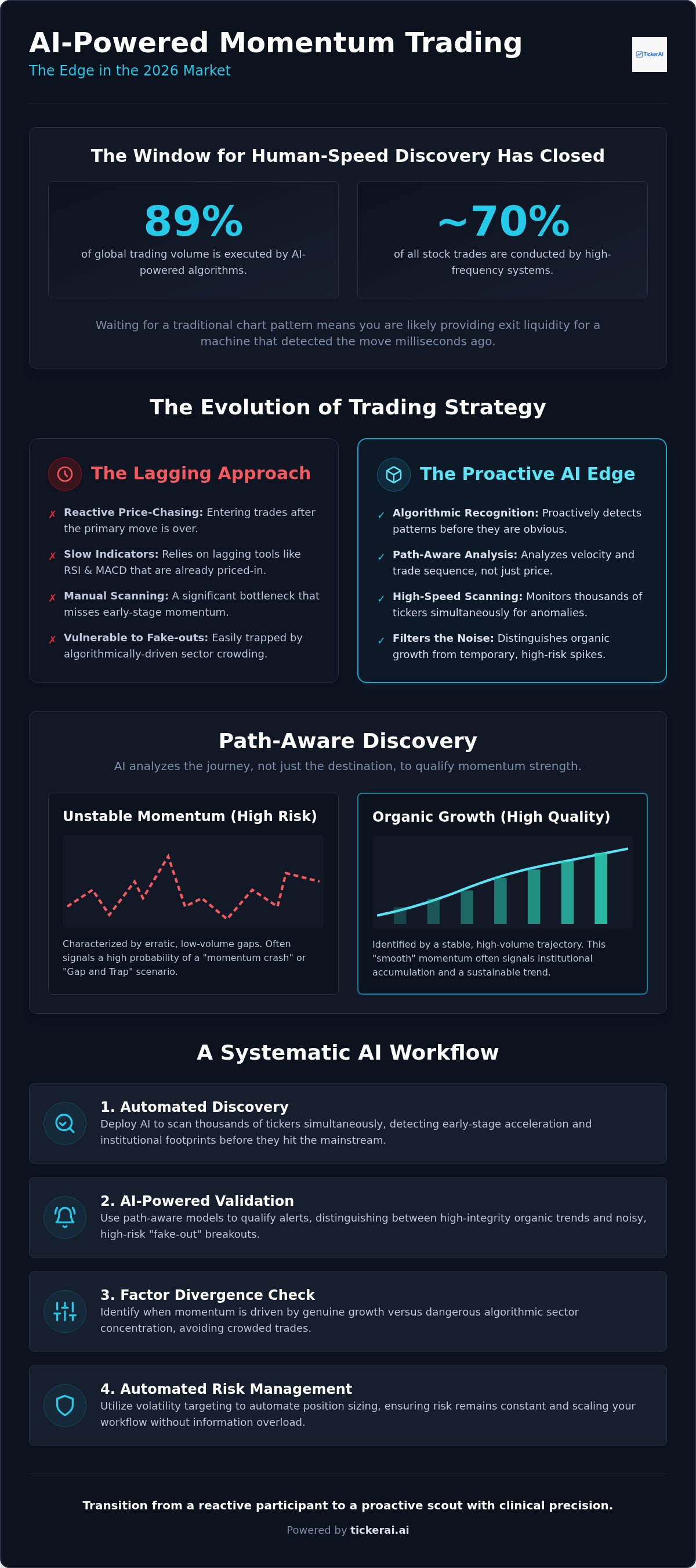
In 2026, AI-powered algorithms execute approximately 89% of global trading volume. If you're waiting for a traditional chart pattern to confirm on a standard candle, you're likely providing exit liquidity for a machine that detected the move milliseconds ago. The reality is stark. Manual scanning cannot compete with high-frequency systems that now account for up to 70% of all stock trades. The window for human-speed discovery has closed.
You've likely felt the exhaustion of information overload or the sting of chasing "fake-out" breakouts that reverse the moment you click buy. It's a common friction point. Missing early-stage momentum in small-caps happens because the noise floor is too high for manual filters. This guide promises to help you master the mechanics of AI for momentum trading to detect high-velocity stock breakouts before they reach the mainstream.
We'll establish a repeatable systematic workflow designed for earlier trend entry and automated risk management via volatility targeting. We will explore how to use path-aware AI to distinguish between organic growth and algorithmic sector crowding. It's time to transition from a reactive participant to a proactive scout with clinical precision.
Key Takeaways
- Shift from reactive price-chasing to proactive algorithmic pattern recognition. Learn why scanning thousands of tickers simultaneously is the only way to maintain an edge in the 2026 market.
- Understand the mechanics of path-awareness. Discover how non-Markovian AI models use price history to predict future velocity shifts with clinical precision.
- Deploy a systematic workflow using AI for momentum trading to detect high-velocity breakouts before they reach mainstream retail participants.
- Navigate the 2026 factor divergence. Identify when momentum is driven by organic growth versus dangerous algorithmic sector concentration that leads to "fake-out" breakouts.
- Automate your discovery and risk management. Use smart watchlists and volatility targeting to scale your workflow without succumbing to information overload.
Defining AI-Driven Momentum Trading in the 2026 Market
The 2026 market environment renders traditional price-chasing obsolete. While Momentum investing was once defined by simply buying assets with the highest recent returns, the current landscape is dominated by high-frequency execution. Today's momentum is about velocity shifts and algorithmic pattern recognition. AI for momentum trading provides the speed necessary to scan thousands of tickers simultaneously. It identifies acceleration before the price action becomes obvious to retail participants.
Lagging indicators like RSI and MACD struggle in this environment. They rely on historical price averages that machines have already priced in. Modern discovery requires path-aware models. These models don't just look at where a price is; they analyze the specific sequence of trades and volume shifts that got it there. This clinical approach separates organic growth from temporary noise.
The Evolution of Momentum Signals
Manual charting is a bottleneck in a 24/7 market. The transition to automated anomaly detection allows traders to filter noise with professional authority. "Dumb" scanners often create false positives. They flag price spikes without context, leading traders into overcrowded sectors or "fake-out" breakouts. Understanding what is quantitative investing is the necessary foundation for this shift. It moves the focus from subjective feelings to systematic, data-driven discovery. By utilizing AI for momentum trading, you're looking for institutional footprints rather than just green candles.
AI vs. Traditional Technical Scanners
Static rule-based filters are rigid. If a scanner is set to flag stocks crossing a specific moving average, it will do so regardless of the market regime. AI models are dynamic. They adapt to whether the market is in a bull or bear momentum phase. This flexibility prevents the system from applying outdated logic to new volatility patterns. It's the difference between a fixed map and a real-time GPS.
Success depends on correctly interpreting AI stock signals. An AI alert isn't just a buy command; it's a technical observation of a high-probability setup. By filtering thousands of data points into actionable insights, these tools act as a proactive scout. They prioritize opportunities based on their likelihood of sustained velocity rather than just temporary price spikes. This allows for earlier entry into momentum trends with a defined risk profile.
The Mechanics of Path-Aware Momentum Discovery
Standard momentum trading often fails because it ignores the journey. AI for momentum trading prioritizes the "path" over the "destination." If a stock reaches a new high through erratic, low-volume gaps, it's a "Gap and Trap" risk. If it climbs through a stable, high-volume trajectory, the momentum is organic. This distinction is critical in a market where algorithmic sector crowding can create artificial price inflation. AI filters the noise to find the signal.
AI utilizes non-Markovian processes to analyze these journeys. While traditional technical analysis is often Markovian, assuming the current price contains all relevant information, AI uses "memory" of past price states. It evaluates the integrity of previous support levels and the speed of the current move to predict future velocity. This allows the system to detect when a trend is exhausting its fuel before a reversal occurs. It's a clinical approach to trend strength.
Analyzing the Price Path
Path-awareness is the study of price trajectory stability. AI filters out noisy price spikes that lack structural support. In the 2026 market, "smooth" momentum in a sector like semi-conductors often signals institutional accumulation. Conversely, "erratic" momentum in low-float small-caps suggests a high probability of a "momentum crash." You can monitor these structural shifts in real-time through TickerAI to avoid chasing liquidity traps that appear strong on the surface but lack depth.
Volatility Targeting for Individual Traders
AI calculates expected volatility to suggest precise position sizing. This follows the "inverse scaling" principle. It ensures that your risk remains constant even when market conditions shift. The logic is simple but effective:
- Reduced Exposure: When the market gets choppy, the AI detects wide price swings and suggests smaller positions to protect capital.
- Increased Exposure: During periods of low volatility and high-conviction trends, the system identifies stable paths and allows for larger position sizes.
This mechanism creates consistent risk across your entire portfolio. It prevents a single high-beta stock from wiping out gains from more stable setups. By automating this calculation, traders remove the emotional urge to over-leverage on a volatile breakout that lacks the structural stability to hold its gains. It's about maintaining a professional edge through systematic discipline.
Navigating Factor Divergence and Sector Concentration
The 2026 market presents a structural paradox. Factor divergence has reached a critical point where price action and fundamental reality often disconnect. In January 2026, price momentum strategies in developed markets showed a 5.1% gain, yet analyst sentiment momentum fell by 0.6%. This gap proves that "buying the winners" no longer guarantees fundamental backing. You're often buying algorithmic momentum rather than business growth.
Sector concentration exacerbates this risk. Momentum trends are increasingly "hijacked" by tech-focused algorithms, leading to overcrowded trades in a handful of mega-caps. AI for momentum trading is essential to navigate this density. It allows traders to look beyond the obvious tech names to find "Diversified Momentum" in sectors like energy or healthcare where institutional support is building quietly. It's about finding the next wave, not the current peak.
Detecting factor crowding is a requirement for survival. When too many algorithms pile into the same trade, the exit door becomes too small. AI monitors institutional exit signs in real-time, identifying when liquidity begins to thin at the top of a trend. This clinical detection prevents you from becoming exit liquidity for high-frequency systems.
Price Momentum vs. Fundamental Sentiment
Analyst upgrades are notoriously reactive. They frequently arrive weeks after a significant price move. AI-driven price trends move at a different speed. The goal is to identify the "Sweet Spot" where price velocity and underlying sentiment still align. This prevents you from entering a trend that has already detached from reality. Utilizing AI for momentum trading helps bridge this information gap. For those seeking broader market context, finding thematic investment opportunities provides a framework for effective sector rotation. It ensures your momentum discovery is rooted in structural shifts rather than temporary spikes.
Spotting Institutional Smart Money Flow
Retail FOMO is loud and erratic. Institutional conviction is quiet and methodical. AI detects the difference by scanning for "Dark Pool" anomalies and block trade signatures that retail scanners miss. These signals indicate where the smart money is positioning before the public breakout occurs. Key detection metrics include:
- Volume/Price Decoupling: High volume accumulation without immediate price spikes.
- Order Flow Imbalance: Large institutional buy orders absorbed at the offer.
- Velocity Persistence: Price movements that ignore minor negative news cycles.
This systematic approach separates sustainable institutional trends from temporary retail-driven FOMO. It provides the professional authority needed to trade with confidence in a concentrated market.
Implementing a Systematic AI Momentum Workflow
Professional execution requires a clinical process. AI for momentum trading is most effective when integrated into a repeatable, systematic workflow. This prevents the haphazard entry patterns that lead to "fake-out" losses. A structured approach ensures every trade meets a high-conviction threshold before capital is deployed. It moves you from a reactive participant to a proactive scout.
- Step 1: Define your momentum universe. Narrow your focus to specific market caps or sectors to avoid scanning fatigue.
- Step 2: Configure alerts. Set parameters for path-aware breakouts and volume anomalies that signal institutional accumulation.
- Step 3: Filter signals. Apply volatility targeting to ensure your risk-reward ratio remains favorable.
- Step 4: Execute with discipline. Use automated triggers to remove the emotional bias of FOMO that often leads to late entries.
- Step 5: Post-trade analysis. Use iterative journaling to refine your AI parameters based on actual performance data.
Setting Up Your Smart Watchlist
Static industry watchlists are obsolete. Organize your tickers by thematic strength. AI dynamically updates these lists based on real-time relative strength, ensuring you're always focused on the leaders of a specific move. High-conviction alert thresholds prevent the noise of minor price fluctuations. This level of organization allows you to organize market opportunities by theme for maximum efficiency. You don't just watch stocks; you monitor momentum clusters.
Risk Management and Stop-Loss Logic
Manual stops are a liability in the 2026 high-frequency environment. They're easily triggered by temporary liquidity sweeps. Instead, use ATR and AI-predicted volatility to set technical stops that respect the stock's natural noise floor. The "Trailing AI Stop" is a superior alternative. It protects your profits by tightening as momentum accelerates, but it widens during healthy consolidation phases. This logic allows you to capture the bulk of a trend without being stopped out by minor volatility spikes. Efficiency is the priority. Stop-loss logic must be as dynamic as your entry strategy.
TickerAI: Scaling Your Momentum Discovery with Institutional-Grade Intelligence
Scaling AI for momentum trading requires a transition from manual observation to automated execution. TickerAI serves as your proactive scout. It filters the noise of 24/7 markets into high-probability setups. This isn't a passive tool. It's a high-speed intelligence partner designed for professional participants. You focus on the decision. The system focuses on the discovery.
Casual hobbyists chase price. Data-driven participants monitor velocity. TickerAI provides the "Momentum Jump" by detecting institutional footprints before they trend on social media. You receive alerts when the path is stable, not when the move is over. It's about entering trends with clinical precision rather than retail FOMO. The platform moves you from reactive scanning to proactive positioning.
Choosing between TickerAI Pro and TickerAI Full-Access depends on your operational scale. The TickerAI Pro Subscription offers institutional-grade alerts and smart watchlists for active swing traders. For those requiring the complete algorithmic suite, the TickerAI Full-Access Subscription provides every curated setup and deep thematic discovery tool in the ecosystem. It's the highest level of intelligence available for individual traders.
Automated Discovery and Swing Setups
Curated swing trade setups are the core of the platform. These setups follow a systematic logic rooted in path-awareness and volume/price correlation. The Smart Watchlist feature organizes high-potential plays by theme. This ensures you're always focused on sectors with the highest relative strength. Alerts are delivered with clinical precision. There's no fluff. There's only actionable data. You don't just get a ticker; you get a technical observation of a high-probability setup.
Removing Emotion from the Momentum Trade
Volatility often triggers the emotional bias discussed in previous sections. TickerAI provides a grounded perspective when the market gets choppy. It acts as an "Always-On" assistant. It scans thousands of tickers while you're offline. This ensures you never miss an early-stage breakout in small-caps or a sudden sector rotation. You focus on decision-making. The AI focuses on detection. It's a tireless partner in a chaotic environment.
Scale your market intelligence with TickerAI Full-Access today.
Mastering the Algorithmic Edge in 2026
The 2026 market environment demands a total departure from manual price-chasing. You've learned that path-awareness and clinical risk management are the only sustainable ways to navigate algorithmic sector crowding. By utilizing AI for momentum trading, you can detect institutional footprints before they become retail noise. This systematic approach separates organic growth from the "Gap and Trap" scenarios that frequently liquidate unprepared traders.
Transitioning to a professional workflow requires tools that match the market's speed. TickerAI provides the necessary infrastructure through real-time algorithmic alerts and institutional-grade volatility targeting. It acts as a proactive scout, filtering thousands of tickers into curated swing trade setups. This ensures your execution remains grounded in data rather than emotion. You focus on high-level decision-making while the machine handles the relentless task of discovery.
The gap between casual trading and professional discovery is widening. Don't be left behind by high-frequency systems that price in moves milliseconds after they occur. Discover high-velocity momentum setups with TickerAI Full-Access and secure your edge today. It's time to trade with the speed and precision your capital deserves. Success is within your reach.
Frequently Asked Questions
What is the best AI tool for momentum trading in 2026?
TickerAI Full-Access is the premier solution for AI for momentum trading in 2026. It provides institutional-grade intelligence through real-time alerts and curated swing trade setups. Unlike generic scanners, it filters noise with clinical precision to prioritize high-velocity breakouts. Traders use it as a proactive scout to identify institutional footprints before they reach social media. It's an "always-on" partner for serious market participants who value speed and data integrity.
How does AI momentum trading differ from traditional technical analysis?
AI momentum trading prioritizes path-awareness over static historical averages like RSI or MACD. Traditional indicators are often lagging in a high-frequency environment where machines execute the vast majority of volume. AI analyzes the specific trajectory and structural support of a price move. This allows for earlier entry and better detection of velocity shifts. It replaces subjective chart reading with systematic pattern recognition and non-Markovian memory of past price states.
Can AI help me avoid "fake-out" breakouts in the stock market?
AI reduces "fake-out" risks by correlating volume anomalies with price action to distinguish organic growth from liquidity traps. It detects when a breakout lacks institutional depth or is driven by temporary retail FOMO. By analyzing "Dark Pool" signatures and order flow imbalances, the system identifies high-conviction trends. This clinical filtering ensures you only commit capital to setups with structural stability and the sustained momentum required for a successful trade.
Is AI momentum trading suitable for beginners or only professional quants?
TickerAI is designed for both professional quants and active individual traders. It provides institutional-grade intelligence in a practically accessible format. You don't need to write custom code or manage complex databases to benefit from AI for momentum trading. The platform acts as a sophisticated filter, allowing beginners to focus on high-level decision-making while the algorithm handles the technical scanning and relentless data processing required for modern discovery.
How do I manage risk when using AI-generated momentum alerts?
Effective risk management relies on volatility targeting and technical stop-loss logic. TickerAI suggests position sizes based on expected market choppiness, utilizing the "inverse scaling" principle. You should set stops using AI-predicted ATR to respect a stock's natural noise floor. This prevents being stopped out by minor liquidity sweeps. Automating these calculations ensures consistent risk across your entire portfolio without the emotional interference that often leads to over-leveraging.
What is factor divergence and why does it matter for momentum traders?
Factor divergence describes the disconnect between price momentum and fundamental sentiment. In 2026, price trends often detach from analyst ratings or earnings growth due to algorithmic sector concentration. This matters because "buying the winners" no longer guarantees business value. AI helps traders identify the "Sweet Spot" where price velocity and underlying sentiment still align, preventing entry into overcrowded or fundamentally hollow trades that are prone to sudden reversals.
Does TickerAI provide automated brokerage execution for its signals?
TickerAI does not provide automated brokerage execution services. It functions as a discovery and intelligence platform, delivering smart watchlists, real-time alerts, and swing trade setups. You maintain full control over your brokerage account and trade execution. This separation ensures that you remain the final decision-maker while the AI acts as a tireless assistant that scans and detects opportunities 24/7 across thousands of different tickers.
How often does TickerAI update its momentum watchlists?
TickerAI updates its momentum watchlists in real-time to match the pace of the modern market. The system dynamically re-ranks tickers based on shifting relative strength and volume anomalies. This prevents "watchlist fatigue" by ensuring only high-conviction thematic plays remain visible. You receive instant alerts when a ticker meets your specific path-aware breakout criteria, allowing for earlier entry into emerging momentum trends before they reach the broader retail audience.


