

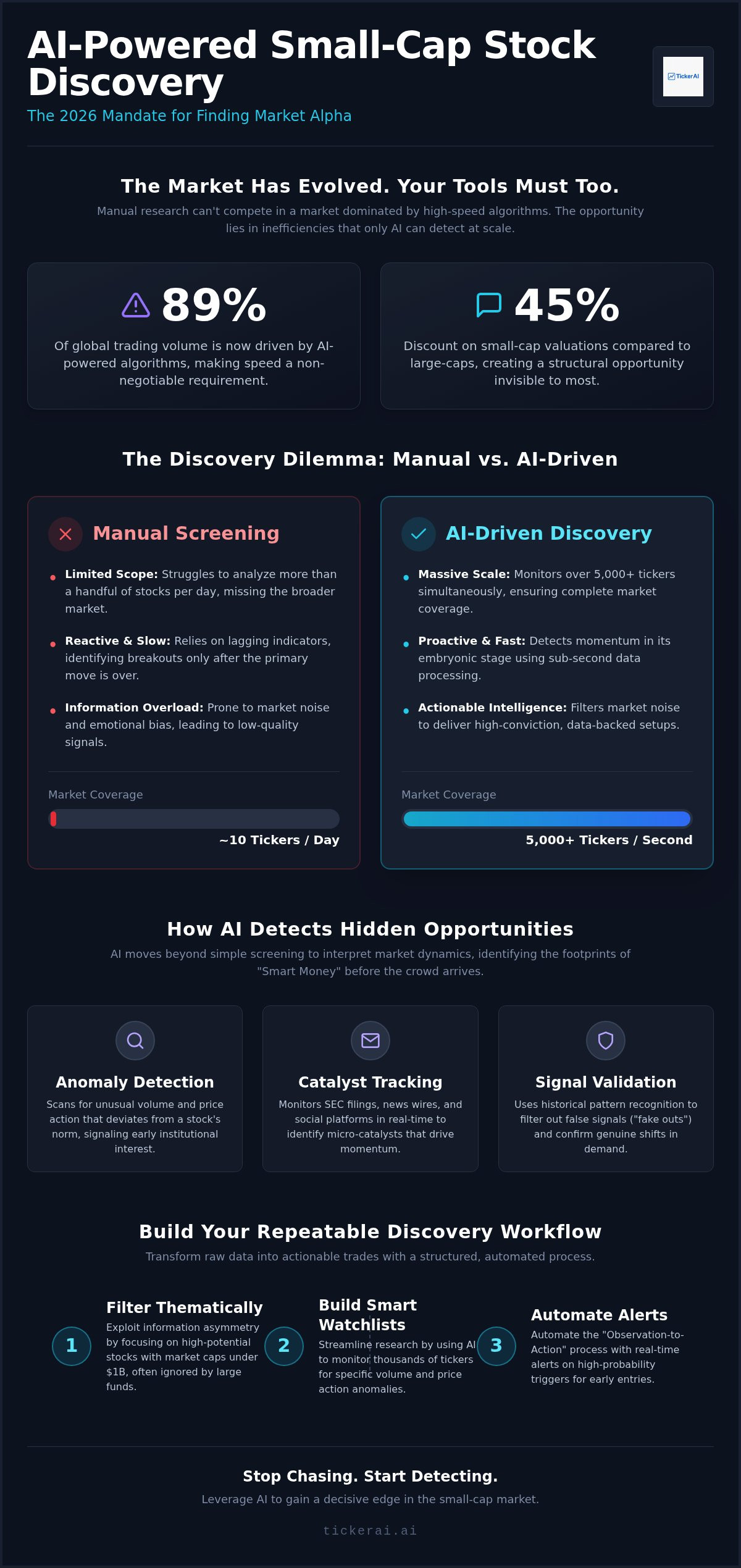
Why are you still manually scanning for gems when AI-powered trading algorithms now drive nearly 89% of global volume? In 2026, AI-powered small-cap stock discovery isn't just a technical edge; it's a survival requirement. The current market presents a unique window. Small-cap valuations sit at a steep 45% discount compared to large-cap equities, yet most of these opportunities remain invisible to the retail eye. You've likely felt the frustration of identifying a momentum breakout only after the price has spiked. Manual research is slow, noisy, and often arrives too late to capture the primary move.
It's time to stop chasing and start detecting. You'll learn how to leverage advanced AI algorithms to identify high-potential small-cap opportunities before they hit the mainstream radar. We're moving past information overload toward clinical precision. This article provides a repeatable discovery workflow that filters market noise into actionable intelligence. We'll explore how real-time alerts on hidden movements can reduce your research time while increasing signal quality. You'll gain a structured approach to finding alpha in the data gaps where institutional algorithms are often too large to trade.
Key Takeaways
- Exploit the information asymmetry created when institutional "Big Money" ignores high-potential stocks with market caps under $1B.
- Streamline your research with AI-powered small-cap stock discovery to detect institutional footprints through volume and price action anomalies.
- Expand your market coverage from a handful of manual picks to over 5,000 tickers monitored simultaneously by high-speed algorithms.
- Build a repeatable discovery workflow using thematic filters and Smart Watchlists to capture high-probability technical triggers.
- Automate the "Observation-to-Action" process with TickerAI alerts to secure early entries on swing trade setups and long-term ideas.
The Small-Cap Alpha Opportunity: Why AI is Mandatory in 2026
Alpha exists where the crowd isn't looking. In 2026, small-cap alpha is defined by information asymmetry. This is the gap between what is happening on the tape and what the general market understands. Small-cap equities, typically defined as companies between $300 million and $2 billion in market cap, currently trade at a steep 45% discount relative to their large-cap peers. This valuation gap isn't just a statistic; it's a structural inefficiency waiting to be exploited.
Institutional players are often sidelined in this space. They manage too much capital to enter these positions without causing massive price distortions. This structural exclusion creates a playground for retail and professional traders who use AI-powered small-cap stock discovery to find entries before the "Big Money" eventually follows. In a market where AI-powered trading algorithms drive nearly 89% of global volume, manual research is no longer a viable strategy. It's a liability. You need tools that can scan thousands of tickers in sub-second intervals to keep pace with rapid sector rotations.
The Information Gap: Retail vs. Institutional
Traditional analyst coverage is top-heavy. Wall Street firms focus their resources on the S&P 500, leaving thousands of small-cap tickers completely unrated. This creates a massive information gap that favors the proactive scout. AI levels the playing field by providing high-speed scanning once reserved for elite hedge funds. While a human researcher might analyze ten stocks a day, an automated scout monitors 5,000 tickers every second. Manual research is a bottleneck. Automation is the only solution for a market that never sleeps.
Inefficiency as a Feature, Not a Bug
Low liquidity in small-cap stocks is often viewed as a risk, but for the informed trader, it's a feature. It results in sharper, more volatile technical breakouts that are easier to detect with algorithmic precision. These stocks respond with extreme velocity to specific catalysts compared to their mega-cap peers. By finding thematic investment opportunities with AI, you position yourself ahead of the curve. You detect the institutional footprints before the crowd arrives. The 2026 market rewards those who can filter noise and execute with clinical precision.
How Algorithmic Scanning Detects Small-Cap Momentum
Algorithmic scanning doesn't just watch the market; it interprets it. In the small-cap arena, momentum often begins with subtle shifts in volume that precede significant price appreciation. Traditional discovery methods rely on lagging indicators. By the time a human trader spots a trend on a daily chart, the most profitable portion of the move is often exhausted. AI-powered small-cap stock discovery changes this dynamic by identifying momentum in its embryonic stage. It processes millions of data points to find the signal within the noise.
Anomaly Detection and Signal Processing
Anomaly detection is the identification of data points that deviate from a stock’s established norm. In practice, this means scanning for institutional footprints that are too small for large-cap scanners but massive for a $500 million company. AI identifies these unusual volume spikes hours or days before price discovery reaches the mainstream. This is the core of "Smart Money" tracking: identifying institutional footprints in smaller tickers where even a moderate buy order leaves a visible mark. The algorithm uses historical pattern recognition to filter out "fake outs" where volume increases without a corresponding shift in structural demand. This level of signal processing allows you to focus on high-conviction setups while ignoring the noise.
Sentiment and Catalyst Tracking
Momentum is rarely a random event. It's usually driven by a specific catalyst. Sophisticated algorithms scan SEC filings, news wires, and earnings transcripts for micro-catalysts that human analysts might overlook. This includes identifying specific language shifts in Form 8-K filings or sudden changes in retail interest across social platforms. Understanding how to interpret AI stock signals is critical here. It's the difference between chasing a "pump" and entering a legitimate momentum cycle. The AI quantifies social sentiment to gauge retail interest levels, ensuring you aren't the last one into a crowded trade.
Integrating technical indicators like RSI and MACD into AI logic provides a secondary layer of validation. Instead of viewing these as standalone signals, the algorithm treats them as logic gates. If a stock shows a volume anomaly and an SEC catalyst, but the RSI is extremely overbought, the AI might deprioritize the alert. Predictive modeling replaces the lagging nature of manual indicators. It projects potential price paths based on historical volatility and current order flow. This multi-factor approach creates a high-speed intelligence partner that is always "on." If you're ready to move beyond manual scanning, exploring automated swing trade setups can provide the execution edge you've been missing. Using AI-powered small-cap stock discovery ensures you're trading based on data, not hope.
Manual Screening vs. AI-Driven Discovery: A Performance Comparison
Manual screening is an endurance test you're destined to lose. It's slow. It's inconsistent. In the 2026 market, relying on human eyes to catch a momentum breakout is a strategic error. By the time you've manually verified a ticker's fundamental data and technical setup, the institutional crowd has often already bid up the price. AI-powered small-cap stock discovery removes this friction. It replaces manual labor with high-speed algorithmic filtering. You gain the ability to spot entries before they become obvious to the retail masses.
Efficiency Metrics: Speed and Breadth
Speed defines the modern winner. Manual scanning takes hours to produce a handful of leads. AI discovery takes milliseconds to process the entire market. Consider the breadth of coverage. A professional trader might manage a watchlist of 20 stocks. An automated system monitors over 5,000 tickers simultaneously. It doesn't blink. It tracks after-hours surges and pre-market gaps that manual researchers miss. This is the core of automated stock market analysis for scaling your intelligence. You're no longer limited by your own bandwidth. You're limited only by your parameters.
Removing Cognitive Bias from Small-Cap Trades
Small-cap stocks are the breeding ground for "story" bias. Investors often fall for a compelling narrative while ignoring the actual price action. AI is immune to the story. It adheres strictly to the data. It utilizes objective entry and exit signals based on quantitative triggers like volume anomalies and RSI divergence. There is no hope involved. There is only execution. Check the guide on using AI to remove emotion from trading to understand how systematic discipline outperforms gut feeling. The algorithm identifies the setup. You make the decision. This partnership eliminates the "one more day" trap that destroys small-cap portfolios.
Cost-efficiency is the final differentiator. Building a team to monitor 5,000 stocks is financially impossible for most. Automation provides that same institutional-grade coverage for the price of a subscription. It's about maximizing signal quality while minimizing the time spent in front of a screen. You get the edge of a hedge fund without the overhead of a research department. High-speed intelligence is now accessible. Use it to find the alpha before the mainstream crowd even realizes the move has started.
Building Your Small-Cap Discovery Workflow
Static watchlists are a relic of manual trading. In 2026, a high-performance workflow requires moving from passive observation to proactive detection. AI-powered small-cap stock discovery isn't about watching every ticker; it's about filtering the market to find specific setups that match your risk profile. You need a system that converts raw market data into a prioritized list of actionable opportunities. This process begins with a defined thematic focus and ends with systematic execution.
Start by identifying high-growth sectors where information asymmetry is highest. Biotech, robotics, and green energy often provide the volatility necessary for significant alpha. Once your themes are set, the workflow follows a logical progression. You configure your parameters, set your triggers, and let the algorithm act as your tireless scout. This allows you to focus on high-level decision-making while the AI handles the data-heavy scanning of thousands of tickers.
Configuring Smart Watchlists and Alerts
Transition from broad, generic lists to action-oriented monitoring. Your watchlists should be modular, grouped by specific catalyst types such as earnings surprises, FDA approvals, or major government contracts. This structure ensures that when an alert triggers, you immediately understand the context of the move. To maintain signal quality, configure your alerts to trigger only when relative volume exceeds the 30-day average by at least 250% during the first hour of trading. This high threshold filters out minor fluctuations and highlights true institutional interest. Real-time alerts on volume breakouts or price anomalies provide the necessary lead time to secure an early entry.
Validating the Signal: The Final Human Check
AI is your scout, not your sole decision-maker. Once a signal is generated, perform a quick clinical validation of the fundamentals. Check the current liquidity and bid-ask spread to ensure trade feasibility. Small-caps can have wide spreads that erode profit margins if not managed carefully. Verify the catalyst to ensure the move isn't a "pump and dump" scenario. Integrating these discoveries into a broader systematic approach to stock investing ensures consistency. Execution must follow a predefined risk-management plan with clear stop-losses and profit targets. If you're ready to automate this workflow and reduce your research time, explore TickerAI Pro subscriptions to gain access to institutional-grade discovery tools.
TickerAI: Your Scout for High-Potential Small-Cap Setups
Discovery is only half the battle. High-speed execution requires a system that filters noise in real-time. TickerAI acts as your proactive scout, automating the complex "Observation-to-Action" flow required for the small-cap market. By integrating AI-powered small-cap stock discovery into your daily routine, you move from manual guesswork to clinical precision. The platform is designed for professionals who value time as much as capital. It doesn't just provide data; it prioritizes it.
The 2026 market moves with extreme velocity. TickerAI keeps pace by monitoring thousands of tickers simultaneously. It identifies institutional footprints before they reach the mainstream radar. Whether you're hunting for swing trade setups or long-term investment ideas, the platform provides the structural advantage needed to find alpha in the data gaps. It's a tireless assistant. Always scanning. Always detecting. You focus on the decision; the AI handles the data.
Choosing Your Research Tier: Pro vs. Full-Access
Your choice of tier depends on your trading frequency and the required depth of analysis. TickerAI offers two distinct pathways to market intelligence:
- TickerAI Pro Subscription: Optimized for active swing traders. This tier provides smart watchlists and real-time alerts on technical triggers. It focuses on generating high-probability setups based on volume anomalies and price action.
- TickerAI Full‑Access Subscription: The comprehensive discovery suite. This tier includes everything in Pro plus data-driven insights for long-term investment ideas. It's the preferred choice for professional traders who need total market visibility.
Both tiers leverage the same high-speed intelligence engine. The difference lies in the breadth of the tools provided. Pro delivers the alerts you need for today. Full-Access provides the discovery tools for tomorrow. Currently available as a native iOS app requiring iOS 18 or later, the platform ensures your intelligence is as mobile as the market itself.
The TickerAI Edge: Speed, Logic, and Clarity
In a chaotic market segment, clarity is a competitive advantage. TickerAI avoids the fluff found in consumer finance apps, opting instead for a grounded, data-driven approach. The AI models undergo continuous development to adapt to shifting market mechanics and sector rotations. This ensures your alerts aren't just fast; they're relevant. You get a clinical filter for a noisy environment. This allows for execution with absolute confidence. Stop scanning. Start detecting. Discover your next small-cap opportunity with TickerAI today.
Securing Your Edge in the 2026 Small-Cap Market
The 2026 market doesn't wait for manual analysis. Success in this environment requires a transition from passive observation to high-speed detection. By utilizing AI-powered small-cap stock discovery, you bypass the bottlenecks of human research and identify institutional footprints before they become mainstream news. This systematic approach replaces story-based trading with data-driven execution. It allows you to exploit the steep valuation discounts currently found in the small-cap sector while maintaining clinical discipline. You're no longer guessing where the momentum is heading; you're detecting it as it forms.
Efficiency is your primary competitive advantage. TickerAI delivers the infrastructure needed to maintain this edge through real-time algorithmic alerts and institutional-grade market scanning. You gain access to professional-tier Smart Watchlists that filter the noise and prioritize high-conviction setups. It's time to stop chasing lagging indicators and start positioning ahead of the curve. Elevate your market discovery with TickerAI Full-Access. The alpha is there for those with the right tools to find it. Take control of your workflow and trade with the precision of a professional scout.
Frequently Asked Questions
Is AI-powered small-cap discovery reliable for beginner traders?
AI-powered small-cap discovery is reliable for beginners who possess a baseline understanding of market mechanics. The system acts as a proactive scout to filter thousands of tickers, but users must still execute based on a predefined risk-management plan. It levels the playing field by providing institutional-grade scanning that was once too complex for individuals to build. Beginners should focus on learning to interpret these signals before scaling their positions in a live environment.
How does TickerAI handle the high volatility of small-cap stocks?
TickerAI handles volatility through advanced anomaly detection that identifies when price movement is driven by structural demand. The engine monitors liquidity and order flow to ensure that alerts are generated for tickers with sufficient trade feasibility. By prioritizing volume breakouts over simple price fluctuations, the system filters out noise that lacks the institutional footprints necessary for a sustained move. This clinical approach ensures that you focus on high-conviction setups rather than random market swings.
Can I use TickerAI for long-term small-cap investing or only swing trading?
Both strategies are supported through specific subscription tiers. While TickerAI Pro focuses on swing trade setups, the Full-Access tier provides data-driven insights for long-term investment ideas. The AI-powered small-cap stock discovery engine scans for micro-catalysts and fundamental shifts that indicate multi-year growth potential. This allows investors to build positions in high-potential tickers before they reach mainstream valuations. You can toggle your focus between short-term momentum and long-term structural trends within the platform.
What is the difference between a Smart Watchlist and a regular watchlist?
A regular watchlist is a static list of tickers; a Smart Watchlist is a dynamic monitoring system. Smart Watchlists trigger real-time alerts based on the specific technical and fundamental parameters you define. Instead of manually checking price action, the system notifies you only when a stock hits a specific logic gate, such as a volume anomaly or a MACD crossover. This shifts your workflow from passive observation to proactive execution, saving hours of manual scanning time each day.
Does TickerAI provide specific buy and sell recommendations?
No, TickerAI is a discovery and research tool, not a financial advisor. The platform generates automated swing trade setups and alerts based on quantitative triggers. It identifies high-potential opportunities and provides the data needed for validation, but the final decision to execute a trade remains with the user. This approach ensures that you maintain full control over your specific risk profile and portfolio strategy. It provides the intelligence; you provide the execution.
How much capital do I need to start trading small-cap stocks found via AI?
Capital requirements depend on your brokerage's rules and your personal risk tolerance. Small-cap stocks often have lower share prices, making them accessible for accounts of various sizes. However, liquidity and bid-ask spreads must be considered to avoid slippage. Most professional traders recommend starting with enough capital to diversify across multiple setups. This ensures that a single trade doesn't have an outsized impact on your total portfolio while you follow the AI-driven signals.
How does TickerAI filter out "pump and dump" schemes in the small-cap market?
The discovery engine uses historical pattern recognition and sentiment analysis to distinguish between legitimate momentum and artificial price inflation. It scans for micro-catalysts in SEC filings and news wires to validate the source of a move. If a price spike lacks a verifiable catalyst or shows irregular order flow patterns typical of 'pump' schemes, the AI deprioritizes the signal. This clinical filtering protects users from low-conviction trades that lack structural support from institutional buyers.
What technical indicators does the TickerAI discovery engine prioritize?
The engine prioritizes relative volume, RSI, and MACD as primary logic gates. It specifically looks for volume anomalies that exceed the 30-day average by a specific threshold to confirm institutional interest. These indicators are not viewed in isolation; the AI treats them as a multi-factor signal. By combining technical triggers with fundamental data shifts, the system ensures that AI-powered small-cap stock discovery produces high-signal alerts with significantly reduced noise compared to traditional manual screening methods.


