

A KPMG survey in June 2026 found that 51% of banks were already piloting AI agents to handle complex data tasks. While institutions scale their intelligence, many independent traders still struggle to find a reliable AI stock trading signals service that cuts through the noise. You know the frustration of analysis paralysis. You watch a momentum breakout happen, but the entry window is already closed by the time you've verified the setup. Manual research shouldn't take hours of your daily effort only to yield late results. It's a drain on your capital and your focus.
This guide explains how modern screeners move beyond static filters to identify high-conviction swing trades and long-term opportunities in real-time. We'll detail a repeatable research workflow that replaces manual labor with algorithmic precision. You will learn to configure real-time alerts for specific trade setups and automate the discovery of thematic investment ideas. It's time to stop chasing the market and start anticipating it with a proactive, high-speed intelligence partner.
Key Takeaways
- Learn why AI-driven screening outperforms traditional hard-coded filters by identifying non-linear patterns and non-obvious market correlations.
- Understand how a professional AI stock trading signals service utilizes anomaly detection to spot institutional buying patterns before the retail crowd reacts.
- Compare the quantitative efficiency of automated scanning against manual research to maximize ticker coverage while reducing time to discovery.
- Master a repeatable 5-step workflow that moves seamlessly from algorithmic thematic filtering to high-conviction trade execution.
- Discover how to leverage high-speed market intelligence to filter out noise and focus exclusively on actionable swing trade setups.
Beyond Static Filters: Why AI is the Next Evolution of Stock Screening
Traditional stock screening is a passive exercise in information retrieval. You enter a fixed parameter, like a Price-to-Earnings ratio under 15, and the database returns a static list. This approach treats the market as a museum rather than a living system. In 2026, the high volatility of global markets demands a proactive discovery engine. An AI stock screener doesn't just store data; it hunts for opportunity. It moves beyond linear filters to detect the complex, non-linear patterns that define modern market regimes. This transition marks the shift from basic filtering to the discovery of Algorithmic Alpha.
The foundation of this technology lies in Algorithmic trading, which has evolved from simple execution scripts to sophisticated intelligence layers. Today's professional trader doesn't need more data. They need a filter that prioritizes actionable setups over raw information. While a standard scanner gives you a list of companies, a robust AI stock trading signals service provides a prioritized feed of high-conviction opportunities based on real-time market mechanics. It acts as a proactive scout in a fast-moving environment.
The Limits of Traditional Quantitative Screening
Static filters are inherently brittle. They rely on historical data that often loses relevance the moment a market regime shifts. When volatility spikes or interest rate expectations pivot, a "low P/E" filter might just lead you into a value trap. These manual workflows create lagging indicators. By the time you've filtered, sorted, and verified a ticker, the momentum breakout is often over. This inefficiency leads directly to analysis paralysis. Traders find themselves staring at a screen of 500 "qualified" stocks with no clear signal on which one to execute. Traditional screening is a bottleneck, not a bridge to profit.
How Machine Learning Transforms Stock Discovery
Machine learning replaces rigid rules with adaptive intelligence. Using neural networks, these systems identify relationships between technical indicators and fundamental catalysts that a human would miss. This isn't just about faster math. It's about context. Natural Language Processing (NLP) now allows discovery engines to scan news feeds and earnings transcripts for sentiment shifts. This provides a comprehensive AI stock trading signals service that detects catalysts before they're priced in. To understand the broader shift toward data-driven models, it helps to review what is quantitative investing and how it informs systematic discovery. AI doesn't just find stocks; it prioritizes them based on real-time conviction levels.
The Architecture of Alpha: How AI Scanners Detect Momentum and Value
Most platforms treat AI as a conversational chatbot. That's a mistake. True alpha comes from automated discovery engines that scan the entire market in milliseconds. This architecture uses a dual-engine approach. It fuses deep fundamental analysis with technical precision. By removing human bias, the system maintains clinical precision even in volatile conditions. It isn't just answering questions; it's proactively identifying opportunities that meet strict risk-reward criteria. This is the difference between a passive search tool and a proactive intelligence partner.
Technical Discovery: Spotting Momentum Breakouts
AI-driven scanners monitor thousands of tickers simultaneously to detect non-linear price action. They don't just look for a simple cross of a moving average. Instead, they identify Smart Money Flow by detecting volume and price anomalies that signal institutional accumulation. These anomalies often precede large-scale breakouts. This is where a professional AI stock trading signals service provides its greatest value. It flags momentum before it reaches mainstream retail scanners. By analyzing millions of historical breakout patterns, the AI calculates the statistical probability of a successful swing trade setup. It filters out the "fake-outs" that often trap manual traders during regime shifts.
Fundamental Intelligence: Automating SEC Filing Analysis
Fundamental discovery used to require hours of manual reading. Now, Natural Language Processing (NLP) extracts actionable insights from earnings calls and annual reports in seconds. The system quantifies management sentiment and tracks subtle guidance changes across entire industries. It identifies sector-wide trends by analyzing thematic shifts in hundreds of filings at once. For example, if multiple firms in a sub-sector mention the same supply chain easing, the AI flags the entire theme for discovery. If you're looking for high-conviction swing trade setups, you need this layer of fundamental validation. It transforms raw text into a quantitative score. This ensures your technical signals are backed by real-world catalysts rather than just random price fluctuations.
This integrated architecture creates a repeatable discovery process. It eliminates the guesswork of manual screening. You get a streamlined feed of tickers that exhibit both technical momentum and fundamental strength. It's a clinical, data-driven approach to market participation that prioritizes high-probability setups over raw data volume. The result is a more efficient workflow that focuses your time on decision-making rather than data entry.
AI Screener vs. Traditional Scanners: A Quantitative Comparison
Manual screening is a linear process. It requires the trader to define a narrow box and hope the market fits within it. This approach is fundamentally limited by human bandwidth. While a dedicated trader might review 50 charts in an hour, an AI-driven engine analyzes the entire investable universe in milliseconds. The quantitative gap between these methods isn't just about speed; it's about the depth of discovery. Traditional scanners provide a list of tickers that meet a criteria. A professional AI stock trading signals service provides a prioritized feed of high-probability setups that have already been vetted for risk and reward.
The shift from manual to automated discovery changes the trader's role from a data gatherer to a decision maker. You no longer spend your morning sorting through hundreds of "low P/E" stocks that lack a technical catalyst. Instead, the AI filters out the noise, presenting only the tickers where fundamental strength aligns with technical momentum. This efficiency is critical during high-volatility periods when opportunities appear and vanish within minutes. If you aren't using an algorithmic filter, you're competing against those who are.
Efficiency Benchmarks for the Professional Trader
Efficiency in 2026 is measured by three primary metrics: time to discovery, ticker coverage, and the signal-to-noise ratio. Manual workflows typically involve 2-4 hours of daily research. Automated market scanning reduces this to minutes. This time-saving isn't just a convenience; it's a competitive edge. Real-time alerts ensure you're notified of a breakout the moment it occurs, rather than finding it on a "top gainers" list when the move is already 5% extended. During peak earnings season, when thousands of filings are released simultaneously, AI handles the information overload by extracting key sentiment shifts while the manual trader is still reading the first report.
Removing the Human Element from Discovery
The primary enemy of consistent returns is emotional bias. Traditional screening often falls victim to "confirmation bias," where a trader looks for data that supports a pre-existing idea. Rule-based discovery engines eliminate this risk. By relying on clinical, data-driven observations, you remove the "gut feeling" that leads to overtrading or chasing momentum. This systematic approach is the foundation of long-term success. Understanding using AI to remove emotion from trading is essential for anyone looking to build a professional-grade workflow. When discovery is evidence-based, confidence follows. You aren't guessing; you're executing on a setup that has been quantitatively verified by a tireless intelligence partner. This discipline ensures that your AI stock trading signals service remains a tool for precision, not a source of FOMO.
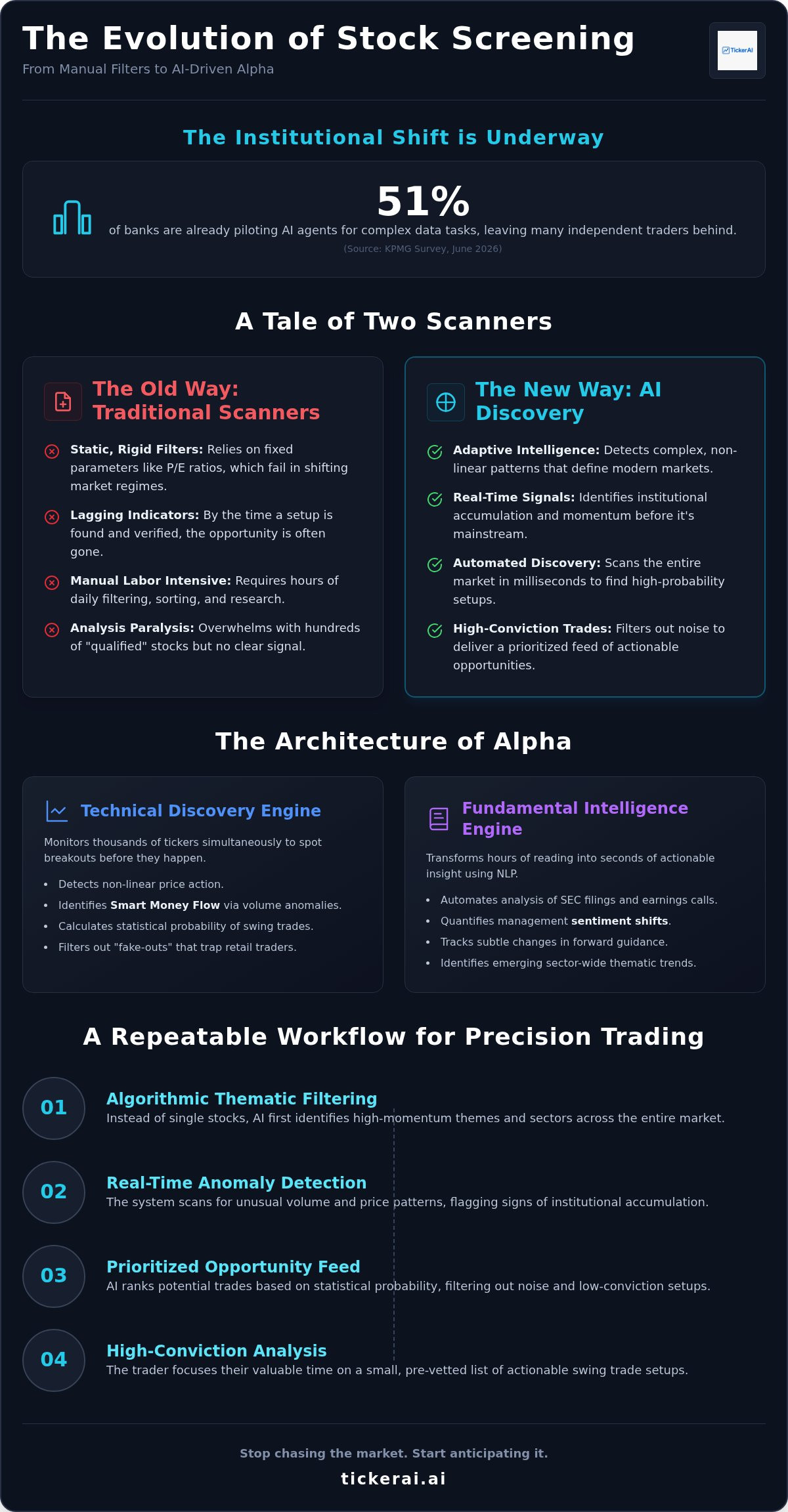
Building a Repeatable Workflow: From Algorithmic Discovery to Execution
Discovery is only the first half of the equation. Without a methodical execution path, even the most accurate signals are wasted. A professional workflow transforms raw algorithmic output into a series of calculated decisions. This process replaces the chaotic, manual search for tickers with a structured pipeline. By integrating an AI stock trading signals service into your daily routine, you move from reactive searching to proactive execution. The goal is a repeatable system that scales your intelligence without increasing your workload.
Effective market participation requires a transition from observation to action. You observe a thematic shift; you take an automated step to monitor it. You detect a technical breakout; you execute a risk-adjusted trade. This systematic approach ensures that your capital is always deployed where the statistical probability of success is highest. To understand the broader implications of this shift, explore how automated stock market analysis scales intelligence across diverse market regimes.
Step 1 & 2: Defining Themes and Setting Smart Watchlists
Start with thematic filtering. In 2026, market movements are often driven by specific macro themes like AI infrastructure or energy transition. Use your discovery engine to identify tickers exhibiting high correlation with these sectors. Once a theme is identified, set up a smart watchlist. These aren't static lists. They are dynamic environments that update in real-time based on algorithmic signals. Filter for action-oriented alerts. Don't waste time on general market news. Focus exclusively on tickers that meet your specific technical and fundamental criteria. This keeps your focus sharp and your screen clear of noise.
Step 3 & 4: Validating Signals and Managing Risk
Validation is your safeguard against false positives. When the AI flags a momentum breakout, cross-reference it with fundamental catalysts. An institutional buying pattern is more significant when it aligns with an earnings beat or a management sentiment shift. Use the AI to calculate your risk-to-reward ratio before entering any position. Professional traders prioritize protection over profit. The system should provide logical stop-loss and take-profit levels based on historical volatility and current support zones. This removes the "guesswork" from risk management. You aren't hoping the trade works; you're executing a setup with a known risk profile.
Finally, move to execution. If the signal is validated and the risk is acceptable, the decision becomes binary. This clinical approach to trading is what separates professionals from hobbyists. If you're ready to automate your discovery and streamline your execution, you can access professional-grade swing trade setups through a high-speed intelligence partner. Step 5 is simply the review: analyze the trade outcome and refine your filters. This creates a continuous loop of improvement that sharpens your edge over time.
TickerAI: Precision Discovery for the Professional Trader
TickerAI functions as a high-speed intelligence partner. It is a proactive scout for the serious participant. In a market where a 51% adoption rate of AI agents is already standard among institutions, retail traders cannot rely on manual effort. TickerAI provides the clinical precision required to compete. It is a dedicated AI stock trading signals service that filters chaos into actionable opportunity. This is not a passive database. It is an active discovery engine designed for those who value speed and clarity.
Innovative pragmatism defines the platform. We value technology for the tangible advantages it provides. Every feature focuses on time-saving. The logic is simple: automate the discovery so you can focus on the execution. It is a tireless assistant that is always "on." It detects while you decide. This approach removes the fluff of consumer finance and replaces it with data-driven authority. You get a high-speed intelligence partner that matches the pace of the modern market.
Pro vs. Full-Access: Choosing Your Intelligence Tier
Subscription levels are designed to match your specific research depth and trading frequency. A TickerAI Pro Subscription is the baseline for active swing trade setups. It prioritizes short-term movements and high-velocity setups. Use this tier if your focus is capturing rapid momentum shifts. A TickerAI Full-Access Subscription expands this capability. It includes long-term investment ideas and deeper systematic discovery. This tier is for the researcher who needs a comprehensive view of the market landscape. Both tiers leverage the same high-speed market intelligence. The difference lies in the breadth of the opportunities processed.
The TickerAI Edge in 2026
Automated market scanning is no longer a luxury. It is a requirement for survival. The platform's core differentiators are Smart Watchlists and Real-Time Alerts. These tools organize discovery into actionable themes. You don't just get a ticker; you get a setup. Real-time alerts ensure you never miss a momentum breakout because of a meeting or a time zone difference. The AI scans while you sleep. It monitors while you work. It delivers when the window is open.
This is a sophisticated filter for a chaotic environment. It provides a repeatable workflow. It removes emotional bias. It delivers results with clinical speed. Stop wasting hours on manual research that yields late results. Join TickerAI to discover your next opportunity and start trading with the precision of an algorithmic partner. This is the evolution of professional discovery. Use this AI stock trading signals service to secure your edge and scale your intelligence.
Securing Your Competitive Edge in the Algorithmic Era
The transition from manual screening to algorithmic discovery is no longer a choice for serious market participants. It's a requirement for survival. By moving beyond static filters, you gain a high-speed intelligence partner that identifies non-linear patterns and institutional anomalies in real-time. This guide has detailed a repeatable workflow that scales your research without increasing your daily effort. You don't have to chase breakouts anymore. You can anticipate them with clinical precision.
A professional AI stock trading signals service provides the systematic discipline needed to remove emotional bias from your execution. Whether you require AI-driven short-term swing stock alerts or curated long-term investment ideas, the objective remains the same: superior discovery in a fraction of the time. Real-time market scanning and anomaly detection ensure you focus exclusively on high-conviction setups. The technology acts as your proactive scout, filtering chaos into clarity while you focus on high-level decision making. It's time to trade with an edge that matches the speed of the 2026 market.
Start your AI-powered stock discovery with TickerAI today. Your next high-conviction opportunity is already being detected.
Frequently Asked Questions
What is the difference between an AI stock screener and a traditional scanner?
Traditional scanners rely on linear, hard-coded filters like fixed price-to-earnings ratios. They are passive data retrieval tools. An AI stock screener functions as a proactive discovery engine. It utilizes non-linear pattern recognition to identify complex relationships that static rules miss. While traditional tools return a list of tickers, AI prioritizes high-conviction opportunities based on real-time market mechanics and historical probability. It moves beyond simple filtering into algorithmic alpha discovery.
Can an AI stock screener help find penny stocks or small-cap gems?
Yes, the discovery engine scans the entire investable universe, including small-cap and micro-cap tickers. It detects unusual volume anomalies and liquidity shifts that often precede significant price movements in lower-cap stocks. The AI ignores the noise of social media hype, focusing instead on data-driven catalysts and institutional accumulation patterns. This allows you to identify high-potential setups in smaller companies before they reach mainstream retail scanners or traditional news outlets.
How accurate are the swing trade alerts generated by AI?
Accuracy is rooted in statistical probability. The AI analyzes millions of historical breakout patterns to calculate the conviction level of every signal. It cross-references technical momentum with fundamental catalysts to reduce the frequency of "fake-outs." While no system guarantees results, using a professional AI stock trading signals service provides a clinical, evidence-based approach to market participation. It prioritizes setups with a high risk-to-reward ratio, ensuring your capital is deployed systematically rather than emotionally.
Do I need technical knowledge to use an AI-powered stock discovery tool?
A baseline understanding of market mechanics is beneficial, but you don't need to be a data scientist. The platform is designed for "innovative pragmatism," meaning it handles the complex algorithmic processing in the background. It delivers actionable intelligence through an accessible interface. You focus on high-level decision-making while the AI acts as your high-speed intelligence partner. It simplifies the transition from raw data observation to calculated trade execution without requiring custom coding skills.
How does AI handle sentiment analysis for stock market news?
The system utilizes Natural Language Processing (NLP) to scan earnings transcripts, news feeds, and SEC filings in seconds. It quantifies management sentiment and tracks subtle shifts in guidance across entire sectors. This transforms qualitative text into a quantitative score. By detecting these changes in real-time, the AI identifies thematic investment ideas before they are fully priced into the market. It provides a level of fundamental depth that traditional technical scanners simply cannot match.
Is an AI stock screener worth the subscription cost for a retail trader?
The value lies in the tangible time-saving and clarity provided by automated discovery. For a retail trader, a professional AI stock trading signals service replaces hours of manual research with real-time alerts. It eliminates the analysis paralysis caused by data overload. By providing curated swing trade setups and smart watchlists, the service allows you to compete with institutional-grade intelligence. It is a calculated investment in efficiency and systematic discipline for serious market participants.
Can TickerAI integrate with my existing brokerage for execution?
TickerAI is a specialized discovery and market intelligence tool, not a brokerage. It does not provide brokerage execution services. The platform functions as your proactive scout, identifying high-conviction opportunities and risk-adjusted setups. Once the AI flags a signal, you execute the trade through your preferred external brokerage platform. This ensures a clear separation between unbiased algorithmic discovery and trade execution, allowing you to maintain full control over your capital and brokerage choice.
How does AI detect Smart Money or institutional buying patterns?
The AI monitors price action and volume anomalies that indicate institutional accumulation. It looks for "footprints" in the data, such as persistent buying at specific levels or unusual order flow patterns that precede large-scale breakouts. By analyzing these non-linear data points across thousands of tickers simultaneously, the AI identifies where Smart Money is moving. This allows you to align your positions with institutional flow rather than chasing momentum after the move is already extended.


