

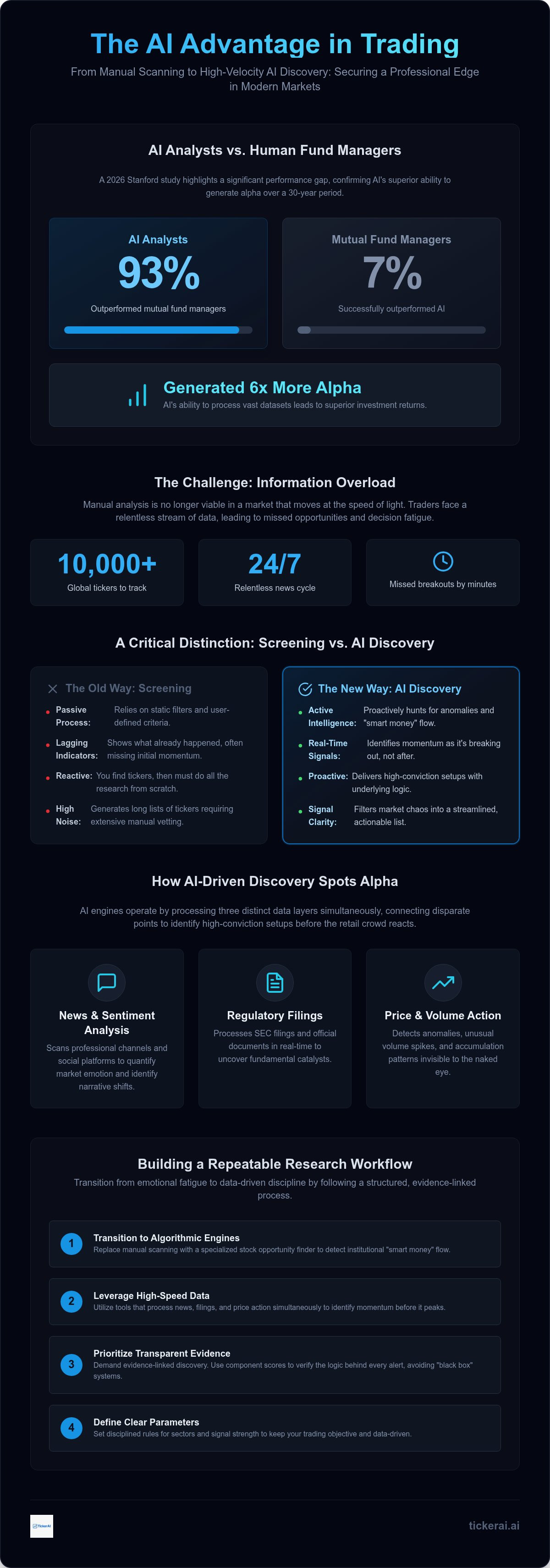
A 2026 Stanford study confirms that AI analysts outperformed 93% of mutual fund managers over a 30-year period; they generated six times more alpha. This isn't a future possibility. It's the current standard for professional performance. Most traders still drown in information overload while trying to track 10,000 tickers manually. You've likely felt the frustration of missing a momentum breakout by minutes or the fatigue of second-guessing a trade entry. Relying on a manual stock opportunity finder is no longer a viable strategy in a market that moves at the speed of light.
You deserve a workflow that prioritizes evidence over noise. This guide outlines the transition from manual scanning to high-velocity AI discovery. You'll learn how to secure a professional edge in 2026 by replacing emotional fatigue with data-driven confidence. We'll examine a repeatable research workflow that delivers real-time alerts with high-conviction logic. By the end, you'll have a blueprint for time-saving automation that turns market chaos into a streamlined list of actionable setups.
Key Takeaways
- Transition from manual scanning to algorithmic engines. High-frequency noise requires a specialized stock opportunity finder to detect anomalies and institutional "smart money" flow.
- Leverage high-speed data ingestion. Modern discovery tools process news, filings, and price action simultaneously to identify momentum before it peaks.
- Prioritize transparency through evidence-linked discovery. Use component scores to verify the logic behind every alert instead of relying on opaque "black box" systems.
- Build a repeatable five-step research workflow. Define clear parameters for sectors and signal strength to ensure your trading remains disciplined and data-driven.
- Access professional-grade intelligence through TickerAI Pro and Full-Access. These tiers provide real-time swing trade setups and smart watchlists for a calculated market edge.
Beyond the Screener: Why You Need a Stock Opportunity Finder in 2026
The 2026 market doesn't wait for human analysis. High-frequency noise and algorithmic dominance have compressed the window between signal and execution. Traditional methods are failing. If you're still relying on static filters, you're competing against algorithmic trading systems that process millions of data points in milliseconds. You need a tool that shifts the focus from simple filtering to anomaly detection. A stock opportunity finder isn't just a filter; it's an intelligence engine designed to locate alpha in a sea of volatility. It moves you past the "what" and into the "why" of market movement.
The Information Overload Problem
The modern trader faces a staggering 10,000+ global equities and a relentless 24/7 news cycle. Manual charting has become a dangerous bottleneck for retail participants. It's impossible for a human to track every price action shift or regulatory filing across the technology and biotech sectors simultaneously. This delay results in missed momentum and late entries. In 2026, the cost of being slow is measured in lost alpha. You can't out-scan a machine. You need to automate the detection phase to focus your energy on decision-making and risk management. Efficiency is the only way to combat the mental drain of constant monitoring.
Discovery vs. Screening: A Critical Distinction
Traditional screening is a passive process. It relies on lagging indicators and static criteria that often miss the initial impulse of a move. Discovery is different. It's an active, AI-led search for institutional "smart money" flow and accumulation patterns. While a screener tells you what happened yesterday, discovery shows you what's breaking out right now. AI-driven discovery identifies momentum before it appears on basic retail lists. It connects disparate data points like unusual volume spikes, sentiment shifts, and fundamental catalysts to highlight high-conviction setups.
A stock opportunity finder is a proactive intelligence scout that filters market chaos into actionable, high-probability trade setups.
This shift from "finding a ticker" to "evaluating a setup" is essential for professional survival. You don't need more tickers to watch; you need better signals to trade. By automating the discovery phase, you eliminate the emotional fatigue of second-guessing and the physical drain of manual scanning. You move from a reactive state to a calculated, proactive stance that mirrors institutional workflows. This is about precision, speed, and the clinical execution of a defined strategy.
The Mechanics of AI-Driven Discovery: How Algorithms Spot Alpha
Alpha is rarely found on the surface. It lives in the anomalies that most retail screeners ignore. A professional stock opportunity finder operates by processing three distinct data layers simultaneously: news sentiment, regulatory filings, and raw price action. This high-speed ingestion allows the engine to detect institutional "smart money" flow before the retail crowd reacts. It isn't just about price movement. It's about the conviction behind the move. By scanning thousands of tickers every second, the algorithm identifies accumulation patterns that are invisible to the naked eye.
Sentiment analysis has evolved into a quantitative metric. Algorithms now scan professional channels and social platforms to measure market emotion. This data is then cross-referenced with order flow to identify where reality diverges from the narrative. As regulators increase their focus on SEC enforcement on AI claims, the necessity for verifiable, evidence-linked discovery becomes paramount. You need to know exactly why a signal was generated. This transparency prevents the "black box" trap that leads to undisciplined trading.
Anomaly detection is the core of this mechanical process. It identifies price and volume deviations that fall outside of historical norms. When a stock experiences a sudden influx of professional interest without an obvious public catalyst, the engine flags it as a potential setup. This allows you to position yourself ahead of the narrative. It turns the market from a guessing game into a game of detection and execution. You focus on the setups with the highest probability of follow-through.
Quantitative Signal Processing
Understanding what is quantitative investing is critical for the modern active investor. In 2026, this approach levels the playing field by removing emotional bias from the discovery process. The engine merges technical indicators with fundamental catalyst tracking, such as FDA approvals or contract wins, in real-time. Multi-factor ranking ensures that each ticker is scored based on its probability of success. This systematic approach turns a chaotic market into a prioritized list of opportunities. It replaces guesswork with clinical precision.
Automating Technical Analysis
Manual trendline drawing is a relic of a slower era. Modern discovery engines use automated pattern recognition to identify "Squeeze Context" and high-relative volume (RVOL) spikes as they happen. These tools detect the "Institutional Footprints" left in the order flow, signaling when big players are accumulating a position. By identifying these low-competition swing setups early, you gain a structural advantage over those waiting for a traditional breakout. Professional traders often integrate AI-driven discovery tools into their daily routine to maintain this tactical edge. This automation doesn't just save time. It preserves the mental capital required for high-stakes decision-making.
Evaluating the Signal: Evidence-Linked Discovery vs. Blind Alerts
Transparency isn't a luxury in 2026. It's a requirement. Blind alerts lead to emotional fatigue. They cause account drawdown. A professional stock opportunity finder must provide visible logic for every ranking. This is the difference between gambling on a "black box" and executing a high-conviction trade. Evidence-linked discovery breaks down a signal into component scores. You see the exact weight of momentum, volume, and fundamental catalysts. This methodology aligns with recent academic research on AI in trading, which emphasizes the need for interpretable machine learning models in volatile environments.
Component scores provide the "why" behind the ticker. If a stock is flagged, the system should link that signal directly to contextual evidence. This includes SEC filings, news bursts, or insider trade reports. Without this link, you're flying blind. Filtering for quality is your first line of defense against "pump and dump" traps. High-speed AI filters can detect artificial volume inflation and social media manipulation in seconds. You don't just find a ticker; you validate its integrity. This clinical approach ensures you aren't chasing ghosts in a manipulated tape.
Understanding Signal Scores
Clarity is the objective. Learning how to interpret AI stock signals allows you to align discovery with your specific risk profile. Momentum-led signals favor the aggressive swing trader. Catalyst-led signals suit those looking for fundamental shifts. High-conviction setups often feature "Squeeze Potential" as a secondary confirmation. This metric tracks short interest against daily volume to identify explosive move potential. It's about layers of evidence. More layers mean higher conviction.
Validating the Catalyst
Price action is a lagging indicator. It tells you where the stock has been, not necessarily where it's going. High-conviction swing trades require a verified catalyst. AI engines parse earnings reports and regulatory filings in milliseconds to find the "Hidden Movements" that precede a breakout. These might be subtle changes in revenue guidance or a series of strategic insider buys. By the time a story hits mainstream headlines, the move is often over. A sophisticated stock opportunity finder puts you in position before the crowd arrives. It turns information asymmetry into your professional edge. You focus on the data, not the hype.
Building Your Workflow: From Discovery to Discipline
Discovery is only the first half of the equation. Without a systematic framework for execution, even the best signals are wasted. A professional stock opportunity finder provides the raw data; your workflow provides the discipline. You must move from observation to action with clinical precision. This requires a repeatable investment workflow that eliminates hesitation and standardizes your decision-making process. By following a structured sequence, you ensure that every trade is backed by data rather than impulse.
- Step 1: Define Discovery Parameters. Narrow your focus. Set specific filters for Sector, Market Cap, and Signal Strength to ensure you only see high-probability setups that fit your risk profile.
- Step 2: Review Evidence-Linked Setups. Don't trade blindly. Analyze the component scores and fundamental catalysts provided by the AI to verify the signal's integrity before committing capital.
- Step 3: Cross-Reference Themes. Align individual tickers with broader thematic investment opportunities. Stronger moves often occur when a stock has both a technical signal and a macro tailwind.
- Step 4: Execute with Rule-Based Risk. Set hard stops and profit targets before entering the trade. Automation handles the detection; you handle the risk management.
- Step 5: Conduct Post-Trade Analysis. Journal every trade. Use the AI's historical data to refine your parameters and improve your process over time.
Removing Emotion from the Equation
Gut feelings are a liability in high-velocity markets. Emotional fatigue leads to FOMO and late entries. By using AI to remove emotion from trading, you shift your reliance from intuition to data. You trust the discovery process because it's rooted in verifiable logic. This systematic discipline ensures that your capital is only deployed when your specific criteria are met. It turns trading into a business of execution rather than a series of reactive guesses.
Leveraging Smart Watchlists
Organization is a competitive advantage. Group your discovered opportunities into actionable themes like AI Infrastructure or Biotech Catalysts. A Smart Watchlist isn't a static list; it's a dynamic intelligence tool. Use real-time alerts to monitor movements within these groups. Automated re-ranking prevents "watchlist staleness" by prioritizing stocks that show increasing momentum. This keeps your focus on the most relevant setups at all times. To start building your own systematic workflow, access the TickerAI discovery engine today.
TickerAI: Precision Discovery for Professional Traders
Professional discovery requires specialized infrastructure. TickerAI serves as that intelligence layer. It isn't a generalist tool. It's a high-speed engine built for the 2026 market reality. While legacy platforms provide raw data, TickerAI provides filtered intelligence. It automates the transition from raw market noise to executed trades. This is the "Observation-to-Action" flow in practice. You receive smart watchlists and real-time alerts that prioritize evidence over speculation. This clinical approach ensures you focus only on high-conviction swing trade setups.
The TickerAI edge lies in its ability to scan global equities for institutional footprints. It detects anomalies that manual scanners miss. This proactive scout operates 24/7. It delivers actionable alpha directly to your dashboard. You don't waste time on 10,000+ tickers. You focus on the five or ten that meet your specific criteria. This efficiency preserves your mental capital. It allows you to make calculated decisions in a fast-moving environment. A professional stock opportunity finder should be an assistant, not a distraction. TickerAI fulfills this role with precision.
TickerAI Full-Access vs. Pro
Choosing the right tier is a strategic decision. It depends on your trading frequency and capital requirements. When evaluating an AI stock picking service, you must match the tool's capabilities to your workflow. TickerAI Pro is designed for the active trader. It delivers high-speed swing stock alerts and real-time market scanning. It's built for rapid execution. TickerAI Full-Access offers a deeper experience. It includes thematic research and long-term investment ideas. This tier is for the investor who needs both immediate setups and a macro-perspective. Both tiers provide the same core algorithmic discovery. The difference is the depth of the data delivered.
Action-Oriented Discovery in Practice
Consider the impact of automated momentum detection. TickerAI identifies breakouts as they consolidate. It flags unusual volume spikes and "Squeeze Context" before the retail crowd arrives. This isn't about chasing green candles. It's about identifying the catalyst behind the move. The engine filters out the noise of social media hype. It focuses on regulatory filings and institutional accumulation. This methodology provides a structural advantage. You trade based on evidence-linked signals. This systematic discipline is what separates professional participants from casual hobbyists. Join TickerAI and unlock professional stock opportunity discovery today.
Secure Your Professional Edge in 2026
The 2026 market demands a shift from manual scanning to high-velocity discovery. You've seen how algorithmic engines detect anomalies that retail screeners miss. Success now relies on a repeatable workflow that replaces emotional fatigue with data-driven confidence. By utilizing evidence-linked signals, you validate setups before committing capital. This transition ensures your trading is proactive rather than reactive. Integrating a professional stock opportunity finder into your daily routine is no longer optional for those seeking alpha. It's the standard for institutional-grade performance.
TickerAI provides the infrastructure to automate this process. You receive AI-powered swing trade setups and real-time market alerts delivered with clinical precision. This is institutional-grade research for individuals who value speed and clarity. Stop fighting the noise and start executing with a tactical advantage. The tools for professional-grade discovery are ready for deployment.
Discover High-Potential Stocks with TickerAI Pro
Your journey toward systematic discipline starts with the right intelligence partner. Position yourself ahead of the move and trade with calculated authority today.
Frequently Asked Questions
What is a stock opportunity finder?
A stock opportunity finder is an automated intelligence engine designed to detect market anomalies and high-conviction trade setups across global equities. Unlike manual scanning, it processes news, filings, and price action simultaneously to identify institutional footprints. It acts as a proactive scout, filtering through thousands of tickers to prioritize actionable alpha. This tool transforms raw market data into a prioritized list of opportunities, allowing traders to focus on decision-making rather than data ingestion.
How does an AI stock opportunity finder differ from a traditional screener?
Traditional screeners are passive filters that rely on static, lagging data points. In contrast, an AI-powered stock opportunity finder is an active discovery engine that identifies momentum breakouts before they peak. It utilizes pattern recognition to spot institutional accumulation and "smart money" flow in real-time. While a screener tells you what happened, AI discovery shows you what is breaking out now. It replaces rigid filters with dynamic, multi-factor ranking for a professional edge.
Can I use a stock opportunity finder for long-term investing?
Yes, these tools are highly effective for identifying long-term investment ideas. While many traders use them for short-term swing trade setups, the underlying logic identifies fundamental catalysts and thematic shifts that drive multi-year growth. TickerAI Full-Access specifically provides deep research into thematic opportunities like AI infrastructure and biotech innovations. By scanning regulatory filings and earnings transcripts, the engine detects early-stage accumulation by institutions, which often precedes significant long-term appreciation in high-quality equities.
Does TickerAI provide personal financial advice?
TickerAI does not provide personal financial advisory services. It is a high-speed intelligence partner that delivers data-driven discovery, smart watchlists, and algorithmic alerts. All signals and setups are based on quantitative logic and market mechanics rather than individual financial circumstances. Users are responsible for their own brokerage execution and risk management. It is designed to act as a sophisticated filter for serious participants who manage their own portfolios and value clinical, unbiased market information.
How often are the stock discovery signals updated?
Discovery signals are updated in real-time to match the pace of the 2026 market environment. The engine continuously scans price action, volume spikes, and news bursts to ensure you never miss a momentum shift. High-velocity alerts are delivered to your dashboard the moment an anomaly is detected. This persistence eliminates the delays associated with manual charting and ensures that your watchlist reflects current market reality. Continuous monitoring allows you to maintain a calculated, proactive stance.
Is an AI stock finder worth the subscription cost in 2026?
For professional traders, the cost is justified by the efficiency gains and alpha generation potential. A 2026 Stanford study noted that AI analysts outperformed 93% of mutual fund managers, generating six times more alpha over 30 years. By automating market scanning, you save hours of manual labor and reduce the emotional fatigue of second-guessing entries. The ability to detect institutional footprints early provides a structural advantage that typically outweighs the subscription fees of professional-grade discovery engines.
What technical indicators does the AI use for discovery?
The engine utilizes a multi-factor approach, merging technical indicators with fundamental catalyst tracking. Key metrics include high-relative volume (RVOL) spikes, Squeeze Context, and price action anomalies. It also monitors institutional footprints within the order flow to detect professional accumulation. These technical data points are cross-referenced with sentiment analysis and regulatory filings. This comprehensive processing ensures that every signal is backed by multiple layers of evidence rather than a single, isolated indicator.
How do I integrate AI alerts into my existing trading plan?
Integrate AI alerts as the primary discovery layer of your workflow. When an alert is triggered, review the evidence-linked setup provided by the AI to verify the catalyst. Cross-reference the ticker with your existing thematic watchlists to ensure alignment with your strategy. Finally, execute the trade using rule-based risk management, such as pre-defined stops and profit targets. This systematic approach ensures that you use AI for detection while maintaining full control over execution and discipline.


