

What if the strongest move on your screen is the trade you should be willing to skip? A fast-rising stock, confident posts, and repeated alerts can make hesitation feel like a mistake. But a compelling story or sudden price spike isn’t, by itself, a valid entry. Learning how to avoid FOMO in stock trading starts with recognizing urgency and separating market noise from a setup that meets your criteria.
It’s natural to worry that waiting means missing your chance. The goal isn’t to catch every move. It’s to make decisions you can explain before you place a trade, and to accept that passing can be disciplined execution.
This guide shows you how to spot common FOMO triggers, pause before acting, and use a repeatable review process to assess potential trades. You’ll learn to compare a candidate with consistent criteria instead of relying on social buzz or alerts alone. AI-powered opportunity discovery and watchlists can help organize stocks for independent review, but alerts are research inputs, not instructions to trade. The decision remains yours.
Key Takeaways
- Separate evidence of momentum from a trade rationale formed before the price accelerated.
- Recognize how headlines, online discussion, and repeated alerts can make popularity feel like confirmation.
- Use consistent cues to compare a researched candidate with a FOMO-driven entry.
- Learn how to avoid FOMO in stock trading with a five-step review: pause, name the trigger, revisit criteria, assess risk, then decide or pass.
- Use watchlists and alerts to organize candidates for independent research, not as automatic trade signals.
What FOMO in stock trading looks like, and why it pushes traders to chase
Trading FOMO is the urgency to participate because a price move or perceived opportunity seems to be slipping away. A stock is climbing, other traders are discussing it, and waiting starts to feel like choosing to miss out. That reaction can turn a developing idea into a rushed entry, even when you haven’t established a clear thesis, timeframe, or acceptable risk.
Momentum itself isn’t the problem. It can be useful information when identifying a stock to research. Chasing happens when the price move becomes the reason to enter, replacing an independent rationale. A candidate can be moving quickly and still merit review, but movement alone doesn’t show that its current price offers a suitable setup.
How FOMO shows up before a stock trade
A rapid rise can make a late entry feel unusually compelling. The chart may seem to confirm that demand is strong, while fear of waiting narrows your attention to possible gains. You might abandon a planned entry threshold or skip basic checks just to act before the price moves again.
Online attention can intensify that pressure. Copying a popular trade without understanding its thesis, risks, or time horizon means adopting someone else’s conclusion without the reasoning behind it. A researched candidate is different: you can explain why it merits attention and what conditions would invalidate the idea, even if the stock has already attracted a crowd.
Watch for cues such as repeatedly refreshing the quote, feeling compelled to buy immediately, or changing a planned threshold because the stock is moving away. These reactions don’t prove a trade is wrong. They do signal that urgency may be influencing your decision and deserves a closer look.
Why missing a move feels worse than it should
Visible gains can make a missed opportunity feel like a personal loss. Seeing a stock rise after you considered it may trigger regret: “I could have been in.” But not capturing a move isn’t the same as losing money on a trade. That comparison often ignores what might have happened after entry, including volatility, a reversal, or the challenge of choosing an exit.
Social comparison adds another distortion. Posts and conversations tend to highlight compelling calls or winning outcomes, not every position, missed forecast, or loss behind them. The psychology of FOMO in investing includes fear of regret and the pull to follow a crowd. Repeated enthusiasm can make popularity feel like confirmation, even when it provides no independent evidence about a stock.
Urgency describes your decision state; it doesn’t prove that a stock is a sound trade. Treat that feeling as a cue to check your reasoning, not as a signal to enter. Learning how to avoid FOMO in stock trading begins with separating what the market is doing from why you’re considering a trade. If you can’t state your rationale without referring to the price spike or crowd excitement, pause and reassess.
What triggers trading FOMO: momentum, social proof, and constant alerts
FOMO often builds when several signals arrive at once. A sharp price acceleration catches your eye. A breaking headline supplies a story. Online posts suggest consensus, while phone alerts keep bringing the stock back into view. Each signal can provide context, but together they can create pressure to act before you’ve checked what the information actually supports.
Separate the trigger from the evidence. A price move tells you what the stock is doing, not whether its current price fits your plan. A headline may explain a catalyst, but doesn’t establish how long its effects could last. Social discussion reflects attention, and an alert flags activity. None is an automatic entry signal.
- Price acceleration: The fear is that waiting means paying more or missing the move. Compare the price action with your planned criteria.
- Breaking headlines: A dramatic story can make immediate action feel necessary. Review the underlying information and consider whether it changes your thesis.
- Online discussion: Repeated enthusiasm can feel like confirmation. Popularity alone doesn’t validate a trade idea.
- Frequent alerts: Notifications can interrupt analysis and prompt repeated checking. Treat each one as a cue to review, not a demand to respond.
How social media and crowd activity amplify urgency
A post may show a confident prediction or a winning trade without revealing the decision process, risk, timeframe, or full results behind it. Investor.gov cautions investors against letting online personalities or crowd enthusiasm drive decisions. Use that warning as a prompt to verify claims against primary market information and your own criteria, rather than assuming a widely shared idea has been independently confirmed.
Repeated exposure matters. Seeing the same claim across several accounts can feel like multiple confirmations, even when those accounts may be reacting to the same original post or headline. Ask what is independently verifiable and what is simply being repeated.
When momentum alerts become a source of pressure
An alert can flag a price change, market event, or research candidate. It doesn’t tell you to enter immediately. If a notification interrupts a planned review, return to the reason you set your criteria and assess the stock on that basis. For a clearer framework for interpreting algorithmic signals, see this guide to interpreting AI stock signals.
To support a more organized review, AI stock discovery and smart watchlists can help surface and monitor candidates. Use alerts as research inputs, then evaluate each idea independently. If you’re learning how to avoid FOMO in stock trading, notice when information is clarifying a decision and when repeated exposure is only making it feel urgent. No single trigger predicts a reversal, and a popular stock isn’t automatically unsuitable. The task is to test the idea, not the crowd’s excitement.
FOMO versus a valid setup: how to assess a stock without chasing
A fast-moving stock can still be a valid research candidate. The test is whether the idea stands on evidence and fits your plan, not whether the chart looks exciting. Compare the decision cues below and focus on what you can verify before deciding whether the stock merits further review.
| Evidence-based candidate | FOMO-driven chase |
|---|---|
| The thesis and relevant evidence are stated clearly. | The explanation is mainly that the stock is rising or getting attention. |
| The intended timeframe matches the reason for considering the trade. | The timeframe shifts to justify entering after the move began. |
| Entry conditions and acceptable risk were considered in advance. | A planned threshold is abandoned because the price may keep climbing. |
| Unknowns are identified for further research. | Missing information is filled with assumptions or confident predictions. |
Ask whether you established the thesis, timeframe, and intended risk before the price accelerated. If not, don’t treat the move itself as proof that the setup is valid. You can still research the stock, but separate that review from an immediate decision to enter.
Questions that separate market evidence from urgency
Start with one question: What changed in the evidence, and what changed only in my fear of missing out? Then check whether the stock matches your stated timeframe and research criteria. Identify what you know, what you don’t know, and what requires more review. Label uncertainty directly instead of resolving it with a guess. This makes your reasoning easier to test.
Next, mentally set aside the social commentary and pressure to act quickly. Would the candidate still meet your criteria if you hadn’t seen the posts or watched the latest price jump? If your rationale depends on those cues, urgency rather than a complete thesis may be driving the decision.
Why a strong move is not an automatic entry signal
Price movement shows that the market price has changed. On its own, it doesn’t establish whether a stock suits your objectives, where it may move next, or whether the current price fits your entry plan. A strong move can be a reason to investigate, but it isn’t a substitute for assessing the idea and its risks.
Be alert to thesis drift: changing your original rationale simply to make a late entry feel defensible. For example, a stock that first caught your attention for one defined catalyst shouldn’t become an entirely different trade idea just because its price kept rising. Reassess the available evidence and preserve the option to pass.
A checklist supports consistency, not certainty. Passing each item can’t predict an outcome or remove investment risk. Its value is that it reveals whether a decision follows your process or bends around urgency. That distinction is central to how to avoid FOMO in stock trading: review the candidate on its merits, and let an unmet criterion remain unmet rather than changing the standard mid-decision.
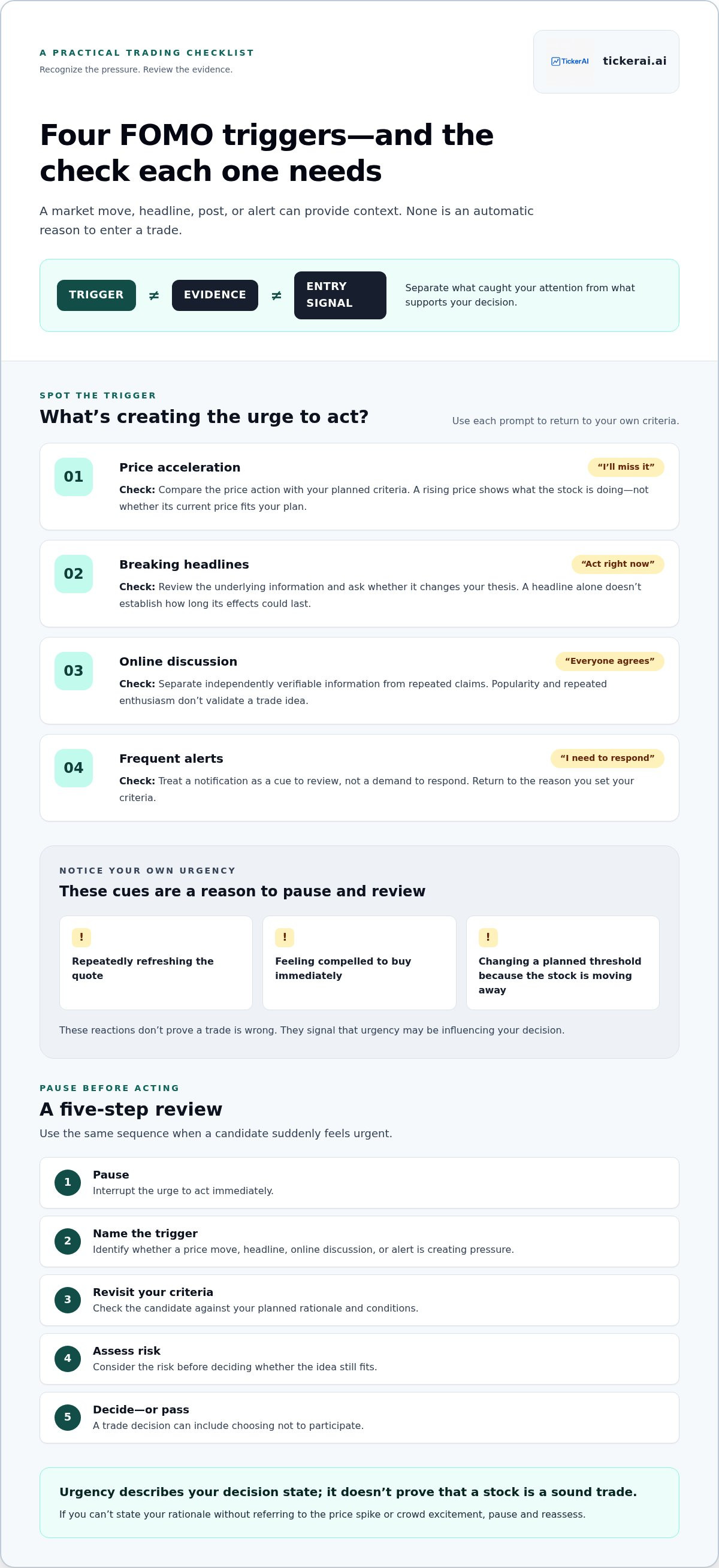
A five-step process to pause before acting on a stock opportunity
A repeatable review can interrupt an impulse before it becomes an order. The pause isn’t a countdown to entry. It’s a deliberate break from the urge to act, giving you room to check whether the opportunity still fits your plan. Follow these steps whenever a fast move, headline, alert, or post creates pressure.
The pause-and-review sequence
- Pause. Stop before placing the trade. Step away from the order screen if needed. Don’t set a fixed delay and assume you’ll enter when it ends; resume only when you can review the idea clearly.
- Name the trigger. State what prompted the urgency: a rapid price move, breaking headline, notification, or social post. Naming it helps separate the event from your reaction.
- Revisit the original criteria. Return to your thesis and the conditions that made the stock worth researching. Check the relevant evidence. Has something material changed, or are you reacting to price action alone?
- Assess intended risk. Review the risk you planned to accept and whether the current setup still fits it. If the move has changed the entry context, don’t quietly adjust your risk assumptions to make the trade feel acceptable.
- Decide or pass. Continue your review only if the evidence and criteria still support considering the setup. If a key condition is missing, wait or pass without inventing a new rule on the spot.
This sequence turns how to avoid FOMO in stock trading into a decision habit, rather than a demand to suppress every emotional reaction. For more on building a consistent process, read about using AI to support systematic trading discipline. Tools can organize information, but they don’t make the decision for you.
How to make passing a valid decision
An incomplete setup is a reason to wait or pass, not proof that you failed to participate. If the stock has already moved beyond your planned conditions, avoid inventing a replacement entry rule just to catch up. The opportunity may remain on your watchlist for later research, or it may no longer fit your criteria. Either outcome is valid.
Record the trigger, the evidence you reviewed, and why you acted or passed. Later, assess whether you followed your process, not only whether the stock rose or fell afterward. A disciplined pass can still be the right decision even if the price continues higher; a profitable outcome doesn’t automatically validate an impulsive entry. Tracking these decisions can reveal recurring pressure points and help you refine your review habits over time.
For an organized way to monitor research candidates, explore AI stock opportunity discovery. Use watchlists and alerts as inputs to your independent review, then apply the same pause-and-review sequence before deciding what to do.
Use market discovery tools without letting alerts dictate your trades
Market discovery tools can help organize research, especially when price moves and new information compete for your attention. Their role is to surface and monitor candidates, not decide whether a trade belongs in your portfolio. An alert should prompt a review against your criteria. It shouldn’t replace that review or trigger an automatic order.
TickerAI offers AI-powered stock opportunity discovery, smart watchlists, real-time alerts, swing trade setups, and long-term investment ideas. These are research inputs for independent consideration. TickerAI doesn’t provide personal financial advice or execute trades. Subscribers remain responsible for evaluating each candidate and making their own decisions.
Turn alerts into inputs for independent review
Use a notification as the start of a process: open the candidate, identify what the alert has flagged, and compare the information with your thesis and timeframe. Then check whether the idea meets the criteria you set before the alert arrived. A surfaced opportunity is not the same as an individual trading decision.
This distinction keeps useful discovery separate from urgency. AI can help surface and organize ideas, but it can’t guarantee a favorable outcome or remove emotional bias. If an alert creates pressure to act before you understand the setup, return to your review criteria instead of treating the notification as a verdict.
Choose a consistent next step after the review
Once you’ve reviewed the candidate, keep the next step simple. If it meets your criteria, follow your existing process and risk limits. If it doesn’t, pass. Don’t change the criteria just because the stock has moved or the alert has drawn your attention. Consistency is central to how to avoid FOMO in stock trading while still using discovery tools to find ideas worth examining.
A useful workflow also distinguishes “not yet” from “never.” You might keep a candidate on a watchlist for further research, or remove it if it no longer fits your approach. Either way, the tool helps organize what to review; it doesn’t require you to trade. This keeps discovery active without turning every alert into a demand for action.
To make candidate discovery part of a more structured research workflow, explore TickerAI’s stock opportunity discovery and review its Pro and Full-Access subscription tiers. Use the platform to identify and monitor research ideas, then apply your own criteria before making a trade decision.
Make your next trading decision more deliberate
Set your decision standard before the next stock starts drawing attention. Write down what would make a candidate worth reviewing, what evidence you need, and what would lead you to pass. Then judge the quality of your process, not whether a skipped stock later rose or a trade happened to gain. That separation helps you learn without letting hindsight rewrite your rules.
Learning how to avoid FOMO in stock trading isn’t about being faster than every price move. It’s about making room for a considered decision, even when the market feels urgent. Use discovery tools to keep research organized while retaining responsibility for your own choices and risk.
Explore TickerAI’s AI-powered stock opportunity discovery as an input to your research workflow, and review the available subscription options. A missed move doesn’t define your discipline. Your next thoughtful decision is a chance to strengthen it.
Frequently Asked Questions
Is FOMO normal in stock trading?
Yes, feeling urgency around a fast-moving stock is a common reaction, but it doesn’t show that a trade is right for you. Treat the emotion as a cue to check your decision, not as something you must eliminate. For example, if you feel pressure after seeing a stock jump during a meeting, note the feeling and return to your research when you can focus. You can acknowledge the impulse without acting on it.
Can social media cause FOMO when trading stocks?
Yes, social media can intensify FOMO by making enthusiastic predictions and selected wins easy to see. Before acting on a post, identify its factual claim and look for a reliable source that can verify it, such as company disclosures for company-specific news. Consider whether the information is current and relevant to your timeframe. A post can prompt further research, but it can’t establish that a trade suits your strategy.
Should I buy a stock after it has already risen sharply?
Not based on the rise alone. Reassess the stock against the rules you set before seeing the move, including what evidence would support an entry and what conditions would make you stand aside. Avoid changing those rules simply because the original opportunity looks less attainable. If you’re unsure whether the current situation still fits your plan, pause and gather more information. No review process can predict the stock’s next move.
How can day traders avoid FOMO during a fast market move?
Use a brief, predefined review before entering an order, even during a fast session. A practical part of how to avoid FOMO in stock trading is checking that the setup matches your trading plan, the intended position fits your risk limits, and you can explain the entry without relying on excitement. If you can’t complete those checks, don’t improvise a new rule to keep up with the market.
Is it better to miss a trade than chase it?
Neither outcome is automatically better; judge the decision by whether it followed your process and risk limits. If you pass, record which criteria weren’t met and what information you had at the time. Review that note later without using the stock’s subsequent price as the only scorecard. This can help distinguish a sound decision with an uncertain result from one that drifted away from your plan.
Can AI stock alerts prevent FOMO?
No. AI alerts can’t prevent an emotional reaction or determine whether a trade fits your circumstances. TickerAI provides AI-powered stock opportunity discovery through its Pro and Full-Access subscription tiers, but its research ideas aren’t personal financial advice, and the platform doesn’t execute trades. Use a surfaced candidate to begin your own assessment. You remain responsible for considering the evidence, your risk limits, and whether to act or pass.


