

Most traders treat watchlists like a digital graveyard for stocks they missed. They spend hours manually charting tickers only to enter a position after the momentum has already peaked. It's an inefficient, manual process that ignores the reality of the 2026 market. With 62% of U.S. retail investors now using AI to inform their decisions, the competitive landscape has shifted. Building a watchlist for swing trading isn't about collecting tickers anymore. It's about engineering a high-speed filter for execution. You need a system that detects technical anomalies and momentum breakouts before they hit the mainstream scanners.
You're likely tired of the noise and the constant feeling of being one step behind the tape. We understand that professional trading requires clinical precision, not guesswork. This guide will show you how to master a systematic, AI-driven workflow that turns market volatility into a structured list of 5 to 10 high-conviction setups. We'll break down a repeatable 15-minute daily research routine using TickerAI's discovery engine to identify high-probability swing setups. You'll learn to leverage automated scanning to eliminate market noise and focus exclusively on tickers ready for immediate action.
Key Takeaways
- Shift your strategy from static stock tracking to a dynamic discovery engine that identifies high-velocity opportunities in real-time.
- Master a streamlined, 15-minute daily workflow for building a watchlist for swing trading that prioritizes momentum breakouts over lagging indicators.
- Integrate institutional-grade criteria by aligning technical anomaly detection with sector strength and volume analysis.
- Utilize AI-powered filtering to eliminate market noise and emotional bias, ensuring every candidate meets a strict three-point validation check.
- Scale your operations using TickerAI Smart Watchlists to replace manual nightly scanning with automated, high-conviction alerts.
The Evolution of the Swing Trading Watchlist
Traditional methods of market analysis are failing in the high-volatility environment of 2026. Static spreadsheets and manual stock lists are obsolete the moment they're saved. In a market where price action is dictated by high-frequency algorithms, Swing trading requires a transition from passive "data collection" to active "opportunity discovery." The objective is no longer to track every moving ticker. It's to filter 5,000+ stocks into a clinical, actionable subset in milliseconds. Success now depends on speed and the ability to process technical anomalies before the broader market reacts.
The Information Overload Trap
Retail traders often believe that more data leads to better conviction. This is a dangerous fallacy. Excessive information creates analysis paralysis, not profit. In a fast-moving algorithmic environment, the cost of manual charting is high. If you're still drawing trendlines by hand across hundreds of tickers, you're already behind the tape. You don't need more data; you need better filters. Building a watchlist for swing trading effectively means distinguishing between "Market Noise"-random price fluctuations-and "Actionable Signals" that indicate institutional accumulation. Manual processes simply can't keep pace with the 2026 market's velocity.
Moving Toward Proactive Scouting
Modern trading demands a proactive scout. Think of AI not as a replacement for your judgment, but as a tireless assistant that scans the horizon while you focus on decision-making. TickerAI automates the "Observation" phase of the trading cycle, identifying momentum breakouts and volume spikes in real-time. This automation is the foundation of a systematic approach to stock investing. It removes the emotional bias that leads traders to chase "hot stocks" after they've already peaked.
Systematic discipline is the only way to survive high-volatility regimes. When you deploy AI-driven discovery, you replace guesswork with a structured workflow. You aren't just looking for stocks; you're hunting for specific, high-probability setups that meet a rigid set of technical criteria. This shift is essential for building a watchlist for swing trading that actually predicts momentum rather than just reflecting yesterday’s winners. By the time a setup hits your screen, it has already been vetted for liquidity, trend alignment, and relative strength.
Anatomy of a High-Probability Swing Setup
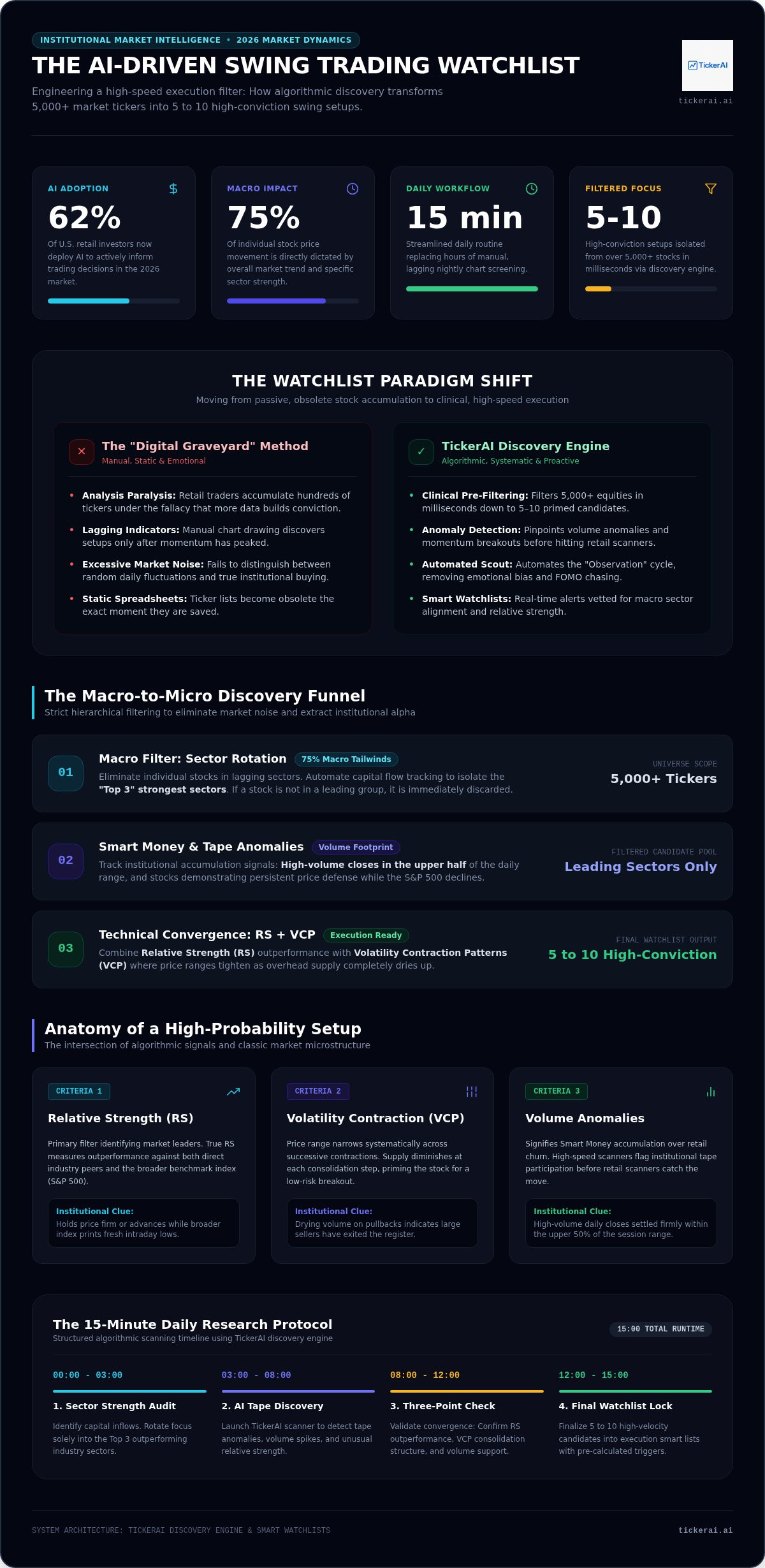
High-probability setups aren't born in isolation. They are the result of multi-factor convergence. When building a watchlist for swing trading, you must look for where technical patterns meet institutional intent. This is the institutional approach. It prioritizes "Smart Money" flow over retail sentiment. You detect this through volume anomalies, such as high-volume closes in the upper half of a daily range, and price action that defies broader market trends. A stock that holds steady while the S&P 500 drops is a prime candidate for your list. It shows that supply is being absorbed by large-scale buyers.
Technical Indicators That Actually Matter
Forget lagging indicators that clutter your screen. Focus on Relative Strength (RS). It's the primary filter for identifying true market leaders. RS doesn't just mean a stock is going up; it means the stock is outperforming its peers and the benchmark index. Pair this with Volatility Contraction Patterns (VCP). These structures show a stock's price range narrowing as supply dries up, which is a prerequisite for a low-risk breakout. The real edge comes from the synergy between algorithmic signals and these traditional chart structures. AI identifies the anomaly in the tape, while the chart pattern confirms the optimal entry point. It's a clinical process that removes guesswork from the equation.
The Macro Filter: Sector Rotation
Sector strength is the ultimate tailwind for individual stocks. A great chart in a dying sector is a trap. Win rates improve significantly when finding thematic investment opportunities that attract institutional capital. Studies often suggest that up to 75% of a stock's price movement is tied to the general market and its specific sector group. Automating the detection of capital flow allows you to rotate into the "Top 3" strongest sectors. If a stock isn't in a leading group, it doesn't belong on your watchlist. This macro-to-micro logic is the secret to building a watchlist for swing trading that delivers consistent alpha.
As algorithms become more prevalent in the 2026 market, understanding the ethical implications of AI in trading is crucial for maintaining transparency. Professional discovery tools prioritize data integrity to ensure these automated filters remain reliable. You can start identifying these high-conviction setups today by exploring TickerAI's curated swing trade setups, which bridge the gap between raw market data and actionable execution.
Step-by-Step: Building Your Automated Discovery Workflow
Manual analysis is a liability in a market where 62% of U.S. retail investors already use AI to inform their decisions. You don't have time to sift through thousands of charts every night. Building a watchlist for swing trading requires a high-speed discovery engine that handles the heavy lifting of scanning. This sequential workflow transforms raw market data into a curated list of high-conviction setups, allowing you to focus on execution rather than data entry.
Step 1: Setting the Quantitative Baseline
Your first task is to define your "Universe of Stocks." This prevents you from falling into penny stock traps or illiquid tickers that suffer from massive slippage. Professional traders use automated stock market analysis to set hard filters. Focus on mid-to-large cap stocks, typically those with a market cap over $2 billion, to ensure institutional participation. Set a minimum average daily volume of at least 1 million shares to guarantee liquidity. It's also vital to remember that while the PDT rule was eliminated in June 2026, the federal minimum equity to maintain a margin account remains $2,000. Your baseline must align with this risk-based intraday margin framework.
Step 2: Activating the AI Signal Layer
Once the baseline is set, deploy AI-driven anomaly detection to identify early momentum. TickerAI identifies breakouts before they appear on traditional lagging screeners by analyzing volume clusters and price deviations. This is where you move from broad observation to clinical selection. Interpreting momentum scores and trend strength indicators allows you to categorize your findings into two distinct groups:
- Observation Tickers: Stocks showing early signs of relative strength or volatility contraction patterns.
- Active Setups: Tickers that have triggered a specific AI momentum alert and are ready for entry.
The final step in this workflow is setting real-time alerts for price and volume triggers. This ensures you're notified the moment a setup becomes actionable. Efficiency is maintained through daily pruning. Spend 15 minutes each evening reviewing your list. If a ticker loses its relative strength or the sector rotation shifts, remove it immediately. A lean watchlist of 5 to 10 stocks is far more profitable than a cluttered list of 50. This structured approach ensures you focus exclusively on setups with the highest probability of success in the 2026 market.
Filtering for Alpha: Noise vs. Actionable Alerts
Filtering is where the amateur trader gets overwhelmed and the professional gets paid. When building a watchlist for swing trading, your goal isn't just to find stocks that might move. It's to validate which stocks will move with institutional backing. You need a clinical 3-point validation check. First, verify trend alignment across multiple timeframes to ensure the primary momentum is in your favor. Second, look for volume confirmation; price moves without volume are just noise. Third, calculate your Risk-to-Reward (R:R) ratio. If the potential profit isn't at least 3x the potential loss, the ticker doesn't make the list. This gatekeeper ensures you only take trades where the math is skewed in your favor.
The Quality Over Quantity Mandate
A cluttered watchlist is a distraction. A focused list of 5 high-conviction setups consistently outperforms a scattered list of 50. Professionals utilize the "Power of 3" by selecting the top performers within the three strongest market sectors. This ensures you're trading where the capital is flowing. In the context of swing trading, Alpha is the excess return generated by exploiting specific technical anomalies that the broader market has yet to price in. By using AI to remove emotion, you can objectively prune candidates that don't meet these rigid standards. You're not looking for a "good" trade. You're looking for the best trade.
Setting Action-Oriented Alerts
Price alerts are insufficient. To stay ahead of the tape, you need volume and volatility triggers that signal a shift in market mechanics. A stock breaking a resistance level on low volume is a high-risk candidate for a false breakout. Multi-timeframe analysis helps identify these traps by confirming that the intraday move aligns with the daily trend. TickerAI Pro alerts are designed to ignore minor fluctuations and only trigger when institutional-grade momentum is detected. This functionality reduces screen time by 80%. It allows you to focus on decision-making rather than monitoring every tick.
A "Ready-to-Trade" system ensures you only engage when the probability is high. This is the final stage of building a watchlist for swing trading that actually scales. If you're ready to automate this filtering process, you can get started with TickerAI Pro alerts today to receive high-conviction setups in real-time. You'll move from chasing the market to letting the best opportunities come to you.
Scaling with TickerAI Smart Watchlists
Scaling your performance requires a transition from manual labor to algorithmic oversight. You can't achieve professional consistency if your process relies on nightly hours of manual charting. Modern building a watchlist for swing trading utilizes AI to handle the "Observation" phase of the trading cycle. This allows you to focus exclusively on decision-making and risk management. With the global AI trading market projected to reach $33.45 billion by 2030, the gap between retail hobbyists and tech-enabled professionals is widening. TickerAI bridges this gap by providing individual traders with the same high-speed discovery engines used by institutional desks.
The elimination of the Pattern Day Trader (PDT) rule in June 2026 has fundamentally changed the landscape. Traders no longer need $25,000 to participate in high-velocity intraday margin frameworks. This regulatory shift makes scaling more accessible, but only if you have the tools to filter the resulting increase in market noise. Automated discovery replaces the fatigue of manual scanning with a streamlined list of high-conviction setups. You aren't just finding stocks; you're deploying a systematic filter that detects momentum before it becomes obvious to the broader market.
TickerAI Full-Access: The Complete Discovery Suite
For traders who require a macro-to-micro view, TickerAI Full-Access offers a comprehensive discovery engine. It provides real-time momentum alerts and automated thematic discovery to identify sector rotation as it happens. You gain direct access to Smart Money flow data, allowing you to align your swing trades with institutional accumulation. This suite is designed for those who want to integrate curated swing trade setups into a professional-grade plan. It transforms raw data into a structured list of actionable opportunities, ensuring you never miss a momentum breakout due to information overload.
Action: Upgrade to TickerAI Full-Access for real-time swing alerts and master thematic discovery.
TickerAI Pro: Precision for Active Traders
TickerAI Pro is built for precision. It offers deeper algorithmic insights and advanced filtering capabilities that allow you to customize your smart watchlist for specific risk profiles. Whether you focus on low-volatility pullbacks or high-velocity breakouts, the Pro tier provides the technical granularity needed for consistent execution. By leveraging these institutional-grade tools, you eliminate the emotional bias inherent in manual research. You move from a reactive state to a proactive scouting position, ensuring your building a watchlist for swing trading remains efficient and profitable.
Action: Explore TickerAI Pro for professional-grade market intelligence and deep algorithmic filtering.
Mastering the 2026 Discovery Workflow
The 2026 market demands a shift from manual data collection to automated opportunity discovery. You've seen how legacy methods fail to keep pace with algorithmic speed. Success now hinges on your ability to deploy systematic filters that prioritize momentum and relative strength. By building a watchlist for swing trading that integrates AI-powered momentum discovery, you replace emotional guesswork with clinical execution. You don't need more screen time; you need smarter alerts.
Leveraging real-time institutional-grade alerts ensures you stay ahead of the tape without the fatigue of nightly scanning. It's about precision and efficiency. TickerAI acts as your proactive scout, filtering thousands of tickers to deliver only the highest-conviction setups. This workflow is designed for 2026 market speed, giving you the edge required to identify breakouts before they hit the mainstream.
Ready to optimize your research? Start Discovering High-Probability Swing Setups with TickerAI. Take control of your workflow and trade with the confidence of an institutional professional.
Frequently Asked Questions
How many stocks should be on a swing trading watchlist?
A professional swing trading watchlist should contain 5 to 10 high-conviction setups. Exceeding this number often results in analysis paralysis and diluted focus. Your goal is to identify the "best of the best" rather than a broad collection of possibilities. By maintaining a lean list, you ensure that every ticker meets strict technical and fundamental criteria. This systematic discipline is essential for building a watchlist for swing trading that remains actionable in fast-moving markets.
What is the best time of day to update a swing trading watchlist?
The optimal time to update your list is during the post-market session or 30 minutes before the market opens. Updating after the close allows you to analyze daily candles and volume anomalies without the distraction of intraday noise. Pre-market updates help you account for overnight news and gap-up potential. A repeatable 15-minute daily research routine is more effective than sporadic, hours-long sessions that lead to mental fatigue and poor decision-making.
Can I use AI to build a watchlist for free?
While basic AI tools exist, professional-grade discovery typically requires a subscription for real-time data and advanced anomaly detection. TickerAI offers Full-Access and Pro tiers that provide curated swing trade setups and smart watchlists. Free tools often lack the speed and institutional-grade depth needed for the 2026 market. Investing in a dedicated discovery engine allows you to replace manual nightly scanning with automated, high-probability alerts, ensuring you don't miss momentum breakouts before they happen.
How do I know if a stock is ready for a swing trade?
A stock is ready for execution when it aligns technical patterns with institutional volume. Look for a volatility contraction pattern (VCP) followed by a high-volume breakout above a key resistance level. TickerAI identifies these setups by detecting price and volume anomalies that suggest "Smart Money" accumulation. If the stock shows relative strength against the benchmark index and belongs to a leading sector, it's a high-probability candidate for an immediate swing position.
What technical indicators are best for swing trading watchlists?
Relative Strength (RS) is the most critical indicator for identifying market leaders. You should also utilize Volatility Contraction Patterns (VCP) to find stocks ready for explosive moves. Volume is the ultimate validator; price action without significant volume is usually noise. Professionals combine these traditional chart patterns with AI-driven momentum scores to confirm trend strength. This multi-factor approach ensures your building a watchlist for swing trading process focuses on tickers with the highest probability of success.
How does TickerAI differ from a traditional stock screener?
Traditional screeners require you to manually input static parameters and sift through hundreds of results. TickerAI functions as an automated discovery engine and a "tireless scout." It proactively scans 5,000+ tickers in real-time to detect technical anomalies and sector rotations that manual filters often miss. Instead of providing a raw list of data, the platform prioritizes and alerts you to specific setups that meet professional-grade criteria, significantly reducing your total research time.
Is it better to have a sector-specific or market-wide watchlist?
Start with a market-wide scan but narrow your focus to the top three strongest sectors. Trading individual stocks within leading groups provides a macro tailwind that increases your win rate. A sector-specific focus is too narrow, but a market-wide list without sector filtering is too noisy. Identifying thematic investment opportunities allows you to rotate capital into areas where institutional flow is heaviest. This balanced approach ensures you're always positioned in high-velocity market segments.
How often should I prune my swing trading watchlist?
You should prune your watchlist daily to maintain peak efficiency. Remove any ticker that fails to trigger an alert within your expected timeframe or loses its relative strength. If a stock's price action breaks below its primary support level, it's no longer a high-conviction candidate. Daily pruning keeps your workflow structured and prevents you from holding onto "stale" ideas. A lean list ensures you're always ready to execute when the right signal appears.


