

What if the constant pinging on your phone was a source of profit rather than a symptom of notification fatigue? Most traders are currently drowning in a sea of generic notifications that trigger emotional FOMO rather than calculated entries. You've likely felt the exhaustion of clearing dozens of low-quality pings only to realize you missed a legitimate breakout because it was buried in the noise. This is the primary failure of modern tools; they lack the logic required to deliver action-oriented stock alerts that actually improve your bottom line. It's a common struggle in a fast-moving environment where data is plentiful but clarity is rare.
We are going to fix your notification workflow. This guide identifies the critical criteria required to transform raw data into high-probability, execution-ready signals. You'll learn how to move past basic price hits and incorporate the specific technical context needed for immediate decision-making. We'll provide a methodical checklist to streamline your scanning process, increase your entry confidence, and ensure that every alert you receive demands an actual trade response. It's time to stop chasing every ticker and start letting the right setups find you with clinical precision.
Key Takeaways
- Distinguish between basic price hits and actionable signals to eliminate the execution paralysis caused by excessive market noise.
- Identify the three pillars of action-oriented stock alerts, focusing on precision, context, and timeliness to ensure every notification is trade-ready.
- Utilize multi-factor models and smart money flow as confirmation layers to filter out low-probability movements before they reach your screen.
- Implement a structured audit of your alert workflow to align your notification settings with your specific swing or long-term strategy.
- Leverage AI-driven anomaly detection and smart watchlists to automate the discovery of high-potential trade setups and reduce manual scanning time.
The Cost of Market Noise: Why Generic Alerts Fail
Market noise isn't just a nuisance. It's a performance killer. When your brokerage sends a ping because a stock moved 2%, it lacks context. Is it a breakout? A dead cat bounce? A liquidity trap? Generic alerts force you to do the heavy lifting. They create a paradox of choice. Too many inputs lead to execution paralysis. You spend your time scanning charts instead of managing risk. By the time you verify the move, the opportunity has often vanished.
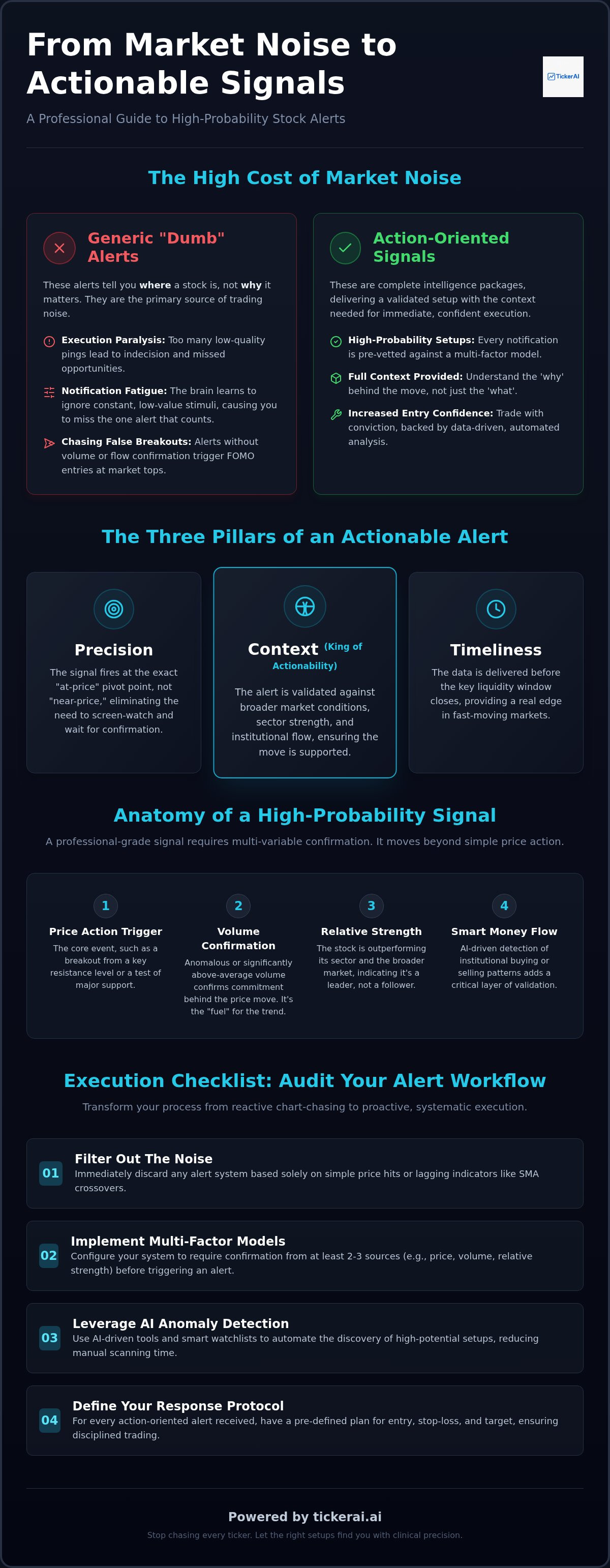
True action-oriented stock alerts differ from standard price notifications. A price alert tells you where a stock is; an actionable signal tells you why it matters and what the setup looks like. Relying on basic Technical analysis indicators like SMA crossovers often results in "lagging noise." These signals trigger after the primary momentum has shifted. By the time you react, the risk-to-reward ratio has collapsed. You aren't trading a strategy; you're chasing a ghost.
The Psychology of Notification Fatigue
Your brain is wired to ignore repetitive, low-value stimuli. This is sensory adaptation. In trading, this leads to missed opportunities. When 90% of your alerts are noise, you stop treating them with urgency. Research suggests high alert frequency correlates with increased trading errors. Signal-to-Noise Ratio in trading is the mathematical relationship between trade-ready data points and irrelevant market chatter. A low ratio means you're working harder for smaller gains. You eventually develop a "cry wolf" reflex, ignoring the one signal that actually mattered.
Financial Impact of Chasing False Breakouts
Generic price spikes often occur at the peak of exhaustion moves. Chasing these leads to "bag holding." You enter at the top because a "dumb" alert fired without volume or institutional flow confirmation. This is why using AI to remove emotion from trading is essential for modern discipline. It filters out the erratic price action that triggers FOMO. Manual verification takes time. If you spend 20 minutes vetting every 5-minute alert, you've already lost the edge. High-speed markets reward those with streamlined workflows, not those with the most notifications. Integrating action-oriented stock alerts ensures you only engage when the data supports a high-probability outcome.
Defining Action-Oriented Stock Alerts
An alert is only as good as the action it enables. Most traders confuse a "price hit" with an alert. A notification that says "AAPL is at $220" is merely a data point. It lacks intent. True action-oriented stock alerts are comprehensive intelligence packages. They provide a specific entry trigger, a projected target, and the contextual validation required to execute a trade without hesitation. This process relies on automated stock market analysis to scale intelligence beyond human capacity. Without these components, you aren't trading; you're reacting to noise.
Three pillars define actionability: Precision, Context, and Timeliness. Precision ensures the signal fires at the exact pivot point. Context ensures the broader market supports the move. Timeliness ensures you receive the data before the liquidity window closes. Context is the King of Actionability. Without it, even the most precise price hit is just a random number in a vacuum. By prioritizing these pillars, you shift from a passive observer to a proactive participant in the market.
The Anatomy of a High-Probability Signal
A professional-grade signal combines price action with volume confirmation. Volume is the fuel. If a stock hits a target on low volume, it's likely a liquidity trap. We also look for relative strength versus sector benchmarks. Is the stock leading its peers or just being dragged along by the index? This quantitative approach mirrors the strategies of James O'Shaughnessy, a pioneer in quantitative stock analysis, who emphasized data over intuition. High-probability signals require multi-variable confirmation to survive the filtering process.
Precision vs. Proximity
Many legacy platforms offer "near-price" alerts. These fire when a stock approaches a level. This creates unnecessary noise. It forces you to watch the screen, waiting for the actual touch. Action-oriented stock alerts favor "at-price" triggers supported by algorithmic filtering to remove "whipsaw" signals. These occur when price briefly touches a level before an immediate reversal. TickerAI Pro excels here by filtering for specific swing trade setups that meet strict volatility and momentum criteria. By narrowing the focus to execution-ready patterns, you eliminate the mental fatigue of monitoring "almost" trades. For those ready to upgrade their workflow, exploring smart watchlists and alerts can provide the necessary edge in a fast-moving market.
Quantitative Filters: The Secret to Professional Noise Reduction
Professional noise reduction requires a shift in logic. Basic SMA and EMA triggers are reactive. They tell you what happened, not what is likely to occur. To generate action-oriented stock alerts, you must employ multi-factor models that process disparate data streams simultaneously. This is the difference between a notification and an execution-ready signal. Learning how to interpret AI stock signals is the first step toward professional-grade discipline. It allows you to see the underlying mechanics of a price move rather than just the surface-level volatility. These models don't just look at price. They analyze the order book. They measure liquidity depth. They assess sector rotation. This creates a "weighted" signal that accounts for market reality.
Institutional Activity as a Filter
Retail-driven moves often lack the "fuel" for sustained trends. They are easily reversed by institutional rebalancing. To filter this noise, we monitor "Smart Money" flow. This includes tracking unusual option activity and dark pool prints. These data points reveal where the largest market participants are positioning themselves. If an alert fires without institutional confirmation, it's likely a low-probability event. By integrating institutional data into your smart watchlist, you ensure that every signal is backed by significant capital. This isn't just data. It's confirmation. Stop following the crowd. Start following the capital. High-conviction trades require high-conviction partners in the order flow.
Algorithmic Anomaly Detection
Breakouts aren't random. They have signatures. Algorithmic anomaly detection identifies volume signatures and volatility clusters that precede high-momentum moves. It effectively filters out "fake-outs" by requiring multi-timeframe correlation. If the intraday price action contradicts the primary trend, the system suppresses the alert. AI functions as a tireless intelligence partner, detecting subtle market anomalies that are invisible to the naked eye. This level of precision is necessary in the 2026 market. It ensures your action-oriented stock alerts focus only on high-probability setups. No fluff. No distractions. Just data-backed opportunities. This automated approach removes the hesitation that often plagues manual traders during rapid price shifts.
Execution Checklist: Auditing Your Alert Workflow
A high-speed intelligence partner is useless if your workflow is cluttered with legacy settings. To maximize the utility of action-oriented stock alerts, you must perform a systematic audit of your current notification environment. This isn't a passive review. It's a clinical purge of low-value data. Follow this five-step checklist to recalibrate your system for professional-grade execution.
- Step 1: Audit your "Noise-to-Trade" ratio. Calculate the number of notifications received versus the number of trades executed over the last 30 days. If your ratio is below 10%, your filters are too wide.
- Step 2: Define your core strategy. A swing trade setup requires different volatility parameters than a long-term investment. Ensure your triggers match your holding period.
- Step 3: Eliminate redundant technical triggers. Don't stack RSI, MACD, and Stochastic alerts on the same ticker. They often signal the same momentum shift. Choose the most reliable indicator for that specific asset class.
- Step 4: Implement a "Context-First" rule. Every notification must be accompanied by sector performance or volume confirmation. Never trade a price hit in a vacuum.
- Step 5: Review historical performance. Stale data is a liability. If a service consistently delivers alerts after the primary move has occurred, terminate the subscription immediately.
Measuring Signal Quality
Precision is measured by drawdown. Track how far an asset moves against your entry point before hitting its target. If your alerts frequently trigger deep drawdowns, your entry logic is flawed. Identifying which triggers lead to the highest win rates allows you to allocate more capital to those specific setups. Professional traders prioritize data integrity. Late alerts or "stale" prints from low-tier providers aren't just annoying; they're expensive. You need real-time discovery to maintain an edge.
Optimizing Your Smart Watchlist
Static watchlists are a relic of the past. Modern systems group stocks by thematic catalysts, such as AI, Energy, or Cybersecurity. This allows for sector-wide monitoring. You should also shift from "Alert-on-Price" to "Alert-on-Trend." A price hit is a moment; a trend is a move. Streamline your delivery to a single high-priority channel, like a dedicated terminal or encrypted mobile app. This reduces the cognitive load of checking multiple platforms. To centralize your strategy, upgrade your workflow with TickerAI Full-Access and automate your discovery process. By centralizing your action-oriented stock alerts, you ensure that every buzz in your pocket represents a legitimate, high-probability opportunity.
TickerAI: Precision Engineering for the Active Investor
TickerAI isn't just a notification service; it's a sophisticated filter for a chaotic market. While competitors focus on delivery speed, we prioritize signal quality. Speed without intelligence leads to faster mistakes. TickerAI Full-Access automates the discovery of swing trade setups by scanning thousands of tickers against proprietary technical and quantitative models. This isn't a simple price tracker. It's a proactive scout that identifies anomalies before they become mainstream news. Our system operates with clinical precision, ensuring the platform remains a tool for professionals rather than casual hobbyists.
The logic behind our smart watchlists is rooted in innovative pragmatism. We value technology for the specific, tangible advantages it provides in time-saving and clarity. By deploying action-oriented stock alerts, TickerAI removes the burden of manual oversight. You stop staring at charts and start focusing on execution. Our real-time alerts prioritize Action-Ready opportunities, ensuring that every ping on your device has been vetted for volume, momentum, and institutional flow. Transitioning to AI-powered market intelligence isn't a luxury; it's a necessity for the professional participant. It maintains a balance between being technologically advanced and practically accessible, projecting the image of a reliable, high-speed intelligence partner.
Full-Access vs. Pro: Choosing Your Signal Depth
The TickerAI Pro subscription caters to those with high-frequency discovery needs. It delivers rapid signals for active participants who thrive on intraday volatility and require constant data updates. Conversely, TickerAI Full-Access provides curated long-term investment ideas alongside swing setups. This creates a balanced portfolio approach for those who want both growth and stability. Automated market scanning is the future of retail trading. It allows you to compete with institutional algorithms without needing expensive infrastructure. You get the intelligence of a hedge fund with the accessibility of a modern, tech-forward app.
Getting Started with TickerAI
Configuring your first AI-driven smart watchlist is a streamlined process designed for efficiency. You select your thematic catalysts, like AI or Energy, and let the system detect the strongest candidates based on real-time data flow. Setting up real-time alerts ensures you never miss high-conviction opportunities that fit your specific risk profile. The platform acts as a tireless, high-tech assistant that is always on. It detects, filters, and prioritizes data while you focus on the final decision-making process. The transition from identifying a problem to presenting the solution is seamless and persistent. Join TickerAI to start receiving action-oriented stock alerts today.
Transitioning to Execution-Ready Intelligence
The shift from reactive monitoring to proactive execution is a requirement for the modern investor. You've identified the high cost of market noise and the psychological drain of notification fatigue. By implementing a systematic audit of your workflow and prioritizing multi-factor quantitative filters, you reclaim your most valuable asset: time. True market edge isn't found in the quantity of data but in the precision of the filter.
Implementing action-oriented stock alerts ensures you engage only when the probability of success is highest. This transition requires moving beyond basic price hits and embracing the institutional-grade logic that separates signals from static. It's time to replace manual scanning with clinical precision. Upgrade your market intelligence with TickerAI Action-Oriented Alerts and leverage AI-powered anomaly detection, curated swing trade setups, and professional-grade smart watchlists.
The market moves fast. Make sure your intelligence moves faster. Your next high-conviction setup is already forming in the data.
Frequently Asked Questions
What makes a stock alert action-oriented versus just informative?
Action-oriented alerts include specific execution data like entry price, target levels, and stop-loss parameters. Informative alerts simply state a current price or percentage change. Actionable signals provide the context required to execute immediately without manual chart verification. They prioritize high-probability setups over generic market data. This ensures you spend less time scanning and more time managing risk in a fast-moving environment.
How many stock alerts are too many for a swing trader?
Receiving more than 10 to 15 alerts per day often leads to execution paralysis and notification fatigue. For a focused swing trader, quality beats quantity every time. If your "Noise-to-Trade" ratio is low, you're likely overwhelmed by low-conviction signals. A streamlined workflow should only trigger for setups that meet your specific risk-reward criteria. Excessive pings dilute your focus and increase the likelihood of trading errors.
Can AI alerts replace manual technical analysis?
AI alerts automate the discovery phase but don't replace the need for final human discretion. Automated scanning identifies high-potential movements and filters out 90% of market noise. This allows you to focus on high-conviction decision-making rather than repetitive chart work. While the AI handles multi-factor models and institutional flow detection, you remain the pilot who executes based on the provided intelligence and your own risk tolerance.
What technical indicators are best for reducing market noise?
Multi-factor models that combine price action with volume confirmation and institutional flow are superior to single-lagging indicators. Relying on basic SMA or RSI triggers often results in false breakouts and whipsaws. Effective noise reduction utilizes anomaly detection to spot institutional accumulation. Integrating dark pool prints and unusual option activity into your action-oriented stock alerts provides a confirmation layer that retail-only indicators lack.
How do I set up a smart watchlist that only triggers on high-conviction moves?
Configure your watchlist to filter by thematic catalysts and institutional volume signatures rather than broad price changes. Set alerts for specific technical setups like bull flags or relative strength breakouts versus sector benchmarks. A smart watchlist should be dynamic, grouping stocks by high-conviction themes such as AI or energy. This ensures you only receive notifications when an asset aligns with a proven strategy and institutional interest.
Is it better to get alerts via SMS, email, or push notifications?
Push notifications or dedicated terminal channels are generally preferred for their real-time delivery and lower latency. SMS can be delayed by carrier congestion, and emails are easily buried in a cluttered inbox. The goal is to receive intelligence through a single, high-priority channel that minimizes distractions. This ensures you can act on action-oriented stock alerts before the liquidity window closes or the risk-to-reward ratio shifts.
How does TickerAI filter out false signals during high volatility?
TickerAI utilizes AI-driven anomaly detection to distinguish between erratic price action and legitimate institutional positioning. The system analyzes order book depth and liquidity clusters to verify the strength of a move. During high volatility, the algorithm requires multi-timeframe correlation before firing a signal. This clinical approach filters out the noise that typically triggers emotional FOMO trading, ensuring only high-probability setups reach your device.
What is the difference between a price alert and a catalyst-based alert?
A price alert triggers when a stock hits a specific numerical value, often lacking technical context. A catalyst-based alert identifies the reason behind the move, such as an earnings surprise, dark pool print, or sector rotation. Catalyst alerts are inherently more actionable because they reveal the underlying fuel for a trend. They provide the fundamental and technical validation needed to justify capital allocation in a fast-moving, high-stakes market.


