

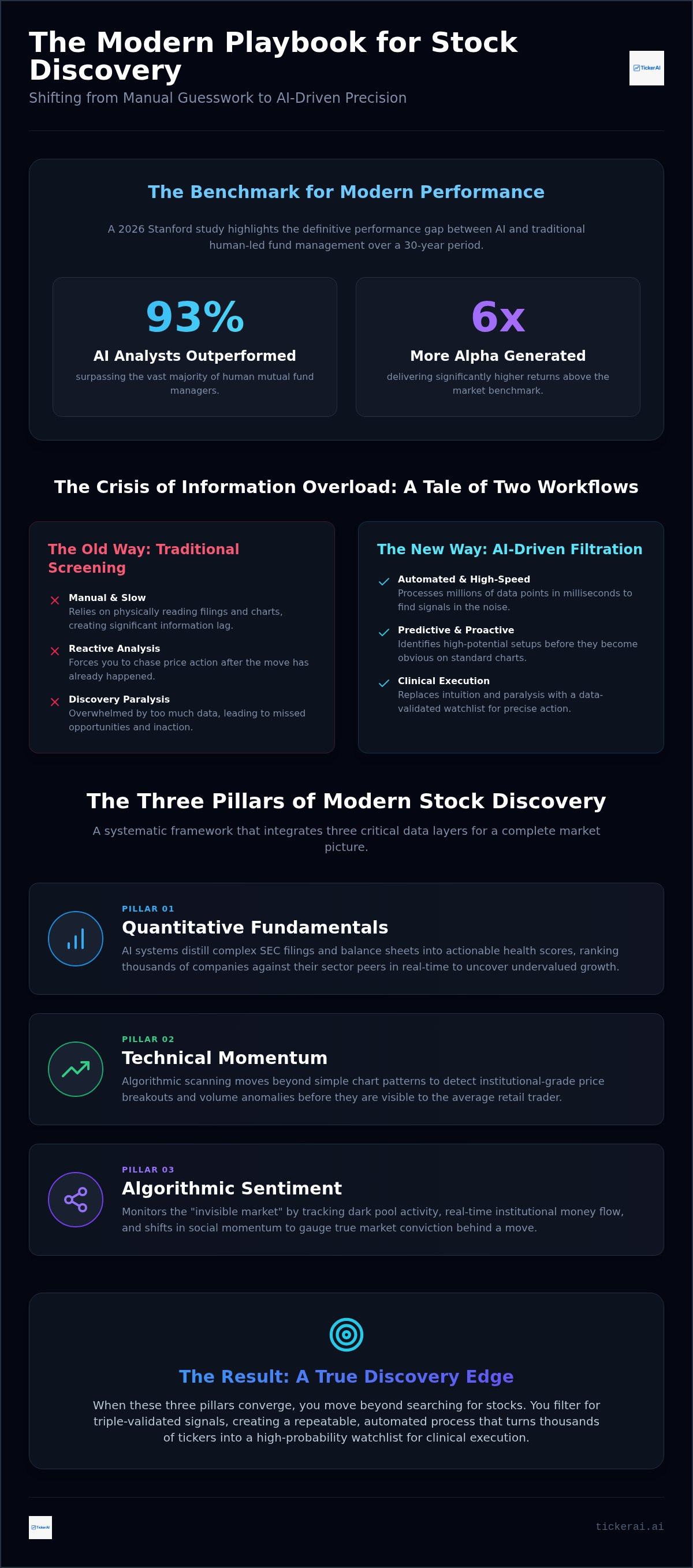
A 2026 Stanford study concluded that AI analysts outperformed 93% of mutual fund managers over a 30-year period, generating six times more alpha. This isn't a distant possibility; it's the current benchmark for professional performance. You likely feel the weight of information overload from constant news cycles and thousands of active tickers. Manual research is no longer just slow. It's a strategic liability that results in missed moves and analysis paralysis.
If you want to learn how to find promising US stocks in this environment, you must shift from manual scanning to algorithmic filtration. This guide provides a systematic, AI-driven framework to replace intuition with high-speed intelligence. We'll show you how to build a repeatable research workflow that detects institutional money flow in real-time. You'll gain clarity on precise entry points for swing trades and master a discovery process that identifies high-potential market movements before they've peaked. It's time to stop chasing tickers and start executing with clinical precision.
Key Takeaways
- Transition from manual screening to high-speed AI filtration to overcome the data density of the 2026 market.
- Identify technical breakouts and fundamental anomalies before they appear on standard charts using advanced anomaly detection.
- Master a repeatable, automated workflow for how to find promising US stocks by tracking real-time institutional money flow.
- Replace active, time-consuming scanning with passive algorithmic alerts to eliminate discovery paralysis.
- Leverage professional-grade intelligence to narrow thousands of tickers into a high-probability watchlist for clinical execution.
The Information Overload Crisis: Why Traditional Screening Fails in 2026
The US market in 2026 operates at a velocity that renders traditional screening methods obsolete. Every second, millions of data points—spanning order flow, alternative sentiment, and macro indicators—hit the exchange. If you're wondering how to find promising US stocks using static filters like P/E ratios or simple volume spikes, you're competing against institutional machines that process this data in milliseconds. Manual scanning isn't just inefficient; it's a structural disadvantage that leaves you reacting to old news.
This environment creates "Discovery Paralysis." This is the technical gap between observing a price movement and possessing the validated data required to act on it. By the time a retail trader manually verifies a catalyst, the move is often exhausted. Traditional screeners produce lagging results that force you to chase price action rather than anticipating it. Success in 2026 requires a shift in focus. The primary investor skill is no longer identifying "what to buy," but mastering "how to filter" through the noise to find high-probability setups with clinical speed.
The Limits of Manual Fundamental Analysis
Reading every SEC filing is a physical impossibility for the modern investor. The sheer volume of 10-Ks, 8-Ks, and real-time regulatory disclosures exceeds human cognitive capacity. Relying on manual research also invites confirmation bias, where traders subconsciously prioritize data that supports their initial thesis while ignoring contradictory signals. Information lag in 2026 is the quantifiable time decay between a market-moving data point’s release and its eventual integration into a trader’s manual execution strategy.
Why Technical Patterns Require Algorithmic Validation
Manual charting frequently identifies the "what" but misses the "why." A classic breakout pattern might look textbook on a 15-minute chart, yet lack the institutional sponsorship needed to hold. Modern institutional algorithms are specifically programmed to exploit these retail patterns, creating "bull traps" that hunt for liquidity at predictable stop-loss levels. To navigate this, you must integrate automated stock market analysis to verify if a move has the volume profile and momentum depth to sustain a trend. Without algorithmic validation, a chart pattern is just a drawing in a high-frequency battlefield. Mastering how to find promising US stocks is now a matter of combining technical intuition with high-speed, automated data verification to ensure every trade has a statistical edge.
The Three Pillars of Modern Stock Discovery
Traditional market analysis often forces a binary choice between fundamental and technical data. In the high-velocity 2026 market, this separation is a structural liability. To master how to find promising US stocks, you must integrate a three-pillar framework that merges quantitative fundamentals, technical momentum, and algorithmic sentiment. This triad creates a "Discovery Edge" by ensuring every trade setup is backed by financial health, price confirmation, and institutional sponsorship.
- Pillar 1: Quantitative Fundamentals. AI distills complex balance sheets into actionable scores, ranking companies against sector peers in real-time.
- Pillar 2: Technical Momentum. Algorithmic scanning detects price breakouts and volume anomalies before they are visible on standard 15-minute charts.
- Pillar 3: Algorithmic Sentiment. This tracks the "invisible" market: dark pool activity, institutional flow, and social momentum shifts.
When these three pillars converge, discovery paralysis disappears. You no longer search for stocks; you filter for signals that meet specific, triple-validated criteria. This systematic approach ensures that how to find promising US stocks becomes a repeatable, automated process rather than a game of chance.
Quantitative Fundamentals at Scale
Manual metric extraction is a relic of the past. Modern systems automate the analysis of quarterly reports, comparing a stock’s fundamental health against thousands of peers in milliseconds. This process identifies undervalued growth opportunities that manual screeners miss due to data lag. Understanding what is quantitative investing is essential for anyone moving from intuition-based picks to a data-driven discovery model.
Algorithmic Signal Analysis
In 2026, the signal-to-noise ratio is the most critical metric for any serious trader. Algorithmic signals identify "hidden" institutional accumulation by spotting volume anomalies that precede major price movements. This level of detection provides the conviction required for high-stakes swing trades. Learning how to interpret AI stock signals allows you to verify chart validity and avoid the bull traps set by high-frequency institutional bots. Serious participants use AI stock opportunity discovery to maintain this clarity and execute with precision.
Algorithmic Alpha: How AI Detects Promising Stocks Before the Crowd
Speed is the primary differentiator in 2026. Traditional research relies on public news, which is often priced in by the time it reaches your screen. To gain a true edge, you must move upstream. AI-driven anomaly detection identifies subtle price and volume deviations that precede major press releases or earnings beats. These deviations represent the market's "pre-reaction" to non-public institutional positioning. This is how to find promising US stocks before the retail crowd creates a crowded trade.
Capital in the US market is never static. It flows. AI automates sector rotation tracking by monitoring the migration of liquidity from laggards to emerging leaders. By integrating catalyst mapping, these systems link upcoming events to historical price reactions. This allows you to quantify the probability of a breakout based on past performance data. Smart watchlists then organize these thematic opportunities, ensuring you focus only on tickers with high-velocity potential.
Spotting Institutional Footprints
Large players don't trade on public exchanges when they want to build significant positions. They use dark pools and block trades to minimize price impact. AI tracks these "hidden" footprints, providing a window into institutional sentiment that manual charting misses. Retail hype is a trailing indicator. Institutional accumulation is a leading one. Smart Money Flow is the quantifiable migration of capital through high-conviction, large-block transactions that occur within institutional liquidity pools or outside public order books. Detecting these flows allows you to align your trades with the market's most powerful participants.
Thematic Discovery vs. Hot Stock Chasing
Chasing "hot tips" from social media is a high-risk strategy that often ends in liquidity exits for early entrants. Professional discovery requires a broader lens. Using finding thematic investment opportunities with AI allows you to identify sector-wide shifts before they become mainstream headlines. Promising stocks are frequently found in unloved or overlooked sectors just before a capital rotation occurs. Smart watchlists are essential here. They act as a persistent filter, tracking long-term investment ideas and alerting you only when the technical and fundamental pillars align for entry. This systematic approach ensures how to find promising US stocks remains a data-driven exercise rather than a pursuit of social media trends.
Building Your Systematic Discovery Workflow
Discovery is a filtration problem, not a search problem. Attempting to solve how to find promising US stocks by manually scanning 6,000 tickers is a recipe for exhaustion. A systematic workflow replaces the "hunt" with an automated funnel. This process moves capital from observation to execution with clinical speed. Follow this five-step sequence to build a professional-grade research engine.
- Step 1: Define Your Universe. Use AI filters to narrow 6,000 tickers down to 50 high-probability candidates based on liquidity and volatility.
- Step 2: Set Algorithmic Alerts. Transition from active searching to passive monitoring to capture moves as they happen.
- Step 3: Validate with Multi-Pillar Analysis. Cross-reference the fundamental, technical, and sentiment pillars to ensure triple-validation.
- Step 4: Execute with Discipline. Remove the "gut feeling" from the entry process by following pre-defined signal parameters.
- Step 5: Review and Refine. Use a systematic journal to track AI signal accuracy and calibrate your filters for the current market regime.
Moving from Search to Monitoring
Active scanning is a low-leverage activity. In 2026, serious participants set real-time market alerts for momentum breakouts and institutional anomalies. This shift allows you to reduce screen time while increasing opportunity capture. Integrating using AI to remove emotion from trading into your daily routine ensures that you only interact with the market when a high-conviction signal triggers. Monitoring is about readiness; searching is about noise.
The Discovery-to-Action Pipeline
Not all data is actionable. You must distinguish between "General Market News" and "Action-Oriented Alerts." Actionable alerts are prioritized based on historical win probabilities and specific technical setups. Before committing capital, use this verification checklist for any "promising" stock:
- Institutional flow confirmation (Dark pool or block trade activity).
- Momentum breakout validation on multiple timeframes.
- Fundamental health score above the sector median.
- Sentiment divergence check (Retail exhaustion vs. institutional accumulation).
This pipeline ensures that every trade is a calculated move rather than a reactive chase. You can build your automated workflow today with TickerAI Smart Watchlist & Alerts to maintain this systematic edge.
TickerAI: The Professional Engine for US Stock Discovery
TickerAI serves as the high-speed intelligence partner for serious market participants. While previous sections outlined the logic of algorithmic discovery, TickerAI provides the execution engine. It replaces the manual burden of scanning with a tireless, automated scout that operates across thousands of tickers. This is the definitive solution for how to find promising US stocks without succumbing to data fatigue. The platform functions as a sophisticated filter for a chaotic environment, prioritizing clarity and speed.
The platform offers two distinct tiers tailored to professional needs. TickerAI Pro provides essential discovery tools, including smart watchlists and real-time alerts for momentum breakouts. For active swing traders, TickerAI Full-Access automates the entire discovery workflow. It integrates real-time anomaly detection and institutional flow tracking, ensuring you catch market shifts as they occur. Full-Access users receive curated swing trade setups and long-term investment ideas, moving them directly from observation to action with clinical precision.
Actionable Intelligence, Not Just Alerts
Raw data dumps often contribute to the very discovery paralysis we aim to solve. TickerAI prioritizes curated setups over unfiltered data streams. Every alert is a high-conviction signal validated by our multi-pillar framework. Smart watchlists allow you to organize your market perspective by theme, sector, or volatility profile. If you are currently evaluating an AI stock picking service, consider the depth of curation as your primary benchmark. A professional engine should filter out noise, not create more of it.
Securing Your Edge in the 2026 Market
The cost of manual research in 2026 is measured in missed opportunities and delayed entries. AI-driven discovery is a requirement for those seeking to compete with institutional algorithms. Systematic discipline is the final barrier to success. By automating the discovery-to-action pipeline, you remove the emotional friction that often derails manual trading strategies. This is how to find promising US stocks with repeatable accuracy and strategic speed.
The 2026 market rewards those who prioritize high-speed intelligence. Stop chasing price action and start anticipating it with a tool designed for professionals. Join TickerAI to discover your next opportunity and secure your strategic advantage today.
Master the 2026 Market with Algorithmic Precision
The transition from manual screening to automated filtration is no longer optional for the serious participant. Success in 2026 depends on your ability to process market signals faster than the competition. By integrating the three pillars of discovery—quantitative fundamentals, technical momentum, and algorithmic sentiment—you eliminate the cognitive load of discovery paralysis. Mastering how to find promising US stocks is a matter of building a repeatable, data-driven workflow that prioritizes high-speed intelligence over intuition.
TickerAI provides the professional engine required to execute this strategy. It replaces manual delays with a high-tech scout that never sleeps. You can leverage automated market scanning across 6,000+ tickers to ensure no opportunity goes undetected. With real-time momentum breakout detection and AI-powered short-term swing stock alerts, you maintain a persistent edge in a high-velocity environment. It's time to stop reacting to the market and start anticipating it.
Discover high-potential US stocks with TickerAI Full-Access
The tools for superior discovery are at your fingertips. Execute with clinical precision and let technology handle the noise.
Frequently Asked Questions
How does AI find promising stocks better than a traditional screener?
AI analyzes non-linear data and anomalies in real-time; traditional screeners rely on static, lagging data points like P/E ratios. AI detects institutional footprints in dark pools and volume deviations before they hit retail charts. It filters 6,000+ tickers in milliseconds to identify specific momentum breakouts. This high-speed intelligence is the modern standard for how to find promising US stocks. It allows you to move from observation to action before price discovery is complete.
Is AI-driven stock discovery suitable for long-term investors or just swing traders?
It serves both strategies by filtering for different time-horizon signals. While swing traders use it for real-time momentum breakouts, long-term investors use it to identify emerging thematic trends and fundamental anomalies. TickerAI provides both curated swing trade setups and long-term investment ideas. The systematic discovery process identifies quality assets that institutional money is accumulating. This is a critical factor for long-term portfolio strength and capital preservation in 2026.
What are the most important signals to look for when finding US stocks?
Focus on the convergence of three pillars: quantitative fundamentals, technical momentum, and institutional flow. Signals like volume anomalies often precede major news; dark pool activity indicates where large-scale capital is positioning. When learning how to find promising US stocks, prioritize signal-to-noise ratios over raw price action. AI validates these signals by comparing them against historical data to ensure the move has institutional sponsorship and a high probability of follow-through.
How much time does a systematic discovery workflow take daily?
A systematic workflow reduces active research time to approximately 15 to 30 minutes per day. By shifting from manual searching to passive monitoring via algorithmic alerts, you eliminate the need for constant screen time. TickerAI automates the heavy lifting of scanning thousands of tickers. You simply review curated watchlists and high-conviction alerts that meet your specific criteria. This allow for clinical execution without the exhaustion or delays of manual research.
Can AI predict stock market crashes or just individual stock movements?
AI focuses on detecting systemic anomalies and liquidity shifts rather than making crystal-ball predictions. It identifies broad sector rotations and capital outflows that often precede wider market volatility. While individual stock movements are more common, tracking institutional money flow at the index level provides a macro perspective on market health. It acts as a proactive scout. It alerts you to risk-off signals before they become mainstream headlines or social media trends.
What is the difference between an alert service and an AI discovery platform?
Alert services typically push raw data or basic technical triggers, often leading to information overload. An AI discovery platform like TickerAI acts as a sophisticated filter that prioritizes actionable intelligence. It provides curated setups validated by multi-pillar analysis rather than just data dumps. The platform integrates smart watchlists and real-time anomaly detection. This guides you through a complete discovery-to-action pipeline with professional authority and clinical data-driven precision.
How do I avoid FOMO when using AI-powered stock alerts?
Use systematic discipline to remove emotion from the entry process. AI alerts provide data-driven conviction; this replaces the "gut feeling" that leads to chasing price action. By setting strict parameters for your trade setups, you only execute when the AI validates the fundamental and technical pillars. This clinical approach ensures you treat every alert as a calculated opportunity. You avoid chasing crowded trades and focus on setups with high historical win probabilities.
Do I need technical knowledge to use TickerAI for stock discovery?
You don't need to be a data scientist, but a baseline level of industry knowledge is beneficial. TickerAI is designed to be practically accessible while maintaining professional-grade depth. The platform handles the complex algorithmic processing and presents the results through intuitive smart watchlists and clear alerts. It functions as a high-tech assistant that filters the noise. This allows you to focus on decision-making and execution rather than manual data processing.


