

In 2026, the classic price-to-earnings ratio is no longer a reliable compass for value. It's a lagging indicator in a market moving at machine speed. You've likely felt the weight of analysis paralysis while staring at endless data feeds. Manual research is simply too slow for finding undervalued stocks with AI to be anything other than a professional requirement. It's frustrating to enter a position only to realize you've stepped into a value trap because your manual screening couldn't keep pace.
This guide shows you how to leverage advanced algorithms to detect real-time divergence between fundamental value and market sentiment. We'll outline a repeatable, automated discovery workflow that delivers high-conviction alerts for mispriced assets. You'll gain the data-driven confidence needed for precise entry points. With 88% of organizations now utilizing AI functions, the window for manual discovery has closed. This framework allows you to identify high-potential stocks before the broader market reacts and capture opportunities that others miss.
Key Takeaways
- Transition from manual research to machine-speed execution to capture market mispricing before high-frequency algorithms close the gap.
- Deploy multi-agent pipelines to process structured financial statements and unstructured sentiment data for a more accurate calculation of intrinsic value.
- Establish a repeatable workflow for finding undervalued stocks with AI by configuring automated alerts for historical P/E deviations and volume anomalies.
- Define a precise investment universe based on liquidity and sector constraints to ensure every alert meets high-conviction criteria.
- Scale your market intelligence with an "always-on" digital scout that filters global noise into actionable swing trade and long-term setups.
The Crisis of Manual Research: Why Traditional Value Investing is Lagging
Traditional value investing relies on a luxury that no longer exists: time. In the 2026 market environment, high-frequency algorithms identify and close value gaps in milliseconds. By the time a human analyst identifies a low P/E ratio, the institutional smart money has likely already priced in the anomaly. Manual research is no longer a viable strategy; it's a liability. Finding undervalued stocks with AI is the only way to process the sheer volume of modern financial data without falling behind the curve.
The sheer scale of information is staggering. Every year, thousands of SEC filings, quarterly reports, and earnings call transcripts are released. Attempting to parse these manually leads to information overload and missed entries. The professional investor needs a system that filters this noise with clinical precision. Without automation, you're essentially trying to win a high-speed race on foot. Data is noise. Analysis is the edge.
There's also the persistent danger of the value trap. Many traditional screeners flag stocks based on low multiples, but in a fast-moving economy, these often signal terminal decline rather than opportunity. AI distinguishes between a temporary market overreaction and a fundamental shift in business viability. It identifies the divergence between price and intrinsic value before the broader market reacts.
The Speed Gap in Retail Investing
Institutional players aren't just faster; they're more proactive. They use sophisticated models to front-run fundamental news before it hits mainstream feeds. If you're relying on static, end-of-day data for discovery, you're essentially trading in the past. Professionals are closing this latency gap by implementing automated stock market analysis to scale their intelligence. This shift from reactive screening to proactive discovery is the new baseline for performance. Speed is not just a benefit, it's a requirement for survival.
Identifying the Noise Floor
Market sentiment often creates artificial undervaluation. A single negative headline can trigger a retail sell-off, creating a temporary price drop that looks like a bargain. However, manual filtering often falls prey to emotional bias. You might see a deal where an AI sees a structural weakness. Finding undervalued stocks with AI allows you to ignore the noise floor. It prioritizes data over narrative. This removes the gut feeling that leads to missed setups and replaces it with calculated, data-driven entry points. An algorithmic scout stays on while you focus on execution.
Mechanics of Alpha: How AI Detects Market Mispricing
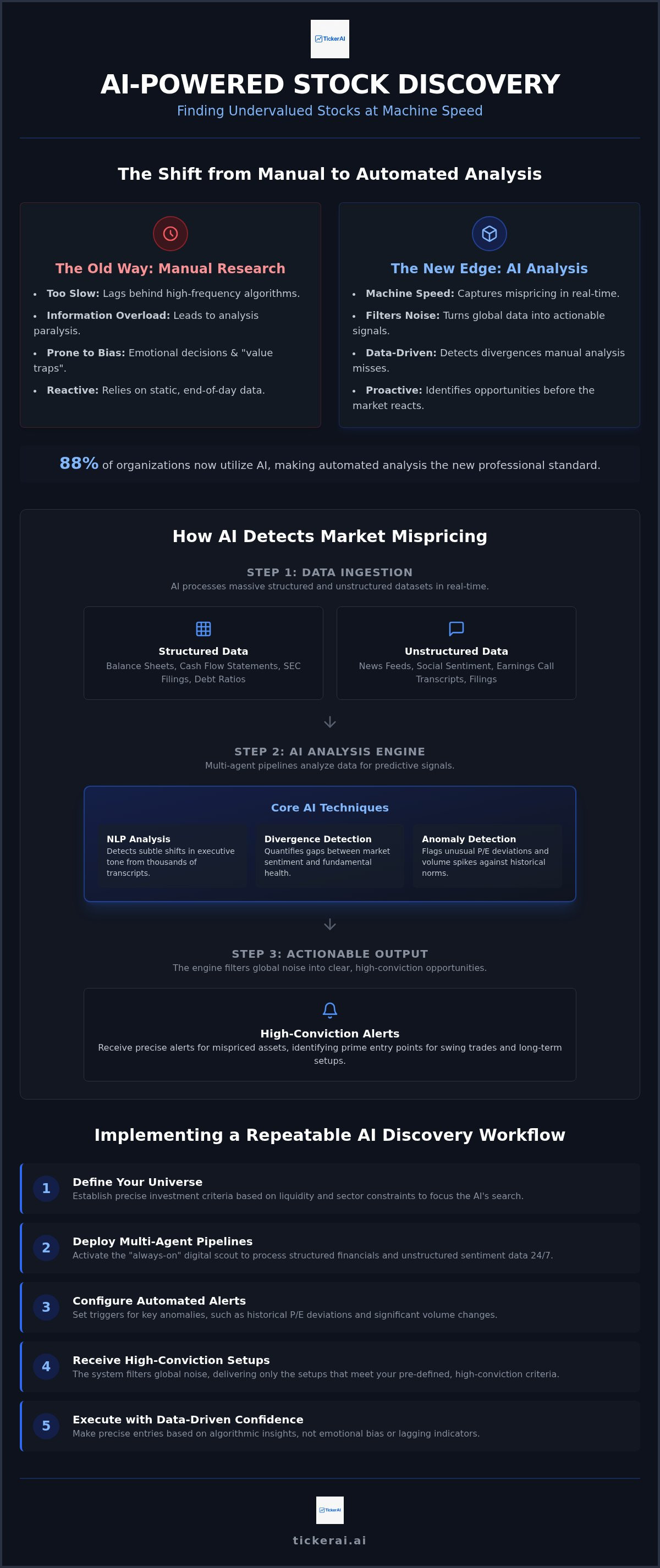
Finding undervalued stocks with AI is a process of systematic anomaly detection. It utilizes machine learning to identify assets trading significantly below their calculated intrinsic value. Unlike traditional screeners that rely on static, lagging ratios, AI models ingest massive datasets in real-time. This includes structured financial statements, quarterly filings, and unstructured alternative data. The goal is to isolate high-conviction opportunities where the market has temporarily mispriced a company's future cash flows. Data is the raw material. Intelligence is the output.
The discovery engine processes information across two primary channels:
- Structured Data: Automated analysis of balance sheets, cash flow statements, and debt-to-equity ratios across 5,500+ global equities.
- Unstructured Data: Real-time ingestion of news feeds, social sentiment, and regulatory filings to gauge market psychology.
Natural Language Processing (NLP) in Fundamental Analysis
Executive tone often precedes fiscal reality. Professional AI models use NLP to scan thousands of earnings call transcripts, detecting subtle shifts in language that manual analysis might miss. For example, a decrease in confident descriptors during a Q&A session can signal internal headwinds before they manifest in a 10-Q filing. NLP converts the nuances of executive communication into discrete quantitative signals for predictive modeling. This automation allows for the rapid extraction of key data points from complex SEC filings, ensuring no detail is overlooked due to human fatigue.
Divergence Detection: Sentiment vs. Reality
Market fear frequently creates "oversold" conditions that don't align with a company's underlying health. AI quantifies this fear by analyzing social and news sentiment. When sentiment reaches an extreme low while fundamental metrics remain stable, a divergence occurs. This is often the prime entry point for a value play. Implementing quantitative investing strategies removes the guesswork from these entries. It replaces emotional hesitation with algorithmic certainty. You can monitor these divergences through a TickerAI Smart Watchlist to ensure you're alerted the moment the gap widens.
Pattern recognition is the final layer of confirmation. The AI identifies historical precedents for successful mean reversion, comparing current price action to past cycles. By tracking price-volume behavior, the system detects institutional accumulation. When large players begin building positions in a "cheap" stock, the AI flags the activity. This confirms that the undervaluation is being recognized by the smart money. Finding undervalued stocks with AI provides a clinical filter for this accumulation, allowing you to enter positions with institutional-grade conviction.
Multi-Agent Pipelines: The Technology Behind Modern Discovery
Finding undervalued stocks with AI requires more than a single, isolated algorithm. Modern discovery engines utilize a multi-agent architecture where specialized AI models collaborate to validate a specific investment thesis. This hierarchy ensures that a signal isn't just a statistical fluke but a robust, multi-dimensional opportunity. By delegating specific analytical tasks to different agents, the system maintains clinical precision across thousands of tickers simultaneously. Data is processed through a logical chain of command before it ever reaches your watchlist.
The architecture typically follows a three-tier logic:
- The Scout Agent: This is the "always-on" scanner. It continuously monitors the global equity universe for price-to-intrinsic-value anomalies. It doesn't sleep. It doesn't get tired.
- The Analyst Agent: Once a ticker is flagged, the Analyst performs a deep-dive fundamental cross-reference. It compares current margins, cash flow growth, and debt structures against a dynamic peer group.
- The Risk Agent: This agent calculates the mathematical downside. It evaluates historical volatility regimes and liquidity constraints to ensure the asset can be exited without significant slippage.
Peer Grouping and Relative Valuation
Static industry codes like SIC or GICS are increasingly outdated. Modern tech-heavy firms often operate across multiple sectors, making traditional peer comparison inaccurate. AI-driven thematic grouping uses clustering algorithms to identify business model overlap based on actual revenue segments and product descriptions. This methodology is essential for finding thematic investment opportunities that traditional screens miss. It provides a clearer picture of relative valuation by comparing a company to its actual competitors, not just its administrative category. Logic dictates that you compare a business to its true rivals.
Signal Convergence: When Fundamentals Meet Technicals
The most powerful entries occur at the intersection of value and momentum. This is the "Golden Cross" of professional discovery: a company with strong fundamentals meeting a confirmed technical breakout. AI is particularly effective at filtering out "ghost" signals in small-cap stocks where low liquidity often generates false volatility. Cross-agent signal confirmation acts as a rigorous filter that reduces false positives by requiring multiple data points to align before an alert is triggered. This systematic approach ensures that finding undervalued stocks with AI leads to high-conviction trades rather than speculative gambles. Precision is the ultimate goal.
Step-by-Step: Implementing an AI Stock Discovery Workflow
Establishing a repeatable workflow is the difference between a retail hobbyist and a professional participant. Finding undervalued stocks with AI starts with rigorous constraint setting. You must first define your investment universe. Filter by market cap, sector, and liquidity to ensure every discovery is actionable within your specific risk profile. Without these boundaries, your data feed becomes a distraction. Intelligence requires focus.
Once your universe is defined, configure automated alerts for specific undervaluation triggers. Focus on historical P/E deviation, unexpected margin expansion, or volume anomalies that suggest institutional accumulation. These aren't just numbers; they're digital footprints of market mispricing. The goal is to move from manual screening to an "always-on" detection system that flags opportunities before the price corrects. Logic dictates that speed is your primary edge.
Setting Your Discovery Parameters
Balancing aggressive growth discovery with conservative value protection is critical. You need to distinguish between a temporary price dislocation and a terminal decline. High-potential movements often look identical to value traps in the early stages of a scan. You must learn how to interpret AI stock signals to filter out assets with structural weaknesses. Professional discovery parameters should prioritize companies with stable cash flows and manageable debt-to-equity ratios. Filter for quality. Execute on value.
Managing the Watchlist
A broad discovery feed is useless without organization. Utilize smart watchlists to categorize assets by conviction level and expected catalyst date. This moves your strategy from broad monitoring to specific, action-oriented execution. Real-time alerts are the only way to catch the optimal entry window for undervalued assets in a high-frequency environment. The clinical discipline of waiting for an AI-confirmed catalyst prevents premature entries that tie up capital. If the data doesn't confirm the move, the trade doesn't exist.
The final step is establishing a feedback loop. Execute a clinical review of every AI-generated swing trade setup for technical alignment. Journaling your AI signal performance over time allows you to refine your parameters. This continuous optimization ensures your workflow evolves alongside shifting market regimes. Finding undervalued stocks with AI is a dynamic process. Start building your data-driven pipeline by subscribing to TickerAI Full‑Access for professional-grade discovery tools.
TickerAI: Scaling Your Market Intelligence with Automated Discovery
TickerAI acts as a clinical filter for a chaotic market. It moves you from data overload to actionable intelligence. Finding undervalued stocks with AI is no longer a luxury; it's a technical necessity for serious participants. TickerAI provides the infrastructure for high-speed discovery without the noise of traditional advisory services. We don't provide personal financial advisory or brokerage execution. We provide the data and the tools you need to execute with confidence. You remain the decision-maker. The AI remains the scout.
Choosing your subscription tier defines the depth of your research pipeline. A TickerAI Pro Subscription offers curated Swing Trade Setups and smart watchlists for focused opportunity detection. For those requiring a deeper dive into the global equity universe, the TickerAI Full-Access Subscription provides comprehensive market scanning and real-time alerts across 5,500+ tickers. Speed is the ultimate differentiator in finding value. Capture the mispricing before the broader market algorithms close the gap.
Automated Opportunity Detection
TickerAI scans for Swing Trade Setups and Long-Term Investment Ideas while you focus on execution. The system acts as an "always-on" scout. It monitors global markets for mispriced assets and anomalies that manual research would overlook. Integrating Smart Watchlist & Alerts into your daily routine ensures you never miss a high-conviction entry point. The automation handles the heavy lifting of data ingestion and pattern recognition. You receive high-speed intelligence ready for clinical review. Efficiency is the baseline for performance.
The Future of Individual Edge
In 2026, the individual investor needs institutional-grade discovery tools to remain competitive. Removing emotional bias is impossible through manual research alone. Systematic, AI-powered research provides the clinical distance required for objective decision-making. TickerAI is your high-speed intelligence partner. It prioritizes information based on your specific risk parameters and investment universe. Finding undervalued stocks with AI becomes a streamlined, repeatable process that scales with your ambition. Professional results require professional tools. TickerAI delivers the edge.
Capturing the Value Edge in a Machine-Speed Market
The market in 2026 waits for no one. Manual research is now a documented liability. Algorithms close value gaps in milliseconds. Finding undervalued stocks with AI is the only path to maintaining a professional edge. By deploying multi-agent pipelines and systematic workflows, you transform raw market noise into high-conviction entry points. This process isn't about speculation. It's about clinical detection. It's about execution. Scaling your intelligence requires an always-on partner that prioritizes clarity over data volume. You now have the framework to move beyond information overload and act with institutional precision.
Start discovering high-potential market movements with TickerAI to access real-time AI-powered market alerts, curated swing trade setups, and professional-grade smart watchlists. Secure your position in the next market cycle with data-driven confidence.
Frequently Asked Questions
Can AI actually find undervalued stocks better than a human analyst?
AI outperforms human analysts by processing vast datasets without fatigue or emotional bias. While a human might analyze ten tickers a day, an AI scans thousands in seconds. It identifies divergence between price and intrinsic value across global equities instantly. This allows for finding undervalued stocks with AI at a scale that manual research cannot match. Human judgment remains critical for final execution, but the AI provides the superior data filter.
How does AI fundamental analysis differ from traditional stock screening?
Traditional screening relies on static, lagging ratios like P/E or P/B. AI fundamental analysis is dynamic. It ingests unstructured data like earnings call transcripts and news sentiment to predict future cash flows. Instead of just looking at where a stock was, AI models identify where the price is diverging from real-time fundamental shifts. This creates a proactive discovery engine rather than a reactive filter based on yesterday's closing data.
Is finding undervalued stocks with AI suitable for long-term investors or just day traders?
AI discovery is effective for both swing traders and long-term investors. Day traders use real-time alerts to capture intraday mispricing. Long-term investors utilize the system to identify assets trading significantly below historical valuation regimes for multi-year holds. Finding undervalued stocks with AI provides high-conviction entries regardless of your time horizon. The platform categorizes opportunities into swing trade setups and long-term investment ideas to match your specific strategy requirements.
What data sources does an AI stock discovery tool use to find value?
Professional AI tools ingest a massive spectrum of data. This includes:
- Structured financial statements and SEC filings like 10-Ks.
- Real-time price-volume data across global exchanges.
- Unstructured earnings call transcripts and global news feeds.
By cross-referencing these disparate datasets, the AI identifies anomalies that a single-source screener would miss. This multi-dimensional approach is the core of modern market intelligence.
How often does the AI update its undervaluation signals?
Signals are updated in real-time as new data points enter the market. Unlike traditional reports that are published quarterly, an AI discovery engine is "always-on." It monitors price action and sentiment shifts continuously throughout the trading session. If a company releases a material filing or a major headline breaks, the AI recalculates the trigger immediately. This ensures your smart watchlist reflects the most current market conditions without delay.
Can AI identify 'value traps' before I invest?
AI is specifically designed to distinguish between true undervaluation and a terminal value trap. It identifies structural weaknesses in balance sheets or negative shifts in executive tone that signal long-term decline. By calculating downside potential and historical volatility regimes, the Risk Agent flags stocks that appear cheap but lack a fundamental catalyst for recovery. This clinical approach prevents you from entering positions where the low multiple is justified by deteriorating business health.
Do I need technical knowledge to use an AI stock discovery platform?
You don't need to be a data scientist to utilize an AI stock discovery platform. TickerAI is designed to be practically accessible for serious participants. The complex algorithmic processing happens in the background. You receive actionable intelligence through intuitive smart watchlists and clear alerts. While a baseline understanding of market mechanics is necessary to execute trades, the platform handles the heavy lifting of data ingestion, filtering, and opportunity prioritization.
How do I integrate AI stock alerts into my existing trading plan?
Integrate AI alerts as the primary discovery layer of your trading plan. Use the AI as a proactive scout to flag high-potential market movements. Once an alert is triggered, perform a clinical review for technical alignment within your specific strategy. This allows you to focus on decision-making and execution rather than manual scanning. By journaling AI signal performance over time, you can refine your parameters and increase your conviction in automated discovery.


