

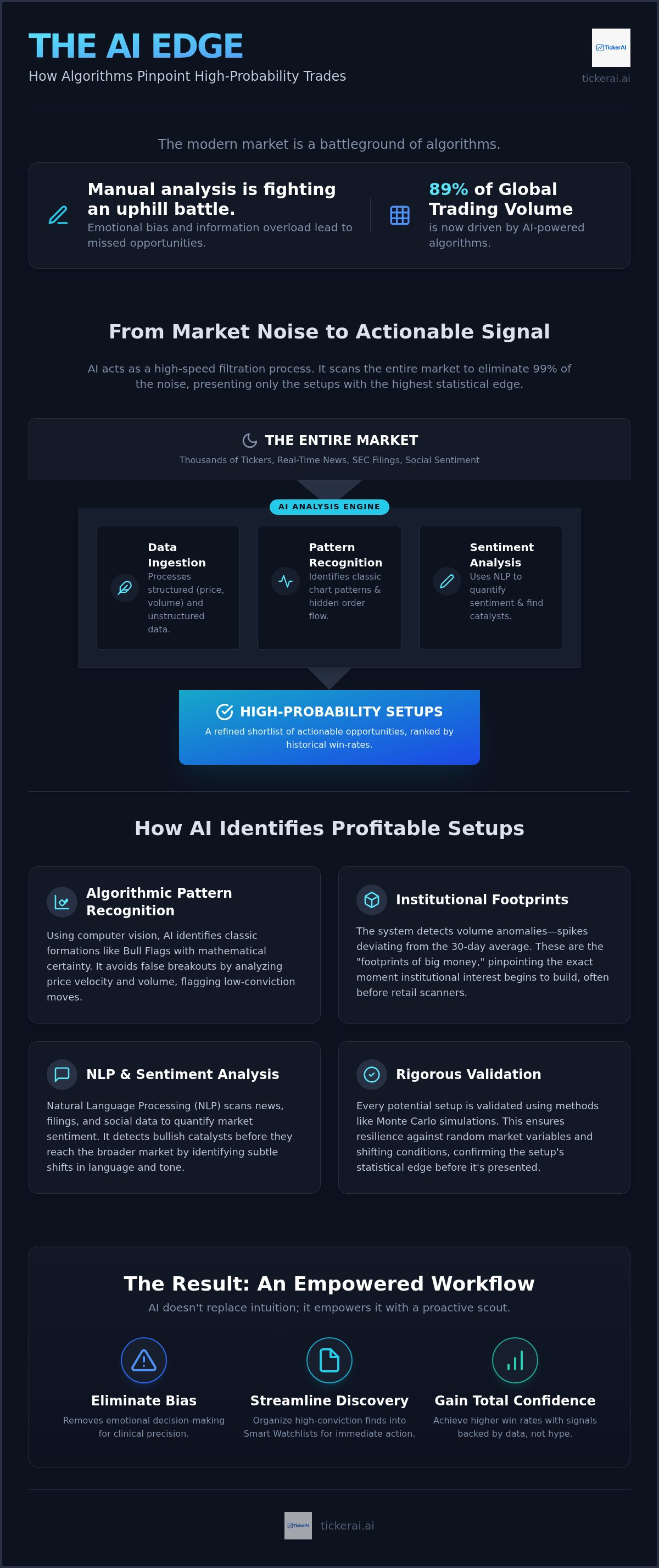
Nearly 89% of global trading volume is now driven by AI-powered algorithms. If you're still scanning thousands of tickers manually, you aren't just trailing the market; you're fighting an uphill battle against a machine that never sleeps. It's easy to feel buried under 24/7 information overload. Emotional bias often clouds judgment, leading to hesitant entries or missed exits. You recognize that manual analysis is no longer sufficient for the speed of modern finance. This professional guide explains exactly how AI identifies profitable trade setups by processing technical indicators, fundamental data, and real-time sentiment at millisecond speeds.
You'll discover the precise algorithmic mechanics required to filter market noise and pinpoint high-probability swing trade setups with clinical precision. We'll move beyond the hype to examine a repeatable, automated discovery workflow that eliminates analysis paralysis. This process isn't about replacing human intuition. It's about empowering it with a proactive scout that prioritizes the most lucrative opportunities. By mastering these data-driven filtering techniques, you can achieve higher win rates and gain total confidence in your signal accuracy. Prepare to transform your approach into a streamlined, high-speed intelligence operation.
Key Takeaways
- Understand how high-speed data ingestion and computer vision automate the detection of classic chart formations and hidden order flow levels.
- Learn to leverage Natural Language Processing (NLP) to quantify market sentiment and detect bullish catalysts before they reach the broader market.
- Master the validation process using Monte Carlo simulations to ensure setup resilience against random market variables and shifting conditions.
- Discover how AI identifies profitable trade setups by processing multi-layer data streams to eliminate emotional bias and information overload.
- Streamline your workflow by organizing high-conviction discoveries into TickerAI Smart Watchlists for immediate, real-time execution.
The Architecture of Discovery: How AI Ingests Market Data
AI stock discovery is a high-speed filtration process, not a speculative prediction engine. It functions as a sophisticated lens that clarifies market chaos. While traditional algorithmic trading followed rigid, linear rules, modern AI utilizes neural networks to identify non-linear relationships between thousands of variables. This architecture enables the system to ingest structured data like price, volume, and time-series records simultaneously with unstructured data. Real-time news feeds, SEC filings, and social sentiment are processed in milliseconds. The system scans for subtle correlations, such as how a specific phrase in an earnings transcript might impact volatility days later. The goal is simple: find the signal within the noise.
Structured Data and Time-Series Analysis
Discovery begins with the ingestion of structured time-series data. The system analyzes historical price action across various timeframes to ensure pattern consistency. This requires precise data normalization. Data normalization is the mathematical process of scaling numerical values to a standard range so that different indicators can be compared without bias. This allows the AI to evaluate a small-cap stock's momentum alongside a mega-cap's volume profile accurately. By identifying volume anomalies; spikes that deviate from the 30-day average; the AI pinpoints the exact moment institutional interest begins to build. These anomalies are the footprints of big money. The AI detects these outliers before they appear on standard retail scanners, providing an early-mover advantage.
The Filtration Layer: Moving from Noise to Signal
Market noise is the primary enemy of the professional trader. Thousands of tickers move daily, but few offer high-probability entries. AI solves this by acting as a proactive scout. It automatically eliminates "dead tickers" characterized by low liquidity or erratic, low-volume noise. This represents a critical step in how AI identifies profitable trade setups. The system doesn't just find patterns; it ranks them. Setups are categorized based on historical probability clusters where similar conditions led to successful outcomes. TickerAI prioritizes high-confidence movements over speculative, low-conviction spikes. This ensures your attention stays fixed on setups with the highest statistical edge. By filtering out 99% of market activity, the AI presents a refined shortlist of actionable opportunities that align with proven swing trade mechanics.
Pattern Recognition: Automating Technical Setup Identification
AI doesn't "look" at charts like a human trader. It employs computer vision and algorithmic scanning to identify classic formations such as Bull Flags and Cup and Handle patterns with mathematical certainty. Beyond visual geometry, it analyzes order flow to pinpoint hidden support and resistance levels. These levels often represent institutional liquidity pools invisible to retail eyes. As noted in the U.S. GAO Report on AI in Financial Services, the integration of machine learning allows for the processing of massive datasets to enhance decision-making accuracy. This multi-layered approach is how AI identifies profitable trade setups by requiring a strict convergence of technical indicators like RSI, MACD, and EMA before a signal is generated.
Market regimes aren't static. An AI system dynamically recalibrates its criteria based on whether the environment is trending or range-bound. In a bear market, the system tightens its breakout parameters to account for increased volatility and lower follow-through. This adaptability ensures that the discovery process remains relevant regardless of broader economic shifts. It acts as a tireless filter for a chaotic environment.
Algorithmic Chart Pattern Recognition
False breakouts are the primary cause of retail losses. AI avoids these traps by analyzing the velocity and acceleration of price action. If a stock crosses a resistance level on weak volume or low price-velocity, the AI flags it as a low-probability event. It identifies multi-factor setups that manual traders often overlook, such as a Bull Flag appearing specifically at a high-volume node. For traders looking to scale their intelligence, implementing automated stock market analysis is the next logical step in professional evolution. The system scans thousands of tickers simultaneously to find these rare alignments.
Momentum and Trend Strength Indicators
Machine learning models quantify trend exhaustion using advanced statistical distributions. Instead of guessing when a move is "overextended," the AI assigns a quality grade to each momentum setup based on historical decay rates. The standard Observation-to-Action flow follows a clinical sequence. First, the system detects a volatility contraction. Second, it monitors for an institutional volume spike. Finally, it triggers an alert only if the risk-to-reward ratio exceeds a predefined threshold. You can start monitoring these high-conviction movements today with TickerAI Pro to ensure you never miss a verified entry.
Alternative Data: NLP and Sentiment-Driven Discovery
Price and volume are secondary indicators of a primary catalyst. Professional discovery requires context. AI bridges this gap by scanning unstructured data streams that manual traders cannot process in real-time. This is a core component of how AI identifies profitable trade setups. It doesn't just watch the tape; it listens to the market. By tracking institutional "Smart Money" through large block trade detection, the system identifies where the largest participants are positioning. It then correlates these news events with price action to confirm setup validity. If a breakout occurs without a corresponding sentiment shift or institutional flow, the AI flags it as a low-conviction event. This ensures your capital stays focused on setups backed by fundamental momentum.
Natural Language Processing in SEC Filings
NLP in algorithmic trading is the computational processing of unstructured text to extract sentiment, detect thematic shifts, and quantify management confidence. AI scans 10-K and 10-Q filings at speeds impossible for humans. It detects subtle changes in management tone. If a CEO replaces "we are confident" with "we anticipate" regarding future revenue, the AI detects the hedging. This identifies "hidden" catalysts before they hit mainstream news outlets. According to the FIU College of Business on AI in the stock market, machine learning is essential for analyzing these complex, non-traditional datasets. It turns dense legal text into actionable intelligence.
Quantifying Market Emotion
Market emotion is a quantifiable data point. The system transitions from qualitative news to quantitative sentiment scores. This creates a clinical filter for your discovery process. High-risk setups often occur during peaks of retail panic or euphoria. AI identifies these extremes and avoids them. It uses sentiment as a secondary filter to ensure the prevailing mood supports the technical setup. For instance, a technical breakout with a negative sentiment score is often a trap. Understanding how to interpret AI stock signals is vital for maintaining signal clarity. The process follows a logical flow. Observation: Sentiment drops below the 20-day average. Outcome: Volatility increases. Action: The AI ignores the technical trigger to protect capital. This proactive filtering prevents emotional bias from dictating your entries. It ensures you only participate in high-probability environments where data supports the direction.
Validating Setups: Backtesting and Historical Win Proofs
Identification is merely the first stage of the discovery cycle. Validation is where the statistical edge is confirmed. High-probability discovery requires rigorous stress-testing against multiple market cycles to ensure consistency. This rigorous testing phase is central to how AI identifies profitable trade setups that withstand volatility. It doesn't rely on a single success. It requires proof across thousands of iterations. Monte Carlo simulations play a vital role here. These simulations test setup resilience by introducing random market variables. This ensures the strategy isn't dependent on a specific sequence of events. If a setup fails when variables shift slightly, the AI discards it. Walk-forward optimization follows this. This ensures the logic remains relevant in the 2026 market by testing it on data the model hasn't previously processed.
Risk management is baked into the validation layer. Professional participants look beyond raw returns. They analyze the Sharpe Ratio to evaluate risk-adjusted performance. A high return is useless if it requires excessive volatility. Maximum drawdown is equally important. This metric tracks the largest peak-to-trough decline in equity. AI models optimize these ratios to ensure that discovered setups offer a sustainable path to growth. It's a clinical approach to capital preservation.
The Backtesting Workflow
The AI follows a structured sequence to verify a setup's historical viability. This eliminates guesswork and replaces it with data-driven certainty. The workflow includes:
- Step 1: Define the technical and fundamental parameters of the setup with absolute precision.
- Step 2: Run the strategy against 5 to 10 years of historical tick data to capture every price movement.
- Step 3: Analyze the distribution of returns to identify "fat tail" risks or outlier events.
- Step 4: Refine parameters to minimize maximum drawdown while maintaining profit targets.
Tracking Performance and Win Rates
Trust is earned through data. Not promises. Historical win proofs are critical for building confidence in any alert service. By analyzing these records, you can see exactly how AI identifies profitable trade setups that maintain a high Sharpe Ratio over time. You should use a digital trading journal to compare AI alerts against your actual execution. This identifies slippage or execution gaps. When evaluating an AI stock picking service, look for these granular validation metrics. It's the difference between a speculative tool and a professional partner. Ready to see validated setups in action? Start your TickerAI Pro subscription and access the same data-driven discovery used by institutional desks.
Executing with TickerAI: Integrating Discovery into Your Workflow
Discovery is a process. Execution is a discipline. Understanding how AI identifies profitable trade setups is only the first stage of a professional strategy. To capitalize on these signals, you must integrate them into a structured environment that prevents hesitation. TickerAI provides the architecture to turn raw data into actionable trades through high-speed filtering and thematic organization. By utilizing TickerAI Smart Watchlists, you can categorize discoveries by sector, industry, or specific catalyst. This ensures your focus remains on the most relevant opportunities rather than a fragmented list of tickers. It's a clinical approach to market scanning.
Your choice of subscription should reflect your research intensity. TickerAI Pro is designed for the active swing trader who requires real-time market alerts and automated scanning. For professionals requiring maximum intelligence and deep-thematic discovery, TickerAI Full-Access provides the most comprehensive toolset. Regardless of the tier, success requires systematic discipline. The AI functions as your proactive scout; it finds the signal, but you must execute the plan. Relying on a data-driven workflow eliminates the analysis paralysis that often plagues manual traders.
From Discovery to Watchlist
Thematic organization is the key to managing information overload. You can organize TickerAI discoveries into actionable themes such as "AI Infrastructure" or "Small-Cap Growth" to track sector-wide momentum. This allows you to see where institutional capital is flowing in real-time. Customizing alert triggers to match your specific risk tolerance ensures you only receive notifications for setups that meet your criteria. This streamlined process is essential for finding thematic investment opportunities with AI. It transforms a chaotic market into a prioritized pipeline of high-conviction setups.
The Final Filter: Your Trading Plan
The AI is a scout, not a manager. Final execution remains a human responsibility. Use the AI-calculated volatility levels to set precise stop-losses and profit targets. This removes the guesswork from risk management. By using AI to remove emotion from trading, you maintain a psychological edge over the broader market. The system identifies the setup; you verify the alignment with your trading plan. This hybrid model combines algorithmic speed with human judgment. It ensures that every entry is backed by statistical proof and executed with clinical precision. This is the professional standard for the 2026 market.
Mastering the Future of Systematic Discovery
Success in the 2026 market requires more than just intuition. It demands a clinical approach to data. We've explored the multi-layered mechanics of how AI identifies profitable trade setups by processing millisecond-level price action and complex sentiment catalysts. From computer vision pattern recognition to rigorous Monte Carlo validation, the process is designed to eliminate emotional bias and information overload. You now have the framework to transition from manual scanning to a high-speed, automated intelligence workflow. This isn't just about speed. It's about precision. It's about the ability to filter thousands of tickers into a handful of high-probability opportunities.
The transition from observation to action is seamless when you have the right tools. TickerAI functions as your tireless, proactive scout. It provides the proactive market scanning and real-time algorithmic alerts needed to maintain a professional edge. Stop fighting the noise. Start leveraging data-driven swing trade discovery to elevate your win rates. Start discovering institutional-grade setups with TickerAI Full-Access today. Your ability to adapt to these algorithmic standards will define your performance in the years ahead. It's time to trade with confidence.
Frequently Asked Questions
How does AI identify profitable trade setups differently than a human trader?
AI identifies setups by processing multi-layer data streams at millisecond speeds. Human traders are limited by cognitive bandwidth and emotional bias. AI scans thousands of tickers simultaneously to find non-linear relationships that are invisible to the naked eye. This clinical precision is how AI identifies profitable trade setups without the fatigue or hesitation common in manual analysis. It functions as a tireless, high-tech assistant that prioritizes data over intuition.
Can AI identify setups for both day trading and long-term investing?
Yes, AI adapts its scanning logic to various timeframes for maximum utility. TickerAI identifies both short-term swing trade setups and long-term investment ideas. The system analyzes price velocity for rapid movements while evaluating fundamental health and macro trends for multi-month positions. This versatility allows the platform to act as a proactive scout for any portfolio duration. It ensures you receive high-conviction alerts that match your specific investment horizon and risk profile.
How accurate are AI-generated stock alerts in 2026?
Accuracy depends on the validation layer and the prevailing market regime. In 2026, AI-powered algorithms are involved in nearly 89% of global trading volume. High-conviction alerts use backtesting and Monte Carlo simulations to ensure statistical significance. While no system can guarantee returns, the data-driven filtering used by TickerAI focuses on setups with verified historical win proofs. This rigorous validation process provides total confidence in the accuracy of every signal generated by the system.
Do I need coding knowledge to use AI for trade discovery?
No coding knowledge is required to use professional AI discovery tools. TickerAI provides a streamlined interface for its Full-Access and Pro subscriptions. The complex algorithmic processing and neural network calculations happen on the backend. You simply receive actionable alerts and organize these discoveries into smart watchlists. It's designed to be a high-speed intelligence partner for serious participants. This allows you to focus on decision-making rather than building technical infrastructure.
What is the best way to backtest an AI trading strategy?
The most effective method involves running a strategy against 5 to 10 years of historical tick data. You must use walk-forward optimization and Monte Carlo simulations to test resilience against random market variables. This rigorous process validates how AI identifies profitable trade setups by ensuring the logic holds up across diverse market cycles. Analyzing the Sharpe Ratio and maximum drawdown during this phase is essential for evaluating the risk-adjusted return of any setup.
How does AI handle market volatility when identifying setups?
AI uses dynamic recalibration to adjust its parameters during periods of high volatility. It tightens breakout criteria and expands risk-to-reward thresholds to protect capital from erratic price action. By quantifying market sentiment and emotional extremes, the system identifies when volatility indicates trend exhaustion or a new institutional entry. This proactive filtering prevents entries into high-risk environments. It ensures that the discovery process remains relevant regardless of broader economic shifts or sudden shocks.
Is AI stock discovery better for small-cap or large-cap stocks?
AI discovery is effective across both categories but utilizes different analytical filters for each. For large-caps, the system tracks institutional order flow and hidden liquidity pools. For small-caps, it monitors volume anomalies and alternative data catalysts that often precede explosive movements. TickerAI scans the entire market to find high-potential movements regardless of market capitalization. This ensures you have access to a diverse pipeline of opportunities ranging from stable growth to high-momentum breakouts.
Can AI find trade setups based on news and social media sentiment?
Yes, AI utilizes Natural Language Processing (NLP) to scan headlines, transcripts, and SEC filings. It quantifies the emotional state of the market to identify bullish or bearish catalysts. By correlating news events with institutional block trades, the system confirms the validity of a technical setup. This alternative data ingestion provides an early-mover advantage. It allows you to detect thematic shifts before they reach mainstream news outlets or impact the broader retail market.


