

Analysis paralysis is not a lack of willpower; it is a failure of your data-filtering system. In a market where retail trading turnover has reached the 99.7th percentile, the sheer volume of information is designed to overwhelm. You've likely felt the friction of the 24/7 news cycle, perhaps second-guessing a trade because of a sudden shift in Federal Reserve interest rate expectations or a new SEC regulatory update. This hesitation isn't just stressful. It's expensive.
Learning how to avoid analysis paralysis when investing requires moving beyond manual research. You need a system that prioritizes execution over deliberation. This guide promises to replace your indecision with a high-speed, AI-driven workflow that filters market noise and triggers confident execution on high-probability setups. We'll explore a repeatable investment framework that leverages real-time anomaly detection and smart watchlists to reduce emotional stress and increase your execution rate during market hours. By the end of this article, you'll have a systematic blueprint for navigating the 2026 market with clinical precision.
Key Takeaways
- Identify how asymmetric information and rapid algorithmic shifts trigger indecision in the 2026 market landscape.
- Transition from subjective manual research to systematic discovery by using AI to automate the observation phase of your investment cycle.
- Implement a 4-step framework on how to avoid analysis paralysis when investing by defining clear market anomalies and binary entry criteria.
- Establish clinical precision in your execution with pre-defined exit rules that eliminate second-guessing during high-volatility market hours.
- Scale your discipline using TickerAI discovery tools to filter noise and isolate high-conviction swing trade setups instantly.
The Anatomy of Analysis Paralysis in the 2026 Market
Analysis paralysis is a state of over-analyzing data to the point where decision-making stalls. In the 2026 market, this isn't just a psychological hurdle. It's a systemic failure. The environment is defined by asymmetric information and lightning-fast algorithmic shifts. If you're stuck in a loop of "one more indicator," you're already behind the curve. Retail trading turnover is currently in the 99.7th percentile. The competition isn't just other traders; it's high-speed intelligence. Your brain isn't wired to compete with real-time data streams without a filter.
Every minute spent second-guessing a setup is a minute where alpha erodes. Missed entries aren't neutral; they're direct hits to your potential capital growth. This is the "Cost of Inaction." Manual stock scanning is the primary culprit. It leads to decision fatigue, which inevitably triggers emotional trading. You start the day with a clinical plan and end it with a reactive, unplanned position because you're exhausted by the noise. Understanding how to avoid analysis paralysis when investing starts with acknowledging that your manual research process is a bottleneck.
Why Traditional Research Methods Fail Today
The myth of the "perfectly informed" trade is dead. In a high-frequency market, waiting for every technical indicator to align perfectly means you're entering when the move is already exhausted. Manual charting is too slow. It can't account for real-time market mechanics or sudden liquidity shifts. Speed is the new edge. If your research takes hours, your data is stale before you hit "buy." Information FOMO is the result. You chase the news instead of anticipating the move. You become a reactive participant in a proactive market.
Filtering Market Noise: The First Step to Clarity
Clarity requires a ruthless filter. You must distinguish between "signal," which is actionable data that fits your specific criteria, and "noise," which is the sensationalist media and social sentiment designed to trigger a reaction. The shift is psychological. Stop trying to know everything. Focus on knowing only what matters to your specific edge. By using AI to remove emotion from trading, you transition from a reactive observer to a proactive executor. This is the first step in learning how to avoid analysis paralysis when investing. You don't need more data. You need better filters. You need a system that prioritizes execution over deliberation.
Transitioning from Manual Research to Systematic Discovery
Stop relying on gut feelings. Professional traders don't guess; they follow systems. Systematic discovery is the bridge between chaotic over-analysis and clinical execution. It replaces subjective hunches with objective, data-driven criteria. When you define your parameters before the market opens, you eliminate the need for mid-trade deliberation. This shift is fundamental to how to avoid analysis paralysis when investing. If a ticker doesn't meet your pre-set quantitative requirements, it doesn't earn a place on your screen. There is no "maybe" in a systematic workflow.
AI now automates the "Observation" phase of the investment cycle. This is where most retail participants lose their edge. They spend hours manually scanning thousands of charts, only to reach a state of decision fatigue before the first trade is even placed. By delegating this phase to high-speed algorithms, you focus entirely on decision-making and risk management. Quantitative tools can now track institutional money flow in real-time, identifying where "smart money" is positioning. This allows you to move from reactive chasing to proactive anticipation. You aren't waiting for the news to break; you're watching the volume anomalies that precede it.
Delegating the "Observation" phase to AI isn't just for trading; in the competitive 2026 job market, tech professionals can discover QuickApply to streamline their search by automating the application process.
The Power of Automated Market Scanning
Speed is your primary defense against indecision. Automated scanning identifies momentum breakouts before they become mainstream headlines. AI anomaly detection is particularly effective in small-cap stocks, where hidden institutional activity often leaves a distinct footprint in price action and relative volume. By using AI stock opportunity discovery, you reduce the research phase from hours to seconds. You're presented with curated trade setups that already meet high-probability criteria, allowing you to bypass the manual scanning trap that leads to exhaustion.
Smart Watchlists: Organizing Opportunity
Organization creates clarity. A static watchlist is a liability in a dynamic market. Professional discovery requires structuring watchlists by theme, sector rotation, or volatility profile. If capital is rotating into high-margin tech or AI-driven IPOs, your watchlist must reflect that shift instantly. This organizational discipline helps you distinguish between proactive vs reactive trading. You aren't scanning for everything; you're monitoring specific segments for confirmed signals. Organizing your opportunities this way is a tactical step in how to avoid analysis paralysis when investing. It ensures that when a setup triggers, you're ready to act without hesitation.
A 4-Step Framework to Eliminate Indecision
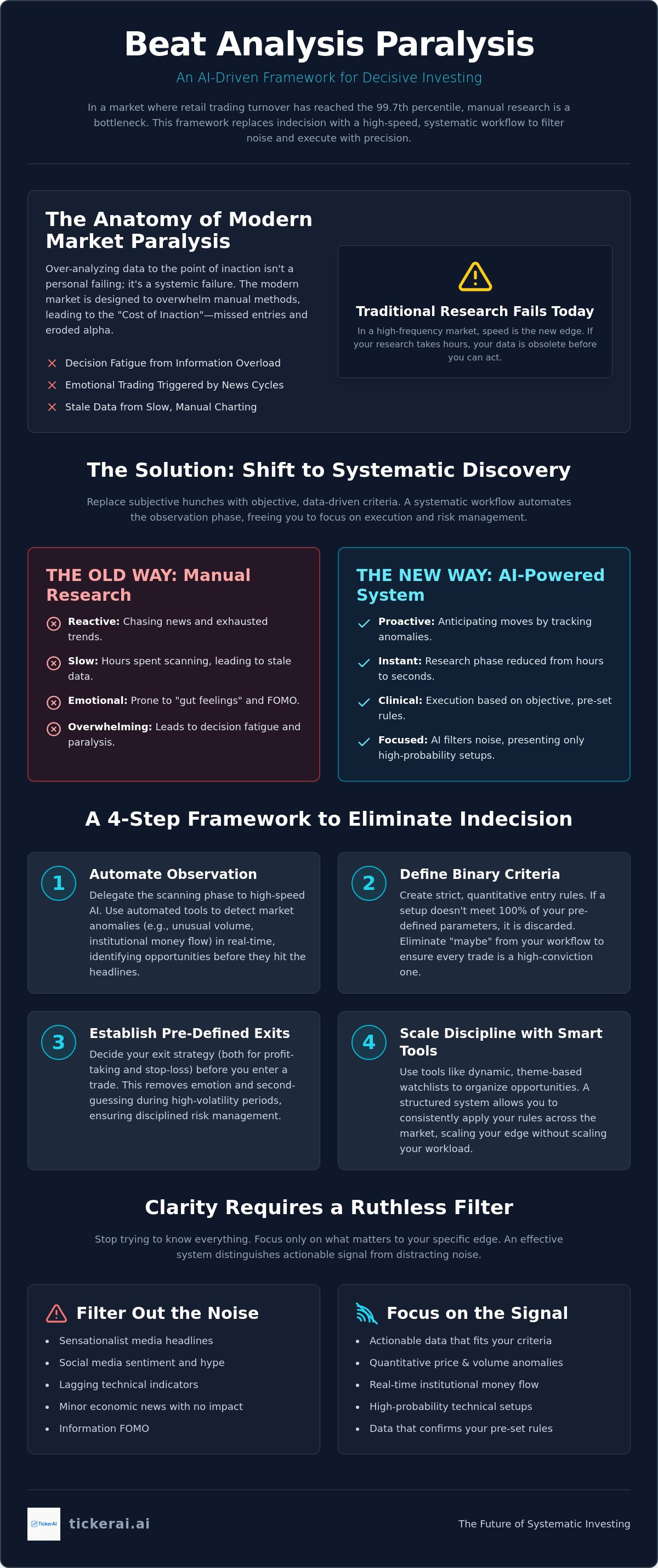
Eliminating indecision requires a transition from a discretionary mindset to an algorithmic one. You don't need to be a coder to trade like a machine. You simply need a protocol that dictates your actions before the market opens. This 4-step framework is the definitive method for how to avoid analysis paralysis when investing in a high-velocity environment.
- Step 1: Define your 'Edge'. Identify the specific market anomaly you're trading. Whether it's a mean-reversion setup in oversold tech or a momentum breakout in AI-driven IPOs, you must know exactly what "success" looks like before you scan a single ticker.
- Step 2: Establish Binary Entry Criteria. Create a checklist where every item is a "Yes" or "No." If the setup is a "maybe," it's a "no."
- Step 3: Automate the Discovery. Don't watch the paint dry. Use AI alerts to notify you the moment your binary criteria are met.
- Step 4: Execute without Re-evaluation. Trust the pre-set plan. Once the alert triggers, your role shifts from analyst to executor.
Establishing Binary Entry Criteria
Remove "maybe" from your trading vocabulary. Second-guessing occurs in the gray area of subjective analysis. To stop this, use technical indicators as hard execution triggers. For example, a rule might state: "Buy only if the 14-day RSI is below 30 and the price is holding above the 200-day Moving Average." This creates a logical Observation-to-Action flow. If Signal A occurs, then Execution B follows. There is no room for debate. By stripping away the need for "feeling" the market, you maintain clinical precision during volatile hours.
Trusting the Pre-Set Plan
Deep-dive research belongs in the preparation phase, not the execution phase. Performing extra research once an alert is triggered is just a sophisticated form of procrastination. It invites doubt. Professional execution relies on pre-calculated risk-to-reward ratios. You should already know your stop-loss and profit target before the trade is live. Mastering the art of interpreting AI stock alerts for entry and exit points ensures that you aren't guessing when the alert hits your phone. You see the alert, verify the criteria, and hit the button. This is how to avoid analysis paralysis when investing. You aren't deciding what to do; you're following instructions you gave yourself when you were calm and objective.
Building Your Rule-Based Execution Plan
A rule-based execution plan is the final safeguard against the emotional volatility of the 2026 market. It provides the clinical precision needed to act when others hesitate. By pre-defining your exits, you remove the burden of "thinking" during market hours. This is a critical component of how to avoid analysis paralysis when investing. If you don't have a hard stop-loss and a profit target set before the trade is placed, you aren't trading; you're gambling on your future emotional state. Professional trading requires a shift. From hoping for profit to managing for risk.
The "One In, One Out" rule is an essential tool for managing portfolio size and preventing decision fatigue. In a market where retail turnover is at historic highs, the temptation to over-trade is constant. If your portfolio is at its pre-defined capacity, you cannot add a new position without closing an existing one. This forced prioritization ensures you only hold your highest-conviction setups. It stops you from diluting your attention across too many tickers, which is a common trigger for paralysis. You maintain focus. You keep your mental capital intact.
Risk Management as a Cure for Paralysis
Defined risk is the most effective cure for the fear of being wrong. When you calculate your position sizing to ensure no single trade can cause significant capital erosion, the psychological weight of the decision vanishes. You aren't risking your portfolio; you're risking a calculated percentage, such as 1% or 2% of total equity. This provides the psychological relief of knowing your maximum downside upfront. If the stop-loss hits, the system worked. It protected your capital for the next opportunity. This objective approach is fundamental to how to avoid analysis paralysis when investing. You stop fearing the outcome because every possible outcome is already accounted for in your risk model.
The Role of the Trading Journal
Your journal is not a diary. It is a technical audit of your system. You should log every alert received versus every execution made. This helps identify exactly where your process breaks down. Are you missing alerts? Are you hesitating on entries? By tracking these data points, you build the evidence needed to trust your system during high-pressure market shifts. Understanding the importance of a trading journal allows you to audit your logic rather than your emotions. When the data proves your system has a positive expectancy, hesitation becomes illogical.
To start automating your execution and removing the manual research bottleneck, explore TickerAI Full-Access Subscription for real-time, rule-based trade setups.
Scaling Discipline with TickerAI Discovery Tools
Discipline is a finite resource. In a high-speed environment, manual effort inevitably fails. TickerAI Discovery Tools are designed to scale your discipline by removing the cognitive load of manual research. The platform filters thousands of stocks in real-time. It presents only the setups that meet rigorous, data-driven criteria. This is the final step in mastering how to avoid analysis paralysis when investing. You stop being a researcher and start being a manager of high-probability opportunities. You focus. You execute.
The transition from analysis paralysis to algorithmic alpha is about speed and clarity. In 2026, the retail crowd is often late to the move because they're stuck in the observation phase. TickerAI bypasses this entirely. By utilizing real-time alerts, you eliminate the manual scanning trap that leads to decision fatigue. Whether you choose a TickerAI Pro Subscription for core intelligence or the TickerAI Full-Access Subscription for comprehensive market coverage, you're equipping yourself with a proactive scout that never sleeps. It scans while you decide.
Leveraging AI for Swing Trade Setups
Actionable intelligence is the core of our platform. You gain access to curated swing trade setups designed for immediate action. These aren't just ideas. They're setups backed by real-time anomaly detection and momentum indicators. TickerAI identifies momentum breakouts before they become mainstream news. This gives you a distinct advantage over the reactive retail crowd. This significantly reduces the decision gap between discovering a stock and placing the trade. When the system does the heavy lifting, your only job is to follow the rules you've already established. This is how to avoid analysis paralysis when investing at scale.
Your Path to Consistent Execution
Consistency is the byproduct of a repeatable routine. By setting up custom alerts tailored to your specific trading style, you ensure that you only interact with the market when your edge is present. This fosters a state of clinical precision in your daily routine. You aren't hunting for trades; you're waiting for the market to come to you. This systematic approach transforms the chaotic market of 2026 into a structured environment where execution is the default response to a confirmed signal. You remove the friction. You keep your capital moving.
Stop overthinking and start executing. Start your AI-driven discovery with TickerAI Full-Access today.
Mastering the Algorithmic Alpha of 2026
The 2026 market doesn't reward the most informed trader; it rewards the one who executes with clinical precision. You've seen that the root of indecision isn't a lack of data but a lack of a definitive filter. Transitioning from manual research to a systematic discovery model is the only sustainable way to protect your capital and your mental bandwidth. By defining binary entry criteria and automating the observation phase, you solve the problem of how to avoid analysis paralysis when investing. Success requires moving beyond the noise of the 24/7 news cycle.
Your edge lies in speed and clarity. You need a system that detects institutional flow and momentum breakouts before they become common knowledge. It's time to replace subjective hunches with clinical, data-driven alerts that trigger immediate action. Discover high-potential market movements with TickerAI Full-Access and leverage our AI-powered swing trade setups, real-time market anomaly detection, and professional-grade smart watchlists. Stop watching the tape and start managing your execution. You have the framework; now you need the high-speed intelligence engine to power it. Build your future on data, not doubt. Success in this environment belongs to the proactive participant.
Frequently Asked Questions
What is the most common cause of analysis paralysis in investing?
The most common cause is information overload from 24/7 financial news cycles and asymmetric data flows. Investors often try to synthesize too much conflicting data instead of focusing on a specific edge. This leads to a state of over-analysis where the "perfect trade" becomes an impossible goal. You end up watching the move happen instead of participating in it.
How can I simplify my stock research process to avoid overthinking?
Simplify your process by adopting a binary criteria system where every ticker is either a "Yes" or a "No" based on pre-set rules. This is a core strategy in how to avoid analysis paralysis when investing. By automating the observation phase with AI-driven discovery, you move directly from signal detection to execution. You bypass the manual scanning bottleneck that causes decision fatigue.
Does using AI tools actually help reduce emotional trading decisions?
AI tools reduce emotional trading by filtering market noise and presenting objective, data-driven setups. They remove the "hunch" factor from the discovery phase. When a system provides a validated alert, your role shifts from a biased observer to a systematic executor. This clinical approach significantly lowers the impact of fear and greed during high-volatility market hours.
How do I know if I have too much information for a trade?
You have too much information when your data points begin to contradict each other, leading to hesitation. If you're checking a fifth technical indicator after the first four have already signaled an entry, you're over-analyzing. Professional trading requires a lean set of high-probability criteria. You don't need an exhaustive list of every possible metric to execute a successful swing trade.
What are the best rules to set for a rule-based trading system?
The best rules are hard execution triggers like RSI levels, volume anomalies, and moving average crosses. Combine these with strict risk management protocols, such as a maximum 2% portfolio risk per trade. Establishing these boundaries ensures that your actions are dictated by logic. You stay grounded even when the 2026 market environment becomes unpredictable or moves at high speed.
Can a trading journal really help me overcome indecision?
A trading journal helps overcome indecision by providing a technical audit of your system's performance. By logging every alert and your subsequent reaction, you identify precisely where your execution process breaks down. Seeing data-driven proof that your system has a positive expectancy builds the confidence needed to act. You stop second-guessing because you have a record of past success.
Is it better to use a stock alert service or do my own research?
An AI-powered alert service is more efficient for active traders because it removes the manual research phase where paralysis usually occurs. While personal research is valuable for long-term thesis building, real-time discovery requires algorithmic speed. Using a professional service allows you to bypass the manual scanning trap. You focus your mental energy on execution and risk management instead.
How do I trust an AI signal when the market is volatile?
Trusting AI signals requires understanding that algorithms remain objective during periods of high volatility. In a fast-moving market, manual analysis is prone to emotional bias and panic. An AI signal processes market mechanics at speeds impossible for humans, maintaining its logic regardless of sentiment. This objectivity is essential for how to avoid analysis paralysis when investing when the tape is moving rapidly.


