
Most traders aren't failing because they lack technical knowledge. They're losing because they're trapped in a reactive loop that forces them to buy the top. When comparing proactive vs reactive trading, the distinction is clinical. Reactive traders chase price action after the move has already happened. Proactive traders use automated discovery to position themselves before the breakout. If you're constantly fighting chronic FOMO, you aren't trading the market. You're simply reacting to its wake.
It's a frustrating cycle. You see a ticker trending, jump in with high expectations, and watch the liquidity exit as soon as your order fills. We understand the stress of inconsistent results despite your technical expertise. This article promises a shift. You'll discover how to move from impulsive entries to a data-driven discovery process that eliminates the need to chase and identifies setups before the crowd.
We're detailing a repeatable workflow designed for the 2026 market environment. You'll learn how to leverage high-speed intelligence to identify setups, lower your emotional overhead, and secure superior risk-reward ratios. It's time to stop being a spectator of market moves. Start becoming an architect of your entries.
Key Takeaways
- Learn to differentiate between chasing past price action and identifying high-probability zones before the market arrives.
- Discover why the proactive vs reactive trading shift replaces market-induced anxiety with clinical, systematic patience.
- Establish a repeatable workflow that uses scenario mapping to define entry, stop, and target levels before any capital is at risk.
- Utilize AI-powered scanning and anomaly detection to filter thousands of tickers for high-conviction setups in seconds.
- Secure superior risk-reward ratios by transitioning from manual discovery to an automated, data-driven execution strategy.
Understanding Proactive vs Reactive Trading in Modern Markets
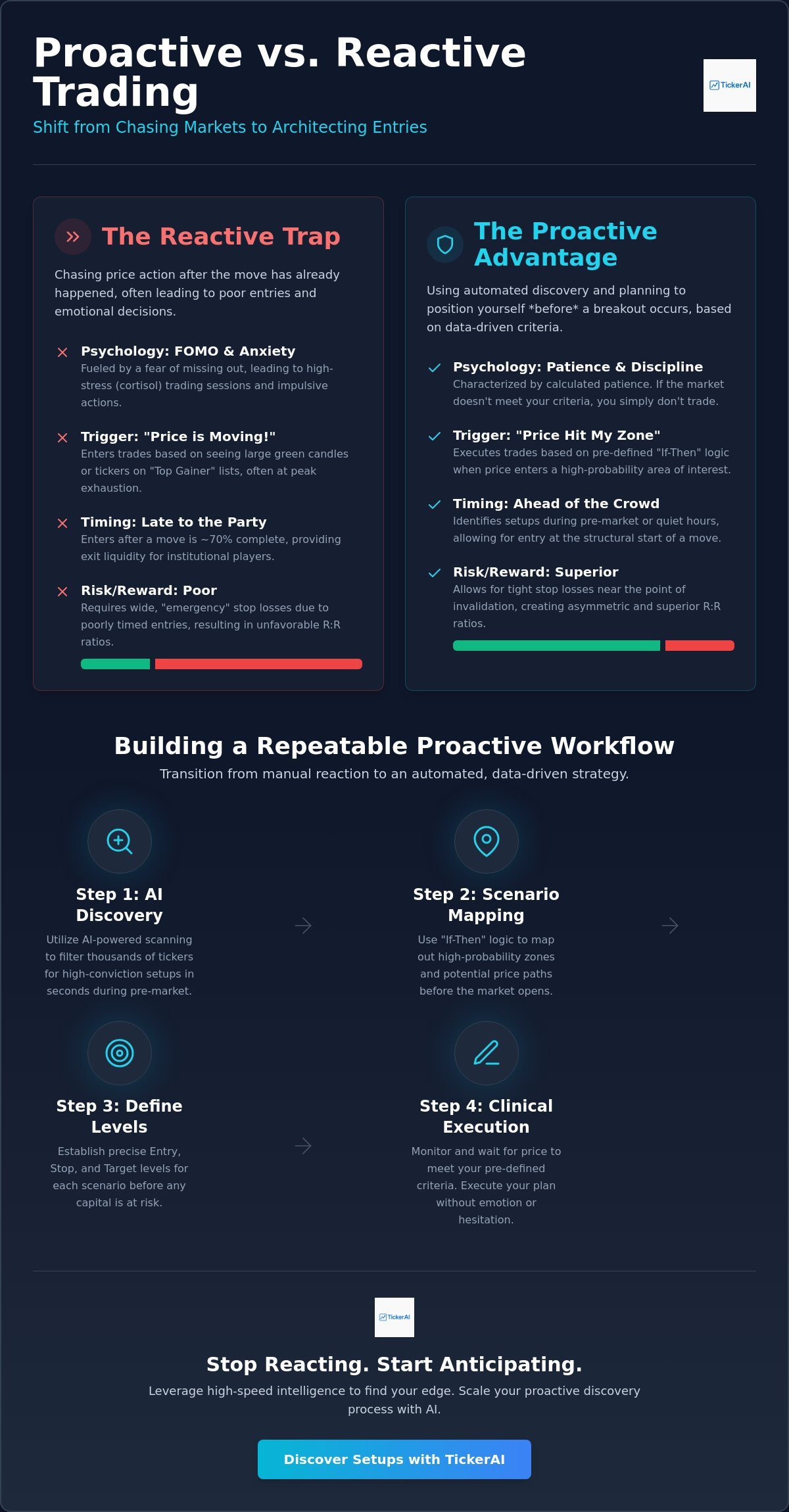
The core struggle for retail participants in 2026 is speed. Most traders operate in a reactive state, responding to price action that has already printed on the chart. By the time a manual trader recognizes a breakout, the move is often 70% complete. In contrast, proactive trading involves identifying high-probability zones before price arrives. It's the difference between being the liquidity and providing it. Understanding proactive vs reactive trading is no longer optional; it's a survival requirement in a market dominated by institutional speed.
The bridge between these two worlds is a robust "Discovery" process. Discovery isn't about watching a ticker move in real-time. It's about the systematic identification of setups during the pre-market or quiet hours. Without a discovery process, you're forced to react to the loudest noise in the room. With it, you're prepared to execute on the quietest signals. In 2026, manual reaction is simply too slow to compete with modern execution layers.
The Reactive Trap: Why Chasing Momentum Fails
Retail traders often fall victim to the "Late Entry" phenomenon. You see a series of aggressive green candles and feel the urge to participate. This is reactive trading at its worst. By buying at peak exhaustion, you're likely providing the exit liquidity for institutional players. Algorithmic trading systems are specifically programmed to exploit this retail impulse. These high-frequency models detect retail order flow and often trigger reversals just as the crowd enters. You aren't catching a trend; you're catching the tail end of a distribution cycle.
Common symptoms of the reactive trap include:
- Buying into extended vertical moves without a defined pullback.
- Using wide, emergency stop losses because your entry was poorly timed.
- Experiencing high cortisol levels during market hours due to a lack of a pre-set plan.
- Chasing tickers that appear on "Top Gainer" lists after they've already moved 15%.
The Proactive Advantage: Trading with Anticipation
Proactive traders don't wait for the market to tell them what to do. They use "If-Then" logic to map out scenarios before the session begins. If price reaches a specific area of interest (POI), then they look for a predefined entry trigger. If it doesn't, they do nothing. This preparation allows for a clinical execution style that removes the "fight or flight" response from the trading desk. You aren't guessing; you're verifying.
The benefits of this approach are tangible and measurable. Proactive trading leads to tighter stop losses because entries occur at the structural start of a move. This naturally creates superior risk-reward ratios. When you enter near a point of invalidation, your downside is capped while your upside remains open. By the time the 2026 market opens, the proactive trader is simply a monitor of their own logic. They don't search for opportunity; they wait for it to meet their criteria.
Proactive vs Reactive: A Strategic Comparison
Comparing these two styles reveals a fundamental divergence in execution logic. In proactive vs reactive trading, the trigger mechanism defines the professional. Reactive traders enter because "price is moving." They see a spike, feel a surge of urgency, and hit the buy button. Proactive traders enter because "price hit my zone." They've mapped out the market structure hours or days in advance. One style is driven by the chart; the other is driven by the plan.
This shift in trigger directly impacts your psychology. Reactive trading is fueled by anxiety. Every tick feels like a potential missed opportunity. Proactive trading is characterized by a calculated boredom. You're simply waiting for a pre-calculated event to trigger. If the market doesn't meet your criteria, you don't trade. This patience isn't a personality trait. It's a competitive edge built on preparation.
The math of these entries is equally distinct. Reactive entries often suffer from poor reward-to-risk ratios. Since you're entering after a move has already confirmed, your stop loss must be wider to stay outside the established volatility. Proactive entries occur at the point of origin. This allows for tighter stops and asymmetric R:R. While a reactive trader might have a higher win rate by catching the middle of a trend, a single proactive win can often offset multiple losses. Proactive trading isn't about predicting the future. It's about preparing for multiple scenarios and executing when the data aligns.
How to Avoid FOMO in Stock Trading Through Preparation
FOMO is the gap between market movement and trader readiness. When you lack a pre-market plan, every aggressive move looks like a lottery ticket you forgot to buy. A proactive watchlist removes this psychological pressure. You only care about the tickers you've already vetted. By using AI stock opportunity discovery, you ensure your list is populated with high-conviction setups before the bell rings. When you're prepared, a sudden pump in an unvetted ticker isn't an opportunity. It's noise.
The Economics of Entry: Slippage and Spread
Chasing price action forces you to use market orders. In the high-speed environment of 2026, this leads to significant slippage. You're buying at the ask during peak volatility, often getting filled cents or dollars away from your intended price. Proactive traders use limit orders. They set their price and let the market come to them. This ensures execution quality and preserves your edge. Over a year of trading, the cumulative cost of slippage from reactive chasing can erode your entire profit margin. Execution quality is just as important as the setup itself.
Building a Proactive Workflow: From Discovery to Execution
Transitioning from a reactive state to a professional operation requires more than just a mindset shift. It requires a repeatable, mechanical workflow. In the debate of proactive vs reactive trading, the winner is decided before the market opens. A proactive workflow is designed to front-load the intellectual labor. By the time the ticker starts moving, your decisions are already made. You aren't "trading the market" in real-time; you're simply executing a pre-calculated script.
This systematic approach involves four distinct stages: Discovery, Mapping, Alerting, and Execution. Each stage is designed to filter out noise and prioritize high-conviction setups. Without this structure, you're vulnerable to the emotional volatility of the live session. With it, you operate with the clinical precision of an institutional desk. You're no longer hunting for trades; you're waiting for your traps to spring.
Step 1: The Art of Discovery
Most retail participants start their day by looking at the "Top Gainers" list. This is the definition of reactive behavior. You're already late. Professional discovery shifts the focus from "What is moving now?" to "What is setting up for tomorrow?" This phase involves scanning the entire market for specific structural footprints. You're looking for consolidation patterns, institutional accumulation, and volume anomalies that suggest a move is imminent.
In the 2026 environment, manual scanning is inefficient. Leveraging automated stock market analysis allows you to scale your intelligence. Instead of manually checking 50 charts, you can filter 5,000 tickers for specific criteria in seconds. This ensures your watchlist only contains assets with the highest probability of follow-through. Discovery is about finding the quiet before the storm.
Step 2: Defining the If-Then Logic
Once a candidate is identified, you must map the scenario. This is where you define your "If-Then" logic. If price crosses $150.50 on high relative volume, then I enter. If it drops below $148.00, my thesis is invalidated. This step removes the need for "gut feelings" during the session. You define the exact entry, stop loss, and profit target before a single dollar is at risk.
A rule-based plan is the ultimate defense against FOMO. It forces you to wait for confirmation levels rather than chasing momentum. Integrating strict risk management into this proactive plan ensures that your downside is always capped. You aren't guessing where the bottom is. You're defining where you're wrong. This clarity allows you to set price alerts and step away from the screen.
Step 3: Alert Setting and Step 4: Mechanical Execution
Technology should monitor the market for you. Once your levels are defined, set smart alerts. This replaces the high-stress habit of staring at 1-minute candles. When an alert triggers, your job is purely mechanical. You check if the volume and price action align with your "If-Then" logic and execute. The decision-making process happened hours ago. Now, it's just about clicking a button. This separation of planning and execution is what differentiates a professional from a hobbyist.
The Role of AI in Shifting from Reaction to Anticipation
The 2026 market environment doesn't wait for manual confirmation. Artificial intelligence is the primary catalyst for the shift in proactive vs reactive trading. While a human trader might scan fifty charts in an hour, AI processes thousands of data points across the entire equity market in milliseconds. This isn't just about speed. It's about depth. AI identifies volume anomalies and price deviations that suggest institutional positioning before the move becomes obvious to the retail crowd.
Spotting "smart money" footprints is the hallmark of a proactive approach. Algorithmic signals remove the human bias that often leads to reactive chasing. Algorithms don't get tired, and they don't have "gut feelings." They provide binary signals based on cold, historical, and real-time data. We're witnessing a total transition from manual charting to intelligence-led trading. You aren't just drawing lines on a screen; you're verifying high-conviction signals generated by a machine that sees what you can't.
AI-Powered Smart Watchlists
A static watchlist is a liability in a fast-moving market. An AI-driven "living" watchlist adapts to real-time volatility and structural changes. TickerAI uses multi-factor AI analysis to generate swing trade setups that prioritize probability over noise. This system identifies stocks entering high-velocity zones before the breakout occurs. By filtering out the 99% of stocks that don't meet your specific criteria, you eliminate analysis paralysis. You stop looking at everything and start focusing on the setups that actually matter.
Real-Time Alerts vs. Manual Monitoring
Staring at a 5-minute chart for hours is a gateway to reactive, impulsive decisions. It triggers a psychological "fight or flight" response that clouds professional judgment. Professional participants use technology to manage their time and their emotions. Even for those utilizing AI tools for long-term investors, the goal remains the same: reduce screen time and increase execution quality. AI acts as a tireless proactive scout that monitors market noise 24/7 so you can focus exclusively on the final decision.
Ready to automate your discovery process and eliminate the urge to chase? Access AI Stock Opportunity Discovery and start anticipating market moves with clinical precision.
Scaling Your Edge with TickerAI Proactive Discovery
The final step in mastering proactive vs reactive trading is the implementation of a scalable technology stack. Manual scanning is a legacy process. It's time-intensive, prone to human fatigue, and fundamentally limited by how many charts a single person can review. TickerAI solves the search cost problem. By automating the discovery phase, you shift your energy from finding trades to managing them. Whether you utilize the TickerAI Pro Subscription or the TickerAI Full‑Access Subscription, the goal is the same: replace emotional guesswork with clinical, algorithmic alpha.
Curated swing trade setups are the core of this advantage. Instead of sifting through market noise, you receive high-conviction opportunities that have already passed a rigorous multi-factor AI filter. This isn't just data. It's prioritized intelligence. It allows you to operate as a professional participant who waits for the market to come to them. Data-driven insights provide a psychological shield against the "talking heads" of financial media. You don't need commentary when you have a verifiable edge.
TickerAI Full-Access: The Proactive Scout
The TickerAI Full‑Access Subscription acts as your 24/7 market scout. It monitors thousands of tickers simultaneously to detect structural shifts before they trigger retail momentum. In the 2026 landscape, the value of AI stock discovery platforms is defined by their ability to find breakouts before they become "hot stocks." Smart watchlists and real-time alerts ensure you're positioned at the point of origin. You aren't buying the news. You're buying the setup that precedes it.
From Chaos to Clinical Precision
The journey from reactive to proactive trading is a journey from chaos to precision. Reactive trading is a high-cortisol trap that relies on luck and speed. Proactive trading is a low-stress discipline built on preparation and technology. By adopting a systematic discovery workflow, you eliminate the FOMO that destroys retail accounts. You stop chasing green candles. You start anticipating them.
The distinction is clear. One style is a hobby. The other is a business. It's time to stop reacting to the market and start discovering it with professional-grade intelligence. Join TickerAI and automate your proactive discovery today.
Mastering the Shift to Algorithmic Alpha
The 2026 market environment doesn't reward hesitation or impulse. Transitioning from proactive vs reactive trading is the only way to secure a sustainable edge in an ecosystem dominated by high-speed execution. You've seen how systematic discovery and rule-based logic remove the psychological burden of market hours. By automating the search for institutional footprints, you stop chasing vertical moves and start positioning yourself at the point of origin.
High-conviction trading requires high-speed intelligence. It's time to leverage AI-powered stock opportunity discovery and real-time smart alerts for swing setups to refine your execution. Eliminate market noise with advanced algorithmic filtering and focus on the decision-making that matters. The tools for professional-grade anticipation are at your fingertips. Take control of your workflow and trade with clinical precision.
Start your proactive discovery with TickerAI Full-Access and transform your approach from market spectator to proactive architect.
Frequently Asked Questions
What is the main difference between proactive and reactive trading?
Proactive trading is defined by anticipation, while reactive trading is defined by impulse. In the context of proactive vs reactive trading, the former identifies high-probability zones before price action arrives. Reactive traders chase green candles after a move has already printed. This leads to late entries and poor risk management. Proactive participants use "If-Then" logic to prepare for multiple scenarios, ensuring they act on a plan rather than an emotion.
How can I stop being a reactive trader and avoid FOMO?
Eliminating FOMO requires a transition from live scanning to a systematic discovery process. You must define your trade criteria before the market session begins. When you have a pre-vetted watchlist, you don't feel the need to chase every ticker that spikes. Using automated tools to flag opportunities allows you to wait for price to hit your zone. If the market doesn't meet your predefined conditions, you simply don't execute. This discipline removes the urgency that fuels impulsive behavior.
Is proactive trading more profitable than reactive trading?
Proactive trading typically yields superior risk-reward ratios compared to reactive styles. By entering at the structural start of a move, you can utilize tighter stop losses. This maximizes your potential R:R. Reactive traders often enter at peak exhaustion, forcing them to use wider stops to avoid volatility. Over a series of trades, the execution quality of a proactive approach often results in more consistent equity growth. It focuses on the quality of the entry rather than the speed of the reaction.
Can AI help me become a more proactive trader?
AI is the most effective tool for shifting your approach. It automates the discovery of setups by scanning thousands of tickers for institutional footprints and volume anomalies. This allows you to scale your intelligence without increasing your screen time. AI removes the human bias that triggers reactive chasing. It acts as a tireless scout, identifying high-conviction zones so you can focus exclusively on mechanical execution. It transforms the trading desk from a search center into a decision center.
Do I need a large account to use a proactive trading strategy?
Account size doesn't dictate the effectiveness of a proactive strategy. The logic of entering at structural points of origin works for small and large accounts alike. Proactive trading is a methodology focused on risk management and execution precision. Whether you're trading ten shares or ten thousand, the goal is to secure asymmetric risk-reward ratios. Scalability is built into the workflow, not the starting capital. It's a professional framework that respects capital regardless of the balance.
What are the best tools for proactive stock market discovery in 2026?
The most effective tools in 2026 utilize algorithmic filtering and machine learning. AI-powered platforms like TickerAI are essential for modern discovery. Look for features such as smart watchlists, real-time alerts, and anomaly detection. These tools filter out market noise and prioritize high-probability swing trade setups. Relying on manual charting or social media sentiment is inefficient. Professional tools provide the data-driven clarity required for proactive execution. They ensure you're looking at the right data at the right time.
How do I build a proactive watchlist?
Building a proactive watchlist involves filtering the market for specific structural criteria during non-trading hours. You should look for consolidation patterns, volume clusters, or institutional accumulation zones. Once identified, map out your exact entry, stop, and target levels. This creates a "living" list of scenarios. Instead of searching for what's moving, you're waiting for your pre-vetted assets to trigger your predefined alerts. It's a systematic approach to opportunity identification that prioritizes patience.
Is reactive trading always bad, or does it have a place?
Reactive trading isn't always "wrong," but it's often inefficient for retail participants. It's frequently used in high-frequency momentum scalping where speed is the primary edge. However, for swing traders and investors, it leads to significant slippage and emotional stress. When evaluating proactive vs reactive trading, the proactive approach is generally more sustainable. It replaces the "fight or flight" response with a clinical, rule-based approach that preserves capital and mental energy. For most, the reactive path is simply too costly.


