

A market alert without a predefined bracket order isn't an actionable trade setup; it's an unhedged liability. While incoming alerts deliver the entry catalyst, your exit mechanics dictate long-term mathematical expectancy. If you hesitate and calculate position sizing manually every time a notification fires, execution slippage and emotional bias immediately compromise your edge. Mastering how to set stop loss and take profit on alerts bridges the gap between raw screening data and disciplined, profitable trade execution.
You've likely watched winning swing trades round-trip into losses, or felt the sting of getting shaken out prematurely by arbitrary, fixed-percentage stops that ignore underlying volatility. You don't need faster reflexes; you need a structured mathematical protocol. In this guide, you'll master the exact framework to translate raw market alerts into disciplined bracket orders with defined risk-reward parameters. We'll break down dynamic ATR-based invalidation levels, One-Cancels-the-Other (OCO) order structures, and reliable webhook execution rules to fully automate your trade containment.
Key Takeaways
- Treat incoming market alerts strictly as entry catalysts that require predefined structural invalidation levels before capital is deployed.
- Master how to set stop loss and take profit on alerts by anchoring risk to dynamic Average True Range (ATR) multiples rather than arbitrary percentage thresholds.
- Deploy One-Cancels-the-Other (OCO) bracket orders to automate your exits and prevent costly orphaned positions when profit targets hit.
- Tailor your exit mechanics to the setup profile, using tight volume-backed stops on momentum breakouts and wider structural anchors on swing trades.
- Decouple trade discovery from broker routing by pairing algorithmic scanning feeds with disciplined, rules-based bracket execution.
Deconstructing Market Alerts: Why Raw Signals Require Structural Risk Parameters
An alert is an informational trigger, not a complete trade plan. Treating an incoming notification as an immediate market buy order invites cognitive bias, hesitation, and costly execution slippage. Real execution demands structure. A bracket order is a conditional order framework that pairs a resting stop-loss order and a take-profit target simultaneously around an active position to enforce automated risk containment.
Without predetermined brackets, exits default to emotional improvisation. Mastering how to set stop loss and take profit on alerts begins by abandoning arbitrary account-dollar targets or rigid fixed-percentage rules. The market doesn't care about your account balance or risk tolerance. Your risk parameters must anchor strictly to technical market structure, placing invalidation points where the setup's original thesis is definitively broken.
The Anatomy of an Actionable Stock Alert
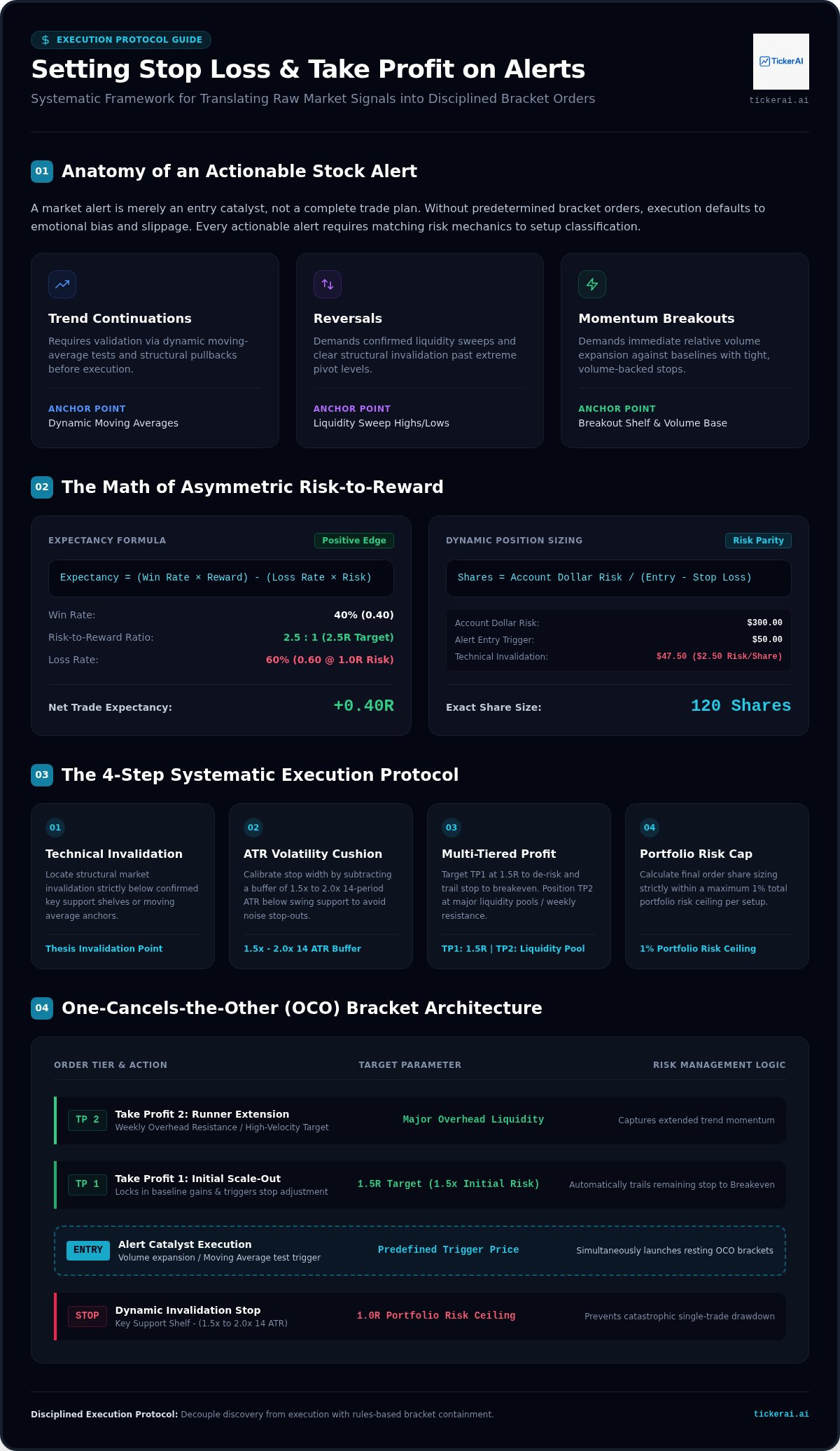
Every actionable alert provides critical technical data: trigger price, timestamp, pattern catalyst, and relative volume against baseline averages. Setup classifications dictate trade management. Trend continuations seek dynamic moving-average tests, reversals require liquidity sweeps, and momentum breakouts demand immediate volume expansion. Before allocating capital to automated feeds, learning how to interpret AI stock signals ensures you can verify these catalysts rather than reacting blindly to raw alert noise.
The Math of Asymmetric Risk-to-Reward
Systematic profitability relies on positive mathematical expectancy, not high win rates. A trader with a modest 40% win rate builds consistent capital growth when operating with a disciplined 2.5:1 risk-to-reward ratio. In terms of expectancy per trade:
Expectancy = (0.40 × 2.5R) - (0.60 × 1.0R) = +0.40R
Capturing this mathematical edge requires dynamic position sizing. Never buy arbitrary share blocks like a flat 100 or 500 shares. Instead, calculate share size based directly on the distance between your entry price and technical invalidation level:
Position Size (Shares) = Account Dollar Risk / (Entry Price - Stop Loss Price)
If you establish a fixed $300 risk on a setup triggering at $50 with invalidation at $47.50 ($2.50 risk per share), you purchase exactly 120 shares. Calculating position size from structural stop distance standardizes portfolio risk, preventing a single failed alert from causing catastrophic portfolio drawdown.
Step-by-Step Execution Framework: Calculating Precise Stop Loss and Profit Targets
Transforming raw market signals into high-expectancy trades requires a systematic calculation sequence before submitting an order. When an alert triggers, calculate your parameters using this four-step execution protocol:
- Step 1: Identify technical market invalidation below key support levels or moving average anchors.
- Step 2: Calibrate stop width against the Average True Range (ATR) to avoid volatility stop-outs.
- Step 3: Establish multiple profit target tiers based on structural resistance and overhead liquidity pools.
- Step 4: Compute final share sizing based strictly on a 1% portfolio risk ceiling.
Volatility-Adjusted Stop Placement Using Average True Range (ATR)
Arbitrary percentage stops ignore real market conditions. A rigid 2% stop on a low-volatility equity gives away unnecessary cushion, while that same 2% stop on a high-beta runner guarantees premature liquidation. To determine structural invalidation, locate the nearest confirmed swing low or technical support shelf. Next, subtract a volatility buffer of 1.5x to 2.0x 14-period ATR. This dynamic cushion insulates your position against standard intraday noise while preserving trade logic.
Structuring Multi-Tiered Take Profit Targets
Securing profit requires an asymmetric scaling strategy. Anchor Take Profit 1 (TP1) at 1.5R (1.5 times initial dollar risk) to de-risk your position and lock in baseline gains. Once TP1 fills, trail the remaining stop to breakeven. Position Take Profit 2 (TP2) near major liquidity pools or weekly overhead resistance to capture high-velocity trend extensions. Pairing this framework with a verified swing trade setup finder ensures your profit targets align with genuine institutional supply zones.
Pre-Trade Position Sizing Formula
Mastering how to set stop loss and take profit on alerts requires calculating your exact share count before sending the bracket order to your broker. Never widen your stop to justify a larger position, and never reduce stop distance just to buy more shares. Anchor your trade to a strict 1% account risk rule using this formula:
Position Size (Shares) = (Portfolio Equity × 0.01) / Dollar Stop Distance
On a $50,000 account, your maximum 1% loss ceiling is $500. If an alert fires at $100 with an ATR-adjusted invalidation level at $96, your risk distance is $4.00 per share. Your order size is exactly 125 shares ($500 / $4.00). If higher volatility requires an $8.00 stop, your size automatically scales down to 62 shares. To streamline market evaluation before calculating orders, you can deploy TickerAI's smart watchlist and alerts to surface high-probability candidates with clearly mapped technical setups.
Order Mechanics: Comparing OCO Brackets, Trailing Stops, and Webhook Automation
Translating an alert into an active position requires choosing the right execution channel. Whether you route orders manually, configure broker-side brackets, or deploy automated webhooks, order mechanics determine execution fidelity. Deciding how to set stop loss and take profit on alerts depends directly on how each routing method balances speed against systemic risk.
| Execution Path | Latency | Execution Risk | Emotional Detachment | Broker Compatibility |
|---|---|---|---|---|
| Manual Entry | High (3-10s) | High (Slippage, entry hesitation) | Low (Prone to bias) | Universal across all platforms |
| Broker OCO Bracket | Low (<100ms) | Low (Server-side order handling) | High (Rules-enforced exits) | Standard on modern equity brokers |
| Webhook Automation | Minimal (100-500ms transit) | Moderate (Payload/API failures) | Absolute (Fully programmatic) | Requires API or bridging middleware |
Broker-Native One-Cancels-the-Other (OCO) Orders
A native OCO bracket links your stop-loss and limit-profit orders directly on the broker's matching engine. When one leg executes, the exchange or broker server cancels the remaining leg in milliseconds. This linkage eliminates "orphaned orders," a severe operational risk where an uncancelled stop-loss triggers an accidental reverse position when the market reverses after tagging your profit target. Server-side OCO brackets ensure risk containment remains active even if your trading terminal disconnects or loses power.
Dynamic Trailing Stops vs. Milestone Target Scale-Outs
While dynamic trailing stops appear attractive for catching parabolic runners, arbitrary percentage trails often choke swing setups during standard intraday consolidations. A tightening stop reduces statistical trade expectancy by cutting off positions before price reaches expansion targets. Instead of continuous trailing, implement milestone scale-outs: hold the structural stop steady until TP1 fills, then advance the remaining bracket stop directly to breakeven. This locks in capital safety while giving the second half room to run.
For traders automating order delivery via webhooks, schema validation is paramount. Formatting errors such as missing quotes or invalid brackets cause over 70% of alert execution failures. In fast-moving opening prints, network transit delays between 100ms and 500ms can create execution slippage. Always verify your payload logic in a paper-trading environment before linking automated exit brackets to live capital feeds.
Adapting Risk Parameters to Signal Type: Swing Setups vs. Momentum Breakouts
A frequent error among retail traders is treating all signals as structurally identical. A high-beta momentum burst cannot be managed with the wide parameters of a multi-day trend continuation. Understanding how to set stop loss and take profit on alerts requires matching bracket geometry directly to setup velocity. Aligning your invalidation criteria with expected holding periods prevents premature shakeouts on macro trends while cutting failed breakouts before they inflict severe damage. Applying the core principles of using AI to remove emotion from trading reinforces why fixed rules must dictate execution across varying market regimes.
Managing High-Velocity Momentum Breakout Alerts
Breakouts thrive on immediate, heavy volume expansion. When a momentum alert triggers, place structural stops aggressively tight, anchored directly beneath the breakout bar's low or trailing the 8-period exponential moving average (EMA). These setups demand rapid realization: target 2R to 3R impulse expansions using partial profit scale-outs. If price action stalls and re-enters the previous consolidation range on heavy volume, the breakout thesis is instantly invalid. Flatten the trade immediately rather than letting a failed impulse drift into a maximum loss.
Structuring Multi-Day Swing Trade Alerts
Multi-day swing positions operate on a completely different rhythm. These setups seek broader trend continuations and require sufficient leeway to absorb normal intraday noise. Anchor your stops beneath confirmed higher-low structures or major support shelves on the daily chart. Position profit targets against weekly resistance zones and major overhead liquidity pools. Prematurely tightening stops during midday chop chokes off winning swing trades before they can reach multi-day expansion targets. Let daily bars close before re-evaluating technical validity.
Execution discipline hinges on separating these two operational models. Momentum setups require immediate invalidation and fast scale-outs; swing setups demand wider structural thresholds and patient target mapping. Master how to set stop loss and take profit on alerts by classifying each setup before routing the order. To identify institutional-grade setups pre-filtered for high-probability market structure, unlock high-conviction ideas with TickerAI Swing Trade Setups to power your bracket framework.
Executing with Precision: Integrating TickerAI Intelligence into Your Workflow
Operational clarity requires a strict architectural boundary between idea generation and trade routing. Conflating the two invites emotional interference. When you separate market discovery from broker execution, you preserve cold analytical discipline. TickerAI functions as an automated intelligence layer, scanning real-time market anomalies across global equities while leaving order execution entirely in your hands. Automated algorithmic screening powers high-conviction, risk-managed trading by delivering qualified catalysts directly into your predefined execution brackets.
From Raw Anomaly to Bracketed Setup
Raw screener feeds often overwhelm traders with erratic signals and noise. TickerAI Smart Watchlists filter out low-probability churn before alert dispatch, isolating institutional accumulation and high-probability chart patterns. When a curated alert arrives, your operational task remains strictly mechanical: verify the technical catalyst, pull the invalidation level, and load your broker bracket. Mastering how to set stop loss and take profit on alerts transforms this handoff into a rapid, low-friction protocol. You don't guess position sizes or chase intraday extensions; you execute pre-configured mathematical templates.
Building a Repeatable Systematic Trading Process
Sustainable edge requires empirical verification. Maintain an execution log tracking every trade against initial alert parameters. Record entry slippage, target fulfillment rates, and ATR stop containment across shifting market regimes. Auditing these metrics over 50 to 100 trades reveals whether performance leaks stem from setup selection or premature manual intervention.
Refining how to set stop loss and take profit on alerts is an iterative discipline that compounds when fed by high-caliber market intelligence. Eliminate the noise and systematically target institutional-grade setups. Upgrade your market research with TickerAI Pro.
Locking in Your Mathematical Edge on Every Alert
Long-term trading consistency doesn't come from predicting the next candle. It comes from executing disciplined, predefined brackets that protect your capital automatically. By anchoring your invalidation levels to structural support, padding stops with dynamic ATR buffers, and automating exits through server-side OCO orders, you eliminate hesitation and slippage. Mastering how to set stop loss and take profit on alerts transforms raw notifications into a rules-based, repeatable trading framework.
When you decouple idea discovery from execution, your discipline remains intact. Systematic AI handles algorithmic scanning across global equities to isolate high-conviction trade setups, delivering curated real-time alerts that eliminate manual chart screening and market noise. That leaves you free to focus strictly on clean, mathematical order placement. Ready to streamline your screening and capture institutional momentum? Discover high-probability swing trade setups with TickerAI Pro and start executing with calculated precision.
Frequently Asked Questions
Can I set an automatic stop loss and take profit simultaneously on any stock alert?
Yes, by utilizing One-Cancels-the-Other (OCO) bracket orders supported by most modern broker platforms. When configuring how to set stop loss and take profit on alerts, your entry order links simultaneously to both a stop-loss trigger and a limit profit target. If one order fills, the broker server automatically cancels the remaining resting order, preventing unintended exposure or orphaned executions in rapid market swings.
How do I calculate where to place my stop loss when an alert triggers?
Place your stop loss directly below structural support and add a volatility buffer using the Average True Range (ATR). Identify the nearest confirmed swing low or technical moving average on the chart. Then, subtract 1.5x to 2.0x 14-period ATR from that level. This calculation ensures market noise doesn't liquidate your position prematurely while anchoring invalidation to genuine technical breakdown rather than emotional guesswork.
What happens if my stock alert gaps down past my stop loss level overnight?
A standard stop-loss order converts to a market order at the opening bell, executing at the prevailing market price rather than your specified trigger level. This results in negative slippage. To hedge against catastrophic overnight gaps on multiday swing alerts, evaluate non-correlated portfolio position sizing or use defined-risk options structures. Pre-market and after-hours sessions generally bypass standard exchange stop-market triggers.
Is it better to use a percentage-based stop loss or a volatility-based stop loss on alerts?
Volatility-based stop losses are mathematically superior to fixed-percentage stops. Rigid percentage stops treat high-beta momentum stocks and low-volatility large-caps identically, causing premature liquidations in volatile assets and bloated risk in quiet ones. Calibrating stop distance against structural swing points and dynamic ATR multiples aligns risk directly with prevailing market conditions. This volatility calibration is fundamental to mastering how to set stop loss and take profit on alerts.
How much capital should I risk on a single stock alert trade?
Cap your maximum account risk at 1% of total portfolio equity per trade setup. This does not mean allocating only 1% of your cash balance to the stock. Instead, ensure the mathematical distance between your entry price and stop loss multiplied by your total share count equals no more than 1% of total equity. This strict position sizing rule shields your account from severe drawdown cycles.
Can automated webhooks place my stop loss and take profit orders directly with my broker?
Yes, webhook routing middleware can parse alert JSON payloads and transmit linked bracket orders straight to supported brokerage APIs. However, execution reliability depends on strict JSON formatting and server latency. Alert providers like TickerAI focus strictly on algorithmic opportunity discovery and setup identification rather than trade execution. Traders route those alert parameters through independent execution bridges or broker software using verified parent-child bracket payloads.
What is the difference between a trailing stop and a fixed bracket order on swing alerts?
A fixed bracket order anchors stops and profit targets to predetermined price levels, maintaining static parameters until filled or cancelled. A trailing stop ratchets behind price action dynamically as the asset moves in your favor, locking in gains automatically. Fixed brackets suit structured multi-tier take profits at known resistance zones, whereas trailing stops excel in unconstrained, parabolic momentum trends where overhead resistance is absent.


