

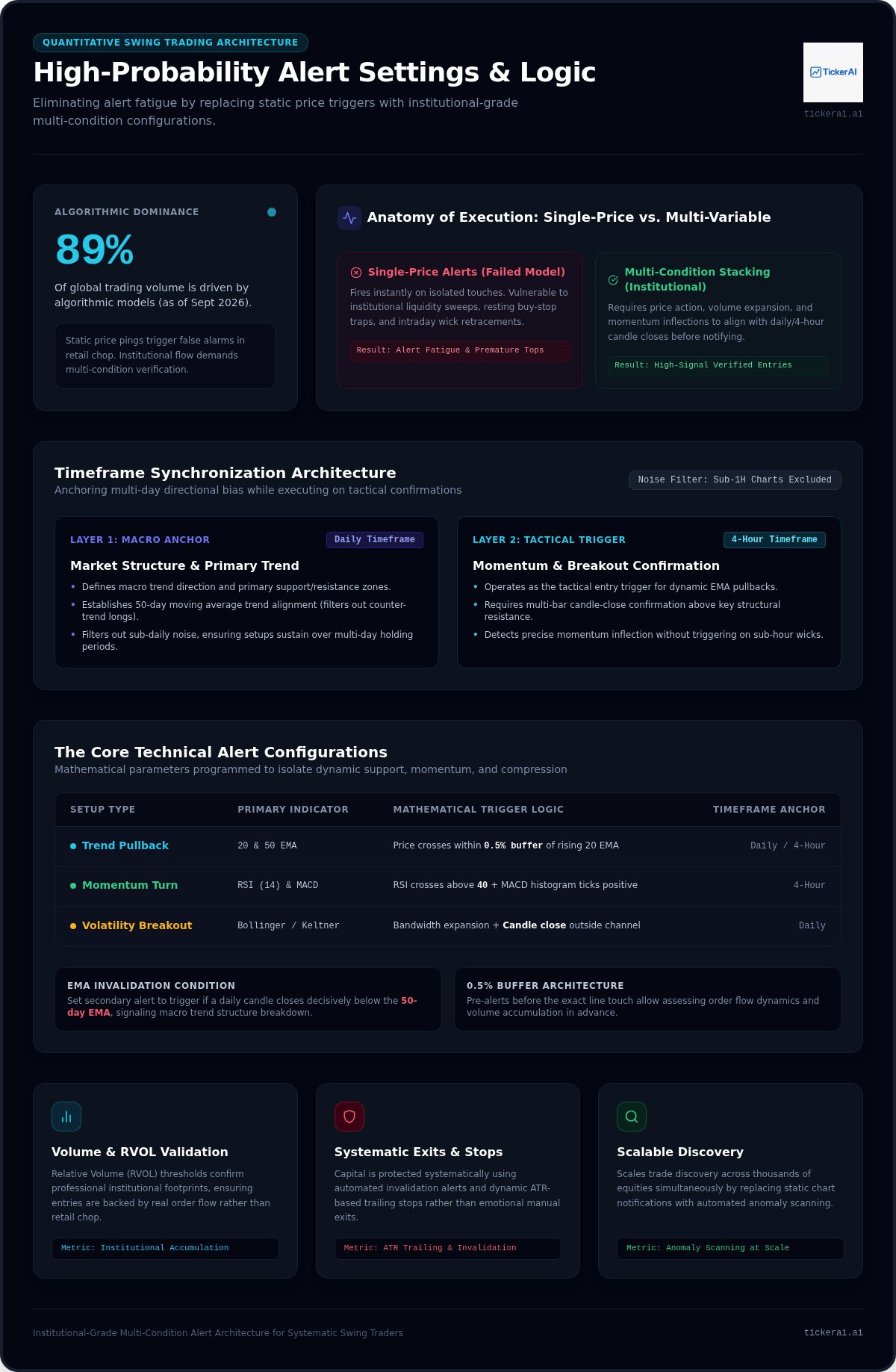
Nearly 89% of global trading volume is driven by algorithmic models as of September 2026, yet many traders still rely on static price pings that fire on pure intraday chop. When an isolated threshold triggers prematurely, you either chase an unconfirmed wick or mute your charts entirely out of frustration. Finding the best alert settings for swing trading isn't about setting more notifications; it's about configuring multi-condition logic anchored to institutional volume and higher-timeframe market structure.
You already know how exhausting it is to battle alert fatigue across conflicting indicators, only to miss an explosive multi-day breakout when it finally runs. This quantitative guide eliminates that guesswork. You'll master the exact technical parameters, timeframe combinations, and automated triggers required to isolate genuine accumulation and capture swing setups with clinical precision. From volume-weighted breakout thresholds to moving-average confluences, here is how to build a high-signal discovery architecture that frees you from manual screen monitoring.
Key Takeaways
- Eliminate alert fatigue by ditching static price thresholds in favor of daily candle-close confirmations that filter out deceptive intraday wicks.
- Deploying the best alert settings for swing trading requires multi-variable triggers, pairing dynamic EMA pullbacks with key structural support levels.
- Validate institutional accumulation by setting Relative Volume (RVOL) thresholds, ensuring you only enter moves backed by professional order flow.
- Protect trading capital systematically using automated invalidation alerts and dynamic ATR-based trailing stops rather than emotional manual exits.
- Scale your trade discovery across thousands of equities simultaneously by replacing static chart notifications with automated anomaly scanning.
Why Single-Price Alerts Fail: The Mechanics of Noise Reduction
Most retail traders configure alerts backward. They drop a horizontal price line across a resistance level, assign an audio notification, and wait. When the price ticks across that line by two cents, their phone buzzes. They buy immediately, only to watch the candle retrace within thirty minutes, leaving them trapped at the absolute top of an intraday wick. This cycle breeds alert fatigue: a psychological state where constant, unconfirmed notifications force traders into erratic, premature entries or cause them to ignore actionable signals altogether.
Static price thresholds generate destructive false positives because they ignore the mechanics of market liquidity. A single price alert tells you where the market is; a multi-variable alert proves institutional commitment. Developing the best alert settings for swing trading demands multi-variable condition stacking: price action, volume expansion, and momentum confirmation working in concert. Without these layers, your system simply reacts to noise.
The Anatomy of a False Breakout
Institutional algorithms frequently run liquidity sweeps above visible resistance to absorb resting retail buy stops. A basic price crossing notification fires precisely inside this trap. Intraday volatility spikes trigger the alert, retail capital rushes in, and institutional sellers immediately fill orders against that incoming demand. True swing trading setups require sustained multi-day commitment. To prevent false entries, your alerts must require multi-bar confirmation, such as a full 4-hour candle close above structural resistance, rather than an instantaneous real-time breach.
Timeframe Synchronization: Daily and 4-Hour Anchoring
Swing trade positions typically develop over several days or weeks. Consequently, signals generated on timeframes below the 1-hour chart represent market noise rather than directional bias. Successful traders use timeframe synchronization to filter conflicting indicator data:
- Daily Anchor: Establishes dominant market structure, defining macro trend direction and primary support or resistance zones.
- 4-Hour Execution: Operates as the tactical trigger, alerting to precise momentum shifts, dynamic pullbacks, and breakout confirmations.
To avoid taking conflicting positions, follow the workflow outlined in how to interpret AI stock signals. Never take an intraday long signal if the daily chart prints lower highs and lower lows against a declining 50-day moving average. Aligning your 4-hour triggers with daily structure ensures the best alert settings for swing trading focus exclusively on institutional-grade setups.
The Core Technical Alert Configurations for High-Probability Swings
Precision execution requires mathematical boundaries rather than visual approximation. Configuring the best alert settings for swing trading means programming your platform to isolate dynamic support zones, momentum inflections, and volatility compression. Instead of guessing where buyers will step in, apply verified parameters across your charting tools.
| Setup Type | Primary Indicator | Trigger Logic | Timeframe |
|---|---|---|---|
| Trend Pullback | 20 & 50 EMA | Price crosses within 0.5% buffer of rising 20 EMA | Daily / 4-Hour |
| Momentum Turn | RSI (14) & MACD | RSI crosses above 40 + MACD histogram ticks positive | 4-Hour |
| Volatility Breakout | Bollinger / Keltner | Bandwidth expansion + candle close outside channel | Daily |
To systematically discover these patterns across broader watchlists without manual configuration, check the professional guide to choosing a swing trade setup finder.
Trend Pullback Alerts: 20-Day and 50-Day EMA Parameters
In sustained uptrends, the 20-day exponential moving average serves as short-term institutional support. Set an alert when the price comes within a 0.5% buffer above the rising 20 EMA. This gives you time to assess order flow before an actual touch. Set a secondary invalidation alert to trigger if a daily candle closes decisively below the 50-day EMA, signaling that the broader trend structure has broken down.
Momentum Reversal Alerts: RSI and MACD Confluence
Buying an asset simply because its Relative Strength Index is oversold often results in catching falling knives. Instead, configure an alert for when the 14-period RSI crosses back above 40 from below. Pair this with a 4-hour MACD histogram inflection alert moving from negative to positive. This multi-condition rule ensures momentum has genuinely turned before you commit capital at key support levels.
Volatility Squeeze Triggers: Bollinger Bands and Keltner Channels
Significant multi-day moves routinely originate from severe volatility compression. Identify consolidation by tracking when standard Bollinger Bands (20, 2) contract entirely inside Keltner Channels (20, 1.5). Set a breakout trigger when the daily close pierces outside the upper band while the bandwidth indicator points sharply upward. Volatility expansion alerts ensure you enter right as the directional impulse begins.
If you prefer an automated engine that continuously tracks these multi-variable conditions across thousands of equities, consider exploring real-time discovery feeds at tickerai.ai to streamline your pipeline.
Volume and Volatility Alerts: Confirming Institutional Footprints
Price moves without abnormal relative volume represent noise; institutional capital always leaves volume footprints. When large funds accumulate equity, they cannot conceal their order flow. They generate massive turnover that pushes price beyond typical ranges. Incorporating volume and volatility parameters into the best alert settings for swing trading prevents you from entering illiquid traps and low-conviction drifts.
Relying on raw share counts is a common mistake. A million shares in an ultra-liquid large-cap stock is normal morning turnover, whereas that same volume in a mid-cap indicates aggressive accumulation. You must configure alerts to measure abnormal expansion relative to historical baseline activity.
Relative Volume (RVOL) Threshold Configuration
Relative Volume compares current volume at a specific time of day to its historical average over a set period. Configure your scanning engine with these strict baseline rules:
- RVOL Threshold: Set alert triggers to fire only when intraday RVOL prints at or above 2.0x relative to the 20-day average.
- Opening Drive Filter: Set an early volume projection alert within the first 30 minutes of regular market hours. If a stock trades 50% of its total 20-day daily average by 10:00 AM Eastern, large blocks are actively changing hands.
- Liquidity Baseline: Filter out thin floats by requiring a minimum liquidity threshold of at least $10 million in average daily turnover.
These volume constraints eliminate erratic penny stocks, isolating genuine institutional accumulation setups instead.
ATR Expansion and Dynamic Range Breakouts
Average True Range measures price volatility over a specific lookback period. A stock breaking out of a multi-week consolidation will exhibit range expansion before embarking on a sustained multi-day run. Configure breakout alerts to fire when an individual daily candle exceeds 1.5x the asset's 14-period daily ATR, accompanied by a close near the highs.
This dynamic ensures you aren't chasing stagnant consolidations. Instead, your system flags the immediate start of directional momentum. For traders scaling this workflow across broad watchlists, coupling dynamic ATR expansion with the machine-driven filters detailed in automated stock market analysis ensures the best alert settings for swing trading execute without requiring constant manual chart surveillance.
Risk Management and Exit Alerts: Protecting Capital Systematically
Entry alerts get all the attention, but exit alerts protect your account balance. Trading without systematic exit notifications leaves risk management to emotional discretion under live market pressure. The best alert settings for swing trading establish automated boundaries for capital preservation before an order is even filled.
A complete risk management alert framework operates in four sequential steps:
- Step 1: Structural Invalidation Alerts. Place an alert one tick below the recent swing low or beneath the rising 50-day moving average. A confirmed daily close below this line invalidates the original setup thesis and requires immediate position closure.
- Step 2: Dynamic Trailing Stop Alerts. Deploy an alert based on Average True Range multiples to trail behind price advances automatically, locking in unrealized gains as the trend develops.
- Step 3: Partial Profit Milestone Alerts. Establish notifications at predefined 2:1 and 3:1 reward-to-risk levels. When triggered, sell down one-third to one-half of the position size to derisk the trade entirely.
- Step 4: Time-Stop Invalidation Alerts. Set a calendar-based alert if a position consolidates for 5 consecutive trading sessions without upward momentum. Stagnant capital incurs opportunity cost; exit sideways positions to deploy funds into active setups.
Trailing Stop Alerts: Dynamic ATR Multiples
Locking in multi-day profits requires dynamic parameters. Anchor trailing stop alerts at 2.0x ATR below the highest swing peak recorded during the trade. As price prints higher highs, adjust the alert trigger upward accordingly. Once the position hits a 2:1 reward-to-risk milestone, tighten that trailing cushion to 1.5x ATR. This systematic technique locks in profit while providing the asset breathing room to trend. For a deeper breakdown on automating discipline, read using AI to remove emotion from trading.
Profit Target Scaling and Distribution Alerts
Institutional distribution gives early warning signs before a sharp reversal occurs. Set price alerts slightly below major overhead resistance levels and previous monthly highs to prepare limit exit orders. Pair these levels with volume exhaustion alerts that fire when an intraday candle creates an abnormal volume spike without upward price progress. Finally, always schedule calendar alerts 24 hours ahead of corporate earnings announcements or major economic releases to close or de-risk swing positions systematically.
To eliminate manual chart management and deploy pre-calculated risk boundaries automatically, configure intelligent tracking with smart watchlists and real-time alerts on TickerAI.
Automating Opportunity Discovery: Scaling Alerts with TickerAI
Managing custom alerts manually breaks down quickly. Setting multi-condition rules across 50 or 100 individual tickers demands hours of tedious charting. As volatility shifts, those static boundaries become obsolete, leaving you with dead alerts or endless false alarms. The best alert settings for swing trading should adapt to market conditions rather than demanding constant manual recalibration.
Cognitive overhead destroys execution discipline. When you spend your energy maintaining alerts, you have less focus left for risk management. Replacing static horizontal alert lines with machine-driven anomaly detection eliminates this maintenance drag entirely.
Algorithmic Anomaly Detection vs. Manual Setting Maintenance
Algorithmic models evaluate thousands of equities simultaneously, identifying institutional footprints in milliseconds. While manual charting requires drawing lines on individual tickers, machine learning scans raw market feeds to isolate real-time shifts in volume profiles, volatility compression, and liquidity absorption. These models flag actionable accumulation patterns well before standard charting indicators register a crossover. To understand the mathematical backbone powering these automated scanning models, explore our guide on what is quantitative investing.
Integrating TickerAI Swing Trade Setups into Your Daily Routine
A streamlined trading desk requires actionable intelligence, not endless screen time. Through the TickerAI Pro and Full-Access intelligence tiers, subscribers receive curated swing trade setups and smart watchlist alerts directly inside their daily routine. Each alert delivers automated technical boundaries, isolating high-probability continuation patterns and volume anomalies without requiring manual chart maintenance.
Pair these algorithmic alerts with your personal position sizing and risk tolerance. You maintain total trade discretion while an institutional scanning engine does the heavy lifting. By leveraging the best alert settings for swing trading through automated intelligence, you spend less time tweaking indicator lines and more time executing disciplined plans. Access institutional-grade market scanning directly via TickerAI.
Upgrade to a Systematic Swing Execution Engine
Capturing consistent multi-day swings doesn't require staring at dozens of fluctuating monitors or reacting to every minor intraday wick. By anchoring entry triggers to institutional volume thresholds, enforcing daily candle-close confirmations, and deploying dynamic ATR trailing stops, you turn erratic market noise into a structured quantitative edge. Mastering the best alert settings for swing trading replaces emotional second-guessing with systematic discipline.
Manual alert maintenance simply cannot scale against modern algorithmic markets. Stop spending hours adjusting static horizontal lines on individual charts. Through automated multi-factor anomaly detection scanning thousands of US equities simultaneously, smart watchlists isolate genuine institutional volume and momentum surges before retail crowds react. Explore TickerAI's AI-powered swing trade setups and alerts to streamline your discovery workflow, protect your capital systematically, and trade with confidence.
Frequently Asked Questions
What are the most reliable alert settings for swing trading breakouts?
The most reliable breakout alerts combine a daily candle close above structural resistance with Relative Volume (RVOL) exceeding 2.0x. Adding an Average True Range expansion requirement of at least 1.5x confirms directional momentum. This multi-condition trigger ensures you enter only when institutional capital supports the move, avoiding the false breakouts typical of isolated price-touch notifications.
How do I prevent alert fatigue when scanning hundreds of stocks?
Prevent alert fatigue by eliminating single-variable price alerts and adopting automated multi-condition anomaly scanning instead. Instead of tracking dozens of manual support lines, deploy smart watchlists that fire only when price, moving average alignment, and abnormal volume converge. Applying the best alert settings for swing trading filters out intraday chop and delivers a concise shortlist of high-conviction trade setups.
Which timeframe is best for setting swing trading technical alerts?
The 4-hour and daily timeframes provide the cleanest signals for swing trading alerts. Daily charts establish primary trend direction and structural support zones, while 4-hour triggers pinpoint dynamic EMA pullbacks and momentum inflections. Setting alerts below the 1-hour chart introduces excessive intraday noise, leading to premature entries and erratic whipsaws.
Should I set price alerts on intraday or daily candle closes?
Configure alerts to trigger on daily candle closes for structural breakouts and trend continuation setups. Intraday price crosses often represent liquidity sweeps designed to trigger retail breakout orders before reversing. Requiring a confirmed candle close ensures that buying or selling pressure holds into the closing bell, validating genuine institutional commitment.
How many technical conditions should an alert require before firing?
A reliable swing trade alert should require three stacked conditions: price location, volume confirmation, and momentum alignment. For example, combine a price pullback into a 20-day EMA with an RVOL reading above 1.5x and an RSI turning hook. Stacking three independent variables filters out false positives while maintaining favorable risk-to-reward entry points.
Can automated alerts completely replace manual chart analysis for swing traders?
Automated alerts replace the tedious labor of manual market screening, but they don't eliminate the need for trade execution discipline. Subscription platforms like TickerAI deliver curated swing trade setups and smart watchlist alerts across thousands of equities simultaneously. However, traders must still manage portfolio exposure, calculate position sizes, and set hard stop-loss orders.
What is the best Relative Volume (RVOL) threshold for swing trade alerts?
An RVOL threshold of at least 2.0x the 20-day average provides the clearest confirmation of institutional order flow. For morning triggers during the first 30 minutes of regular market hours, set alerts for stocks trading at least 50% of their total daily average volume. This filter isolates active institutional accumulation early in the session.


