

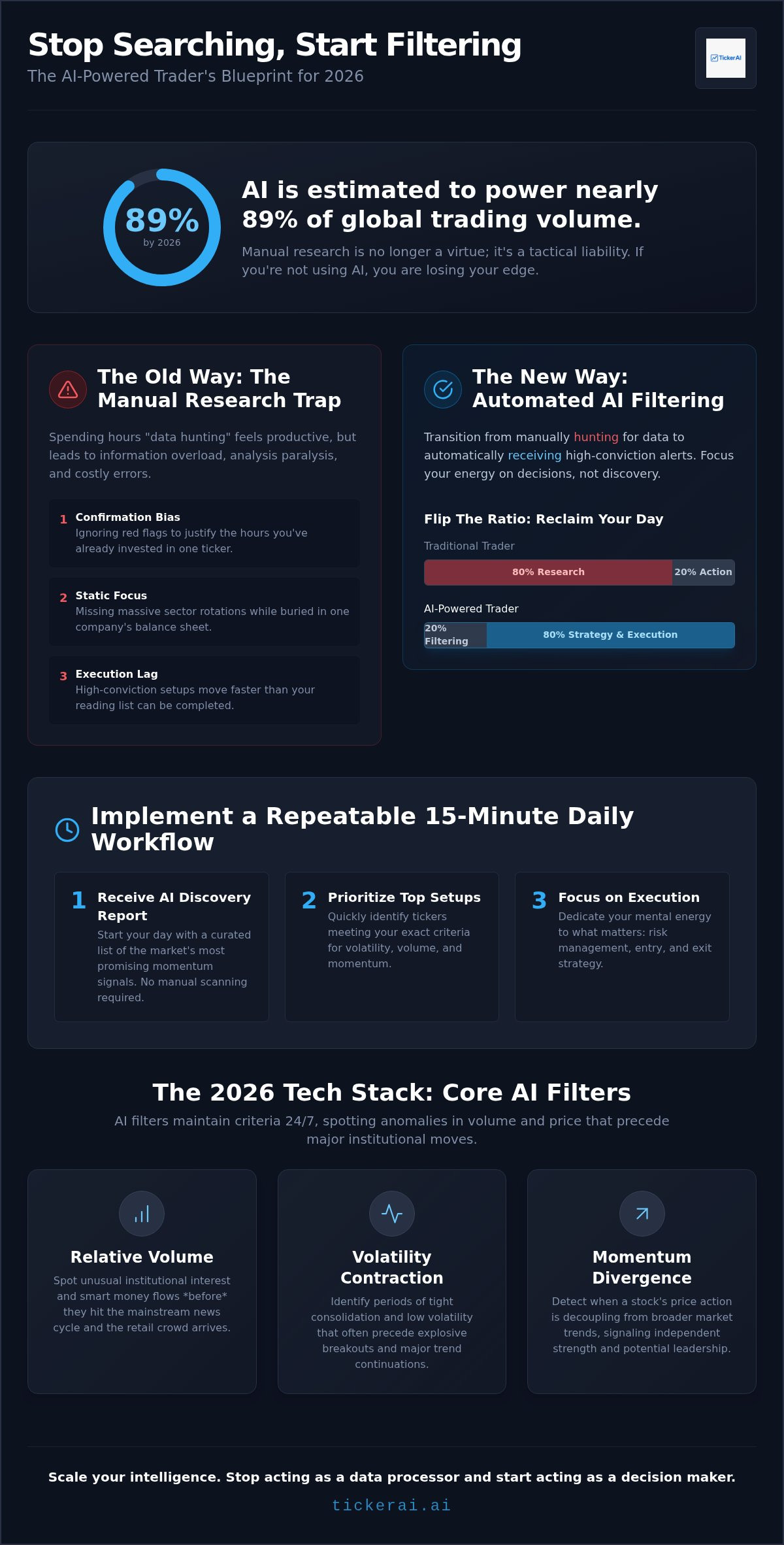
AI is estimated to power nearly 89% of global trading volume in 2026. If you're still manually scrolling through charts and news feeds, you aren't just losing time; you're losing your edge. Learning how to save time on stock research is now the primary differentiator between a professional and a hobbyist. You've likely felt the friction of information overload. Conflicting data points and fragmented news sources lead to analysis paralysis. It's exhausting to scan thousands of tickers only to realize you missed a major move in a sector you weren't even watching.
This guide provides a blueprint to transition from manual market scanning to automated, AI-driven discovery. You'll learn how to reclaim hours of your day while identifying higher-quality trade setups with clinical precision. We'll outline a repeatable 15-minute daily research routine designed for the 2026 market environment. This approach reduces emotional fatigue and ensures you aren't missing high-conviction setups. It is time to stop searching and start filtering. Move from manual labor to high-speed intelligence.
Key Takeaways
- Stop the manual "data hunting" that leads to analysis paralysis. Understand why more data doesn't equal better trades in a market dominated by algorithmic speed.
- Master the transition to automated filtering. We reveal exactly how to save time on stock research by receiving high-conviction alerts instead of scanning charts for hours.
- Leverage the 2026 tech stack. Use AI-powered anomaly detection to spot smart money flows and institutional activity before they hit mainstream news cycles.
- Implement a repeatable 15-minute daily workflow. Reclaim your day by using AI-generated discovery reports to prioritize the most promising momentum signals.
- Scale your intelligence with TickerAI. Position an AI proactive scout to handle the heavy lifting of market scanning while you focus on execution and strategy.
The Information Overload Trap: Why Manual Research Fails in 2026
The "Information Trap" is the most expensive mistake a retail trader can make in 2026. It's the persistent fallacy that more data leads to better decisions. It doesn't. In a market where AI powers nearly 89% of global trading volume, your ability to read faster is irrelevant. Algorithms consume news, filings, and social sentiment in milliseconds. By the time you finish the first page of an earnings report, the price action has already adjusted. Manual research is no longer a virtue; it is a tactical liability.
Manual scanning creates a false sense of security. It feels like productive work, but it's often just noise consumption. To understand how to save time on stock research, you must first accept that your primary job isn't gathering data. It's filtering it. The 2026 market reality demands a "Filtering Mindset" where you ignore 99% of the noise to focus exclusively on actionable market movements.
The Myth of the 'Thorough' Manual Search
Traditional Fundamental analysis remains a cornerstone of value, but manual execution is a bottleneck for active traders. Reading every SEC filing for a potential swing trade is a structural error. It leads to three specific failures:
- Confirmation Bias: The more time you spend researching one ticker, the more you want to be right. You begin to ignore red flags to justify the hours already invested.
- Static Focus: While you're buried in one stock's balance sheet, you miss massive sector rotations happening in real-time.
- Execution Lag: High-conviction setups don't wait for your reading list to be completed.
Opportunity Cost: What Your Research Hours Are Actually Costing You
Every hour spent "hunting" for a setup has a specific dollar value. If your target is professional-level returns, you must value your time at a professional rate. Spending four hours to find one $200 trade setup is a net loss when you factor in mental fatigue. This exhaustion leads directly to analysis paralysis. When the data points conflict, the human brain freezes. You hesitate at the exact moment you should execute.
The most successful participants in the 2026 market don't hunt stocks. They utilize discovery systems. They've mastered how to save time on stock research by moving from a scanning mindset to a filtering mindset. This shift allows you to focus 100% of your mental energy on execution and risk management. Stop acting as a data processor and start acting as a decision maker.
Moving from Manual Scanning to Algorithmic Filtering
Most traders spend 80% of their time finding stocks and only 20% managing their trades. Flip this ratio. The secret to how to save time on stock research is moving from a "hunting" model to a "receiving" model. Instead of scanning 3,000 charts, you wait for high-conviction alerts that meet your specific risk profile. This shift requires a technical infrastructure that prioritizes quality over quantity.
This is where automated stock market analysis becomes your primary leverage. It scales your intelligence by processing thousands of data points across the entire market simultaneously. While a traditional Forbes guide to researching stocks provides a solid foundation for manual due diligence, the 2026 environment requires a tech-forward filter to separate market noise from action-oriented signals. Noise is the daily fluctuation of sentiment; signals are the anomalies in volume and price that precede major institutional moves.
Defining Your Systematic Criteria
Rule-based systems outperform "gut feelings" every time. To automate your discovery, you must define exactly what a high-potential setup looks like for your specific strategy. You don't find the stock; the stock finds you when it crosses your pre-set thresholds. Focus on these core parameters:
- Relative Volume: Spotting unusual interest before the retail crowd arrives.
- Volatility Contraction: Identifying periods of consolidation that precede explosive breakouts.
- Momentum Divergence: Detecting when price action is decoupling from broader market trends.
AI filters maintain these criteria 24/7 without manual input. This ensures that your screen only shows tickers that are mathematically worth your attention, drastically reducing the mental fatigue associated with manual discovery.
The Power of Smart Watchlists
Static watchlists are where trade ideas go to die. Professional discovery requires dynamic, theme-based tracking. Group stocks by catalyst events rather than just industry sectors. You might track stocks with upcoming clinical trial dates, earnings anomalies, or specific smart money inflows. This is the most efficient way to master how to save time on stock research.
An effective system also automates the "pruning" process. If a ticker no longer meets your momentum criteria, it's removed immediately. This keeps your focus lean and actionable. Utilizing a proactive discovery scout ensures your watchlist stays populated with high-conviction setups without you lifting a finger. You spend your time deciding on execution, not searching for tickers.
The 2026 Research Tech Stack: Tools That Reclaim Your Time
In the previous era of trading, sophisticated systematic strategies were the exclusive domain of institutional hedge funds. That barrier has collapsed. Understanding what is quantitative investing is now essential for any retail participant looking to compete. In 2026, the tech stack has evolved from simple data visualization to proactive intelligence. You no longer need to build complex models from scratch; you simply need to deploy the right discovery engines to handle the heavy lifting.
Modern research tools utilize AI-powered anomaly detection to track institutional "smart money" flow in real-time. These systems identify unusual dark pool activity and block trades before they become headline news. Coupled with Natural Language Processing (NLP), these tools scan thousands of earnings call transcripts and SEC filings in seconds. They extract sentiment shifts and key financial metrics instantly, providing a clinical summary that replaces hours of manual reading. This is the foundation of how to save time on stock research while maintaining a professional edge.
AI Discovery Engines vs. Traditional Screeners
A traditional Screener for stocks is a passive tool. It requires you to input static parameters and then manually interpret a list of results. This still leaves the burden of discovery on the user. AI discovery engines flip this workflow. Instead of providing a list of stocks that meet a criteria, they provide high-conviction setups based on pattern recognition and historical probability.
The speed advantage is absolute. While a human trader might analyze ten charts in an hour, an AI engine processes thousands of data points in milliseconds. It identifies complex technical breakouts and volume climaxes across the entire market simultaneously. It doesn't just show you what is happening; it alerts you to what is about to happen based on multi-variable data clusters that static filters simply cannot detect.
Automating Fundamental and Technical Overlays
The most significant time-sink in traditional research is the synthesis of conflicting data points. Automating this overlay is how to save time on stock research at scale. AI tools now summarize thousand-page filings into core bullish and bearish theses, highlighting risks that human eyes often overlook during late-night sessions. This eliminates the bottleneck of manual due diligence.
- Pattern Recognition: Automated technical analysis identifies wedges, flags, and support levels without you drawing a single line.
- Sentiment Integration: Real-time monitoring of social sentiment and news flow gauges market emotion without requiring you to browse forums.
- Real-Time Alerts: Alert engines replace manual chart monitoring, notifying you only when a price action trigger occurs.
By integrating these automated overlays, you shift your focus from data entry to strategic decision-making. Your research stack becomes a tireless assistant that filters the noise, leaving you with only the most actionable opportunities.
A 15-Minute Daily Stock Research Workflow
Efficiency is not about working harder. It's about systemizing the discovery process. For the modern professional, how to save time on stock research comes down to a structured, repeatable sequence that prioritizes high-probability setups over general market noise. You don't need two hours of analysis. You need 15 minutes of clinical execution. This workflow assumes you have already deployed the tech stack discussed in the previous section.
- Step 1: Review the overnight AI-generated discovery report (3 minutes). Start your day with the output of your proactive scout. This report filters global market activity while you sleep, presenting only the tickers that meet your specific volatility and volume thresholds.
- Step 2: Filter the smart watchlist for momentum signals (4 minutes). Identify which names from your core list are showing real-time strength. Focus on those decoupling from the index or showing unusual relative strength.
- Step 3: Evaluate how to interpret AI stock signals against your risk parameters (5 minutes). Cross-reference the signal's conviction level with your stop-loss and position sizing rules. This is where your human judgment adds value to the machine's raw data.
- Step 4: Set automated entry/exit alerts and close the terminal (3 minutes). Once your orders or alerts are set, your job is finished. The system monitors the price action while you focus on your primary career or other objectives.
Morning Routine: The Discovery Phase
The discovery phase is about aggressive exclusion. Professional traders ignore 99.9% of the market. Your goal is to identify the "Daily Top 3" high-potential movements. Financial television and social media forums are designed for entertainment, not execution. They provide lagging indicators and emotional noise. By relying on an AI-generated report, you bypass the "Information Trap" and start your day with a clear, data-driven objective. This is the most effective way to master how to save time on stock research without sacrificing quality.
Execution Phase: Setting and Forgetting
Closing the research terminal early is the ultimate sign of a professional workflow. It demonstrates trust in your systematic discovery process. Alerts should trigger action, not more research. If an alert hits, you execute your pre-defined plan. If it doesn't, you remain on the sidelines. This discipline prevents overtrading and reduces emotional fatigue. To implement this high-speed workflow today, access our automated discovery tools and reclaim your morning.
Scaling Your Intelligence with TickerAI
TickerAI is the practical realization of the filtering mindset discussed throughout this guide. It acts as your proactive scout, scanning thousands of tickers in real-time while you focus on high-level execution. This is the ultimate answer to how to save time on stock research in a market that moves at the speed of algorithms. By delegating the discovery phase to our AI, you eliminate the friction of manual scanning and the fatigue of data overload.
Choosing between TickerAI Pro and TickerAI Full-Access depends on your specific operational requirements. The TickerAI Pro subscription is engineered for the time-starved professional who needs real-time alerts and curated swing trade setups delivered with clinical precision. TickerAI Full-Access provides the complete intelligence layer, including long-term investment ideas and deep smart money tracking. Both tiers ensure you stay informed without being glued to a research terminal, transforming the way you interact with market data.
Automated Market Scanning for High-Potential Setups
Our AI identifies structural anomalies and momentum breakouts the moment they materialize. By tracking institutional smart money flow and technical divergences, the platform surfaces setups with the highest mathematical probability of success. You no longer hunt for ideas; they arrive as curated alerts. This systematic approach ensures that you are always positioned where the capital is flowing, rather than reacting to yesterday's news.
TickerAI utilizes advanced algorithmic filtering to distill over 10,000 global tickers into a handful of high-conviction, actionable alerts delivered in real-time. This level of compression is what allows the 15-minute workflow to be so effective. You spend your limited time evaluating the "Daily Top 3" rather than drowning in a sea of mediocre tickers.
The TickerAI Edge: Professional Discovery for Individuals
Thousands of serious participants use TickerAI to cut their research time by 90%. This isn't just about speed; it's about shifting your identity in the market. You move from being a manual researcher burdened by data to a portfolio manager empowered by high-speed intelligence. This transition is essential for maintaining a competitive edge in 2026. Automated discovery handles the labor, while you handle the decision-making.
Reclaim your day and eliminate the mental fatigue of manual scanning. Mastering how to save time on stock research is a choice to leverage technology over labor. Start saving time with TickerAI Full-Access today.
Mastering the 2026 Market Intelligence Layer
The era of manual data hunting has ended. Success in the current environment requires a clinical shift from information gathering to systematic filtering. By implementing a 15-minute daily workflow and leveraging an AI-powered tech stack, you reclaim the hours lost to analysis paralysis. Professional participants don't read more; they process smarter. They value speed, clarity, and precision over the volume of data consumed.
This guide has outlined how to save time on stock research by transitioning to automated discovery. You now have the blueprint to replace manual scanning with high-conviction alerts. TickerAI provides the proactive scout you need to monitor 10,000+ tickers and deliver real-time swing trade setups directly to your terminal. It is the intelligence layer trusted by professionals to maintain an edge in a high-speed market. It's time to stop acting as a data processor and start acting as a decision maker.
Stop wasting hours on manual research. Get TickerAI Pro Alerts. Your time is your most valuable capital. Deploy it on execution and let the machine handle the discovery.
Frequently Asked Questions
How can I reduce the time I spend on stock research without missing trades?
Shift from manual scanning to automated discovery. Use AI to monitor thousands of tickers simultaneously and trigger alerts when specific momentum or volume criteria are met. This ensures you only review stocks that are mathematically worth your attention. Learning how to save time on stock research involves trusting a systematic filter to handle the heavy lifting while you focus exclusively on trade execution and risk management.
Is AI stock research more accurate than manual analysis?
AI excels at processing objective data clusters and identifying anomalies that human eyes often miss. While manual analysis is prone to confirmation bias and emotional fatigue, AI remains clinical and consistent. In 2026, where AI powers nearly 89% of global trading volume, using algorithmic discovery provides a data-driven edge. It identifies high-probability setups based on historical patterns and real-time smart money tracking rather than subjective gut feelings.
What is the most time-consuming part of stock research to automate first?
Automate the discovery phase first. Hunting for setups across thousands of tickers is the primary bottleneck for most traders. Deploying an AI proactive scout to scan the market for specific technical breakouts or volume climaxes reclaims hours of your day. By automating this initial filter, you move directly to the decision-making phase. This is the most effective way to master how to save time on stock research and reduce mental exhaustion.
Can beginners use AI tools to save time on research?
Yes, modern AI tools are designed for practical accessibility. You don't need to be a quantitative analyst to benefit from curated swing trade setups or smart watchlists. These platforms translate complex market mechanics into actionable signals. For a beginner, this prevents information overload and provides a structured environment to learn market dynamics. It allows new participants to focus on learning execution strategies rather than getting lost in fragmented news feeds.
How do I filter out market noise and focus on quality stock alerts?
Define strict systematic criteria for volatility, volume, and momentum. Noise is the daily fluctuation of sentiment; quality signals are the anomalies that precede institutional moves. Use AI-powered anomaly detection to ignore general news chatter and focus exclusively on tickers showing significant relative strength or smart money inflows. This clinical approach ensures your terminal only displays setups that meet your pre-defined risk parameters, eliminating distractions.
What is a smart watchlist and how does it save time?
A smart watchlist is a dynamic tracking system that automatically updates based on catalyst events and technical triggers. Unlike static lists, it prunes tickers that no longer meet your criteria and adds new high-potential names in real-time. This eliminates the need for manual maintenance. It organizes stocks by themes, such as earnings anomalies or sector rotations, ensuring you are always looking at the most relevant opportunities without manual effort.
How much time should a professional trader spend on research daily?
A professional workflow in 2026 should take approximately 15 to 30 minutes. This efficiency is achieved by reviewing pre-filtered discovery reports rather than performing raw data analysis. The goal is to spend your mental energy on portfolio management and execution, not ticker hunting. Spending multiple hours on manual research often leads to diminishing returns and analysis paralysis. Efficiency is the hallmark of a professional participant in a fast-moving environment.
Do I need technical skills to use automated stock discovery tools?
You do not need programming or advanced technical skills. Modern discovery engines provide a tech-forward interface that is practically accessible for any serious trader. The platform handles the algorithmic processing in the background, delivering clear alerts and curated setups. Your primary requirement is an understanding of your own risk parameters and trading strategy. The technology acts as a high-speed assistant, not a complex barrier to entry.


