

In 2026, stock research isn't a battle of who has the most data. It's a battle of who filters it fastest. Retail traders now command 25% of daily market volume, yet most are still drowning in lagging indicators and social media hype. If you feel paralyzed by too many charts or find yourself chasing moves out of fear, you must learn how to simplify stock research for beginners. The traditional manual approach is obsolete. Success requires a clinical, data-driven strategy that separates actionable signals from market noise before the opportunity vanishes.
You likely recognize that spending hours reading financial reports isn't a sustainable way to build wealth. It's frustrating to watch a swing trade setup pass you by because you were stuck in analysis paralysis. This guide changes that. You'll learn how to cut through the clutter and build a professional-grade stock research workflow in minutes using automated discovery tools. We'll outline a repeatable daily routine that provides confidence in identifying trade setups and long-term ideas. From smart watchlists to real-time anomaly detection, this is your systematic roadmap to high-speed market intelligence.
Key Takeaways
- Learn how to simplify stock research for beginners by replacing inefficient manual data gathering with high-speed automated discovery tools.
- Identify the two essential pillars of analysis—EPS growth momentum and technical trend direction—to isolate actionable signals from market noise.
- Transition from static screening to real-time anomaly detection to capture institutional buying patterns and high-momentum moves.
- Implement a 3-step daily research routine designed to validate swing trade setups using a clinical, rule-based checklist.
- Utilize TickerAI’s Full-Access and Pro tiers to automate the search for high-potential investments and professional-grade market intelligence.
Why Traditional Stock Research Fails Beginners in 2026
At its core, stock research is the methodical process of identifying discrepancies between a company's intrinsic value and its current market price. This fundamental exercise in stock valuation helps investors determine if a security is overbought or undervalued. However, the traditional methods used to arrive at these conclusions have become a liability for the modern retail trader. Reading every 10-K filing and quarterly earnings report is a strategy designed for institutional analysts with 80-hour work weeks. For individuals, this is the "Manual Trap." It's an inefficient use of time that often results in missing the very price action you were trying to predict. It's not about how much you read; it's about what you choose to ignore.
Learning how to simplify stock research for beginners starts with acknowledging that 99% of available data is noise. Market signals, which are the specific catalysts that actually drive institutional buying and significant price movement, are rare. Successful participants in 2026 have abandoned the "gather everything" mindset. They favor a systematic approach to stock investing. This shift prioritizes speed and clinical filtering over raw data volume. It ensures you're looking at the 1% of data that actually moves the needle while others are buried in paperwork.
The Problem of Information Overload
The 24/7 news cycle creates a constant state of false urgency. Retail investors are bombarded with alerts that suggest every headline requires immediate action. Most social media "stock tips" are equally dangerous. They often lead to poor execution because they lack a data-driven basis and rely on hype rather than mechanics. This flood of unverified information leads directly to Analysis Paralysis. Analysis Paralysis is the primary barrier to beginner success; it's the state where an investor is so overwhelmed by conflicting indicators that they fail to make any decision at all.
Manual Hunting vs. Automated Discovery
Manual hunting is like searching for a needle in a global haystack. It's slow, prone to human error, and emotionally taxing. You're forced to react to the market rather than anticipate it. In contrast, automated discovery uses technology to bring the "needles"—high-conviction setups—directly to you. By leveraging automated stock market analysis, you can scan thousands of tickers for anomalies and institutional volume in seconds. This allows you to focus your energy on high-level decision-making instead of tedious data entry. It transforms research from a chore into a competitive advantage.
The Two Pillars of Simplified Analysis: Fundamentals and Technicals
Most beginners get lost in the debate between fundamental and technical analysis. In the 2026 market, choosing one over the other is a strategic error. A hybrid, "techno-fundamental" approach provides the clearest signal. It combines the structural strength of a company with the immediate reality of its price action. Understanding how to simplify stock research for beginners means focusing on high-impact metrics rather than exhaustive spreadsheets. You want to know if a company is fundamentally strong and if the market actually cares enough to move the price.
Fundamental Analysis Without the Spreadsheet
You don't need to be a CPA to understand a company's health. Focus on two critical drivers: Earnings Per Share (EPS) growth and revenue momentum. If a company isn't growing its bottom line, it's stagnant. Institutional ownership is another vital signal. When pension funds and large banks increase their stake, it validates the company's long-term viability. AI tools for long-term investors now summarize these complex health metrics in seconds. This prevents the "Value Trap" scenario. A value trap occurs when a stock looks cheap based on traditional ratios but lacks the catalysts to ever trend upward. Clinical filtering ensures you only allocate capital to companies with proven financial velocity.
Technical Analysis for Non-Chartists
Price action is the ultimate truth. While fundamentals explain the "why," technicals reveal the "when." You don't need to spend your evenings manually drawing trendlines. Automated pattern recognition tools can now identify trend direction and key support levels with precision. For beginners, the "Momentum Breakout" is the most reliable setup to master. It occurs when a stock clears a significant resistance level on high relative volume. This signal suggests that institutional buyers are aggressively entering the fray. Instead of guessing a bottom, you're following the money. Utilizing a smart watchlist ensures these breakouts are flagged the moment they occur, allowing for immediate execution.
Combining these pillars creates a professional-grade filter. A stock with accelerating revenue that is breaking out of a consolidation base represents a high-probability trade. By automating the detection of these dual signals, you remove the emotional bias that often leads to FOMO or premature exits. It's a calculated, systematic process that replaces guesswork with data. This hybrid model ensures you're always positioned in the strongest stocks at the most opportune moments.
Manual Screening vs. AI-Powered Discovery
Traditional screening is a filtered search. You set rigid parameters like price-to-earnings ratios or specific market caps. It's binary. If a stock hits $50.01, it disappears from your "Under $50" list. This is a reactive way to manage a portfolio. To understand how to simplify stock research for beginners, you must move beyond these static boundaries. Screening tells you what happened in the past. Discovery tells you what's happening right now. Static screeners often miss the fastest-moving opportunities because they can't account for sudden shifts in momentum or sentiment. Modern investors gain an edge by finding thematic investment opportunities with AI to identify emerging sectors before they hit the mainstream headlines.
The Limits of Static Screeners
Screeners are limited by your own knowledge. You can only search for what you already know to look for. If you don't know that a specific relative volume spike indicates a potential reversal, you'll never set the filter for it. AI discovery flips this script. It finds patterns you didn't think to search for. There's a fundamental difference between "looking for a stock" and "detecting a move." One is a manual hunt through a database; the other is a high-speed intelligence operation. Automated systems scan thousands of tickers simultaneously. They identify anomalies that manual filters simply can't catch. This transition saves hours of tedious labor and reduces the risk of human oversight.
Detecting Smart Money and Anomaly Flow
Institutional buying is the most reliable signal for beginners. Large funds don't buy in a single transaction. They leave footprints in the tape. Algorithmic scanning detects these footprints, including "dark pool" activity and unusual high-volume clusters that signal institutional accumulation. This isn't about reading the news. It's about monitoring the flow of capital in real-time. By the time a move is "news," the best entry point has usually passed. Transitioning from reactive trading to proactive discovery allows you to enter positions while the smart money is still building their stake. It turns the market from a chaotic environment into a structured field of actionable data points. You're no longer guessing where the market might go; you're following the visible path of institutional capital.
This systematic approach ensures that your research routine is both comprehensive and streamlined. Instead of spending your morning adjusting filters, you spend it reviewing high-conviction alerts. The goal is to spend less time "hunting" and more time "deciding." In the 2026 market, speed is the ultimate currency. Automated discovery provides that speed, allowing you to act with the confidence of a professional analyst without the years of manual training. It's the most efficient way to build a professional-grade workflow in minutes.
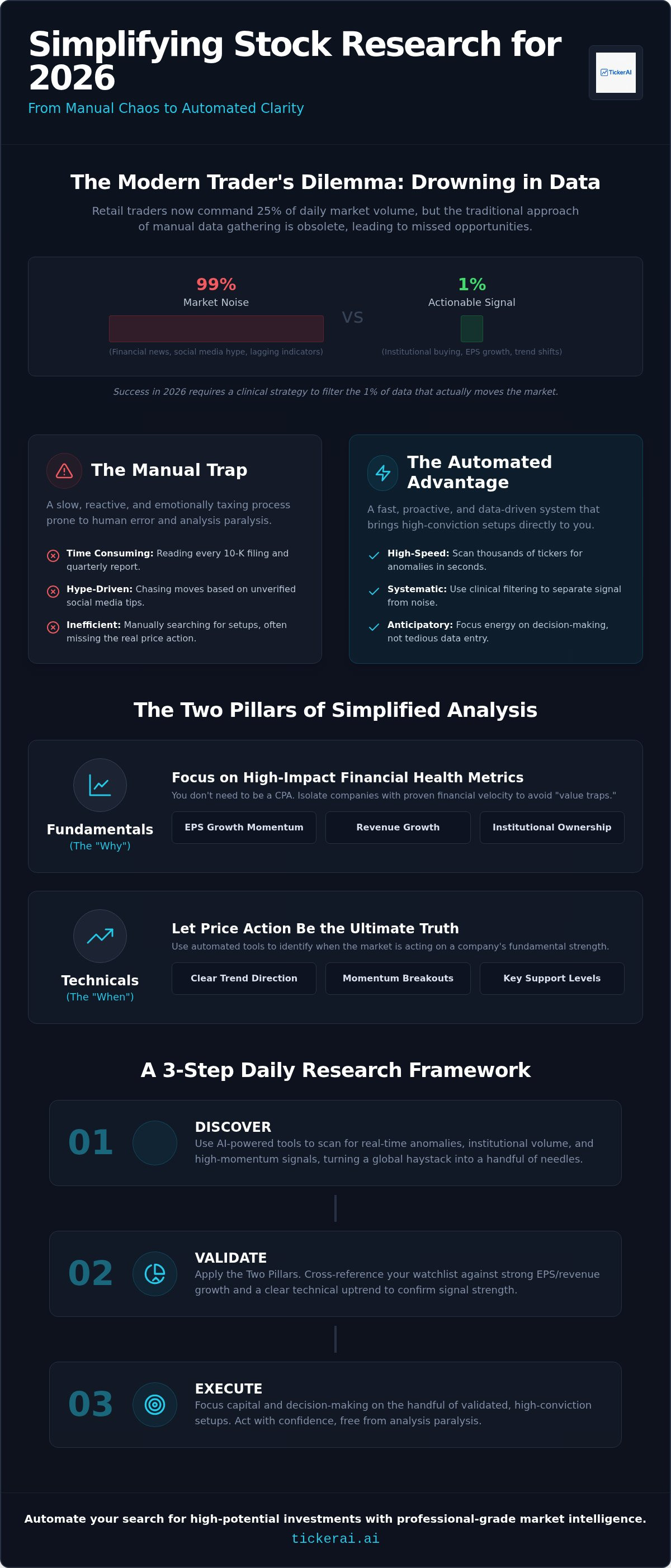
A 3-Step Framework to Simplify Your Daily Routine
Consistency is the differentiator between professional traders and hobbyists. Most retail investors fail because their process is disorganized and reactive. Learning how to simplify stock research for beginners requires a transition from manual hunting to a time-boxed, systematic sequence. You don't need eight hours of screen time. You need a high-speed intelligence workflow that delivers results in minutes. By using AI to remove emotion from trading, you replace gut feelings with a clinical, three-step execution model.
- Step 1: Review High-Conviction Alerts. Start your day by scanning automated alerts for momentum breakouts. Focus only on tickers with unusual volume and price action that align with your strategy.
- Step 2: Apply the Rule-Based Checklist. Run every alert through a strict set of criteria. If a stock doesn't meet every requirement, discard it immediately.
- Step 3: Update Your Smart Watchlist. Move the surviving candidates into a categorized watchlist. Set price-level alerts so you only engage when the stock hits your specific entry point.
Establishing Your Rule-Based Checklist
A checklist acts as a defensive barrier against bad trades. Never enter a position without a pre-defined exit strategy. This includes both your profit target and your stop-loss level. Professionals often utilize the 2% rule; they never risk more than 2% of their total account equity on a single trade. This protects you from catastrophic loss during periods of high volatility. Risk Management is the proactive limitation of potential downside to ensure capital preservation across multiple market cycles. Without these rules, research is just guesswork. With them, it's a calculated business operation.
Optimizing Your Smart Watchlist
Your watchlist should be a filtered repository of high-potential ideas. Categorize stocks by theme, such as AI, Energy, or Biotech. This helps you identify which sectors are attracting the most institutional capital. Stop watching the screen all day. It leads to overtrading and fatigue. Instead, set alerts for specific price levels and let the market come to you. This transforms the 8-hour grind into a 15-minute daily check-in. It allows you to focus on decision-making while your Smart Watchlist monitors the tape. Mastering how to simplify stock research for beginners is not about working harder; it is about utilizing high-speed intelligence to work smarter.
This systematic framework ensures that your research is proactive rather than reactive. It eliminates the need for constant monitoring and reduces the cognitive load associated with market analysis. When you follow a repeatable routine, you build the discipline necessary for long-term success. The market rewards those who treat research as a methodical process. By automating the discovery phase and strictly enforcing your checklist, you maintain a professional edge in any environment.
TickerAI: Automating the Search for High-Potential Moves
TickerAI serves as the engine for the systematic framework established in the previous sections. It is a proactive scout designed for a chaotic market environment. Manual research is a liability; high-speed intelligence is a requirement. If you want to know how to simplify stock research for beginners, you must delegate the data filtering to an algorithmic partner. The platform doesn't just provide data. It prioritizes it. By scanning for real-time anomalies, TickerAI detects momentum breakouts before they become mainstream news. This clinical approach ensures you are reacting to institutional flow rather than social media sentiment.
The curated swing trade setups provide actionable insights without unnecessary fluff. These are not mere suggestions. They are data-driven observations based on technical indicators and market mechanics. To maximize the value of these alerts, investors should study how to interpret AI stock signals. This knowledge transforms raw alerts into a calculated execution strategy. It allows you to move from observation to action with professional precision.
Smart Watchlists and Real-Time Alerts
Manual scanning is a relic of the past. TickerAI monitors over 5,000 stocks simultaneously to deliver automated notifications directly to your terminal. The platform acts as a sophisticated filter. It reduces the entire market into a handful of high-conviction ideas. This eliminates the "Analysis Paralysis" mentioned earlier. You can customize these alerts to align with your specific risk tolerance and investment goals. Whether you are looking for short-term swing trade setups or curated long-term investment ideas, the smart watchlist ensures you never miss a significant move. It is a tireless assistant that is always "on," scanning while you focus on decision-making.
Pro vs. Full-Access: Choosing Your Intelligence Tier
Selecting the right tier depends on your specific objectives. TickerAI Pro is optimized for traders who require consistent swing trade setups and high-speed alerts. It provides the essential tools for daily market discovery. TickerAI Full-Access offers a deeper level of intelligence, including advanced algorithmic processing and a broader range of investment ideas. Mastering how to simplify stock research for beginners involves choosing a tier that matches your capital allocation strategy. Both tiers offer professional-grade tools at a retail-accessible budget. This democratization of data allows beginners to compete with institutional players. It is time to stop the manual hunt. It is time to start the discovery process. Start simplifying your research with TickerAI to gain a persistent edge in the 2026 market.
Mastering the 2026 Market Efficiency
The 2026 market doesn't reward raw effort; it rewards algorithmic efficiency. Continuing to hunt for tickers manually is a path to exhaustion and missed opportunities. By adopting a systematic approach, you replace emotional guesswork with clinical, data-driven execution. You now understand how to integrate fundamental growth with technical momentum and how to execute a time-boxed daily routine. Mastering how to simplify stock research for beginners isn't about finding more information. It's about deploying a high-speed intelligence partner to filter the noise for you.
Success in this environment requires the right tools to detect institutional flow in real-time. Professional-grade discovery is no longer reserved for the institutional elite. It's accessible to any retail investor willing to automate their workflow. You're ready to transition from a reactive observer to a proactive participant with a persistent edge.
Stop manual hunting. Start automated discovery with TickerAI. Leverage AI-powered swing trade setups and real-time momentum breakout alerts to secure your position. The market is moving; it's time to trade with precision and confidence.
Frequently Asked Questions
Is stock research difficult for beginners?
It is traditionally difficult due to information overload, but modern tools eliminate the steep learning curve. The difficulty stems from manual data entry and conflicting indicators. Learning how to simplify stock research for beginners involves shifting from manual searching to automated discovery. When you use AI to filter 5,000+ tickers, the process becomes a matter of clinical decision-making rather than tedious data gathering. This saves time and reduces emotional stress.
How much time should a beginner spend on stock research daily?
A beginner should aim for a time-boxed 15-minute daily check-in rather than an 8-hour grind. Efficiency is more valuable than duration in the 2026 market. By reviewing automated alerts and updating a smart watchlist, you can identify high-potential moves without sacrificing your entire day. This systematic approach ensures you stay informed while avoiding the psychological fatigue that often leads to poor execution. It turns research into a repeatable, low-stress business routine.
Can AI really find better stocks than a human analyst?
AI excels at detecting real-time anomalies and institutional volume that human analysts often miss due to cognitive bias or physical limitations. Algorithms scan the entire market in milliseconds to identify footprints like unusual volume clusters. While humans provide the final decision-making logic, AI acts as a tireless scout. It prioritizes actionable signals over social media hype, providing a more objective foundation for your trades. This speed is essential in a fast-moving environment.
What is the most important metric to look at for a new stock?
Earnings Per Share (EPS) growth combined with relative volume is the most critical dual-metric for new investors. EPS growth validates the company's fundamental health, while high relative volume indicates institutional interest. A stock with strong financials but no volume is a value trap. You need both pillars to confirm a high-probability setup. Focus on stocks clearing key resistance levels on significant volume to ensure momentum is on your side during the trade.
How do I filter out market noise during high volatility?
Filtering market noise requires a clinical, rule-based checklist that ignores short-term headline fluctuations. Volatility often creates false urgency. To maintain discipline, focus exclusively on your pre-defined technical indicators and fundamental catalysts. Automated discovery tools help by only alerting you when a move meets specific, high-conviction parameters. This prevents you from chasing FOMO-driven moves and keeps your strategy grounded in verifiable market mechanics. It is the most effective way to stay objective.
Do I need a large budget to use professional stock discovery tools?
No, the democratization of financial data in 2026 means professional-grade discovery is accessible on a retail budget. Subscription tiers like TickerAI Pro and Full-Access provide sophisticated market scanning without the institutional price tag. This allows beginners to utilize the same intelligence as hedge funds. You don't need significant capital to start; you just need the right technology to ensure your limited capital is allocated efficiently to the highest-potential setups available.
What is the difference between a stock alert and a personal recommendation?
A stock alert is a data-driven notification based on specific technical or fundamental triggers. It is an objective observation of market activity. In contrast, TickerAI does not provide personal financial advisory or custom trading coaching. Alerts are tools for your own research process. You must apply your own risk management rules and checklist to determine if an alert aligns with your specific portfolio goals. The final decision to execute a trade always remains with the user.
Can I use TickerAI for long-term investing or just swing trades?
TickerAI is designed for both short-term swing trade setups and curated long-term investment ideas. The platform’s algorithms detect immediate momentum breakouts for active traders while also identifying long-term value discrepancies based on EPS and revenue trends. Whether you are building a retirement portfolio or seeking weekly gains, the automated scanning provides a comprehensive view of market opportunities. This flexibility is key for those learning how to simplify stock research for beginners in any market cycle.


