

The era of manual chart scanning is over. In a market where AI infrastructure investment is projected to hit $3 trillion by 2028, relying on human eyes to spot momentum is no longer just slow; it's a structural disadvantage. Algorithmic stock picking for individuals has transitioned from a niche quant experiment to a mandatory intelligence layer for serious participants. You've likely felt the pressure of the 24/7 news cycle or the sting of missing a breakout because you were stuck analyzing a different sector. Emotional decision-making and FOMO are the natural results of information overload, but they don't have to define your performance.
This guide shows you how to reclaim your time and sharpen your execution. We will detail how to move beyond manual research to a repeatable, data-driven workflow that detects momentum before the crowd arrives. You'll learn to leverage high-speed discovery tools to filter the noise and focus only on high-probability setups. We're breaking down the transition from a manual scanner to a proactive scout, ensuring you maintain a professional-grade edge in the 2026 market. It's time to stop chasing the tape and start anticipating it.
Key Takeaways
- Shift from the "Information Age" of manual scanning to the "Intelligence Age" by utilizing automated filtering to survive 2026 market volatility.
- Understand the mechanics of pattern recognition to identify "coiled" momentum breakouts before they become mainstream news.
- Adopt algorithmic stock picking for individuals to replace emotional, "hope-based" trading with a systematic, evidence-based discovery workflow.
- Implement a repeatable 4-step process-Discovery, Validation, Risk Assessment, and Execution-to scale your market intelligence without increasing screen time.
- Leverage professional-grade tools like TickerAI to maintain a proactive edge through real-time alerts and curated swing trade setups.
The Evolution of Stock Selection: Why Individuals Need an Algorithmic Edge in 2026
The transition from the Information Age to the Intelligence Age is complete. In previous decades, market success depended on access to data. Today, data is a commodity. The new bottleneck is the human capacity to process it. Algorithmic trading and systematic discovery have become the standard for institutional players, leaving "gut-based" retail traders at a structural disadvantage. Algorithmic stock picking for individuals is no longer a luxury; it's a defensive necessity in a high-speed environment.
Institutional quants have long utilized automated systems to exploit micro-inefficiencies. While many retail participants still rely on lagging indicators or social media sentiment, professionals use automated filtering to detect momentum shifts in real-time. Speed of discovery is the primary differentiator in the 2026 market. If you're waiting for a news alert, you're likely the exit liquidity for an algorithm that spotted the move hours earlier. Success now requires a shift from manual labor to systematic oversight.
From Manual Scanning to Automated Discovery
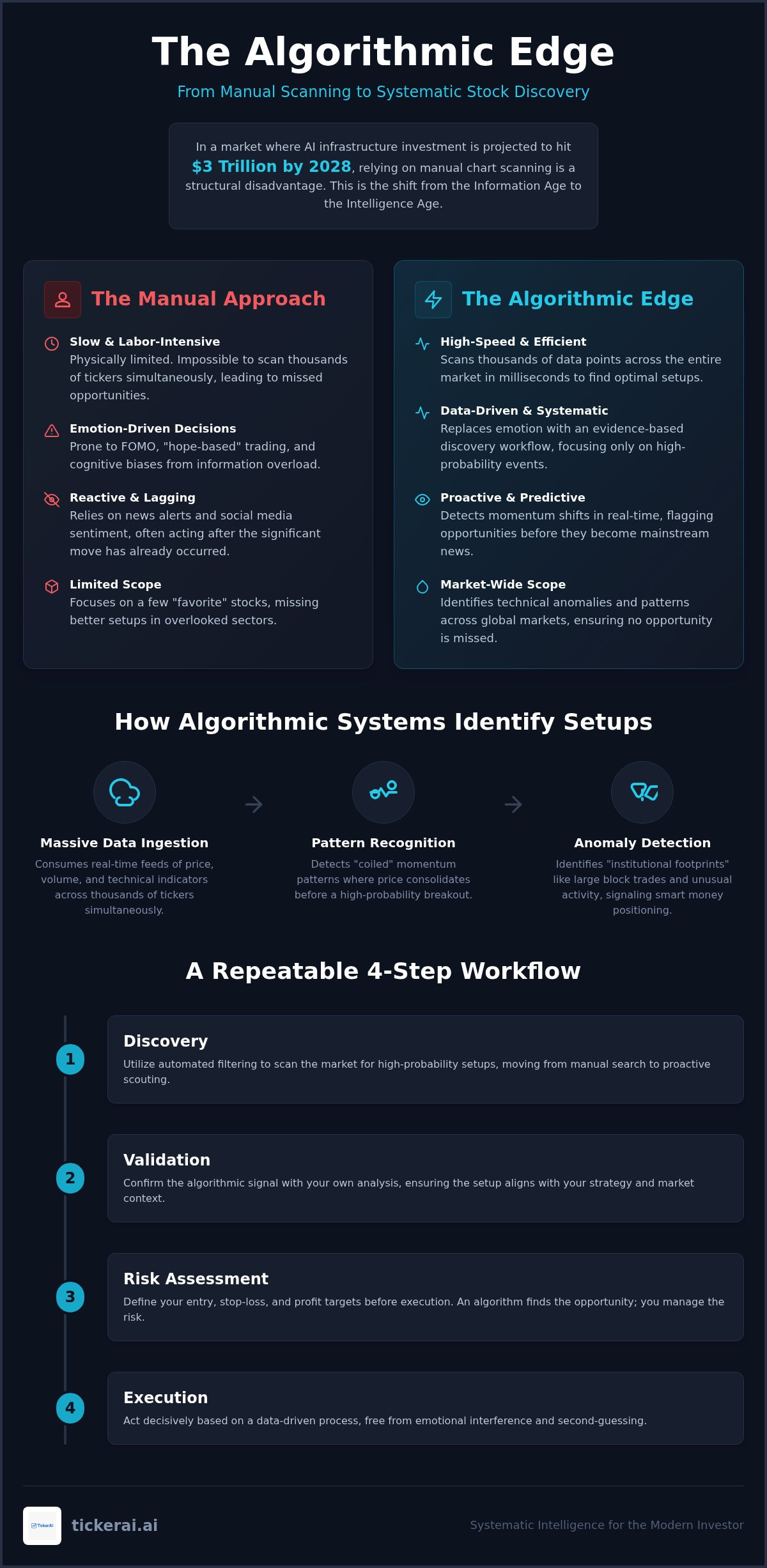
Manual chart analysis is physically limited. You can't scan thousands of tickers across global markets simultaneously. Human fatigue leads to missed setups and inconsistent execution. AI-driven discovery solves this by filtering thousands of data points in milliseconds. It identifies specific technical anomalies, such as "coiled" volume patterns or RSI divergences, across the entire market instantly. Algorithmic stock picking for individuals serves as a high-speed force multiplier for your existing research workflow.
The Institutional Advantage for Retail Investors
The 2026 market landscape has democratized tools previously reserved for billion-dollar hedge funds. The "coding barrier" has vanished. Modern platforms offer no-code interfaces, allowing you to deploy sophisticated logic without writing a single line of Python or C#. This shift allows you to identify "Alpha" by focusing on systematic discovery rather than manual labor. You aren't just trading; you're managing an intelligence network. This level of precision ensures you prioritize high-probability setups while avoiding the noise of a 24/7 market cycle. It's about scaling your intelligence through technology.
Decoding the Mechanics: How Algorithmic Systems Identify High-Probability Setups
Algorithmic systems don't guess; they process raw market data with clinical precision. The engine of any discovery platform begins with massive data ingestion. These systems consume real-time feeds of price action, volume, and technical indicators across thousands of tickers simultaneously. This systematic approach is the core of algorithmic stock picking for individuals. It eliminates the cognitive bias of a manual trader who might fixate on a single "favorite" stock while missing a textbook setup in an adjacent sector.
Pattern recognition is the next layer of the engine. Algorithms are specifically tuned to spot "coiled" momentum. This occurs when a stock's price consolidates within a narrow range on diminishing volume, suggesting a buildup of energy. A manual trader might see a boring, flat chart; an algorithm sees a high-probability breakout setup. The system detects the micro-second the price breaches a resistance level on a volume spike, flagging the opportunity before the move becomes obvious to the broader public.
Institutional players leave footprints in the form of anomalies. Large block trades and unusual dark pool activity signal where "smart money" is positioning. Understanding the Regulation of Market-Moving Information is vital for context; while rules like Reg FD aim for a level playing field, algorithms detect the physical reality of order flow long before public filings or news releases confirm the trend. By identifying these footprints, individual investors can align themselves with institutional momentum.
It's essential to distinguish between a "signal" and a "prediction." An algorithm provides a signal, which is a high-probability event based on historical data and current mechanics. It's not a crystal ball. Professional participants use these signals as a starting point for validation, not as a blind instruction to buy. Managing this expectation is what separates a disciplined strategist from a casual speculator.
Technical Indicator Integration
Effective algorithmic systems utilize multi-factor scoring rather than relying on a single metric. They combine RSI for momentum, MACD for trend confirmation, and Bollinger Bands for volatility analysis. These indicators are weighted dynamically. In high-volatility regimes, the system may prioritize price-action anomalies over standard RSI levels to avoid false positives. Volume-weighted analysis serves as the ultimate filter, ensuring that any signaled move has the necessary capital backing to sustain a trend.
AI and Machine Learning in Discovery
Modern discovery platforms have evolved beyond static "if-then" rules. They now utilize dynamic models that self-adjust as market regimes shift. This allows for automated stock market analysis that can identify thematic rotations, such as a capital flight from mega-cap tech into small-cap energy, before those rotations hit the headlines. Utilizing an intelligence partner to scan these shifts allows you to focus on execution while the software handles the tireless task of discovery.
Systematic Discovery vs. Manual Trading: Breaking the Cycle of Information Overload
Analysis Paralysis is the primary obstacle for the modern investor. With 24/7 market cycles, the volume of data exceeds human processing capacity. Manual trading often devolves into "hope-based" speculation. You see a green candle and hope it continues. Algorithmic stock picking for individuals replaces this with "evidence-based" discovery. It filters the noise. It prioritizes data over sentiment. The result is a clinical approach to opportunity detection that manual methods cannot replicate.
Consider the time-cost. A manual researcher might spend four hours scanning 50 charts. An algorithm scans 5,000 tickers in seconds. Smart watchlists don't just list stocks; they rank them based on predefined technical criteria. This shift moves you from a passive consumer of news to an active manager of intelligence. You spend less time searching and more time validating high-conviction setups. Efficiency is the ultimate edge in a market that never sleeps.
Skeptics often cite the "Black Box" objection. They fear hidden logic or unpredictable behavior. However, professional-grade tools offer transparency. You define the parameters, such as volume thresholds, RSI levels, or moving average crossovers. When the system flags a setup, you know exactly why. Transparency builds the trust necessary for high-conviction execution. You aren't following a mystery; you're overseeing a set of rigid, data-driven rules.
Eliminating Cognitive Bias with Algorithms
FOMO and confirmation bias are the silent killers of retail performance. You search for reasons to stay in a losing trade or jump into a vertical move too late. Algorithms enforce discipline. They maintain a neutral market stance by only flagging setups that meet rigid criteria. By using AI to remove emotion from trading, you transition from a reactive participant to a systematic operator. The machine doesn't care about the narrative; it only cares about the math.
Scalability: Monitoring Thousands of Tickers Simultaneously
Manual sector rotation analysis is an impossible task for an individual. You can't track biotech breakouts while simultaneously monitoring small-cap energy reversals. Algorithmic picking provides the scalability needed to diversify across niche sectors with confidence. It detects capital flow shifts as they happen. By finding thematic investment opportunities with AI, you can participate in emerging trends before they reach peak social media hype. This is how you secure a professional-grade market edge in 2026.
Implementing an Algorithmic Workflow: From Real-Time Alerts to Risk-Managed Execution
Professional-grade results require a structured cycle. High-speed discovery is useless without a methodical framework to process the output. The workflow follows a strict 4-step sequence: Discovery, Validation, Risk Assessment, and Execution. This is the blueprint for successful algorithmic stock picking for individuals. You aren't just reacting to a flashing light on a screen; you're operating a systematic business. Every alert must pass through these filters before a single dollar is risked. This discipline separates the hobbyist from the professional.
Real-time alerts serve as the primary triggers for this workflow. However, they aren't commands to buy. Interpreting them requires analyzing the technical mechanics behind the signal. Use Smart Watchlists to organize these alerts into thematic groups. For example, you might cluster biotech breakouts or AI-driven momentum setups. This categorization prevents your dashboard from becoming a chaotic source of noise. It allows you to see where capital is actually flowing across the market in real-time, providing the context needed for high-conviction decision-making.
Risk management is the final, most critical filter. Pre-defined stop-losses and profit targets must be anchored in the algorithmic data provided by your platform. If the system flags a momentum breakout at $100 with a volatility-based support level at $95, your risk parameter is mathematically defined. Position sizing should follow this logic, ensuring that no single trade can compromise your portfolio. You use the data to dictate your exposure, not your gut feeling or emotional bias.
Filtering for Action-Oriented Signals
High-conviction setups differ from low-probability noise based on confluence. Does the volume spike confirm the price move? Is the broader sector rotating into favor? Custom alerts allow you to filter for these specific criteria, matching your risk tolerance and timeframe. An alert is the start of a research process, not the end. You must validate the signal against the broader market tape before committing capital. This ensures you only trade the highest-probability opportunities while ignoring the "false starts" that trap manual traders.
Risk Management in Algorithmic Picking
Position sizing shouldn't be arbitrary. Use the algorithmic output, specifically volatility bands or ATR data, to determine exactly how much capital to allocate to a setup. Tracking these decisions in a Trading Journal is mandatory for long-term success. It allows you to analyze which algorithmic signals perform best in specific market regimes. If you're looking for the right tools to build this workflow, check out the professional guide to choosing a swing trade setup finder.
Ready to optimize your discovery? Secure your market edge with TickerAI.
TickerAI: Precision Engineering for the Individual Investor’s Market Discovery
TickerAI functions as the definitive intelligence layer for the modern market. It's not an execution bot; it's a proactive scout designed to manage the discovery phase of your workflow. By automating the identification of technical anomalies, it ensures you remain focused on high-level decision-making. This is the practical application of algorithmic stock picking for individuals. It bridges the gap between institutional-grade data and retail accessibility. You don't need a quant team when you have a tireless assistant scanning the tape.
Transparency remains our core principle. Every alert is backed by visible data points. You see the volume spikes, the indicator crossovers, and the price action context. This eliminates the "Black Box" anxiety often associated with automated systems. You aren't just following a signal; you're validating a documented opportunity. The system filters the noise, but you maintain the final authority. This balance ensures that your strategy remains disciplined and evidence-based.
We offer two distinct tiers to match your specific operational needs. The TickerAI Pro Subscription focuses on high-velocity discovery and real-time alerts. For those requiring the complete intelligence suite, the TickerAI Full-Access Subscription provides the ultimate market oversight. Both tiers utilize the Smart Watchlist feature to organize thematic opportunities into actionable clusters. This allows you to monitor sector rotations and breakout themes with clinical precision.
Actionable Swing Trade Setups
TickerAI identifies short-term momentum shifts before they hit the mainstream tape. Our algorithms scan for specific "coiled" patterns across thousands of tickers. This provides curated setups for participants with limited daily research time. You receive the signal, validate the setup, and execute with confidence. The TickerAI Pro Subscription is engineered specifically for this active discovery process. It prioritizes speed, clarity, and technical precision to ensure you never miss a high-potential move.
Long-Term Investment Ideas
Algorithmic scanning isn't limited to short-term volatility. TickerAI also bridges the gap between swing trading and long-term wealth building. The system scans for undervalued growth stocks by analyzing historical price floors and fundamental growth trajectories. This dual-purpose approach ensures your portfolio remains balanced between immediate cash flow and future appreciation. Before committing to a platform, consider evaluating an AI stock picking service to ensure it meets your professional standards.
Secure Your Market Edge in the Intelligence Age
The shift from manual scanning to systematic discovery is no longer optional. You've seen how algorithmic stock picking for individuals removes cognitive bias and scales intelligence across thousands of tickers simultaneously. Success in the 2026 market requires a disciplined 4-step workflow: Discovery, Validation, Risk Assessment, and Execution. By prioritizing data-driven transparency over emotional speculation, you position yourself alongside institutional quants rather than chasing their exit liquidity. Speed of discovery is the primary differentiator. If you aren't automating the search, you're already behind the tape.
It's time to reclaim your time and sharpen your execution. Discover High-Potential Market Movements with TickerAI Full-Access. Gain an immediate advantage with real-time AI alerts, professional-grade smart watchlists, and curated swing trade setups engineered for the serious investor. Stop fighting the noise and start leveraging the math. Your professional-grade market edge is just one systematic discovery away. The tools are ready; the execution is yours.
Frequently Asked Questions
What is algorithmic stock picking for individuals?
Algorithmic stock picking for individuals is the systematic application of data-driven rules to identify market opportunities across thousands of tickers simultaneously. It replaces manual, time-intensive chart scanning with automated logic that detects technical anomalies in milliseconds. By utilizing these systems, you shift from a reactive manual researcher to a proactive market scout. This approach ensures you only focus on high-probability setups that meet rigid, pre-defined criteria.
Do I need to know how to code to use algorithmic stock picking tools?
No, you don't need programming knowledge to leverage these tools in 2026. Modern platforms utilize no-code interfaces and visual dashboards, allowing you to deploy sophisticated logic without writing a line of Python. TickerAI is designed for the professional-grade participant who values efficiency over technical complexity. You manage the intelligence output while the software handles the underlying algorithmic processing and massive data ingestion.
How accurate are algorithmic stock signals in 2026?
Accuracy in 2026 is defined by high-probability confluence rather than guaranteed predictions. Algorithmic signals identify setups where technical indicators, volume, and price action align with historical success patterns. Since the SEC eliminated the Pattern Day Trader rule in June 2026, retail liquidity has shifted market dynamics. Professional systems adjust to these regime shifts, providing signals that serve as the foundation for your final validation process.
Is algorithmic stock picking better than manual research?
It's a superior method for discovery due to its scale and speed. While manual research is limited by human fatigue and cognitive bias, algorithmic stock picking for individuals can monitor the entire market 24/7. It filters out the noise of the news cycle to find "coiled" momentum before it becomes obvious. Technology doesn't replace your judgment; it scales your intelligence so you only analyze the most promising setups.
What is the difference between an algorithmic trading bot and a discovery platform?
A trading bot focuses on execution and brokerage services, often taking trades automatically. A discovery platform, like TickerAI, acts as an intelligence layer. It scans the market to find opportunities and delivers real-time alerts or smart watchlists. TickerAI doesn't offer brokerage execution services. It provides the data-driven insights and curated swing trade setups you need to make informed, manual execution decisions.
How much does an algorithmic stock picking service cost?
Subscription costs for AI-powered discovery tools in 2026 vary based on features and data speed. Industry standard rates typically range from $20 to $150 per month. TickerAI utilizes a recurring subscription model with two primary tiers: Pro and Full-Access. These levels provide different depths of real-time alerts and smart watchlist functionality. You should choose a tier that matches your specific trading frequency and research requirements.
Can algorithmic stock picking help remove emotion from trading?
Yes, algorithms are the ultimate tool for enforcing discipline. They eliminate "hope-based" trading by only flagging opportunities that meet strict mathematical thresholds. By removing the need to manually hunt for setups, you reduce the impact of FOMO and confirmation bias. You transition to a clinical, evidence-based workflow where every trade is triggered by data rather than a gut feeling or social media sentiment.
What should I look for when evaluating an AI stock picking service?
Prioritize transparency, speed of discovery, and the quality of technical integration. A professional service should offer real-time alerts for momentum breakouts and curated swing trade setups. Avoid "black box" systems that don't explain the logic behind a signal. Look for platforms that provide smart watchlists for thematic discovery, acting as a tireless assistant that filters the chaotic 2026 market environment for you.


