

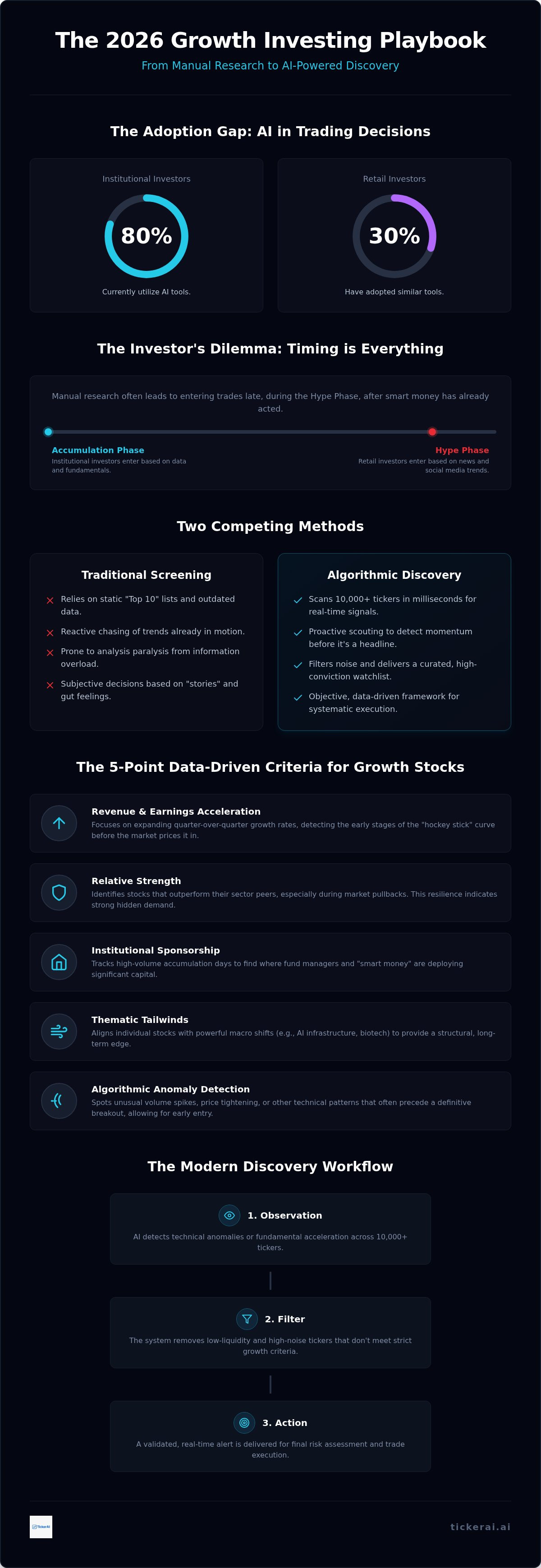
Over 80% of institutional investors currently utilize AI for trading decisions; meanwhile, 30% of retail investors have already adopted similar tools to combat information overload. If you're still manually scanning thousands of tickers or chasing social media trends, you're likely entering trades during the hype phase rather than the accumulation phase. The era of manual research is being replaced by automated growth stock screening that prioritizes clinical data over volatile sentiment. You need a high-speed intelligence partner that filters noise and detects momentum before it becomes a headline.
It's exhausting to watch a high-growth opportunity skyrocket only after it hits your social feed. You've likely experienced the analysis paralysis that comes from looking at too many charts without a clear signal. This article provides a systematic, data-driven framework to uncover high-potential growth ideas for 2026. We'll examine how to track institutional accumulation, establish a repeatable screening workflow, and build a high-conviction watchlist designed for professional-grade execution. It's time to move from reactive chasing to proactive discovery.
Key Takeaways
- Identify fundamental disruption using a systematic framework. Move beyond outdated buy-and-hold strategies.
- Master the 5-point criteria. Detect earnings acceleration and relative strength before the market reacts.
- Utilize automated growth stock screening. Scan 10,000+ tickers in milliseconds to eliminate manual latency.
- Prioritize thematic market leaders. Distinguish high-probability industry movements from late-cycle laggards.
- Implement a modular execution workflow. Validate AI-driven discovery signals against rigorous risk-management rules.
The Evolution of Growth Investing Ideas in 2026
In 2026, the definition of a growth stock has shifted significantly. It's no longer just about finding a company with rising revenue; it's about identifying fundamental disruption and market-share capture at scale. Traditional buy-and-hold strategies often fail in high-volatility environments because they rely on historical performance rather than real-time data. Systematic discovery has replaced passive waiting. This proactive approach uses automated growth stock screening to isolate high-conviction setups before they reach the mainstream consciousness. You don't need more news. You need better filters.
The 2026 market demands clinical precision. Volatile sectors move too fast for manual analysis. AI-driven discovery acts as a tireless scout, scanning thousands of data points to filter out market noise. This shift from reactive chasing to proactive algorithmic scouting is the only way to maintain an edge. Traders who rely on gut feeling are being outpaced by those who utilize a data-driven framework. The goal is simple: detect the anomaly, validate the signal, and execute the trade.
Why Static Stock Lists are Lagging Indicators
Relying on published "Top 10" lists is a strategic error. By the time these lists hit your inbox, the institutional accumulation phase is usually complete. This is the Morningstar Trap. Retail traders often enter exactly when smart money is looking for exit liquidity. In 2026, volatility requires real-time intelligence. Static data is dead data. You need a system that detects the gap between institutional flow and retail awareness in milliseconds. Automated growth stock screening provides this speed, ensuring you're looking at the start of a move rather than the tail end of the hype cycle.
The Mechanics of Modern Growth Discovery
The transition from qualitative stories to quantitative signals is mandatory. Understanding what is quantitative investing provides the necessary blueprint for retail traders to act like institutions. It's about moving from "I like this company" to "The data shows a high-probability setup." Stories are subjective; signals are objective.
Modern discovery follows a strict Observation-to-Action workflow:
- Observation: AI detects a technical anomaly or fundamental acceleration across 10,000+ tickers.
- Filter: The system removes low-liquidity or high-noise tickers that don't meet strict growth criteria.
- Action: The trader receives a validated, real-time alert to begin their final risk assessment.
This clinical approach removes the emotional friction that causes analysis paralysis. It streamlines your focus onto a curated watchlist of high-conviction ideas, allowing for faster decision-making in a fast-paced environment.
The 5-Point Data-Driven Criteria for Growth Stocks
Successful growth discovery requires a multi-dimensional filter that balances fundamental acceleration with technical confirmation. Traditional screeners often fail because they rely on trailing indicators that don't account for real-time institutional flow. Automated growth stock screening solves this by identifying specific anomalies across five critical pillars. This framework ensures you aren't just buying expensive stocks, but investing in high-velocity assets before the crowd arrives.
- Revenue and Earnings Acceleration: AI detects the early stages of the hockey stick curve, focusing on quarter-over-quarter growth rates that are expanding, not just positive.
- Relative Strength: The best growth ideas outshine their sector peers during market pullbacks. This resilience indicates hidden demand.
- Institutional Sponsorship: Smart money leaves footprints. Tracking high-volume accumulation days helps identify where fund managers are deploying capital.
- Thematic Tailwinds: Aligning individual tickers with macro shifts, such as the AI infrastructure boom, provides a structural edge.
- Algorithmic Anomaly Detection: Spotting unusual volume spikes or price tightening allows for entry before a definitive breakout occurs.
Quantifying Fundamental Strength with AI
Modern discovery platforms analyze SEC filings at a scale impossible for human researchers. They don't just look at the bottom line. They evaluate the composition of growth. A company reinvesting heavily in R&D often possesses a stronger competitive moat than one spending excessively on customer acquisition. AI filters these nuances to find companies with genuine fundamental disruption. High-quality earnings are the non-negotiable prerequisite that separates sustainable growth from temporary price inflation. Traders seeking these precise setups often utilize AI-powered opportunity discovery to maintain their edge.
Measuring Technical Momentum and Edge
Technical validation turns a good idea into a tradable setup. Learning how to interpret AI stock signals is essential for timing these entries. Automated systems excel at chart pattern recognition, identifying high-probability momentum breakouts with clinical precision. A key indicator is volatility contraction. When a stock's price range tightens significantly on low volume, it often precedes a high-growth expansion. Automated growth stock screening detects these coiled spring setups across thousands of tickers simultaneously. This process ensures you only focus on stocks ready to move now, rather than tying up capital in dormant assets.
Algorithmic Discovery vs. Traditional Screening
Manual screening is a legacy process. Relying on static P/E ratios or trailing revenue growth often leads traders directly into value traps. A low valuation frequently signals a business in terminal decline rather than a hidden gem. Traditional filters are inherently reactive. They capture what happened in the previous quarter, not what is unfolding in the current session. Automated growth stock screening operates on a different plane. It scans 10,000+ tickers in milliseconds. It detects subtle shifts in institutional volume and price tightening before the breakout occurs. You aren't just filtering data; you're discovering opportunity.
Removing human bias is the primary strategic advantage. Gut feelings and emotional attachments to "story stocks" often result in entering trades during the late-stage hype phase. Data-driven systems prioritize clinical precision. According to a Stanford GSB study from August 2026, AI analysts outperformed 93% of human fund managers by focusing strictly on public financial statements and price action. Efficiency is the inevitable byproduct. You can reduce daily research time from hours of manual charting to seconds of alert validation. This allows you to transition from a passive consumer of financial news to an active market scout.
The Problem with Traditional Stock Screeners
Standard screeners rely on laggy metrics. They fail to capture emerging thematic trends because they lack the ability to process rapid technological pivots or sentiment shifts. This creates analysis paralysis. When you're looking at thousands of tickers with similar static profiles, the decision-making process stalls. High-growth sectors move too fast for analyst-driven ratings, which are often updated too slowly to be actionable. You need prioritized alerts that highlight high-conviction setups the moment they meet your criteria. Don't waste time on stocks that are "cheap" for a reason.
Building an Institutional-Grade Discovery Engine
Individual traders now have access to capabilities previously reserved for elite hedge funds. Over 80% of institutional investors currently use AI for trading decisions, a trend that retail traders are now mirroring with a 75% increase in tool adoption over the last year. Leveraging automated stock market analysis allows you to scale your intelligence without increasing your workload. By integrating real-time discovery into a daily routine, you ensure that your watchlist is always populated with the most relevant opportunities. The system stays "on" so you can focus exclusively on execution and risk management.
Thematic Investing: Organizing Ideas into High-Probability Themes
Growth investing isn't a game of isolated tickers. It's about aligning with structural shifts that move entire industries. Automated growth stock screening allows you to identify these themes before they become mainstream consensus. Individual ticker risk is often high; however, when a stock is part of a broader industry-wide movement, it gains a layer of structural support. The AI in trading market reached $27.85 billion in 2026, and this capital flows into specific thematic pockets. Your goal is to detect these flows and position yourself in the leaders while avoiding the laggards.
Identifying the leader within a theme is critical for maximizing returns. Laggards often appear attractive due to lower valuations, but they lack the relative strength necessary to outperform during market pullbacks. Catalyst events, such as regulatory shifts or major technological breakthroughs, often accelerate these themes. By utilizing a data-driven framework, you can track sector rotation in real-time. This ensures your capital is always deployed in the highest-velocity areas of the market. You aren't just buying a stock; you're buying into a verified momentum cycle.
Identifying Emerging Market Themes
Spotting trends early requires a move away from news headlines toward algorithmic detection. Using finding thematic investment opportunities with AI provides the necessary edge to see where institutional capital is congregating. In the 2026 market, key themes include AI infrastructure, biotech innovation, and the energy transition. These aren't just sectors; they are ecosystems. A move in AI chip manufacturing creates a ripple effect across liquid cooling and power management companies. Automated systems detect these connections, uncovering secondary growth ideas that the retail crowd often misses.
Optimizing Your Smart Watchlist
A static watchlist is a liability. You need a smart watchlist that categorizes ideas by conviction level and time horizon. This allows for immediate execution when a thematic breakout occurs. Automated growth stock screening helps you prune your list by flagging stocks that have lost their relative strength or institutional support. If a stock isn't performing, it doesn't belong on your screen. Setting automated triggers for technical breakouts within these themes ensures you don't miss the entry point due to manual latency. To start building your high-conviction list, you can access real-time thematic alerts here.
High-speed intelligence is the only way to navigate 2026 volatility. By organizing your research into high-probability themes, you reduce the noise and focus on the signals that actually drive performance. This modular approach to discovery creates a repeatable workflow that scales with the market's complexity.
Execution Strategy: From Discovery to Actionable Trades
Discovery is only the first phase of the investment process. Without a rigorous execution framework, even the most precise automated growth stock screening results fail to generate consistent returns. The goal is to convert high-speed intelligence into a repeatable, clinical workflow. This transition requires moving from the observation of a signal to a series of calculated actions that prioritize capital preservation over speculative chasing. You don't need more trades; you need better execution on high-conviction signals.
- Step 1: Signal Reception. Receive the AI-driven discovery signal or real-time alert.
- Step 2: Validation. Cross-reference the setup against your predefined risk-management rules and fundamental criteria.
- Step 3: Entry Definition. Identify the specific price level where technical momentum confirms the breakout.
- Step 4: Systematic Exit. Establish stop-loss and profit targets immediately to remove decision-making during peak volatility.
- Step 5: Process Audit. Journal the trade to identify deviations from your systematic discovery framework for continuous improvement.
Eliminating Emotional Friction
Emotional bias is the primary cause of retail underperformance in fast-moving markets. While 80% of institutional investors rely on AI for objective decision-making, many retail traders still follow "hot tips" that lack structural backing. Understanding using AI to remove emotion from trading is essential for maintaining capital discipline. A systematic setup is an observation-to-action event. A tip is a qualitative story. Clinical traders don't hope for a move; they execute when the data validates the edge. High-growth sectors are inherently volatile, and a data-driven perspective acts as your psychological anchor during market swings.
Leveraging TickerAI for Growth Discovery
Scaling your intelligence requires the right tier of professional tools. TickerAI offers Pro and Full-Access subscriptions tailored to different research intensities. The Pro tier provides essential smart watchlists and real-time alerts for active traders looking for high-potential movements. The Full-Access subscription unlocks the complete suite of AI-powered opportunity discovery, including deep thematic analysis and institutional flow tracking. These aren't just lists. They are curated swing trade setups designed for immediate validation and action.
A Stanford GSB study confirmed that AI analysts, focusing strictly on financial data and price action, outperformed 93% of human fund managers over three decades. You can now apply this same institutional-grade logic to your own portfolio. Automated growth stock screening removes the manual latency that leads to late entries. Don't wait for the market to react to yesterday's news. Take control of your discovery process with real-time, algorithmic intelligence. Discover your next growth investment idea with TickerAI today.
Mastering the 2026 Growth Discovery Cycle
The 2026 market doesn't reward hesitation or manual latency. High-growth sectors move at a speed that renders traditional, static research obsolete. You've learned that sustainable success requires a transition from qualitative stories to a clinical, data-driven discovery framework. By prioritizing institutional sponsorship and thematic momentum, you position your capital where the smart money is flowing, not where it has already been. Objective signals must replace gut feelings if you intend to outperform the retail crowd.
Implementing automated growth stock screening is the only way to maintain this edge across 10,000+ tickers in real-time. You need a high-speed intelligence partner that delivers curated swing trade setups and professional-grade smart watchlists directly to your workflow. This systematic approach removes emotional friction and provides the clarity needed for rapid execution. It's time to stop chasing headlines and start detecting anomalies before the breakout occurs.
Access AI-Powered Growth Investing Ideas with TickerAI Full-Access
The tools for institutional-grade discovery are now at your fingertips. Take the next step toward a more disciplined, algorithmic approach to growth investing today.
Frequently Asked Questions
What is the best way to find growth investing ideas in 2026?
The best method involves a systematic discovery framework that prioritizes data over sentiment. You should focus on identifying institutional accumulation and fundamental disruption before they reach mainstream headlines. By using automated growth stock screening, you can filter 10,000+ tickers to find high-conviction ideas that align with emerging thematic trends. This approach ensures you aren't chasing late-cycle hype but entering trades during the early phases of professional capital deployment.
How does AI improve the discovery of growth stocks?
AI improves discovery by processing massive datasets at speeds impossible for human researchers. It scans technical indicators, fundamental shifts in SEC filings, and institutional volume spikes in milliseconds. This precision removes the emotional bias that often leads to entering trades too late. By prioritizing clinical data, AI identifies the early stages of a hockey stick growth curve, allowing you to act on objective signals rather than subjective qualitative stories.
Can retail investors use institutional-grade growth screening tools?
Yes, retail investors can now access advanced tools previously reserved for elite hedge funds. Platforms like TickerAI offer subscriptions that provide real-time alerts and curated swing trade setups. As of August 2026, retail AI tool usage has increased by 75% in just one year. This democratization of technology allows individual traders to utilize automated growth stock screening to maintain a competitive edge in a fast-paced and highly volatile market environment.
What is the difference between growth investing and value investing?
Growth investing targets companies with accelerating future earnings and fundamental disruption. Value investing seeks companies trading below their current intrinsic worth. While value investors look for cheap assets, growth investors prioritize the velocity of expansion and market share capture. In the 2026 market, many cheap growth stocks are actually value traps in terminal decline. Discovery focuses on identifying high-potential winners that justify their valuations through sustained revenue acceleration.
How do I know if a growth stock is overvalued or a good buy?
Determining a good buy requires analyzing earnings quality and technical validation. A growth stock isn't necessarily overvalued if its revenue acceleration justifies the premium. You should look for relative strength during market dips and volatility contraction before a breakout. AI-driven discovery platforms help you distinguish between temporary price inflation and genuine fundamental shifts. If the institutional accumulation remains strong, the stock likely has more room to run before reaching a climax top.
Why should I use an AI stock discovery platform instead of manual research?
AI discovery platforms eliminate the information overload and analysis paralysis inherent in manual research. A Stanford GSB study from August 2026 found that AI analysts outperformed 93% of human fund managers over three decades by focusing strictly on objective data. Manual research is slow and reactive. Algorithmic systems are proactive and tireless, scanning the entire market 24/7 to ensure you never miss a high-probability setup due to human fatigue or oversight.
What are the risks of investing in high-growth companies?
The primary risks include high price volatility and rapid technological obsolescence. High-growth companies often trade at elevated multiples, making them sensitive to interest rate shifts or missed earnings expectations. You also face the risk of a technological pivot where a competitor's innovation renders a leader's product obsolete. To mitigate these risks, you must use a systematic execution strategy that includes strict stop-loss orders and continuous monitoring of institutional flow and thematic strength.
How often should I update my growth stock watchlist?
You should update your growth stock watchlist in real-time or at least daily. Static lists are lagging indicators that often represent the end of a move rather than the beginning. High-speed intelligence requires a dynamic watchlist that prunes laggards and prioritizes leaders based on current relative strength. Using smart alerts ensures you're notified the moment a stock on your radar meets your specific entry criteria, preventing you from missing high-velocity breakout opportunities.


