

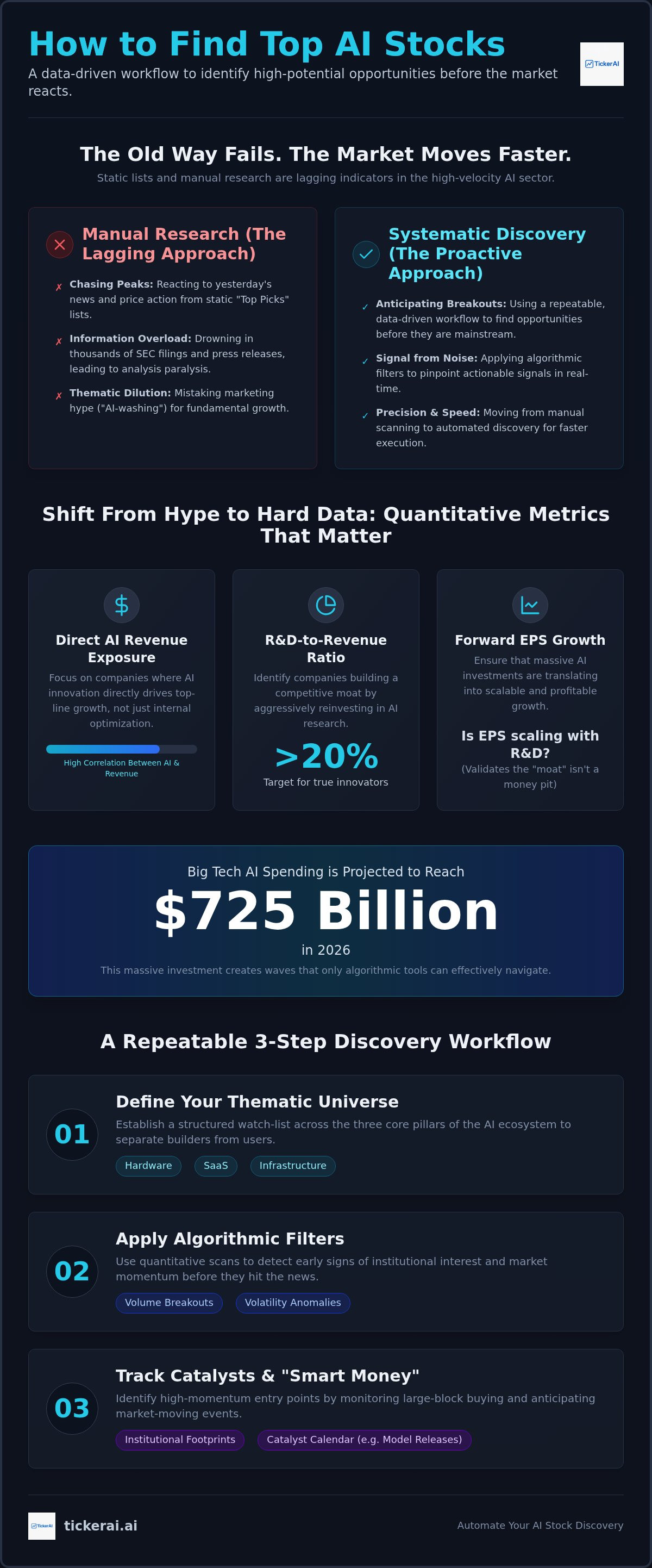
Big Tech AI spending is projected to reach $725 billion in 2026. Most retail capital will arrive late; it chases the same tickers everyone else is already talking about. You know that reacting to financial news is a recipe for sub-par returns. The market moves faster than your newsfeed. Learning how to find top AI stocks shouldn't involve guessing based on social media trends. We agree that the current environment is a chaotic mix of regulatory shifts and massive infrastructure builds. It's difficult to separate fundamental growth from temporary hype. Information overload is a real tax on your portfolio.
This guide changes your approach. You'll master a repeatable, data-driven workflow to identify high-potential opportunities before the broader market reacts. We're moving away from manual market scanning. Instead, you'll learn a systematic discovery process to identify small-cap winners with clinical precision. We will preview the technical indicators and market mechanics required to filter the noise. You'll gain the ability to spot high-momentum setups while others are still reading yesterday's headlines. This is about speed, clarity, and execution.
Key Takeaways
- Static "Buy Now" lists lead to chasing peaks. Shift to a systematic, real-time discovery model to stay ahead of the rapid innovation curve.
- Master how to find top AI stocks by analyzing quantitative metrics. Focus on direct revenue exposure and R&D-to-revenue ratios to identify true fundamental growth.
- Establish a structured thematic universe across Hardware, SaaS, and Infrastructure. Use algorithmic filters to detect volume breakouts and volatility anomalies.
- Track institutional "Smart Money" and the Catalyst Calendar. Identify high-momentum entries by monitoring large-block buying and scheduled AI model releases.
- Leverage TickerAI Full-Access and Pro tiers to automate your research workflow. Replace manual scanning with AI-driven discovery for actionable swing trade setups.
Beyond Static Lists: Why Manual Research Fails in AI Investing
Manual research is a lagging indicator. By the time a traditional analyst report hits your inbox, the alpha has already evaporated. The recent AI boom moves at a velocity that renders monthly "Top Picks" lists obsolete. These lists often lead retail investors to chase the peak of a cycle rather than identifying the next breakout. You're reacting to price action instead of anticipating it. Static lists fail because they lack real-time context. They don't account for intra-day volume spikes or sudden regulatory shifts like the EU AI Act implementation in August 2026.
Thematic dilution is another major risk. Not every company mentioning "generative AI" in an earnings call is a high-growth opportunity. Many are simply trying to justify stagnant margins or aging business models. Understanding how to find top AI stocks means separating the infrastructure builders from the mere users. It requires a shift from reactive news consumption to proactive market discovery. You need to identify companies with direct revenue exposure, not just marketing hype.
The Information Overload Problem
The sheer volume of data is staggering. In 2026, thousands of daily SEC filings and press releases mention AI initiatives. Manual filtering is a mathematical impossibility. It leads to analysis paralysis. You spend hours reading while the trade setup passes you by. You need a high-speed intelligence partner to filter the noise. Efficiency is your only edge in a market where news is priced in seconds.
- Data Velocity: Real-time scanning beats daily newsletters.
- Signal vs. Noise: Filtering out "AI-washing" requires technical verification.
- Execution Lag: Manual research creates a delay between discovery and entry.
Institutional vs. Retail Discovery Gaps
Hedge funds don't rely on intuition. They use quantitative investing to spot anomalies and volume breakouts before they become mainstream. They see the "Smart Money" moving while retail investors are still scrolling social media. This gap is widened by the massive capital tech giants are deploying. Combined AI spending is expected to reach $725 billion in 2026. This level of investment creates waves that only algorithmic tools can navigate effectively.
Bridging this gap requires institutional-grade tools. You must reframe discovery as a systematic workflow. It's about monitoring technical indicators and algorithmic signals rather than following the crowd. High-potential AI opportunities are found through precision, not luck. You need a system that detects institutional footprints before the trend becomes obvious to the general public. This transition from manual charting to automated discovery is the only way to maintain a competitive advantage.
Defining the "Top" AI Stock: Quantitative Metrics That Matter
Revenue is the ultimate filter. Mastering how to find top AI stocks involves more than just reading headlines; it requires a clinical deep dive into the balance sheet. You must distinguish between direct AI exposure and secondary integration. Direct leaders, such as hardware manufacturers or foundational model developers, show a tight correlation between AI innovation and top-line growth. For instance, NVIDIA reported revenue of $215.9 billion for the fiscal year 2026, representing a 65% increase from the previous year. This is direct exposure in its purest form. Secondary integrators use AI to optimize internal workflows, but their revenue remains decoupled from the AI cycle itself.
R&D to revenue ratios are your next critical indicator. Companies reinvesting 20% or more of their revenue into AI research are building a competitive moat. They aren't just participating in the market; they're attempting to dominate it. For those seeking a foundational framework for these metrics, many institutional resources offer a guide to investing in AI that outlines the basic risks and opportunities of the sector. However, for high-speed discovery, you must look at forward-looking earnings per share (EPS) growth. If the EPS isn't scaling alongside AI investments, the "moat" might be a money pit.
AI-Specific Fundamental Indicators
Compute capacity is the new oil. In 2026, a company's access to high-performance data centers and proprietary datasets defines its survival. You should analyze patent filings and technical talent acquisition as leading indicators of future revenue. Monitoring these shifts manually is impossible given the speed of the industry. Smart investors use AI tools for analyzing SEC filings to verify fundamental health instantly. These tools detect subtle changes in management commentary and risk disclosures that human readers often miss.
Technical Momentum and Relative Strength
Volume doesn't lie. High-growth tech stocks require significant institutional accumulation to sustain a breakout. You should identify stocks showing consistent relative strength against the Global Next Generation AI Index. If a ticker is outperforming the index on high volume, it suggests "Smart Money" is positioning for a move. Volatility is a feature, not a bug, in this sector. You shouldn't fear it; you should measure it. Analyzing these technical patterns through systematic discovery tools allows you to separate temporary price spikes from sustainable momentum trends. This data-driven approach ensures you enter the trade before the broader retail market reacts.
The Discovery Workflow: Filtering Market Noise with Algorithmic Scanning
Speed is your primary asset. A systematic discovery workflow is the only defense against market noise. You cannot learn how to find top AI stocks by scanning spreadsheets or reading delayed analyst notes. You need a modular process that scales with the industry's growth. The global AI market is projected to reach $375.93 billion by the end of 2026. This scale requires a four-step algorithmic approach to maintain clarity.
Step 1: Establishing a broad thematic universe. Segment the market into Hardware, SaaS, and Infrastructure. Cloud infrastructure is a foundational layer. As of Q1 2026, AWS holds 30% of the market, followed by Microsoft Azure at 20% and Google Cloud at 13%. Your universe should reflect these weightings to ensure you're tracking the actual drivers of the sector.
Step 2: Applying algorithmic filters. Use technical scanners to detect volatility and volume breakouts. You're hunting for anomalies. When a ticker shows a significant volume spike relative to its 20-day average, the system flags it. This is how you detect institutional footprints before they become public knowledge. It's about monitoring the flow of capital in real-time.
Step 3: Utilizing smart watchlists. These are dynamic tools. They track thematic rotation as capital moves from infrastructure builders to application layers. Static lists fail because they don't account for these shifts.
Step 4: Setting real-time alerts. Price-action anomalies require immediate attention. Alerts ensure you act while the entry point is still valid. You focus on the decision; the system focuses on the detection.
Building Smart Watchlists
Organization is key for finding thematic investment opportunities with AI. You must categorize tickers by sub-sector and priority level. Dynamic watchlists automate the removal of laggards. If a stock's relative strength drops below a specific threshold, it's purged. This keeps your focus on high-momentum setups. Prioritize your watchlists based on historical win rates. This isn't about watching every stock. It's about watching the right ones at the right time.
Automating the Screening Process
Efficiency dictates success. Move beyond manual charting and adopt automated pattern recognition. Algorithms scan thousands of tickers per second to detect consolidation patterns and breakouts. The goal is to filter for action-oriented signals over general market noise. You should also integrate sentiment analysis. This gauges whether a price move is driven by retail social media hype or institutional conviction. In a market where 88% of organizations use AI in at least one function, the data is available. You just need the tools to process it.
Spotting Early Momentum: Tracking Catalysts and Institutional Activity
Momentum is a visible footprint of institutional conviction. Retail participants often wait for a news headline to justify a trade; professionals track the volume that precedes the news. Learning how to find top AI stocks requires monitoring large-block institutional buying and "Smart Money" flow. When institutions accumulate a position, they leave anomalies in price action. These anomalies are your early warning system. You're looking for a structural change in demand that suggests a transition from skepticism to widespread hype. Detecting these shifts before they hit the tape is the key to capturing the meat of a move.
The "Catalyst Calendar" provides the necessary context for these price movements. In 2026, regulatory milestones serve as significant market drivers. For example, the EU AI Act implementation on August 2, 2026, introduces new transparency obligations that will impact valuations across the sector. Beyond regulation, you must track earnings cycles and scheduled AI model releases. Major tech companies are expected to spend $725 billion on AI infrastructure in 2026. This massive capital expenditure creates predictable waves of activity for suppliers and service providers. Spotting the price action that anticipates these events allows you to position yourself before the volatility spikes.
Interpreting Algorithmic Signals
Not every alert is actionable. You must distinguish between a "noise" alert, which represents transient volatility, and a "signal" alert, which indicates a sustained trend. A signal alert often aligns with high relative strength and institutional accumulation. For a technical deep dive, consult our professional guide on how to interpret AI stock signals. Confirming these signals requires multi-timeframe analysis. If a breakout on a 15-minute chart is supported by a daily volume surge, the probability of success increases. This systematic verification ensures you aren't chasing false breakouts.
Removing Emotion from Discovery
Emotional discipline is the difference between a professional and a hobbyist. Chasing FOMO during a vertical price move is a primary cause of drawdown. Systematic discovery relies on a rule-based framework that ignores social media sentiment. By using AI to remove emotion from trading, you maintain a clinical approach even in high-volatility tech sectors. Trust the automated screening process over the latest trending tickers. A data-driven entry and exit plan prevents the "analysis paralysis" that often follows a sudden market shift. To start tracking these momentum shifts with precision, access real-time discovery tools with TickerAI.
TickerAI: Automating Your AI Stock Opportunity Discovery
Manual discovery is a structural liability. You've already seen why static "Buy Now" lists fail and how quantitative metrics define the winners. Now, you need the engine to execute. TickerAI automates the entire discovery workflow by bridging the gap between raw market data and actionable insight. This is how to find top AI stocks without the burden of manual scanning or the risk of analysis paralysis. We provide the high-speed intelligence required to navigate a market where 88% of organizations have already integrated AI into their operations.
The core TickerAI engine utilizes real-time algorithmic processing to detect anomaly signatures across thousands of tickers. These aren't just random price moves; they're high-potential swing trade setups identified by our proprietary analysis. Our system detects institutional footprints before they become mainstream headlines. You receive the signal while the broader market is still processing the noise. This proactive approach ensures you're positioned correctly before the volatility of the 2026 market cycle triggers a retail breakout.
Efficiency is our priority. Smart watchlists provide curated ideas that adapt to thematic rotation automatically. Whether you're tracking long-term investment ideas in infrastructure or short-term momentum in SaaS, our lists are dynamic. Real-time alerts deliver this institutional-grade intelligence directly to your mobile device. You don't need to be at your desk to catch a breakout. The system is always "on," scanning for the technical indicators that signal a high-probability entry. You focus on the decision; we focus on the detection.
The TickerAI Advantage
Clinical precision defines our methodology. We filter out the fluff to deliver data that is immediately actionable. Proactive scouting means we detect momentum breakouts in their infancy. You aren't chasing the peak; you're entering at the point of maximum advantage. Our platform functions as a tireless assistant that prioritizes clarity over volume. For a deeper look at our systematic approach, access the professional guide to algorithmic alpha to see our logic in action.
Choosing Your Discovery Tier
Success requires the right tool for your specific strategy. TickerAI Pro is engineered for the active trader. It focuses on high-frequency swing trade setups and rapid execution signals. TickerAI Full-Access is designed for the serious investor seeking comprehensive research and long-term opportunity discovery across the entire AI ecosystem. Both tiers provide the edge needed to outpace traditional research methods. Your next step is evaluating an AI stock picking service to determine which tier aligns with your specific portfolio goals.
Master the Algorithmic Edge in 2026
The transition from manual news-reading to systematic market discovery is no longer optional. You've learned that identifying high-potential winners requires a clinical focus on quantitative metrics and institutional footprints. Static lists fail because they can't match the speed of an industry projected to exceed $2.4 trillion by 2034. Mastering how to find top AI stocks depends on your ability to filter noise and detect anomalies before the broader market reacts. Efficiency is your only sustainable competitive advantage.
By integrating smart watchlists and real-time alerts, you move from a reactive stance to a proactive scouting model. You focus on high-conviction decisions while technology handles the detection. It's time to replace manual charting with a rule-based system that prioritizes clarity and speed. Stop chasing headlines and start anticipating the next structural shift in the market. You don't need to work harder; you need to process information faster.
Start Discovering AI Opportunities with TickerAI Full-Access to leverage AI-powered swing trade setups and real-time market anomaly alerts. You're now equipped to navigate the next phase of the AI cycle with precision and confidence.
Frequently Asked Questions
How do I identify the best AI stocks for long-term investing?
Focus on fundamental indicators such as R&D-to-revenue ratios and proprietary data rights. Look for companies with sustainable competitive moats, specifically those providing essential infrastructure or foundational models. Evaluating SEC filings for long-term capital expenditure plans is a reliable method. You should prioritize firms showing consistent earnings per share growth alongside their AI investments rather than those using AI for marketing. This clinical approach ensures you identify true long-term value.
Can I find top AI stocks without using expensive professional tools?
Manual discovery is possible but increasingly inefficient due to the high velocity of the 2026 market. You can use free resources like SEC EDGAR for filings or basic stock screeners to filter by sector. However, these methods often lead to lagging entries. Learning how to find top AI stocks effectively usually requires moving toward automated discovery systems that process thousands of real-time data points. Speed is your primary asset in this environment.
What metrics are most important for AI stock discovery in 2026?
Revenue exposure and compute capacity are the primary metrics for success in 2026. You must analyze the percentage of total revenue directly tied to AI products or services. Additionally, tracking R&D spending as a percentage of sales helps identify companies reinvesting in future dominance. Forward-looking earnings per share growth remains a critical filter for distinguishing high-potential growth stocks from those experiencing temporary thematic hype. These quantitative data points provide the necessary clarity.
How does AI-powered stock discovery differ from traditional screeners?
Traditional screeners rely on static, historical data points like trailing P/E ratios. AI-powered discovery utilizes real-time algorithmic scanning to detect price-action anomalies and volume breakouts as they happen. These systems identify patterns and institutional footprints that manual filters miss. This proactive approach allows you to spot high-momentum swing trade setups before they become mainstream news. It provides a significant speed advantage over retail competitors who rely on delayed, traditional scanning methods.
Is it too late to invest in top-tier AI companies?
Opportunities remain abundant as the global AI market is projected to reach $2.48 trillion by 2034. While early infrastructure leaders have seen significant gains, the application and service layers are still evolving. New regulatory frameworks, such as the EU AI Act, create fresh volatility and entry points for disciplined investors. Systematic discovery focuses on finding the next wave of leaders rather than chasing the peaks of established mega-cap companies. The cycle is far from over.
How can I track institutional buying in AI stocks?
Monitor volume breakouts and large-block trade data to identify institutional accumulation. Institutional footprints are often visible as consistent price support on high relative volume. You can also analyze quarterly 13F filings to see where major hedge funds are allocating capital. Algorithmic tools simplify this process by flagging these anomalies in real-time. This allows you to align your trades with professional conviction before the retail crowd arrives and the opportunity window closes.
What is the best way to filter out AI market noise?
Establishing a rule-based discovery workflow is the most effective way to eliminate noise. You should prioritize technical indicators like relative strength and volume breakouts over social media sentiment or general news headlines. Using automated scanners helps you focus on action-oriented signals that meet specific quantitative criteria. This clinical approach prevents analysis paralysis and ensures your decisions are based on data rather than thematic hype. Filtering for how to find top AI stocks requires this level of discipline.
How do real-time alerts help in finding AI stock opportunities?
Real-time alerts provide the speed necessary to capture entry points before they evaporate. These notifications flag price-action anomalies and technical breakouts the moment they occur, ensuring you don't miss high-momentum setups. For active traders, this intelligence is essential for executing swing trade setups with precision. Alerts act as a proactive scout, allowing you to monitor the market continuously without the need for constant manual screen time. They turn detection into a passive, automated process.


