

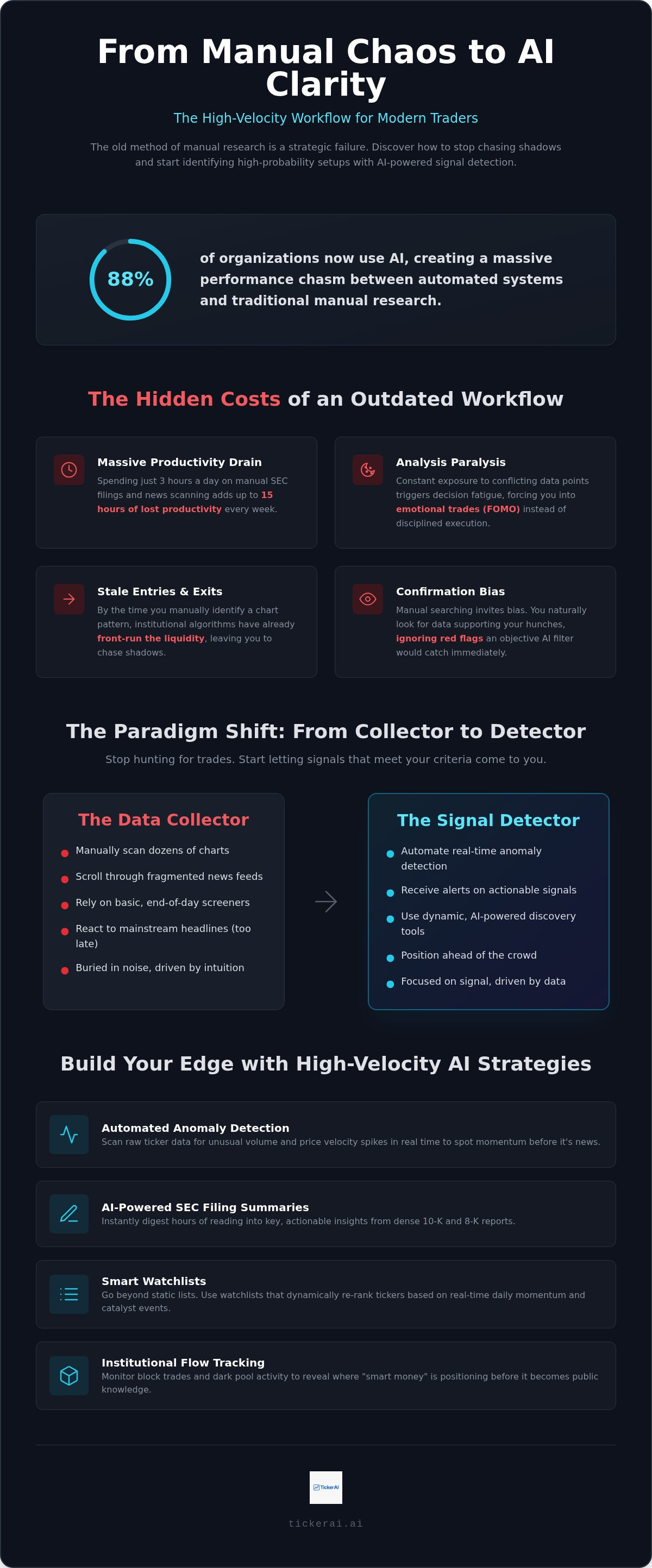
With 88% of organizations now utilizing artificial intelligence in their operations, the gap between manual researchers and automated traders has become a chasm. Most traders still lose hours to social media noise and fragmented news feeds, only to realize they missed the breakout ten minutes after it happened. You can't find trading opportunities faster by simply working harder or opening more browser tabs. Speed in 2026 is a product of clinical filtering, not manual effort.
It's frustrating to watch a high-conviction setup trigger while you're buried in conflicting data points. Analysis paralysis is the primary tax on your profitability; it's a symptom of an outdated workflow. This guide will show you how to eliminate manual scanning and identify high-probability setups using professional-grade AI automation. You'll learn to transition from a data gatherer to a high-speed decision-maker.
We'll break down a repeatable, automated research workflow that delivers consistent swing setups directly to your smart watchlist. From real-time anomaly detection to thematic discovery, you're about to build a system that acts as a proactive scout. The goal is clear: more time focused on execution and less time lost in the noise.
Key Takeaways
- Learn how to leverage professional-grade AI automation to find trading opportunities faster by shifting from manual scanning to clinical signal detection.
- Discover the critical difference between raw data collection and algorithmic processing to identify momentum breakouts before they reach mainstream news feeds.
- Implement high-velocity strategies like automated SEC filing summaries and smart watchlists that re-rank tickers based on real-time daily momentum.
- Build a two-phase research workflow that prioritizes automated anomaly discovery followed by rapid validation of fundamental catalysts.
- Scale your market intelligence using proactive scout tools designed to filter noise and deliver high-conviction swing setups directly to your dashboard.
The Information Overload Crisis: Why Manual Research Is Obsolete
The 2026 market generates more data in one hour than an individual can process in a week. This isn't a hyperbolic claim; it's the mathematical reality of a global financial ecosystem powered by high-frequency systems. Relying on manual research is no longer just slow. It's a strategic failure. When you spend your morning manually scanning charts and scrolling through news feeds, you aren't discovering setups. You're chasing shadows.
Manual charting leads to stale entries and missed exits because the market moves faster than human eyes can track. By the time you identify a pattern on a 15-minute chart, institutional algorithms have already front-run the liquidity. This creates a cycle of frustration. You see the move, try to catch the tail end, and get caught in the reversal. To find trading opportunities faster, you have to stop searching and start observing.
There's also a significant psychological cost to information overload. Constant exposure to conflicting data points triggers decision fatigue. This exhaustion forces you into emotional trading, where fear of missing out (FOMO) replaces disciplined execution. A professional workflow replaces the Search-and-Find struggle with a logical Observation-to-Action flow. You don't hunt for trades; you wait for signals that meet your criteria to appear.
The Hidden Cost of Manual Data Gathering
Calculating the hours wasted on SEC filings and earnings call transcripts reveals a massive productivity leak. If you spend three hours a day digging through 10-Ks, that's 15 hours a week lost to data entry work. Manual latency erodes your edge, especially in volatile sectors like biotech or technology. A delay of just a few minutes can turn a high-probability breakout into a high-risk chase. Beyond speed, manual searching invites confirmation bias. You'll naturally look for data that supports your existing hunches, ignoring the red flags that an objective AI filter would catch immediately.
From Generalist to Specialist: The Power of Filtering
Professional traders don't rely on basic screeners that simply sort by price or volume. They use sophisticated filters to isolate specific market regimes. The goal is to maximize your signal-to-noise ratio. This shift from manual intuition to data-driven logic is the natural evolution of algorithmic trading. By adopting a systematic approach to stock investing, you move from being a generalist overwhelmed by noise to a specialist focused on high-conviction setups. This is the only way to find trading opportunities faster in an environment that never sleeps.
Shifting the Paradigm: From Data Collection to Signal Detection
Signal detection is the automated identification of market anomalies that meet specific, rule-based criteria. This process marks a fundamental shift away from traditional data collection. In the past, traders spent hours gathering price points and news snippets. Today, the objective is to filter that noise to isolate actionable signals. Algorithmic processing identifies momentum breakouts before they hit mainstream news feeds. By the time a headline appears on a retail terminal, the primary move is often complete. To find trading opportunities faster, you must scan raw ticker data for volume anomalies and price velocity in real time.
Understanding what is quantitative investing is no longer optional for retail participants. It provides the framework for systematic discovery. Static screeners, which rely on end-of-day data or simple filters, are insufficient in a high-frequency environment. Dynamic discovery tools analyze the live tape to detect shifts in market structure as they happen. This allows you to position yourself ahead of the crowd rather than reacting to their wake.
Identifying Market Mechanics with AI
AI-driven systems track institutional money flow without the need for manual volume-at-price analysis. These tools monitor block trades and dark pool activity to reveal where the "smart money" is positioning. Automated technical indicators also spot hidden divergence that human eyes frequently miss. By quantifying market sentiment across social and news channels, these systems help you avoid emotional crowd traps during periods of high volatility. This clinical approach ensures your entries are based on data, not gut feelings.
Automating the 'Observation-to-Action' Flow
The goal of a modern workflow is to reduce the gap between a market event and your research response. You can set up sophisticated alerts that trigger based on complex logic, such as a specific RSI level combined with a sudden surge in relative volume. This moves you closer to the ideal Observation-to-Action state. Algorithmic alpha is the speed advantage gained through automated discovery. Professionals use AI-powered discovery tools to maintain this edge. When your system handles the monitoring, you can find trading opportunities faster while remaining focused on high-level risk management and execution.
5 Strategies to Speed Up Your Stock Research Workflow
To find trading opportunities faster, you must optimize every stage of your discovery pipeline. Manual deep dives into individual tickers are a bottleneck. Use these five strategies to automate the heavy lifting and focus your time on high-level decision-making.
- Automated SEC Filing Summaries: Don't waste hours on 10-Ks. Use AI to extract key risks, revenue drivers, and management sentiment shifts in seconds. This allows you to vet the fundamental health of a ticker without getting lost in the fine print.
- Smart Watchlists: Move beyond static lists. Implement watchlists that automatically re-rank based on real-time daily momentum and relative volume spikes. This ensures that the most actionable setups are always at the top of your screen.
- Cross-Sector Scanning: Use automated stock market analysis to monitor multiple sectors simultaneously. This prevents you from missing capital rotation into laggard groups or emerging industry leaders.
- Catalyst Alerts: Program alerts for specific events like FDA approval windows, earnings dates, or macro data releases. This ensures you're ready to act the moment the data hits the tape, reducing the lag between news and execution.
- AI Opportunity Scouts: Outsource the initial discovery phase. A dedicated AI scout scans thousands of tickers to present only the highest-probability setups. This proactive approach filters out the noise before it ever reaches your desk.
Automating Fundamental and Technical Synthesis
Bridging the gap between financial health and price action is essential. High-performance tools now combine valuation metrics with chart patterns automatically. This synthesis reduces your 'time-to-thesis' significantly. Instead of manually verifying a stock's debt-to-equity ratio after seeing a breakout, your system should present both data points in a single view. This clinical approach ensures you focus only on setups where the fundamentals align with the technical signal.
Thematic Discovery: Finding Trends Before the Crowd
Thematic investing requires identifying emerging sectors before they reach peak social media saturation. You can use AI to track sentiment shifts in niche forums and professional news wires to find thematic investment opportunities with AI. By focusing on high-velocity themes such as energy storage or next-gen biotech, you avoid chasing lagging indicators. This proactive scouting allows you to find trading opportunities faster by positioning in leaders before the institutional herd arrives.
Designing a High-Velocity Investment Workflow
A high-velocity workflow is a necessity, not an option. It transforms a chaotic search for tickers into a clinical, repeatable process. Speed in the 2026 market isn't about rushing your decisions; it's about eliminating the friction between data discovery and trade execution. To find trading opportunities faster, you must structure your research into four distinct, automated phases.
- Phase 1: Automated Discovery. Use AI to scan the entire market for anomalies. This phase identifies setups that meet your specific, rule-based criteria before you even open your terminal.
- Phase 2: Rapid Validation. Once a ticker is flagged, verify the catalyst. Check if the price action aligns with the fundamental health or thematic trends identified in previous steps.
- Phase 3: Risk Assessment. Don't guess. Calculate your position size based on current volatility. Set your stop-loss levels immediately to protect your capital from sudden reversals.
- Phase 4: Execution & Monitoring. Manage the trade lifecycle through automated alerts. This ensures you exit when the signal fades, not when your emotions take over.
Overcoming Analysis Paralysis
Research expands to fill the time you allot to it. If you give yourself four hours, you'll find four hours of conflicting data. Limit your research to 3-5 core metrics per trade to maintain your momentum. By using AI to remove emotion from trading, you maintain the systematic discipline required for high-velocity investing. Set a 15-minute time-box for any manual validation. If the thesis isn't clear within that window, discard the ticker and move to the next signal.
The Role of the Smart Watchlist
Static watchlists are a cemetery for capital. They often become cluttered with "stocks I like" that have no immediate momentum or actionable setups. A dynamic watchlist replaces these lists by organizing tickers based on urgency and conviction levels. This ensures you're always focused on the most relevant opportunities during market hours. Integrating real-time alerts keeps the watchlist actionable throughout the trading day, allowing you to find trading opportunities faster as the tape evolves. To maintain this level of precision, consider integrating TickerAI Smart Watchlist & Alerts into your daily routine to ensure your research stays actionable.
Scaling Market Intelligence with TickerAI Discovery Tools
TickerAI acts as your tireless, high-speed intelligence partner. It functions as a proactive scout in an environment where data moves at the speed of light. To find trading opportunities faster, you must delegate the discovery phase to a system capable of processing billions of data points. The TickerAI Full‑Access Subscription identifies high-probability swing trade setups before they hit the mainstream radar. It targets the specific junction where momentum meets fundamental alignment. For professionals requiring deeper technical precision, the TickerAI Pro Subscription delivers algorithmic signals and real-time anomaly detection. This shift transforms you from a manual researcher into a data-driven decision-maker.
AI-Powered Opportunity Discovery in Action
Real-time alerts for momentum breakouts and volume spikes are delivered with clinical precision. These aren't generic price notifications; they're the result of complex filtering that isolates institutional money flow and hidden divergence. TickerAI provides curated investment ideas that eliminate the need for manual scanning across fragmented news feeds and social channels. By filtering market noise, the platform delivers action-oriented alerts that focus your attention on high-conviction setups. You no longer waste time on low-probability tickers. You focus on execution and risk management.
Getting Started with Systematic Discovery
Selecting the appropriate tier is the first step toward scaling your market intelligence. The Pro tier is designed for active traders who need immediate algorithmic feedback and anomaly detection during market hours. The Full‑Access tier offers a broader scope, including long-term investment ideas and curated swing setups. Integrating these Smart Watchlist & Alerts into your existing brokerage workflow is seamless. This ensures your research remains actionable and your response times remain competitive. You'll find trading opportunities faster by letting the AI handle the monitoring while you focus on the decision-making process. Discover high-potential market movements with TickerAI.
The Future of Professional Signal Detection
The 2026 market doesn't reward manual effort; it rewards algorithmic speed. You've seen why traditional research leads to stale entries and how shifting to signal detection preserves your mental capital. By implementing a high-velocity workflow, you move from being a data gatherer to a precise decision-maker. This transition is essential to find trading opportunities faster in an environment where noise grows exponentially every hour.
Your edge depends on the quality of your filters. TickerAI provides the professional-grade algorithmic filtering and clinical precision in market anomaly detection required for modern discovery. You don't have to scan thousands of tickers manually when a proactive scout can do it for you. Access AI-driven swing trade setups delivered in real-time to maintain your competitive advantage. It's time to stop searching and start executing.
Start your AI-powered stock discovery journey with TickerAI. Your next high-conviction setup is already being detected.
Frequently Asked Questions
How can I research stocks in 10 minutes a day?
You can research stocks in 10 minutes a day by automating the discovery phase. Instead of scanning individual charts, use AI-powered smart watchlists that surface high-probability setups meeting your criteria. This allows you to spend your limited time on validation and risk management rather than data collection. TickerAI Pro subscribers use real-time alerts to find trading opportunities faster, focusing only on tickers with confirmed momentum and volume anomalies.
Is AI stock research more accurate than manual analysis?
AI stock research provides superior consistency by removing emotional bias and human error from the observation process. While manual analysis is subject to confirmation bias and fatigue, algorithmic systems apply rule-based logic across thousands of data points simultaneously. This clinical precision ensures that every alert is based on objective market mechanics. Professional-grade AI discovery tools identify anomalies that human eyes often miss, providing a more reliable foundation for systematic trading strategies.
What are the best tools for automating fundamental research?
The best tools for automating fundamental research utilize AI to summarize SEC filings and earnings transcripts instantly. These systems extract key financial drivers and management sentiment shifts, reducing hours of reading to seconds of review. TickerAI integrates these capabilities into its discovery workflow, allowing you to vet the fundamental health of a swing trade setup without manual digging. This automation helps you identify high-conviction thematic opportunities before they reach peak social media saturation.
How do I filter out market noise during high volatility?
Filtering out market noise requires shifting from general news feeds to rule-based signal detection. During high volatility, most price movement is erratic and lacks institutional follow-through. AI discovery platforms prioritize actionable intelligence by applying sophisticated filters to volume spikes and price velocity. This ensures you only receive alerts for setups with high-probability characteristics. By ignoring the broader market chatter and focusing on clinical data points, you maintain discipline when the crowd becomes emotional.
Can AI help me find swing trade setups?
Yes, AI is specifically designed to identify swing trade setups by detecting short-term momentum shifts and technical breakouts. TickerAI Pro and Full-Access tiers deliver curated setups directly to your dashboard based on real-time market scanning. These alerts highlight tickers entering high-velocity phases, allowing you to position yourself ahead of the mainstream radar. This automated approach ensures you never miss a breakout due to slow manual scanning or information overload from fragmented news sources.
What is the difference between a stock screener and an AI discovery platform?
A stock screener is a static tool that filters based on basic criteria like P/E ratios or simple price changes. An AI discovery platform is a proactive scout that uses complex logic to identify real-time anomalies and thematic trends. While screeners require you to do the heavy lifting of interpretation, AI platforms prioritize information and deliver actionable alerts. This distinction is critical for traders who need to find trading opportunities faster in high-frequency market environments.
How do I avoid analysis paralysis when researching stocks?
Avoid analysis paralysis by limiting your research to 3-5 core metrics per trade. Too much data leads to conflicting signals and hesitation. Use AI to handle the initial filtering so you only review tickers that already meet your primary technical and fundamental requirements. Set a hard time-box for manual validation, such as 15 minutes per thesis. If the setup isn't clear within that window, discard it and wait for the next automated alert to trigger.
Do I need coding skills to speed up my stock research?
You don't need coding skills to utilize advanced algorithmic signals. Modern AI discovery platforms provide professional-grade market intelligence through intuitive interfaces and smart watchlists. These tools handle the complex back-end processing and data synthesis for you. By subscribing to a service like TickerAI, you gain the speed advantages of algorithmic trading without writing a single line of code. This allows you to focus your expertise on decision-making and execution rather than technical development.


