
In 2026, your favorite technical indicator isn't just lagging; it's likely being used as a liquidity trap by institutional algorithms. If you feel like you're providing the exit liquidity for high-frequency firms, you're right. Most retail traders suffer from analysis paralysis caused by indicator bloat and inconsistent monthly returns. You know the market has changed, but your manual screening process remains stuck in the past. Using AI to find stock market alpha is no longer a luxury for hedge funds. It's a survival requirement for the professional swing trader.
You want a mathematical understanding of your advantage, not a gut feeling about a chart pattern. This guide masters the definition of a trading edge and provides the exact systematic steps to build a data-driven advantage. We'll move past the secret indicator myth to focus on AI-powered discovery and clinical execution. You'll learn a repeatable workflow for finding high-probability setups and gain confidence in a systematic plan. We'll detail how to filter market noise into actionable alerts and navigate the 2026 regulatory landscape with professional precision. This is your roadmap to algorithmic alpha.
Key Takeaways
- Define a trading edge as a repeatable observation with statistical expectancy rather than chasing subjective chart patterns.
- Transition from manual screening to a systematic workflow using AI to find stock market alpha through automated anomaly detection.
- Quantify your advantage using the expectancy formula to maintain profitability across varied market regimes.
- Identify the three pillars of a sustainable edge, analytical, informational, and technological, to outpace institutional competitors.
- Automate your discovery process with TickerAI to filter market noise and capture momentum breakouts with clinical precision.
What is a Trading Edge? Redefining Advantage in the 2026 Market
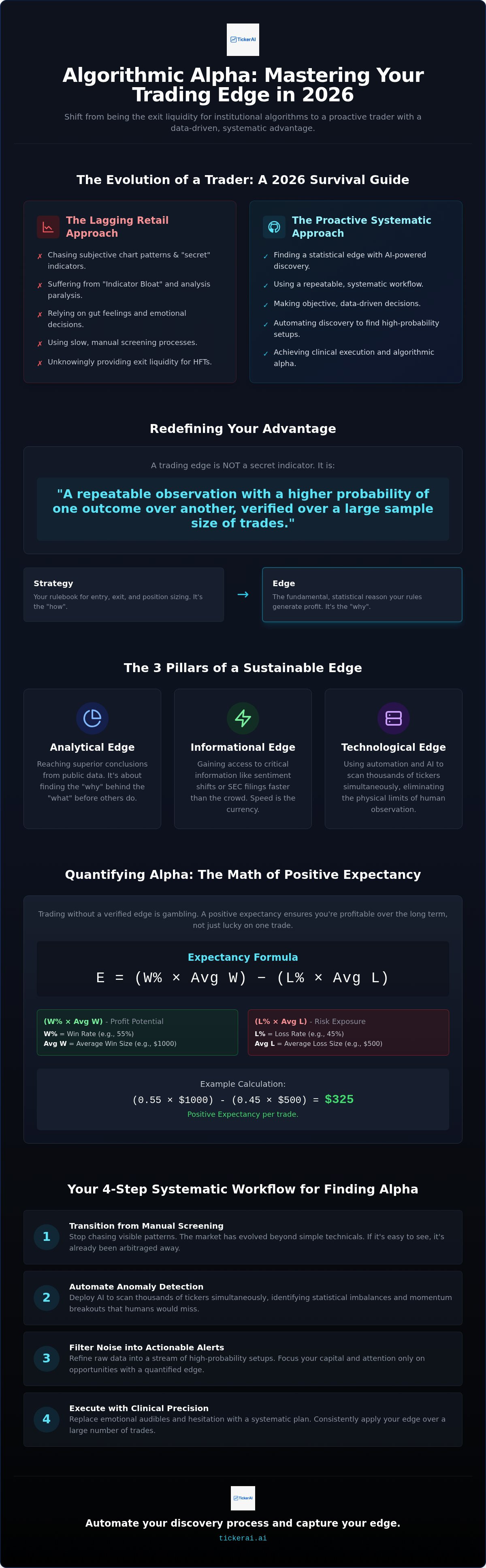
A trading edge isn't a secret formula or a proprietary indicator found on a dark web forum. It's a repeatable observation with a higher probability of one outcome over another. In the current 2026 environment, retail traders often fail because they chase visual patterns without understanding the underlying mechanics. They look at a head and shoulders and see a profit opportunity; professionals look at the same chart and see a liquidity trap. A trading edge is a statistical advantage that manifests over a large sample size of trades. Success requires moving away from subjective gut feelings toward objective, data-driven systematic investing. Using AI to find stock market alpha is the primary method for identifying these statistical imbalances before they're priced out by the broader market.
Strategy vs. Edge: The Critical Distinction
A strategy is merely your rulebook. It defines your entry, exit, and position sizing. However, the edge is the fundamental reason those rules generate profit. For example, a standard breakout strategy isn't an edge on its own. It only becomes profitable when it captures institutional participation or structural market imbalances. Most manual patterns erode over time as Algorithmic Trading systems identify and arbitrage away simple technical inefficiencies. If your advantage is easily visible to the naked eye, it's likely already been incorporated into the price by high-frequency firms. You need a deeper layer of discovery. Professionals focus on why a move is happening, ensuring their strategy aligns with actual market flow rather than just lines on a screen.
The Survival Necessity of a Systematic Approach
Trading without a verified edge is gambling with a significantly higher fee structure. Every trade carries the weight of spreads and commissions. These costs create an immediate negative expectancy for the unprepared participant. To survive long-term, you must adopt a systematic stock investing approach that prioritizes data over emotion. You aren't looking for a win on the next trade. You're looking for the consistent application of a process that yields a positive result over 100 trades. Using AI to find stock market alpha allows you to scan thousands of tickers simultaneously to find these rare, high-probability moments. This systematic discovery removes the temptation for emotional audibles. It replaces hesitation with execution. It's about finding the needle in the haystack, every single day, with clinical precision.
The Anatomy of a Sustainable Edge: Analytical, Informational, and Technological
A sustainable edge isn't a static strategy. It's a dynamic discovery process. In 2026, professional advantages fall into three distinct pillars: analytical, informational, and technological. Relying on just one is a recipe for obsolescence. The modern trader must integrate all three to maintain profitability. Using AI to find stock market alpha allows you to synthesize these silos into a single, high-speed intelligence workflow. It moves you from a reactive participant to a proactive hunter.
- Analytical Edge: Reaching superior conclusions from the same public data sets. It's about finding the "why" behind the "what."
- Informational Edge: Gaining access to sentiment shifts or SEC filings faster than the crowd. Speed is the primary currency here.
- Technological Edge: Using automation to scan thousands of tickers simultaneously. This eliminates the physical limits of human observation.
The 2026 hybrid reality demands a unified approach. Recent Harvard Business School research on AI in financial analysis suggests that AI-generated insights can significantly impact market informativeness. This research highlights how advanced models process complex data to reveal patterns that human analysts might overlook. By leveraging these tools, you aren't just following the market; you're anticipating its next move. You're identifying structural imbalances before the retail herd even realizes a move is underway.
Closing the Latency Gap with Institutional-Grade Tools
Retail traders traditionally lag behind hedge funds by hours or even days. While an institution detects a shift in institutional flow in seconds, the manual trader is still drawing trendlines on yesterday's candle. This latency is where alpha goes to die. You need to level the playing field. Quantitative stock analysis tools for retail investors have finally closed this gap. Manual charting is no longer a sufficient technological edge in an algorithmic market. If you're still clicking through charts one by one, you're the liquidity. Professional-grade discovery requires a proactive scout that works at machine speed. You can start building this advantage today with AI-driven opportunity discovery.
Filtering Noise into Action-Oriented Alerts
Information overload is the silent killer of consistency. There's too much data and not enough insight. Most traders drown in a sea of general market news, social media chatter, and conflicting indicators. You need a filter, not a funnel. Prioritizing high-probability setups over general market noise is essential for maintaining focus. Action-oriented stock alerts allow you to ignore the 99% of price action that doesn't matter. This allows you to focus exclusively on your specific setups. For a deeper look at how to scale this intelligence, read our guide on Automated Stock Market Analysis: Scaling Intelligence in the 2026 Market. Using AI to find stock market alpha isn't about getting more information. It's about getting the right information at the right time.
Quantifying Alpha: The Math Behind Positive Expectancy
Alpha is the excess return of an investment relative to a benchmark index. It's the metric that separates professional participants from passive indexers. To capture it consistently, you must transition from guessing to quantifying. Positive expectancy is the bedrock of any sustainable trading plan. It ensures that your process, when repeated over time, results in net profit. Using AI to find stock market alpha provides the computational power required to calculate these probabilities across diverse market conditions with clinical precision. It replaces hope with a verified mathematical advantage.
The Expectancy Formula is straightforward: (Win Rate % x Average Win) - (Loss Rate % x Average Loss). Many retail traders mistakenly believe they need a high win rate to succeed. In reality, a 40% win rate can be a massive edge if your average win is significantly larger than your average loss. This is the core of professional swing trading. You don't need to be right every time; you just need the math to work in your favor over the long run. An edge is a statistical probability, not a guarantee for the next trade. The Law of Large Numbers dictates that you need a sample size of at least 30 to 50 trades to prove your edge exists. One or two losses are noise. Fifty trades are data.
Backtesting: Building Evidence-Based Confidence
Historical data is your most valuable asset. Backtesting allows you to verify that a specific setup has a statistical advantage before risking capital. Insights from FIU College of Business on the role of AI in stock trading highlight how machine learning can analyze vast datasets to uncover inefficiencies that human observation misses. However, you must avoid curve-fitting. This is the practice of over-optimizing a strategy for past data that won't work in the future. You must account for market regime changes, such as shifts from low to high volatility. For a deeper dive into these methods, see our guide on What is Quantitative Investing? The 2026 Guide to Systematic Discovery.
Risk Management as an Edge Enhancer
Risk management isn't just about protection. It's an edge enhancer. Improper position sizing destroys even the most mathematically sound strategies. If one loss wipes out five wins, your expectancy is negative regardless of your win rate. Professionals prioritize mitigating 'Ruination Risk' through disciplined stop losses and targets. They focus on the downside to let the edge handle the upside. When you know your maximum loss is capped, you can execute your plan without emotional interference. Using AI to find stock market alpha includes identifying the optimal risk-to-reward ratios for every setup. This systematic discipline ensures you stay in the game long enough for your statistical advantage to manifest.
Step-by-Step: How to Get a Trading Edge Using Systematic Discovery
Using AI to find stock market alpha requires a transition from manual hunting to systematic oversight. You aren't just looking for a single trade. You're building a production line for high-probability setups. This workflow replaces the inconsistency of discretionary trading with the reliability of a machine-driven process. It moves the trader from the role of a manual laborer to that of a system architect. To build this advantage, follow these four foundational steps.
- Step 1: Identify a repeatable market anomaly. Focus on structural inefficiencies like post-earnings announcement drift or volatility expansion.
- Step 2: Define strict entry and exit criteria. Establish clear parameters for every trade to eliminate emotional audibles and discretionary errors.
- Step 3: Implement automated scanning. Use technology to detect your specific setups across thousands of tickers in real-time.
- Step 4: Execute with discipline. Journal every trade to track your realized expectancy against your backtested model.
Automating the 'Scout' Phase of Trading
The traditional 4-hour manual chart crawl is a strategic liability. It's slow, exhausting, and prone to human error. AI tools for technical analysis automation now flag patterns 24/7, ensuring you never miss a setup because you were away from your desk. Organizing market opportunities by theme using Smart Watchlists allows you to maintain a bird's-eye view of sector rotation and institutional flow. This efficiency allows you to focus on high-level decision-making rather than data entry. You can start automating your discovery process today with TickerAI Pro.
Developing a Rule-Based Trading Plan
Psychology is the final frontier of a sustainable trading edge. High-stakes environments trigger emotional responses that often override logic. Using "If-Then" logic creates a mental firewall against FOMO and panic. You only act when your pre-defined algorithmic signals align with your plan. This reduces the cognitive load of trading and ensures consistency across hundreds of executions. For a deeper analysis on maintaining this mindset, read our guide on Using AI to Remove Emotion from Trading: A Professional Guide to Systematic Discipline. Consistent alpha comes from following the system, not the noise. Using AI to find stock market alpha is the only way to ensure your rules are applied without bias every single time.
Leveraging TickerAI: Automating Your Edge for Consistent Opportunity
TickerAI transforms the discovery phase from a manual burden into a professional technological advantage. It provides an instant edge by automating the search for high-probability setups across the entire market. Using AI to find stock market alpha means capturing momentum breakouts before the retail crowd even notices the volume spike. You move from a reactive state to a proactive one. By leveraging real-time automated market scanning, you can identify structural imbalances as they form. This clinical precision ensures you're positioned while others are still analyzing lagging indicators. It's about speed, accuracy, and the elimination of human latency.
The platform enables a critical transition from "searching" to "monitoring." Instead of hunting for tickers, you utilize Smart Watchlists that act as a sophisticated filter for a chaotic environment. These watchlists prioritize opportunities based on your specific criteria, allowing you to ignore the 99% of price action that lacks statistical expectancy. It streamlines your workflow. It protects your mental capital. You focus exclusively on the highest-quality swing trade setups while the AI handles the data-heavy lifting. This is how you scale your research without increasing your screen time.
TickerAI Full-Access vs. Pro: Choosing Your Advantage
Selecting the right subscription level depends on your trading frequency and available capital. TickerAI Full-Access provides foundational market alerts and curated investment ideas. It's an ideal entry point for those building a systematic approach. However, the TickerAI Pro subscription is designed for the serious participant requiring institutional-grade discovery. The Pro tier detects subtle anomalies and volume clusters that manual scanners frequently miss. It scans thousands of data points simultaneously to surface setups with the highest probability of success. It's a high-speed intelligence partner that stays "on" even when you're away from your desk. You gain the ability to monitor multiple sectors with the same depth as a dedicated research desk.
The Future of Individual Investing: The AI-Driven Edge
The next decade of trading belongs to those who partner with advanced technology. The era of the manual chart-flipper is over. To remain competitive, you must position yourself as a decision-maker rather than a data-processor. AI-powered stock opportunity discovery allows you to focus on high-level strategy and risk management. You provide the oversight; the machine provides the discovery. This hybrid model is the only sustainable way to find stock market alpha in an increasingly algorithmic environment. Don't let institutional speed be your barrier to entry. Start building your systematic edge with TickerAI today.
Securing Your Advantage in the Algorithmic Era
A sustainable trading edge in 2026 isn't found by chasing subjective chart patterns or following the retail herd. It's built on a foundation of quantifiable statistical expectancy and the clinical elimination of emotional bias. Success requires a shift from manual data processing to high-level decision-making. By integrating analytical, informational, and technological pillars, you move from being market liquidity to becoming a proactive participant. Using AI to find stock market alpha is the only way to maintain this advantage in a high-frequency environment where institutional latency is measured in milliseconds.
The transition to systematic investing starts with a repeatable discovery process. You need tools that filter noise into actionable insight without the burden of manual heavy lifting. Discover high-potential stock setups with TickerAI’s AI-powered discovery tools. Benefit from AI-driven real-time market alerts and professional-grade swing trade setups designed to eliminate emotional bias with data-backed discovery. Your process defines your profitability. It's time to trade with the precision of an expert and the speed of a machine. The market is moving; ensure your edge moves with it.
Frequently Asked Questions
What is a real-world example of a trading edge?
A real-world example of a trading edge is identifying post-earnings announcement drift where a stock continues to move in the direction of an earnings surprise for several days. This repeatable anomaly provides a statistical advantage over a large sample size. Professionals use automated scanning to detect these momentum shifts before the broader retail market reacts. By focusing on structural imbalances rather than subjective chart patterns, you ensure your entry aligns with institutional flow.
How long does a trading edge typically last before it stops working?
The lifespan of a trading edge depends on its complexity and market participation. Simple technical patterns often erode quickly as high-frequency algorithms arbitrage away the inefficiency. More robust edges based on structural market mechanics or sentiment shifts can last for years. However, constant monitoring is required to ensure the edge hasn't decayed. Using AI to find stock market alpha allows you to track realized expectancy in real-time and detect when strategy performance deviates from historical norms.
Can a retail trader really compete with hedge fund algorithms?
Retail traders can compete by utilizing institutional-grade discovery tools that close the latency gap. While you won't beat high-frequency firms on microsecond execution, you can match their analytical depth using AI-powered stock opportunity discovery. Tools like TickerAI Pro scan thousands of data points to surface swing trade setups that were previously only accessible to hedge funds. Success in 2026 isn't about out-trading a bot; it's about using superior filtering to find high-probability setups before the crowd.
How do I know if my trading edge is actually working?
You verify an edge by calculating its positive expectancy over a sample size of at least 30 to 50 trades. A working edge manifests as a consistent mathematical advantage where your win rate and average win size outweigh your losses. If your realized results align with your backtested model, the edge is intact. Tracking these metrics in a trade journal is essential for professional discipline. Sudden deviations in your equity curve often signal a shift in market regime.
Is a high win rate the same thing as having an edge?
A high win rate is not synonymous with having an edge. You can have an 80% win rate and still lose money if your average loss is significantly larger than your average win. An edge is defined by positive expectancy, not just frequency of success. Many professional strategies operate with a 40% win rate but remain highly profitable due to disciplined risk-to-reward ratios. Professionals focus on the math of the entire system rather than one trade.
How much capital do I need to effectively trade an edge?
Effective capital requirements depend on your specific strategy and risk management rules. Most professional swing traders recommend starting with enough capital to allow for proper position sizing without risking more than 1% per trade. While you can start with smaller amounts, having $5,000 to $10,000 provides the flexibility to trade multiple setups simultaneously. This diversification is critical for allowing your statistical edge to manifest over time. Proper capitalization ensures that a string of losses doesn't lead to ruination.
Do I need to learn coding to get a technological trading edge in 2026?
You don't need to learn coding to secure a technological edge in 2026. Modern platforms have democratized algorithmic discovery through natural language interfaces and pre-built models. TickerAI Pro provides institutional-grade scanning and real-time alerts without requiring a single line of Python. This allows you to focus on high-level decision-making rather than technical maintenance. Using AI to find stock market alpha is now possible through accessible platforms that handle the complex data processing for you.


