

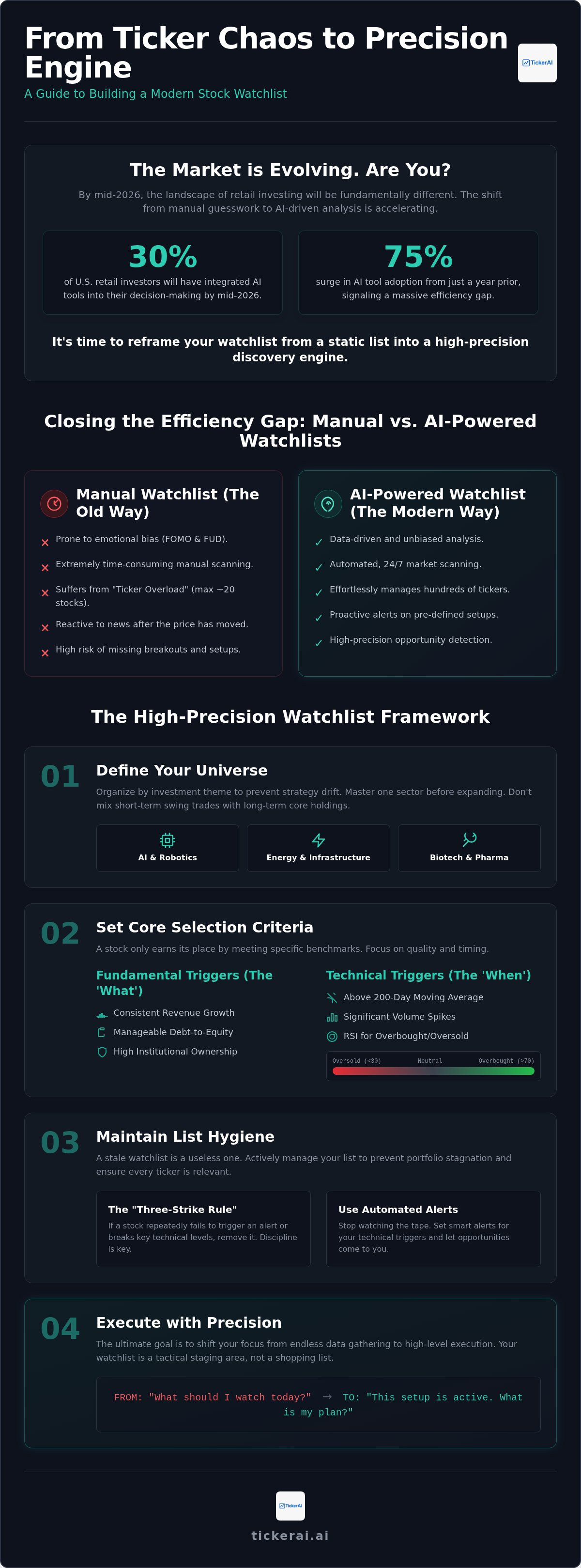
By mid-2026, 30% of U.S. retail investors have integrated AI tools into their decision making, representing a 75% surge from just a year ago. Most traders start by pinning a dozen random tickers to a screen and hoping for a green day. It's a recipe for analysis paralysis. You've likely felt the sting of FOMO after watching a breakout happen on a stock you meant to watch but lost in the noise. Building an effective stock watchlist for beginners shouldn't feel like staring into a digital blizzard.
You don't need more data; you need a filter. This guide transforms your chaotic list of tickers into a high-precision discovery engine that detects market opportunities before the price moves. We'll strip away the manual guesswork and replace it with a repeatable, automated selection process. You'll learn how to curate high-potential setups, configure smart alerts for price action, and build a research workflow that operates with clinical precision. It's time to stop chasing the tape and start anticipating it.
Key Takeaways
- Reframe the watchlist from a static list to a high-precision discovery engine designed to filter market noise and isolate actionable data.
- Identify the specific technical and fundamental triggers required to build a high-performance stock watchlist for beginners that meets professional standards.
- Close the efficiency gap by shifting from manual scanning to automated, algorithmic filtering that eliminates emotional bias and ticker fatigue.
- Maintain list hygiene using the "Three-Strike Rule" and automated price alerts to prevent portfolio stagnation and ensure relevance.
- Leverage Smart Watchlists to identify real-time swing trade setups, shifting your primary focus from data gathering to high-level execution.
What is a Stock Watchlist and Why Beginners Need a System
A watchlist is a high-precision filter for market opportunities. It's the primary tool for separating actionable signals from market noise. Most new investors treat it as a static list of companies they find interesting. This is a strategic error. A professional-grade stock watchlist for beginners functions as a tactical staging area. It's where you monitor assets that meet specific technical or fundamental criteria but haven't yet reached a definitive entry point.
Tracking more than 20 stocks manually is a recipe for failure. This "Ticker Overload" forces you to skim data rather than analyze it. In a 2026 market moving toward near 24/5 trading sessions, manual monitoring cannot keep pace with algorithmic speed. You'll miss breakouts. You'll ignore warning signs. Keep your manual list lean to ensure every ticker receives the clinical attention it requires for success.
There is a sharp distinction between a portfolio and a watchlist. Your portfolio represents executed capital and current risk. Your watchlist represents the hunt. By isolating the two, you remove the emotional urge for impulse buying. You don't buy because a stock looks "cheap" on a whim. You buy because a ticker on your curated list finally triggered a predetermined alert. This separation is your first line of defense against market volatility.
The Psychology of the Watchlist
A structured list is a defense mechanism against analysis paralysis. When you know exactly which stocks you are watching, you stop chasing every headline. This shifts your mindset from reactive to proactive. You aren't a victim of price swings; you're an observer waiting for a specific setup to materialize. Watchlist Fatigue is the primary obstacle for retail beginners, occurring when a cluttered screen causes a trader to freeze during high-probability setups. Eliminating this fatigue allows for faster decision-making when the market moves.
Organizing by Investment Horizon
Effective organization prevents strategy drift. Don't mix short-term swing trade lists with long-term core wealth builders. These categories have different risk tolerances, exit triggers, and timeframes. Segment your discovery into thematic buckets to streamline your research workflow.
- AI and Robotics: High-growth targets suitable for rapid swing setups.
- Energy and Infrastructure: Macro-sensitive assets for mid-term positioning.
- Biotech: Specialized tickers driven by clinical data and regulatory milestones.
Focus is your greatest asset. Beginners should start with a single, focused theme. Master the mechanics of one sector first. Once you can identify opportunities within that niche with clinical precision, you can expand your discovery engine to other horizons.
Core Criteria: How to Select Stocks for Your Watchlist
Selecting assets for a stock watchlist for beginners requires a strict hierarchy of data points. Don't add tickers based on social media hype or gut feelings. Focus on Mid-Cap and Large-Cap stocks during your initial phase. These assets offer higher liquidity and lower volatility than small-cap alternatives, providing a more stable environment to practice trade execution. A stock earns its place on your list only by meeting specific fundamental and technical benchmarks.
Fundamental Analysis for Beginners
Prioritize quality metrics to ensure long-term viability. Look for consistent revenue growth and a manageable debt-to-equity ratio. High institutional ownership is a critical validator; it indicates that professional "Smart Money" is already positioned. Manually digging through hundreds of pages of financial reports is inefficient for the modern trader. You can now utilize AI tools for analyzing SEC filings to automate data extraction. This allows you to identify catalysts, such as insider buying or strategic shifts, before they are fully priced in by the broader market.
Technical Indicators that Signal Opportunity
Technical triggers act as the timing mechanism for your watchlist. The 200-day Moving Average serves as a clinical "line in the sand." If a stock trades below this level, the long-term trend is bearish, and it likely doesn't belong on a bullish watchlist. Watch for volume anomalies. A sudden spike in trading volume often precedes a major price breakout, signaling institutional entry.
Use the Relative Strength Index (RSI) to detect overextended conditions. An RSI below 30 suggests an oversold state, while an RSI above 70 indicates the asset may be overbought. To increase your precision, leverage AI stock signals to validate your manual observations. Algorithmic confirmation removes the emotional guesswork from technical setups, ensuring you only track tickers with a high probability of movement.
Catalysts like upcoming earnings reports or regulatory filings are primary reasons to move a ticker from a general sector list to an active, high-priority watchlist. Tracking these windows manually often leads to missed opportunities. Utilizing AI-powered discovery tools ensures your list remains populated with setups that align with current market mechanics, allowing you to focus on decision-making rather than data hunting.
Manual vs. AI-Powered Watchlists: The 2026 Efficiency Gap
The divide between manual tracking and algorithmic discovery has become a chasm. For most, a stock watchlist for beginners starts in a basic spreadsheet. This approach hits the "Human Limit" almost immediately. A disciplined trader can monitor perhaps 15 tickers with clinical detail. Beyond that, focus fractures. Algorithmic processing doesn't suffer from fatigue or cognitive load. It scans 10,000 tickers in milliseconds, identifying patterns that a human eye would overlook during a standard trading session. Scalability is no longer a luxury; it's a requirement for survival.
AI eliminates the emotional attachment to "famous" tickers. Retail investors often keep legacy names on their lists out of habit, even when the technical setup has soured. AI is indifferent. It prioritizes data over brand recognition, ensuring your list contains the highest-probability setups regardless of the company's fame. This bias elimination ensures your capital isn't tied up in stagnant assets simply because they are familiar.
The Limitations of Traditional Spreadsheets
Traditional spreadsheets are the primary source of data latency. Relying on manual entry or delayed API pulls means you are often working with stale information. In the 2026 market, a price move can complete before you've even refreshed your browser. The hidden time-cost of manual maintenance is staggering. Every minute spent updating a cell is a minute lost on execution strategy. Manual systems fail to provide systematic investment confidence because they rely on human consistency, which is inherently flawed.
The AI Edge in Discovery
Automated market scanning represents a fundamental shift in how a stock watchlist for beginners should function. Instead of you searching for stocks, the opportunities find you. Smart Watchlists are dynamic. They adapt to changing market regimes in real-time. If volatility spikes in a specific sector, an AI-powered engine rotates your discovery focus instantly. This ensures you are always looking where the liquidity is flowing.
Real-time anomaly detection identifies hidden movements, such as unusual volume spikes or rapid trend shifts, that manual charts miss. You aren't just watching price. You're monitoring the mechanics behind the price. In 2026, the competitive edge is found in the speed of discovery, not the depth of a spreadsheet. This transition from manual curation to automated detection allows you to focus on the only thing that matters: the decision to execute.
Watchlist Maintenance: When to Add, Hold, or Delete
Maintenance is the most overlooked phase of portfolio development. A stock watchlist for beginners often transforms into a cluttered graveyard of abandoned ideas. This clutter creates cognitive drag. It's not a museum; it's a dynamic staging area. You must treat your list as a high-velocity filter that only retains tickers showing immediate actionable potential. Efficiency is the priority. Execution is the goal.
Implement the "Three-Strike Rule" to maintain clinical list hygiene. If a stock fails to react to a positive catalyst, breaks a key technical support level, or consolidates for too long without a volume spike, it's out. Quarterly audits are equally vital. Re-verify your fundamental thesis every 90 days. If the revenue growth trajectory has flattened or institutional ownership has dropped, the stock has lost its right to your attention. Ignore social media hype. Market signals are found in tape action, not trending hashtags.
Action-Oriented Alert Strategies
Stop staring at the screen. Continuous monitoring leads to fatigue and emotional "revenge" trading. Set price alerts at specific technical levels, such as historical resistance points or major moving averages. This allows you to focus on strategy while the market does the heavy lifting. Integrate automated market sector rotation analysis to know when to shift your discovery focus. Alert discipline is non-negotiable. Only act on signals that align with your high-conviction setups.
The Purge: Keeping Your List Lean
A lean list of 10 actionable stocks is vastly superior to 100 "maybe" tickers. Large lists dilute your focus and increase the likelihood of missing a breakout. Identify "Dead Weight" ruthlessly. These are stocks that have lost their original catalyst but remain on your list due to emotional bias. Use systematic discipline to prune your watchlist without hesitation. Pruning isn't a sign of failure; it's a sign of professional-grade risk management. You don't need more tickers; you need better signals.
Professional traders don't hunt for data; they wait for signals to trigger. Automate your market scanning with TickerAI Full‑Access to receive real-time alerts for high-precision swing trade setups before the market moves.
TickerAI: The Evolution of the Smart Stock Watchlist
The transition from a manual stock watchlist for beginners to an automated intelligence system is a fundamental shift in trading philosophy. TickerAI transforms the static list of tickers into a proactive discovery engine. It bridges the critical gap between monitoring price action and identifying actionable trade setups. This platform operates as a tireless assistant, scanning the vast global markets while you focus on high-level execution strategy. It moves beyond simple data viewing to provide high-precision market alerts that signal opportunity before the price moves.
Most retail traders fail because they cannot process information at the speed of the 2026 market. TickerAI eliminates this bottleneck. By integrating algorithmic processing with real-time data, it identifies swing trade setups that align with your specific technical and fundamental criteria. This isn't just a list; it's a filtered stream of institutional-grade intelligence designed for the modern retail investor. You stop hunting for data and start waiting for the signals that matter.
Automated Discovery Tiers
Choosing the right tier is essential for matching the tool to your investment horizon. TickerAI Full-Access is the primary choice for active traders. It focuses on real-time swing trade discovery and automated market scanning. TickerAI Pro scales this capability further, offering institutional-grade tools that provide deeper data-driven insights. Before committing, spend time evaluating an AI stock picking service to ensure its logic matches your risk tolerance. The platform filters over 10,000 stocks daily, delivering a curated shortlist that removes the noise of the broader market.
Your First AI-Powered Watchlist
Setting up your first smart watchlist is a streamlined process. You don't need to build complex spreadsheets. Start by selecting your thematic focus, such as AI, Energy, or Biotech. Define your technical triggers-like volume breakouts or RSI levels-and let the engine take over. The system monitors these parameters across thousands of tickers simultaneously. When a setup materializes, you receive a direct alert. This allows you to transition from "Research" to "Results" with clinical speed. It's time to replace manual guesswork with algorithmic precision. Start your systematic discovery journey with TickerAI today.
Transitioning to High-Precision Market Discovery
A professional stock watchlist for beginners is more than a list; it's a dynamic filter for a chaotic market. You've moved from the manual data entry of the past to a systematic research workflow. By applying the "Three-Strike Rule" and focusing on Mid-Cap and Large-Cap assets, you've established a foundation for clinical execution. The gap between research and results is closed when you replace human bias with algorithmic speed. Efficiency isn't just about saving time. It's about ensuring your capital is always positioned in high-probability setups before the broader market reacts.
The 2026 market doesn't reward hesitation. It rewards discovery. Leveraging AI-driven swing trade setups and real-time market anomaly detection allows you to act with the confidence of an institutional trader. You're no longer chasing the tape; you're anticipating it. Identify your next market opportunity with TickerAI Smart Watchlists and gain access to data-driven insights for active traders. Take control of your discovery engine today. You have the tools. Now execute with precision.
Frequently Asked Questions
How many stocks should a beginner have on their watchlist?
A beginner should maintain between 10 and 20 tickers on their primary list. This range provides enough variety to capture sector movements without triggering analysis paralysis. If you exceed this limit, you risk "Ticker Overload," where manual tracking becomes impossible. High-precision monitoring requires deep focus on each asset's specific technical triggers and fundamental catalysts.
What is the best free tool for building a stock watchlist?
Most major online brokers in 2026, including Fidelity and Charles Schwab, offer robust watchlist tools with $0 commissions and no minimum deposit. TradingView remains a standard for technical charting and manual list management. While these free tools are effective for basic tracking, they often lack the algorithmic discovery speed required for high-frequency market shifts.
How often should I update my stock watchlist?
You should audit your stock watchlist for beginners weekly to remove stagnant ideas and daily for active trade setups. Use the "Three-Strike Rule" to purge tickers that fail to react to positive catalysts or break technical support. Regular list hygiene ensures your attention remains on assets with immediate actionable potential rather than legacy ideas that no longer fit your strategy.
Can I use AI to automatically add stocks to my watchlist?
Yes, you can use AI to automate the discovery and population of your list. Services like TickerAI Full-Access scan thousands of tickers simultaneously to identify swing trade setups that match your specific criteria. This removes the manual burden of data mining. It allows you to focus purely on execution and risk management decisions rather than hunting for tickers.
What is the difference between a watchlist and a screener?
A screener is a broad search tool used to filter the entire market based on data points, while a watchlist is a curated staging area for assets you intend to trade. You use a screener to find candidates and a watchlist to monitor them for a specific entry point. Screeners identify the "what," and watchlists determine the "when."
Should I include penny stocks on my beginner watchlist?
No, beginners should avoid including penny stocks on their initial watchlists. These assets suffer from low liquidity and extreme volatility, which often lead to significant slippage and capital loss. Focus instead on Mid-Cap and Large-Cap stocks. These offer a more stable environment for learning price action and technical indicators without the risks associated with micro-cap stocks.
How do I set alerts that actually matter?
Set alerts based on structural technical levels like support, resistance, or the 200-day moving average. Avoid setting alerts for minor price fluctuations that don't change your underlying thesis. High-conviction alerts should act as a signal to open your terminal and prepare for execution. This reduces the need for constant screen monitoring and prevents emotional trading decisions.
What happens if a stock on my watchlist hits its target price?
When a stock hits your target price, you must execute according to your predefined trading plan. The watchlist's job is complete once the alert triggers. Move the ticker from your watchlist to your active portfolio and immediately set your stop-loss and take-profit levels. Never hesitate once your technical triggers are met; the goal is clinical execution, not hesitation.


