

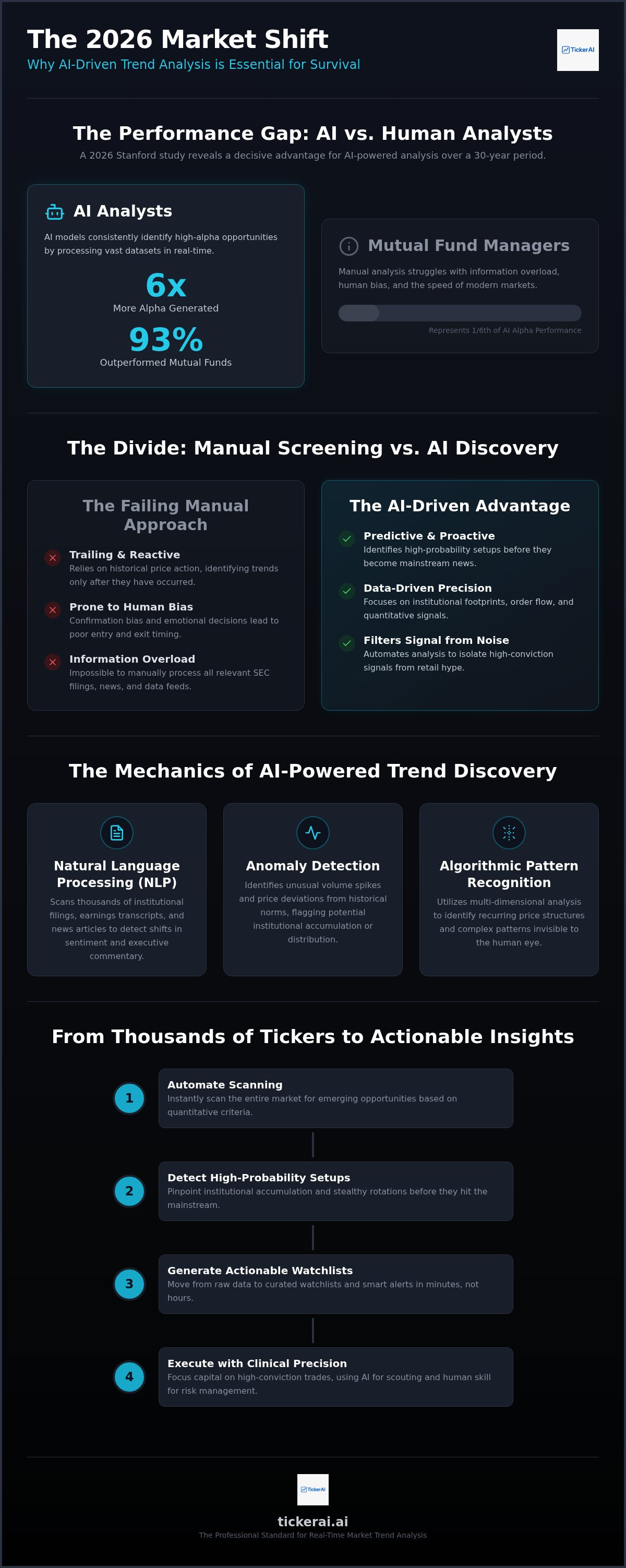
A 2026 Stanford study found that AI analysts outperformed 93% of mutual fund managers over a 30-year period, generating six times more alpha. It's a clear signal that manual analysis is no longer a competitive strategy. You've likely felt the frustration of missing a major sector rotation or realizing you've bought into retail hype just as institutional money starts to exit. Information overload from 24/7 news cycles makes it nearly impossible to filter signal from noise without technical assistance.
Selecting a professional AI tool for identifying market trends is the only way to regain your edge. This guide shows you how to leverage advanced quantitative models to detect high-probability movements and institutional accumulation before they become mainstream headlines. We'll show you how to automate the scanning of thousands of tickers and set up actionable alerts that prioritize clinical precision over social media sentiment. We'll analyze the top-performing platforms of 2026, focusing on tools that deliver speed, transparency, and a decisive advantage in a fast-moving environment.
Key Takeaways
- Transition from trailing manual indicators to real-time quantitative analysis to survive the high-frequency environment of 2026.
- Understand how Natural Language Processing and anomaly detection pinpoint institutional accumulation before it triggers mainstream retail hype.
- Evaluate the essential criteria for a professional AI tool for identifying market trends, focusing on low-latency data and verified regulatory filings.
- Implement a modular workflow to automate trend discovery, allowing you to move from scanning thousands of tickers to managing actionable watchlists in minutes.
- Discover how TickerAI’s Pro and Full-Access tiers provide curated swing trade setups and smart alerts designed for clinical precision.
The Evolution of Trend Identification: Why Manual Scanning Fails in 2026
The 2026 market environment is defined by high-frequency algorithms and instantaneous information dissemination. Traditional technical analysis relies on historical price action; however, in a market where 88% of organizations now use AI regularly according to a 2025 McKinsey survey, those price signals are often priced in before a human can react. Manual scanning creates a "human lag" that turns potential entries into exit liquidity for institutional bots. If you're waiting for a moving average crossover to appear on a manual chart, you're already behind the curve.
Price action alone is no longer sufficient for professional execution. Modern trend identification requires a quantitative approach that synthesizes order flow, institutional accumulation, and sentiment shifts in milliseconds. Using a dedicated AI tool for identifying market trends is the only way to bridge the gap between raw, overwhelming data and actionable intelligence. These systems detect high-probability setups before they become mainstream noise, allowing for a proactive rather than reactive strategy.
The Death of the Manual Screener
Traditional stock screeners rely on static "if-then" logic. They identify what has already happened, not what is likely to happen next. In volatile sectors like energy or emerging tech, these tools are too rigid to capture fluid rotations or stealthy accumulation phases. The industry has shifted from basic filtering to machine learning pattern recognition that adapts to changing volatility. Professional traders are increasingly adopting automated stock market analysis to scale their intelligence across thousands of tickers simultaneously without sacrificing precision.
- Manual Screeners: Trailing, rigid, and prone to human confirmation bias.
- AI-Driven Discovery: Predictive, adaptive, and focused on institutional footprints.
Data Proliferation and the Signal-to-Noise Ratio
The volume of market data generated per second in 2026 is staggering. Between SEC filings, earnings transcripts, and alternative data feeds, the "signal-to-noise" ratio has plummeted for the average participant. This leads to information overload and a catastrophic breakdown in trader discipline. AI acts as a clinical filter, prioritizing high-conviction signals while ignoring the retail hype that often precedes a sharp reversal. By automating the heavy lifting of Trend analysis, traders can focus entirely on risk management and execution. This level of automated scouting is what separates high-performance participants from those lost in the noise.
How AI Tools Detect Market Trends: The Mechanics of Discovery
The core engine of a modern AI tool for identifying market trends relies on Natural Language Processing (NLP) to ingest thousands of institutional filings and earnings transcripts simultaneously. This technology doesn't just scan for keywords; it evaluates linguistic nuances and sentiment shifts in executive commentary. As highlighted in a recent OECD report on generative AI, these capabilities allow for a deeper understanding of financial risks and opportunities that traditional models often overlook. By the time a human analyst reads a single 10-K, the AI has already processed the entire sector.
Beyond text, anomaly detection serves as the primary scout for emerging trends. It identifies unusual volume spikes or price deviations that fall outside of historical standard deviations. This proactive monitoring allows traders to spot institutional accumulation before the price action becomes obvious on a retail chart. Correlation analysis further enhances this by detecting hidden relationships between seemingly unrelated assets, such as a surge in semiconductor shipping rates preceding a breakout in consumer electronics. The shift from historical description to probabilistic forecasting is what defines the current era of intelligence.
Algorithmic Pattern Recognition
Modern systems move far beyond simple indicators like RSI or MACD. They utilize multi-dimensional fractal analysis to identify recurring price structures across multiple timeframes. This automation is critical for detecting institutional distribution phases, where large players exit positions quietly over several days. Quantitative investing identifies a market edge by applying mathematical models and computational power to isolate high-probability setups from vast datasets.
Sentiment vs. Flow Analysis
Social media sentiment is often a trailing indicator of retail hype, which frequently signals the end of a trend rather than its beginning. A professional AI tool for identifying market trends prioritizes options flow and dark pool activity over "trending" hashtags. By tracking where the "Smart Money" is actually deploying capital, the AI can generate a singular trend conviction score. This score integrates disparate data sets, from unusual call buying to sector-wide capital inflows, into a single actionable metric. Refining your watchlist based on these institutional footprints ensures you aren't chasing ghosts in the noise.
Choosing the Right AI Tool: Financial Discovery vs. Marketing Research
Many participants mistake consumer market research tools for financial intelligence platforms. While marketing AI analyzes brand sentiment and buyer personas, a professional AI tool for identifying market trends must focus on capital flow and liquidity. The distinction is critical. Marketing tools operate on weekly or monthly cycles; financial discovery operates in milliseconds. In the 2026 market, a five-minute lag in data processing is the difference between capturing a breakout and becoming exit liquidity for a high-frequency algorithm.
Data depth is the second differentiator. Marketing-focused AI often prioritizes social media feeds like Twitter or Reddit. While these offer a glimpse into retail hype, they lack the structural data found in SEC filings, dark pool prints, and institutional options flow. A professional tool provides actionable setups rather than static reports. It integrates directly into your charting workflow, allowing you to move from discovery to execution without manual data entry. If a tool doesn't offer a specific setup with defined risk parameters, it's a research assistant, not a trading partner.
The Pitfalls of Using Generalist AI for Trading
Large Language Models (LLMs) like ChatGPT are insufficient for real-time market trend analysis. These models are designed for language prediction, not quantitative calculation. They frequently suffer from hallucinations, inventing price levels or misinterpreting technical indicators. Furthermore, their training data often has a cutoff date, making them blind to today's institutional rotations. Specialized AI stock discovery platforms outperform general models because they are built on live, financial-grade data pipelines. They prioritize accuracy over conversational fluency.
Professional Grade Requirements for 2026
A professional AI tool for identifying market trends must include backtesting capabilities. You shouldn't trust a signal without verifying its historical win rate and drawdown. Smart Watchlists are also essential for organizing thematic opportunities, such as "AI Infrastructure" or "Biotech Accumulation," in real-time. This structural organization allows you to monitor entire sectors without manual scanning. Success depends on understanding how to interpret AI stock signals to differentiate between a high-conviction institutional move and a low-probability volatility spike. Reliability is built on verified historical performance, not marketing claims.
A Step-by-Step Workflow for AI-Driven Trend Discovery
Integrating a professional AI tool for identifying market trends into your daily routine requires more than just access to data. It demands a structured framework that moves from high-level discovery to precise execution. In the 2026 market, where institutional bots react in microseconds, your workflow must be as clinical as the algorithms you're tracking. Success isn't about finding every move; it's about isolating the ones with the highest probability of institutional backing.
- Step 1: Define your investment horizon. Distinguish between swing trade setups and long-term investment ideas. AI models require specific volatility thresholds based on your expected holding period.
- Step 2: Configure automated scanners. Use your AI tool for identifying market trends to map specific sector themes, such as domestic energy or frontier tech. This narrows the focus from thousands of tickers to a manageable high-conviction list.
- Step 3: Validate with secondary confirmation. Never trade a signal in isolation. Verify algorithmic alerts against key technical levels or unusual dark pool volume to ensure the trend has structural support.
- Step 4: Execute within a risk framework. Use the AI’s suggested entry and exit points to define your position size. Strict stop-loss discipline is non-negotiable in a high-frequency environment.
Configuring Your AI Radar
Precision begins with your parameters. You must decide if you're hunting for high-velocity "breakout" alerts or "mean reversion" signals in oversold sectors. Over-optimization, or "curve fitting," is a common trap where traders make their scans too specific to past data, rendering them useless for future prediction. Focus on finding thematic investment opportunities with AI by targeting broad capital flows rather than chasing individual ticker anomalies. This ensures your discovery process remains robust across different market regimes.
Removing Emotion from the Execution
The greatest advantage of an automated scout is its lack of bias. AI alerts serve as the "objective truth," countering the FOMO that often leads traders into late entries. Systematic discipline is the only path to long-term profitability when news cycles are designed to trigger emotional reactions. Using AI to remove emotion from trading protects capital by replacing gut feelings with data-driven execution protocols. By the time you feel "certain" about a trend manually, the professional move is likely already over. Start scanning for institutional setups with TickerAI to ensure your decisions are based on math, not sentiment.
TickerAI: The Professional Standard for Real-Time Market Trend Analysis
TickerAI isn't a research assistant; it's a high-speed intelligence partner. It serves as the definitive AI tool for identifying market trends by prioritizing clinical precision over retail noise. While generalist models often struggle with data latency, TickerAI's proprietary algorithms process live exchange data to isolate institutional footprints. It provides the transparency and speed required to navigate the 2026 market environment with confidence. This platform turns chaotic data into a structured edge.
The platform operates through two specialized tiers: TickerAI Pro and TickerAI Full-Access. Both utilize automated market scanning to detect high-potential movements. By focusing on quantitative data-driven insights, the engine identifies swing trade setups and long-term investment ideas before they hit mainstream headlines. This isn't about chasing hype. It's about executing on validated capital flows and institutional accumulation.
TickerAI Pro: Advanced Tools for Active Traders
TickerAI Pro is engineered for participants who require real-time latency and deep institutional flow tracking. It's the primary AI tool for identifying market trends for those who trade high-volatility sectors. It's not just about seeing a trend. It's about seeing the capital moving behind it. Precision matters. Speed is the only currency in a market dominated by high-frequency algorithms.
- Real-time market alerts for high-probability setups.
- Customizable Smart Watchlists for thematic plays like AI, Biotech, and Energy.
- Curated swing trade setups with defined risk parameters.
- Access to institutional flow tracking and dark pool activity.
Utilizing Smart Watchlists allows you to organize emerging trends systematically. Instead of scanning tickers manually, the AI prioritizes opportunities based on conviction scores. This ensures you're monitoring the right sectors at the right time. You focus on the decision; the AI handles the detection.
Getting Started with Systematic Discovery
Choosing the right tier depends on your trading frequency. TickerAI Pro offers the highest speed for active traders, while Full-Access provides a comprehensive suite for those focused on broader market rotations. The onboarding process is streamlined for immediate execution. From initial setup to your first AI-driven alert, the focus remains on time-saving and clarity. You don't need to be a data scientist to leverage institutional-grade intelligence. It's time to replace manual guesswork with algorithmic certainty.
Experience professional AI stock discovery with TickerAI
Mastering the 2026 Market Regimes
The 2026 market doesn't reward those who wait for confirmation on a manual chart. It rewards those who deploy clinical precision to detect institutional footprints before they become mainstream noise. Manual scanning is a trailing indicator that leads to late entries and missed rotations. Success now depends on real-time quantitative discovery. Professional tools must prioritize structural capital flow over social media hype to ensure your strategy is built on math, not sentiment. This shift from historical description to probabilistic forecasting is the only way to maintain a competitive edge.
Selecting a specialized AI tool for identifying market trends is the only way to navigate this high-frequency environment. TickerAI provides the transparency and speed required to stay ahead of rapid sector rotations. By integrating advanced quantitative market scanning into your workflow, you replace guesswork with algorithmic certainty. It's time to stop reacting to the news and start anticipating the money.
Start your AI-powered stock discovery with TickerAI today. Access real-time alerts for high-potential movements and curated swing trade setups designed for the modern professional participant. Take command of your intelligence and execute with the confidence of a data-driven scout.
Frequently Asked Questions
How do AI tools for identifying market trends actually work?
An AI tool for identifying market trends works by synthesizing vast amounts of unstructured data through Natural Language Processing and anomaly detection. It scans SEC filings, earnings transcripts, and dark pool prints to identify patterns invisible to human eyes. By filtering out retail noise, it isolates institutional capital flows. This allows the system to generate conviction scores based on quantitative footprints rather than social media sentiment.
Can an AI tool really predict stock market movements in 2026?
AI tools provide probabilistic forecasting rather than absolute predictions. In 2026, high-frequency algorithms dominate the environment, making manual analysis a trailing indicator. Systems like TickerAI use predictive modeling to identify high-probability setups where historical patterns suggest institutional accumulation. While no tool guarantees outcomes, a 2026 Stanford study found AI analysts outperformed 93% of fund managers, proving that algorithmic discovery significantly increases the probability of capturing alpha.
Is TickerAI suitable for beginner investors or only professionals?
TickerAI is designed for serious participants ranging from active hobbyists to full-time professionals. While the underlying technology is sophisticated, the interface prioritizes clarity and actionable setups. Beginners can utilize the Full-Access tier to identify long-term investment ideas, while the Pro tier serves active traders requiring real-time alerts. It acts as a tireless assistant, allowing any user to focus on decision-making rather than manual data scanning.
What is the difference between a stock screener and an AI trend discovery tool?
A traditional stock screener uses static "if-then" logic to filter what has already happened. In contrast, an AI tool for identifying market trends uses machine learning to recognize fluid patterns and emerging rotations. Screeners are rigid and often provide trailing data. AI discovery tools are adaptive, identifying institutional footprints and volume anomalies before they trend, allowing you to enter positions ahead of mainstream retail recognition.
How much does a professional AI market trend tool cost?
Professional-grade AI tools typically offer tiered subscription models based on data latency and feature depth. General industry pricing for intermediate to expert plans often ranges from $45 to $250 per month when billed annually. TickerAI offers Pro and Full-Access subscriptions tailored to different trading frequencies. Users should evaluate costs based on the specific, tangible advantages provided in terms of time-saving and the quality of actionable intelligence.
Can I use AI to find small-cap stocks before they trend?
Yes, AI is particularly effective at identifying small-cap opportunities by detecting unusual volume spikes or stealthy accumulation phases. These movements often precede mainstream news coverage. By monitoring institutional footprints in lower-liquidity names, the AI flags high-probability setups that manual screeners would miss. This allows you to position yourself in emerging sectors before they become crowded, targeting high-growth opportunities with clinical precision.
Does TickerAI provide personal financial advice or brokerage services?
TickerAI does not provide personal financial advisory, custom trading coaching, or brokerage execution services. It is a quantitative discovery platform focused on data-driven insights and automated market scanning. The platform provides smart watchlists and swing trade setups based on algorithmic logic. Users are responsible for their own execution and risk management through their chosen brokerage, as TickerAI acts solely as a high-speed intelligence partner.
How accurate are the swing trade setups provided by TickerAI?
The accuracy of swing trade setups is rooted in quantitative backtesting and historical signal verification. TickerAI’s proprietary algorithms isolate setups with a high statistical probability of success based on institutional flow and price action fractals. Every alert is designed to remove emotion from the execution process. While market conditions fluctuate, the system’s clinical approach ensures that setups are prioritized based on verified data rather than subjective interpretation.


