

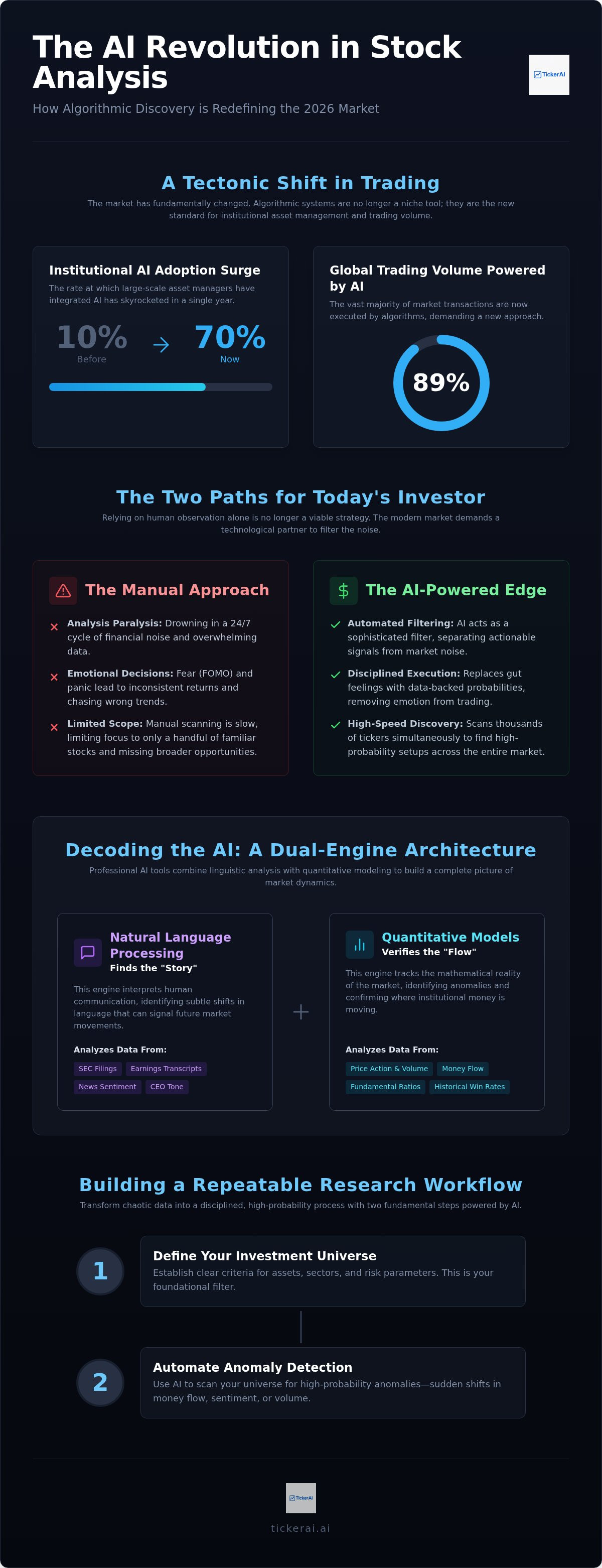
Institutional AI adoption in asset management surged from 10% to 70% in a single year. While the "big money" moves with algorithmic precision, many independent investors are still drowning in a 24/7 cycle of financial noise. You've likely felt the sting of missing a high-potential swing trade because you were stuck in manual scanning mode. Analysis paralysis during high-volatility periods isn't a lack of information. It's a lack of a filter. Using the right AI stock analysis tools is no longer a luxury; it's the baseline for surviving a market that moves at the speed of light.
You want a repeatable, automated research process that detects momentum breakouts before they've peaked. This guide provides the framework to transform chaotic market data into a disciplined, high-probability investment workflow. We'll break down how to evaluate current tech, integrate smart alerts into your daily routine, and build the confidence needed for data-backed entries. Discover how to stop reacting to the news and start executing on systematic alpha.
Key Takeaways
- Understand the critical transition from manual charting to algorithmic discovery required to navigate the 2026 market landscape.
- Master the technical mechanics behind modern AI stock analysis tools, including how Natural Language Processing and quantitative models identify institutional money flow.
- Establish a repeatable two-step research workflow that defines your investment universe and uses automated scanning to detect high-probability anomalies.
- Evaluate platform reliability by prioritizing data latency and historical win rates over marketing hype or "black box" promises.
- Discover how TickerAI automates the discovery of high-potential market movements to deliver curated swing trade setups for disciplined execution.
The Evolution of Market Intelligence: Why AI Stock Analysis Tools are Essential in 2026
AI stock analysis tools represent the convergence of high-performance computing and financial theory. These systems utilize machine learning to ingest millions of data points, including price action, volume profiles, and fundamental ratios. In 2026, the market has moved beyond the era of manual charting. Relying on human observation alone is no longer a viable strategy for generating alpha. The speed of the market demands a technological partner that can process information at a scale no human can match.
The shift toward algorithmic discovery is driven by necessity. Verified 2026 data indicates that AI now powers nearly 89% of global trading volume. To compete in this environment, investors need tools that scan thousands of tickers simultaneously. These platforms are the direct descendants of algorithmic trading, but they offer far more than simple execution. They provide the analytical depth required to find high-probability setups in a fragmented, high-speed environment. It's about moving from guessing to calculating.
Systematic investing is the only defense against the "Information Overload" crisis. Between social media sentiment, SEC filings, and global macroeconomic shifts, the noise is deafening. Modern AI stock analysis tools solve this by prioritizing data based on historical significance rather than current volume. This removes the "recency bias" that often leads traders to chase the wrong trends. You don't need more data; you need better filters.
Overcoming Analysis Paralysis with Automated Filtering
In a 24/7 market, analysis paralysis is a terminal condition for a portfolio. AI tools act as a sophisticated filter, separating noisy price fluctuations from actionable signals. Manual scanning is slow. It limits your scope to a handful of familiar stocks. High-speed discovery engines broaden your universe while narrowing your focus to the trades that actually meet your specific risk parameters. Efficiency is the new edge.
The Psychology of Discipline: Removing Emotion from the Trade
Human emotion is the greatest obstacle to consistent returns. Fear of missing out (FOMO) and panic selling are biological responses to market volatility. By using AI to remove emotion from trading, you replace gut feelings with cold, hard data. Rule-based systems don't feel pressure during a drawdown. They don't get greedy during a rally. They execute based on probability, ensuring you stay disciplined even when the market feels chaotic. Trust the logic, not the impulse.
Decoding the Tech: How Modern AI Stock Analysis Tools Process Market Data
Professional market intelligence in 2026 relies on a dual-engine architecture. To understand AI stock analysis tools, you must distinguish between linguistic processing and numerical calculation. Most consumer-grade tools confuse these functions. Professional systems keep them distinct to ensure clarity and accuracy. They utilize Natural Language Processing (NLP) to interpret human communication and quantitative models to track mathematical reality. One finds the "story," while the other verifies the "flow."
Transparency is the baseline for professional utility. "Black Box" systems that provide a buy/sell signal without context are a liability. Reliable platforms prioritize "Explainable AI." This means the system doesn't just flag a ticker; it shows the underlying data points, such as a sudden shift in institutional money flow or a specific sentiment anomaly in an SEC filing. For those seeking a high-speed intelligence partner, TickerAI provides the discovery engine necessary to filter this data with clinical precision.
Fundamental Analysis Automation: Beyond the Balance Sheet
Traditional fundamental research is slow. Reading through 100-page earnings transcripts takes hours. Modern systems use automated stock market analysis to parse thousands of pages in seconds. These tools identify subtle linguistic shifts. A CEO's change in tone regarding "liquidity" or "margins" can be an early warning sign of structural risk. AI detects these patterns across an entire sector simultaneously, surfacing hidden opportunities that manual researchers would inevitably overlook. It scales your intelligence without increasing your workload.
Technical and Quantitative Signal Detection
Technical analysis has evolved beyond simple moving averages. In 2026, AI-driven pattern recognition identifies institutional "footprints" in real-time. By utilizing quantitative investing principles, these systems detect volume anomalies that suggest large-scale accumulation or distribution. They don't just see a breakout; they see the conviction behind it. This distinction is critical. Discovery-focused AI identifies what is happening now, rather than guessing what might happen tomorrow. It provides a systematic edge by focusing on verified price action and institutional liquidity shifts.
Latency is the enemy of execution. To solve this, advanced tools now utilize edge computing. By processing data closer to the source, these systems minimize the delay between a market event and a user alert. When a high-probability setup occurs, every millisecond counts. Professional-grade discovery engines ensure that by the time a signal reaches your screen, it's still actionable. This isn't about predicting the future. It's about seeing the present more clearly than anyone else.
Categorizing the Landscape: Finding the Right AI Tool for Your Investment Style
Selecting the right infrastructure is a matter of strategic alignment. In 2026, the market for AI stock analysis tools is divided into two primary categories: monolithic all-in-one platforms and specialized discovery engines. All-in-one systems aim to handle everything from news aggregation to brokerage execution. While convenient, they often sacrifice speed and analytical depth. Specialized discovery engines focus on a single objective: identifying high-probability anomalies before the broader market reacts. For the professional investor, the latter is usually the superior choice for generating alpha.
The 2026 professional landscape demands precision. Using generic AI stock analysis tools for specialized swing trading is like using a sledgehammer for surgery. You need a tool that matches your specific execution window and risk tolerance. A mismatch here leads to sub-optimal entries and unnecessary slippage. Clarity on your timeframe dictates your choice of technology.
Discovery Engines vs. Execution Platforms
Discovery is the primary value driver for active investors. Execution is a commodity. An AI stock discovery platform prioritizes the detection of high-potential setups over the simple mechanics of placing a trade. Over-relying on automated execution without a rigorous research foundation is a risk. You need the "why" behind the trade, not just the "how." A discovery-first approach ensures that every position is backed by a verifiable technical or fundamental anomaly.
Evaluating Performance and Signal Quality
When evaluating an AI stock picking service, apply a clinical lens. Marketing materials often highlight "guaranteed returns" or 90% win rates. These are immediate red flags. SEC and FINRA oversight in 2026 has tightened on "AI washing," yet misleading claims persist. Focus on institutional metrics: the Sharpe ratio for risk-adjusted returns and maximum drawdown to understand the volatility profile. If a service cannot provide verified historical win proofs or transparent data sources, it is not a professional tool.
Match the tool to your clock. Intraday traders require sub-second latency and real-time order flow analysis. Swing traders need multi-day momentum detection and volume profile shifts. Long-term investors prioritize fundamental sentiment shifts and thematic trend identification. A tool designed for high-frequency scalping will provide little value to a thematic portfolio manager. Efficient research starts with choosing the tool that speaks your strategy's language.
From Data to Decisions: Integrating AI Tools into a Repeatable Research Workflow
Possessing high-performance technology is only half the battle. To generate systematic alpha, you must integrate AI stock analysis tools into a rigorous, repeatable workflow. A tool without a process is just a distraction. Professional traders don't use AI to guess; they use it to filter. The goal is to move from a chaotic 24/7 news cycle to a structured decision-making funnel. This requires a five-step sequence that prioritizes logic over impulse.
- Step 1: Define your universe. Narrow your focus to specific sectors, market caps, or volatility profiles. Establish your risk parameters, including maximum position size and stop-loss thresholds, before the first scan begins.
- Step 2: Automated scanning. Deploy your AI to identify thematic anomalies and institutional footprints. Let the machine handle the heavy lifting of processing thousands of tickers simultaneously.
- Step 3: Multi-factor validation. Never trade an AI signal in isolation. Cross-reference discoveries with secondary technical indicators or fundamental filters to ensure the "why" behind the move is sound.
- Step 4: Watchlist organization. Move high-probability setups into smart watchlists. This ensures you're monitoring the right assets at the right time.
- Step 5: Rule-based execution. Enter positions only when price action confirms the AI discovery. Stick to your pre-defined exit strategy to maintain discipline.
Consistency is the byproduct of structure. By following this funnel, you stop reacting to the market and start anticipating it. If you're ready to automate your discovery process and build a more disciplined workflow, explore TickerAI's professional research tiers.
Building Smart Watchlists for Thematic Opportunities
Static watchlists are obsolete. In the 2026 market, professional investors utilize dynamic grouping to stay ahead of rotating capital. By finding thematic investment opportunities with AI, you can group stocks by specific catalysts, such as energy sector policy shifts or semiconductor supply chain anomalies. Dynamic management means the AI automatically sorts tickers based on real-time strength. Your watchlist should be a living list of the most actionable setups, not a graveyard of old ideas.
Interpreting Signals for Actionable Alpha
A signal is not a command; it's a discovery. Learning how to interpret AI stock signals is the difference between a professional and a hobbyist. You must distinguish between a generic "buy" alert and a high-probability institutional footprint. Use real-time alerts to time your entries with precision. This allows you to step away from the screen, knowing the system will notify you when the data-backed entry point is reached. Alpha isn't found in the signal itself, but in the disciplined execution of the discovery.
TickerAI: The Professional Engine for High-Potential Stock Discovery
Systematic alpha is a product of superior intelligence and rapid execution. TickerAI is engineered to be the core discovery engine for the modern investor. Our mission is clear: we automate the identification of high-potential market movements. By using advanced AI stock analysis tools, we transform raw data into curated swing trade setups and long-term investment ideas. This isn't about guesswork. It's about data-driven precision in a fast-moving 2026 economy.
Efficiency is our baseline. TickerAI filters the noise of 24/7 financial news to deliver actionable insights. We provide the technical foundation for your strategy. You focus on the decision-making. Our real-time market alerts ensure you never miss a momentum breakout due to manual scanning limits. It's high-speed intelligence for serious participants. We deliver the data; you execute the trade.
The TickerAI Advantage: Discovery Over Hype
We prioritize discovery over personal advisory. TickerAI does not sell custom coaching or financial advice. We sell an automated scouting system. Our platform uses high-performance scanning to find under-the-radar stocks that manual researchers often overlook. It acts as a tireless, high-tech partner for your portfolio. By focusing on algorithmic discovery, we help you build a research foundation that is both scalable and objective. Logic replaces hype. This clinical approach ensures that every alert is backed by a verifiable technical or fundamental anomaly, giving you the confidence to act when the signal triggers.
Choosing Your Tier for Algorithmic Alpha
We offer tiered research options to match your specific trading frequency and professional needs. The TickerAI Pro Subscription is designed for investors who require curated swing trade setups and smart watchlists. For those demanding comprehensive market coverage, the TickerAI Full-Access Subscription provides our most robust suite of discovery tools. Both tiers include real-time alerts to keep you ahead of institutional money flow. This structured approach allows you to scale your research capabilities as your portfolio grows.
The 2026 market is unforgiving to those relying on manual processes. Success requires a technological edge that minimizes latency and maximizes clarity. You need a system that scans while you sleep and alerts you when the probability is highest. Stop reacting to the news cycle. Start executing on systematic discoveries. Start your systematic discovery journey with TickerAI today.
Master the Algorithmic Edge in 2026
The market landscape has shifted permanently toward high-speed, automated intelligence. Relying on manual research is a structural disadvantage when institutional adoption has reached 70% in just one year. By integrating AI stock analysis tools into a disciplined workflow, you move from reactive trading to proactive execution. You've learned how to decode the tech, categorize the landscape, and build a research funnel that removes emotional bias. It's about moving from guessing to calculating.
Professional-grade research is no longer restricted to institutional desks. TickerAI delivers curated swing trade setups and real-time market alerts designed for the active investor. This infrastructure acts as a tireless scout, detecting high-potential movements while you focus on high-level decision-making. It's time to replace analysis paralysis with systematic discovery. Build your portfolio on a foundation of data-driven confidence rather than gut feelings.
Discover High-Potential Market Movements with TickerAI and secure your edge in the 2026 market. The tools are ready; the next move is yours.
Frequently Asked Questions About AI Stock Analysis Tools
What are the best AI stock analysis tools for beginners in 2026?
Beginners should prioritize platforms that combine automated scanning with clear signal explanations, rather than raw data dumps that require advanced interpretation. Look for tools that offer curated setups, smart watchlists, and real-time alerts, so the system does the heavy filtering work while you focus on learning execution. Starting with a tiered subscription, like TickerAI's Pro tier, gives you structured discovery without requiring institutional-level technical expertise from day one.
How accurate are AI stock predictions and analysis?
No AI stock analysis tool predicts the future with certainty, and any platform claiming otherwise is a red flag. What professional-grade tools do accurately is detect verified patterns: volume anomalies, institutional accumulation footprints, and sentiment shifts in real-time. Accuracy should be measured by the quality of signal detection and risk-adjusted outcomes over a statistically significant sample, not by any single trade result. Transparency in methodology is the only reliable accuracy benchmark.
Can AI tools replace professional financial advisors?
AI stock analysis tools are discovery and research engines, not advisory services. They identify high-probability setups and filter market noise; they don't assess your personal financial situation, tax obligations, or long-term wealth planning needs. A financial advisor addresses your holistic financial picture. An AI discovery platform addresses market intelligence. These are fundamentally different functions, and conflating them leads to misaligned expectations and potential risk mismanagement.
What is the difference between a stock screener and an AI analysis tool?
A traditional stock screener applies static, user-defined filters, such as P/E ratios below a set threshold or price above a moving average. It finds what you already know to look for. An AI stock analysis tool goes further by dynamically identifying anomalies you didn't know to search for, including unusual institutional volume patterns, cross-sector sentiment shifts, and momentum breakouts forming in real time. The screener confirms your thesis; the AI discovery engine generates new ones.
Do AI stock analysis tools work for short-term swing trading?
Yes, and swing trading is one of the strongest use cases for AI-powered discovery. Multi-day momentum detection, volume profile shifts, and real-time alerts are specifically valuable for traders operating on two-to-ten-day timeframes. The key is matching the tool's data latency and signal frequency to your execution window. Platforms built around curated swing trade setups, like TickerAI, are engineered specifically for this style, delivering actionable entries rather than long-horizon thematic signals.
How much do professional AI stock analysis tools typically cost?
Pricing varies significantly across the market, and specific figures for any platform should be confirmed directly on their pricing page, as costs change frequently. While many sophisticated analysis tools require Monthly and Annual Premium Subscription Fees, investors should also look for high-quality resources that offer institutional-grade valuation models for free. For TickerAI's current subscription pricing across Pro and Full-Access tiers, visit the official website directly to get accurate, up-to-date information before committing to a plan.
Is it safe to link my brokerage account to an AI analysis tool?
This depends entirely on the specific platform and the permissions you grant. Many discovery-focused platforms, including TickerAI, don't require brokerage integration at all because they're research and alert tools, not execution platforms. If a tool does request brokerage access, verify whether it's read-only data access or full trading authorization, as those carry very different risk profiles. Always review the platform's data security policies and check for SOC 2 compliance or equivalent standards before connecting any financial account.
What data sources do AI stock analysis tools use for their research?
Professional AI stock analysis tools typically ingest data from multiple structured and unstructured sources: real-time price and volume feeds, SEC filings and earnings transcripts, options flow data, and macroeconomic indicators. The quality and latency of these sources directly determine signal reliability. Platforms that rely on delayed data or a single data stream produce inferior signals. The most effective tools cross-reference multiple independent sources to validate anomalies before surfacing them as actionable discoveries.


