

Monitoring five hundred tickers manually isn't a strategy; it's a fast track to burnout. Most traders lose their edge because they're drowning in data. By the time you spot a momentum breakout on a manual scan, the institutional move is often over. Transitioning to a workflow using AI for swing trading isn't about replacing your intuition. It's about scaling your intelligence through clinical precision. You need a system that filters the noise before it hits your screen.
You know the frustration of analysis paralysis during peak market volatility. It's a common drain on performance that leads to hesitant execution and missed entries. This guide provides a professional blueprint for integrating high-speed AI discovery into your daily routine. You'll learn to identify high-conviction entries while cutting your screen time through smart, automated alerts. We'll examine the specific steps to build a repeatable discovery process that turns market chaos into a structured, executable watchlist.
Key Takeaways
- Shift from manual charting to high-speed automated analysis to eliminate data noise and cognitive fatigue.
- Discover how using AI for swing trading identifies institutional price action and non-linear patterns that traditional scanners miss.
- Establish a systematic workflow by triangulating clinical AI alerts with your specific risk management parameters.
- Scale your market intelligence through professional-grade discovery tools that monitor thousands of tickers in real-time.
- Focus on high-conviction decision-making by automating the discovery of curated swing trade setups and smart watchlists.
The Evolution of Swing Trading: Why AI is the New Standard in 2026
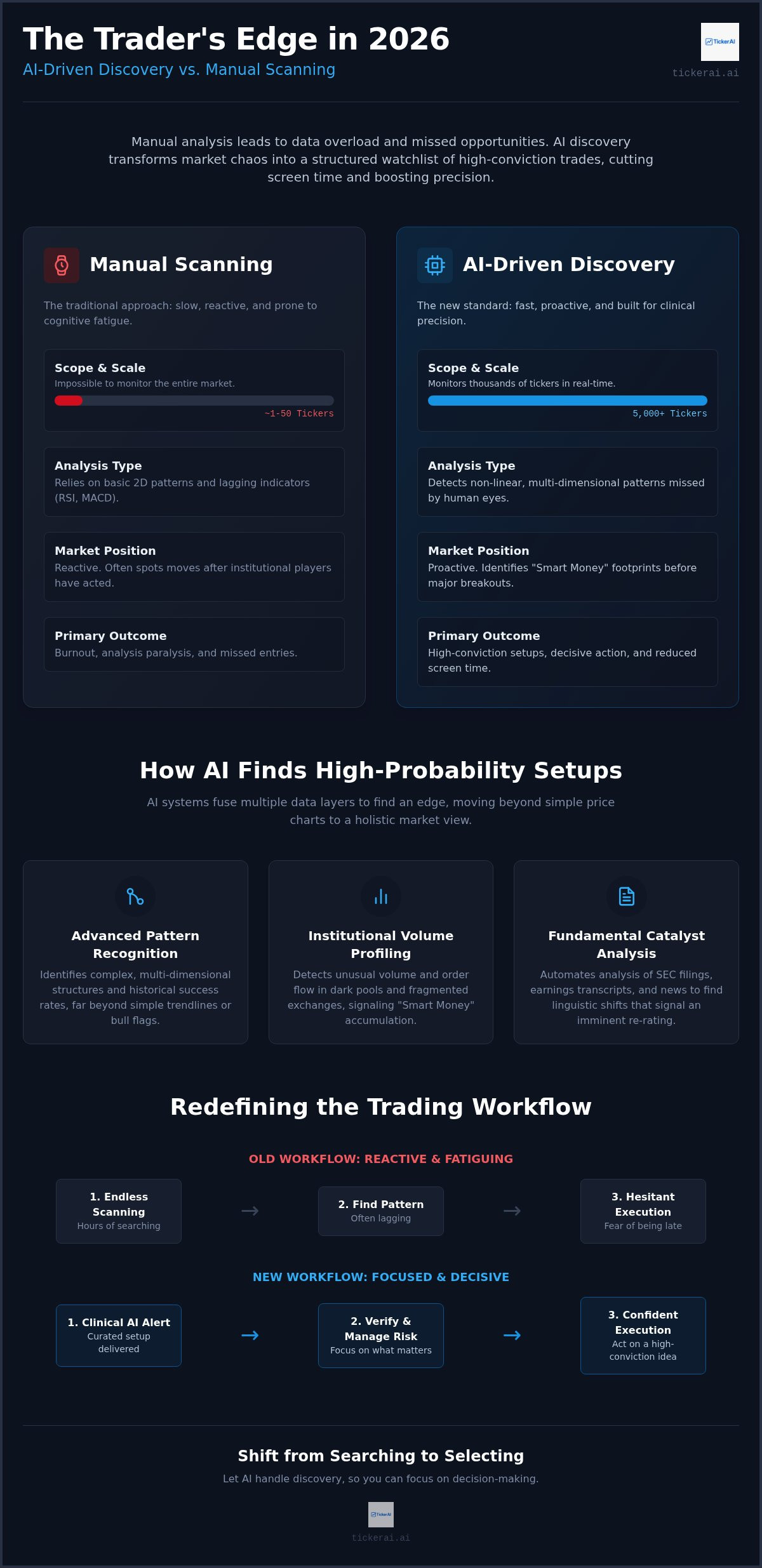
Manual charting is a relic of a slower market. In the 2026 landscape, the distance between identifying a setup and seeing the move complete has compressed significantly. Relying on hand-drawn trendlines and basic oscillators is no longer a viable strategy for the serious participant. The modern environment demands automated stock market analysis to filter through the noise of thousands of tickers in real-time. This isn't just about speed; it's about shifting from a reactive posture to a proactive discovery mindset.
Traditional scanners fail because they're built on linear logic. They look for static triggers like a simple RSI cross or a fixed volume spike. Markets are non-linear. They're driven by complex institutional algorithms that disguise their tracks. Professionals are now using AI for swing trading to detect these subtle anomalies. This "Algorithmic Alpha" is the competitive edge that allows retail traders to spot institutional accumulation before the breakout appears on a standard retail screen. It's the difference between chasing a move and being positioned for it.
The Problem with Manual Scanning in 2026
Information overload is the primary killer of trading performance. Monitoring over 5,000 active tickers manually is a mathematical impossibility. This leads to a massive latency gap. By the time a human trader recognizes a head-and-shoulders pattern on a daily chart, institutional algorithms have already front-run the move. These bots exploit retail trader hesitation. They thrive on the three-second delay between your observation and your execution. Manual scanning isn't just slow; it's a vulnerability that high-frequency systems actively target.
Defining AI-Assisted Swing Trading
AI should be viewed as a high-speed scout, not a black-box execution bot. It acts as a tireless assistant that filters the entire market against your specific criteria. This process integrates technical precision, fundamental shifts, and sentiment data points into a single, actionable alert. Systematic discovery through these tools is the core foundation of quantitative investing. It removes the emotional weight of "searching" and replaces it with the clinical efficiency of "selecting."
- Pattern Recognition: AI identifies multi-dimensional structures that go beyond 2D chart patterns.
- Sentiment Analysis: Real-time processing of news and social data to gauge market conviction.
- Volume Profiling: Detecting institutional footprints in dark pools and fragmented exchanges.
Traders using AI for swing trading don't spend hours staring at static screens. They focus their mental energy on risk management and trade sizing. The AI handles the discovery; you handle the decision. This synergy creates a professional workflow that prioritizes high-probability setups over high-volume activity.
Algorithmic Discovery: How AI Detects High-Probability Swing Setups
High-probability setups are rarely found on the surface of a price chart. While retail traders rely on lagging indicators like RSI or MACD, sophisticated systems use neural networks to identify non-linear structures. Using AI for swing trading allows for the detection of multi-dimensional patterns that human eyes simply cannot process across thousands of tickers simultaneously. These systems don't just see a bull flag in isolation; they analyze the historical success rate of that specific structure within the context of current market volatility and liquidity.
Anomaly detection represents the second pillar of professional discovery. By monitoring order flow across fragmented exchanges and dark pools, AI identifies unusual volume that signals institutional accumulation. This "Smart Money" footprint often precedes the public breakout by hours or even days. Additionally, AI monitors cross-sector correlations to spot thematic rotations in real-time. When capital flows from defensive sectors into high-beta technology, the system flags the strongest candidates within that rotation. It detects the shift while the retail crowd is still focused on yesterday's winners.
Fundamental catalysts provide the necessary context for these technical moves. When you're using AI for swing trading, the system handles the heavy lifting of data ingestion. Modern algorithms automate the analysis of thousands of SEC filings, 8-K reports, and earnings transcripts. They look for specific linguistic shifts or unexpected guidance changes that suggest a stock re-rating is imminent. This fusion of technical, fundamental, and sentiment data creates a high-conviction environment for your decision-making. It turns a chaotic market into a prioritized list of executable opportunities.
Multi-Factor Signal Processing
Effective discovery requires more than just price data. It involves combining price action with real-time sentiment analysis harvested from social feeds and news wires. This multi-factor approach helps filter out "fakeouts" by comparing current price movements against historical win probabilities. Success in this environment depends on interpreting AI stock signals with a focus on data confluence rather than isolated triggers. You can leverage these insights to build smart watchlists that prioritize quality over quantity.
The Advantage of Predictive Modeling
Predictive modeling replaces speculative guessing with probability-based forecasting. Instead of asking where the price might go, the system calculates the likelihood of specific outcomes based on massive historical datasets. Predictive scores are defined as a calculated probability of price movement over a specific time horizon. This allows you to identify Smart Money flow through granular order flow analysis. It acts as a proactive scout, alerting you when the mathematical odds are heavily stacked in your favor. This systematic approach ensures you only allocate capital to setups with the highest statistical conviction.
Manual Scanning vs. AI-Driven Discovery: Quantifying the Advantage
Quantifying the advantage of algorithmic systems isn't about minor gains; it's about a total shift in operational efficiency. Manual scanning is a resource drain. It forces you to trade your most valuable asset, time, for a fraction of the market's potential. Using AI for swing trading replaces this brute-force research with precision-guided discovery. While a human analyst might review fifty tickers in a focused hour, an AI system processes the entire liquid market in milliseconds. This isn't just a difference in speed. It's a difference in the quality of the opportunities you uncover.
Consistency is the primary casualty of manual analysis. Human traders have "bad days" driven by fatigue, distraction, or external stress. These factors lead to missed signals and inconsistent chart interpretation. AI systems maintain a state of constant, clinical readiness. They apply the same rigorous multi-layered filtering to the five-thousandth ticker as they did to the first. This algorithmic hygiene significantly reduces false positives. By the time a setup reaches your screen, it has already passed a series of statistical stress tests that manual traders simply don't have the bandwidth to perform.
The 'Screen Time' Revolution
Discovery exhaustion is a real threat to execution quality. If you spend four hours hunting for a setup, your mental capital is depleted by the time you need to manage the trade. Modern traders are flipping this ratio. By utilizing a professional swing trade setup finder, you can reduce your research phase to fifteen minutes of high-level alert review. This transition allows you to focus your energy on trade sizing and risk management rather than the tedious labor of manual charting. You become a decision-maker rather than a data-entry clerk.
Removing Emotional Bias
Data provides the only effective shield against FOMO and panic. When you're using AI for swing trading, every alert is backed by objective metrics rather than subjective "gut feelings." This clinical perspective acts as a necessary counter-point to the emotional volatility of the market. High-conviction trade plans are built on a foundation of repeatable logic. You can effectively remove emotion from trading by relying on a system that prioritizes statistical probability over speculative excitement. Discipline becomes a byproduct of your workflow rather than a daily struggle of willpower.
- Breadth: Scan 5,000+ tickers for specific volume anomalies instantly.
- Accuracy: Eliminate confirmation bias by using multi-factor data validation.
- Efficiency: Reclaim hours of daily research time for high-level strategy.
Building Your Systematic Workflow: From AI Alert to Execution
A systematic workflow transforms raw data into executable profit. Using AI for swing trading requires a structured bridge between discovery and order entry. It's not enough to receive an alert; you must have a pre-defined protocol for validation. This ensures that every trade you take aligns with your risk profile and market outlook. Professionals don't gamble on signals. They execute on high-probability frameworks.
- Step 1: Configure smart watchlists. Organize your discovery process by building watchlists around high-conviction themes like sector rotation or unusual institutional activity.
- Step 2: Triangulate alerts. Never trade a signal in isolation. Cross-reference AI alerts with your personal risk management rules and current market breadth.
- Step 3: Validate the setup. Use institutional-grade indicators, such as Volume Weighted Average Price (VWAP) or dark pool liquidity levels, to confirm the AI's detection.
- Step 4: Execute with precision. Set clear stop-loss and take-profit targets. These should be based on AI-calculated volatility metrics to ensure your exits are mathematically sound.
- Step 5: Post-trade analysis. Journal every trade to identify which signals perform best in specific environments. This refines your personal "AI Edge."
Scale your execution by accessing curated swing trade setups that fit your professional workflow.
Daily Routine for the AI-Assisted Trader
Efficiency is the goal. Your pre-market routine should focus on reviewing automated sentiment scores and overnight catalyst alerts. This sets the tone for the session. During intraday hours, your primary task is managing real-time momentum alerts and adjusting trailing stops. Discovery is handled by the system; your job is monitoring. Post-market, shift your focus to the horizon. Scan for upcoming thematic investment opportunities that the AI identifies for the following week.
Risk Management in the AI Era
Technology doesn't eliminate risk; it redefines it. You must set alerts for "regime changes" where previous AI models may lose efficacy due to shifting market dynamics. Position sizing should be dynamic, based on AI-generated probability scores rather than a fixed dollar amount. The risk-to-reward ratio is the primary filter for any AI-discovered setup. If the mathematical edge doesn't meet your threshold, the trade is discarded regardless of the signal strength. Discipline is the final filter in an automated discovery process.
TickerAI: Professional-Grade Discovery for the Active Swing Trader
TickerAI represents the practical application of high-speed intelligence for the modern market. It's not a black-box system designed to replace the trader; it's a sophisticated filter built to empower them. Professionals using AI for swing trading require a platform that bridges the gap between raw data and executable setups. TickerAI achieves this by fusing technical precision with fundamental intelligence. The methodology doesn't just look at price action. It analyzes the underlying catalysts, from SEC filings to institutional order flow, to ensure every alert has a structural foundation.
Smart Watchlists are the core of the TickerAI experience. Instead of a disorganized list of tickers, the platform organizes the market into actionable, high-potential themes. Whether you're tracking sector rotations in technology or growth-oriented momentum shifts, the system prioritizes the strongest candidates. The real-time alert engine ensures you never miss a critical breakout. This proactive scout monitors the tape while you focus on high-level strategy. It's about scaling your intelligence without increasing your workload.
Choosing the right membership tier depends on your specific trading goals. The TickerAI Pro Subscription offers comprehensive discovery tools for the active trader looking for an edge in daily scans. For those requiring the highest level of market coverage, the TickerAI Full‑Access Subscription provides deep thematic insights and advanced signal clarity. Both tiers are designed to scale with your performance, providing the professional-grade infrastructure needed to compete in the 2026 environment.
Actionable Swing Trade Setups
TickerAI delivers curated ideas backed by clinical logic. You won't just receive a ticker symbol; you'll receive the data-driven "why" behind the setup. The system specializes in identifying institutional buying patterns before the public breakout occurs. By detecting these footprints in dark pools and fragmented exchanges, TickerAI provides a lead time that manual scanners cannot match. These alerts integrate seamlessly into your existing brokerage workflow, allowing for frictionless execution once your personal risk parameters are met.
The TickerAI Edge in 2026
Speed and clarity are the primary benchmarks when evaluating an AI stock picking service. TickerAI excels by removing the fluff and focusing on high-conviction signals. Professional traders choose this platform because it respects their time and intelligence. It provides a data-driven counter-point to market noise, ensuring that your trade entries are based on probability rather than speculation. It's time to transition from manual research to algorithmic discovery. Discover your next swing trade setup with TickerAI Full-Access and secure your competitive advantage.
Secure Your Algorithmic Edge
The 2026 trading environment doesn't reward manual labor; it rewards high-speed intelligence and clinical execution. Transitioning to a workflow using AI for swing trading allows you to filter market noise and isolate institutional-grade setups before they become retail consensus. You've seen how systematic discovery reduces cognitive load and eliminates the emotional bias that leads to execution errors. By automating the search for anomalies, you reclaim your most valuable asset: time for high-level decision-making.
Scaling your performance requires professional-grade infrastructure. TickerAI provides the precise tools necessary to identify momentum shifts through AI-driven stock discovery and real-time smart watchlists. Don't let high-probability setups slip through the cracks of a manual scan. Access curated, institutional-grade swing trade setups and refine your edge. Scale your market intelligence with TickerAI Full-Access subscriptions and position yourself ahead of the curve. The tools for professional-grade discovery are ready. It's time to execute with conviction.
Frequently Asked Questions
Is AI better than manual technical analysis for swing trading?
AI is superior for scale and speed. It eliminates human fatigue and recognition latency. Manual charting is limited to a handful of tickers. AI processes the entire liquid market in milliseconds. It detects institutional accumulation that remains invisible to standard technical indicators. Professionals use it to scale their intelligence without increasing screen time.
How much capital do I need to start using AI for swing trading?
Capital needs are determined by your brokerage and risk tolerance. Professional discovery tools are accessible to most active traders. The goal is to have sufficient capital to execute on the highest-conviction alerts while maintaining proper position sizing. It's about capital efficiency. You need enough to diversify across multiple setups identified by the system.
Can AI predict stock market crashes or sudden reversals?
AI doesn't use a crystal ball. It uses data-driven anomaly detection. By monitoring institutional order flow and sentiment shifts, it identifies the early stages of a reversal. This provides a proactive scout for regime changes. It calculates the probability of a crash rather than predicting a specific date. You get a statistical heads-up before the move accelerates.
What is the difference between an AI trading bot and an AI discovery tool like TickerAI?
Trading bots are for automated execution. Discovery tools like TickerAI are for intelligence scaling. The difference lies in control. TickerAI provides curated swing trade setups and smart watchlists. You maintain the final decision. This approach combines algorithmic speed with human risk management. It acts as a high-tech assistant rather than a black-box replacement.
How do I filter out 'noise' when receiving multiple AI stock alerts?
Noise is filtered through triangulation. Using AI for swing trading is most effective when you cross-reference alerts with your personal strategy. Use institutional-grade indicators to confirm the signal. Only setups meeting your risk-to-reward threshold should move from the alert phase to the execution phase. Discipline is your final filter for every automated signal.
Do I need coding skills to use AI for swing trading in 2026?
You don't need coding skills to benefit from this technology. In 2026, professional platforms are designed for active participants, not developers. You interact with the system through intuitive dashboards and real-time alerts. Your edge comes from signal interpretation and strategic execution. Using AI for swing trading has become a matter of logic, not programming.
How reliable are AI-generated swing trade setups?
These setups are highly effective for identifying momentum anomalies. Their reliability stems from processing massive historical datasets to find repeatable patterns. However, no signal is 100% certain. Success requires using these setups within a structured workflow that prioritizes stop-losses and disciplined position sizing. They provide a high-probability starting point for your own analysis.


