

What if you could secure the day's most profitable entries before the crowd even wakes up? In the 2026 trading cycle, an automated pre-market stock scanner is the only way to maintain a competitive edge against high-speed institutional algorithms. You've likely felt the frustration of missing a high-conviction gap-up because you were busy filtering through thousands of low-quality tickers manually. It's exhausting to battle analysis paralysis while the market's most significant moves are already being established.
This guide helps you master the mechanics of pre-market automation to isolate high-probability setups with clinical precision. You'll learn to build a streamlined morning workflow that delivers real-time alerts based on relative volume and catalyst-driven gaps. We'll explore how to move beyond basic data filtering to achieve autonomous opportunity discovery using advanced scouts. By the end of this article, you'll have a clear roadmap for delivering high-conviction swing trade setups directly to your device.
Key Takeaways
- Capitalize on the 4:00 AM to 9:30 AM EST volatility window by shifting from manual scanning to high-speed automated intelligence.
- Utilize Relative Volume (RVOL) as a primary filter to detect institutional interest and distinguish real momentum from technical noise.
- Implement an automated pre-market stock scanner to reclaim research time and eliminate the fatigue-driven errors common in manual chart checking.
- Build a multi-layered discovery workflow that combines quantitative metrics like float with AI-driven catalyst detection for news-backed setups.
- Leverage tools like TickerAI Full-Access to transition from passive data monitoring to proactive, autonomous opportunity discovery.
The Pre-Market Advantage: Why Automation is Non-Negotiable
The pre-market trading session, running from 4:00 AM to 9:30 AM EST, represents a high-stakes environment where volatility is the only constant. Liquidity is thinner than during regular hours, and spreads are significantly wider. Price action during these hours is frequently dictated by institutional "smart money" reacting to overnight earnings, regulatory shifts, or global macro data. For a professional trader, this isn't a time for casual observation; it's a window of extreme opportunity where the day's most significant moves are often established before the opening bell even rings.
Institutional players use sophisticated algorithms to position themselves early. If you aren't using a similar level of technology, you're essentially trading in the dark. Professional-grade trading in 2026 demands an "automated scout" that can process massive datasets in milliseconds. This ensures you aren't reacting to the market, but rather participating in movements as they materialize with clinical precision.
The High Cost of Manual Research
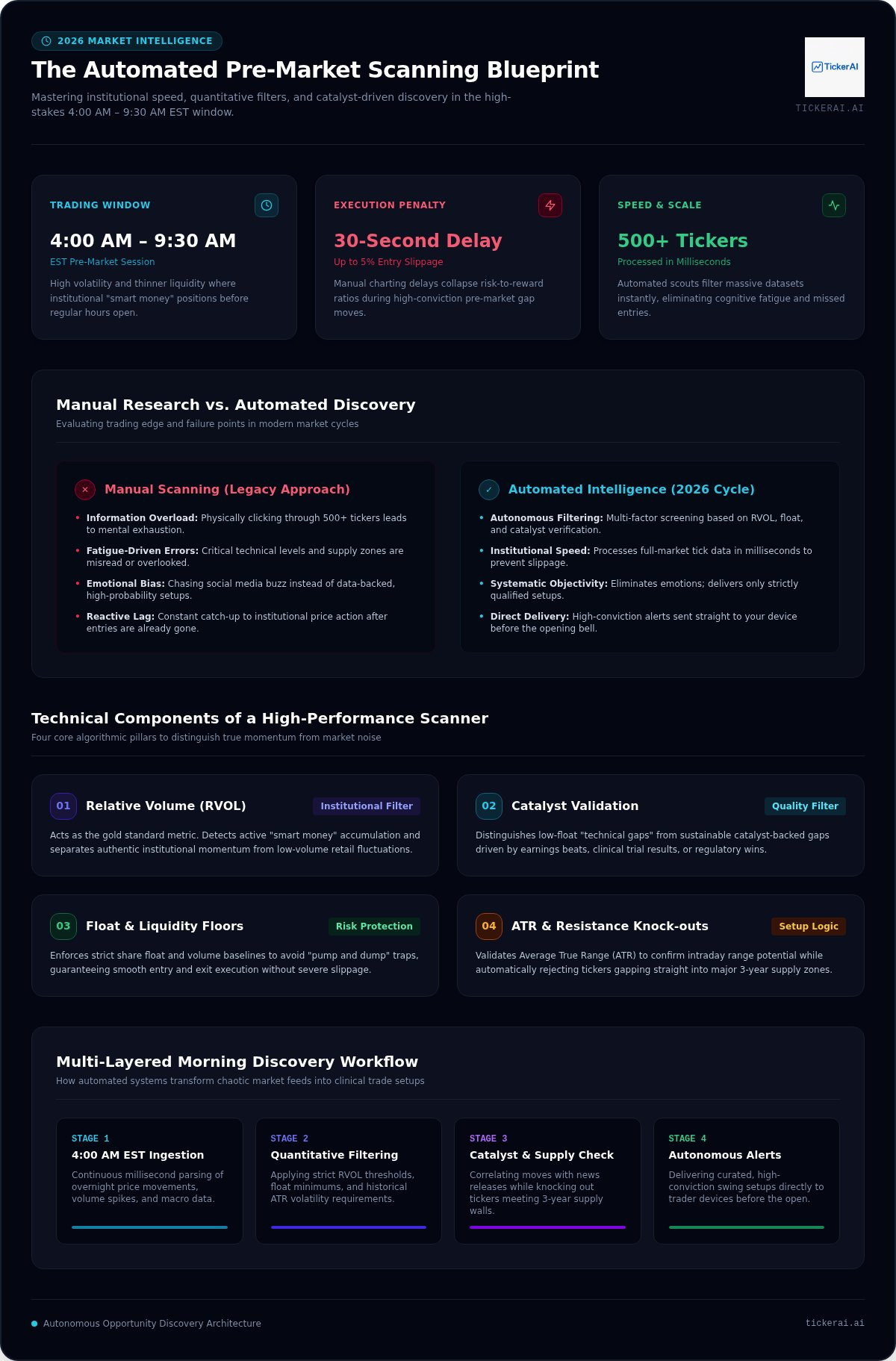
Manual scanning is a legacy approach that consistently fails in the current market cycle. Attempting to check 500+ tickers manually is a losing strategy that inevitably leads to information overload. This process creates fatigue-driven errors, where critical technical levels are ignored or misinterpreted due to mental exhaustion. When you're physically clicking through charts, you're inherently slow. In a fast-moving gap-up scenario, a 30-second delay in manual charting can result in a 5% slippage on your entry price. By the time you confirm the setup, the risk-to-reward ratio has already collapsed.
Beyond speed, manual research invites emotional bias. Without an automated pre-market stock scanner, traders often find themselves chasing "hot" tickers mentioned on social media rather than sticking to high-probability, data-backed setups. This lack of precision is a primary cause of missed entries and avoidable losses. Automation removes the human element, ensuring that only the most qualified tickers make it to your screen for final decision-making.
Defining Automated Discovery in 2026
Modern trading requires automated stock market analysis to scale intelligence effectively. We've moved far beyond simple "Gap Up" filters that return hundreds of low-quality results. Today's edge lies in multi-factor algorithmic discovery that validates liquidity, relative volume, and catalyst strength simultaneously. An automated pre-market stock scanner is a system that independently filters, validates, and alerts based on pre-set quantitative criteria. This tool acts as a tireless assistant, scanning the entire market while you focus on high-level strategy. It transforms a chaotic data stream into a curated list of actionable opportunities, allowing you to enter the market with confidence and clarity.
Technical Components of a High-Performance Scanner
A high-performance automated pre-market stock scanner is defined by its ability to separate actionable signals from market noise. In the 2026 trading environment, price action alone is an incomplete metric. You need a multi-dimensional approach that validates every tick against institutional behavior. Relative Volume (RVOL) remains the gold standard for detecting "smart money" interest. When a ticker shows high RVOL, it indicates that institutions are actively positioning; this is a far more reliable signal than retail-driven fluctuations in low-liquidity environments.
Gap analysis provides the next layer of validation. A "technical gap" often occurs in low-float stocks due to a temporary lack of sellers, but these lack the sustainability of "catalyst-driven momentum." Sophisticated systems prioritize gaps backed by tangible events like earnings beats, clinical trial results, or major contract wins. To avoid the traps of "pump and dumps," your scanner must enforce strict float and liquidity floors. Filtering for tradability ensures you only see setups where you can enter and exit without devastating slippage.
Algorithmic Filters for Momentum
To isolate high-probability trades, your scanner should utilize specific quantitative parameters that ensure the ticker has room to run. Sophisticated traders rely on an automated pre-market stock scanner to validate these technical components in real-time:
- ATR Validation: Ensures the ticker has sufficient historical volatility to reach profit targets within a single session.
- Resistance Knock-outs: Automatically ignores tickers gapping directly into major 3-year supply zones where selling pressure is likely.
- Liquidity Floors: Filters out low-float "zombie" stocks that lack the depth for professional-grade entries and exits.
Distinguishing "unusual volume" from standard pre-market noise is the difference between a professional scout and a basic filter. By automating these checks, you remove the emotional urge to chase a stock just because it's on a "top gainers" list.
Integrating Real-Time Catalyst Detection
The true edge in 2026 lies in the integration of AI-driven sentiment and catalyst detection. These agents scan SEC filings, earnings transcripts, and FDA approvals in milliseconds. By matching price gaps with high-impact news, you create high-conviction setups that have a fundamental reason to move. This is where finding thematic investment opportunities with AI becomes a practical reality. When a specific sector gains momentum, your scanner detects the thematic shift before the broader market can react. For traders seeking this level of autonomous discovery, leveraging institutional-grade AI tools is the logical next step to securing a competitive edge.
Automated vs. Manual Scanning: Evaluating Your Trading Edge
The core difference between a retail hobbyist and a professional trader lies in the speed and scale of discovery. While a manual trader might track 20 to 30 tickers on a static watchlist, an automated pre-market stock scanner monitors over 5,000 instruments simultaneously. This isn't just about volume; it's about efficiency. A manual process requires hours of chart flipping to find a single viable setup. Automation delivers that same setup in milliseconds. This scalability ensures you never miss a move because your eyes were on the wrong ticker at the wrong time.
Precision is the second pillar of the automated edge. Manual scanning is inherently prone to "false positives" where a trader perceives a pattern that doesn't exist due to fatigue or hope. Automated systems utilize clinical filters to reduce noise and isolate high-probability setups. By using AI to remove emotion from trading, you stabilize your performance and maintain systematic discipline. You stop trading what you "feel" and start trading what the data validates.
The Professional Evaluation Framework
Evaluating a scanner requires looking beyond basic price alerts. Professional traders prioritize alert latency. A delay of even three seconds can be the difference between a high-probability entry and chasing a move. You must also distinguish between "raw data feeds" and a "tradable edge." A raw feed tells you a stock is moving; a tradable edge tells you why it matters and if it's liquid enough to trade. This distinction is critical for maintaining a competitive advantage in the 2026 market cycle.
Choosing between TickerAI Pro and TickerAI Full-Access is a calculation of ROI. TickerAI Pro provides essential discovery for active traders who need smart watchlists. TickerAI Full-Access offers institutional-grade AI discovery for those requiring deeper autonomous scouting and real-time validation. The goal is to match the tool's capabilities with your specific execution requirements and portfolio size.
Why Retail Scanners Fail Professional Traders
Retail scanners often rely on "delayed data" or simplified filters that create crowded trades. When thousands of retail traders see the same basic "top gainer" alert, the alpha disappears instantly as the trade becomes over-saturated. These one-size-fits-all systems lack the customization needed to isolate unique, news-backed setups. A scanner without AI validation is simply a faster way to find bad trades. To maintain an edge, you need a system that prioritizes catalyst-driven moves over simple price fluctuations. This ensures your capital is only deployed in high-conviction environments where the probability of follow-through is highest.
Step-by-Step: Building an Automated Pre-Market Workflow
Professional traders don't guess; they execute. A repeatable workflow transforms raw data into high-conviction trades. Without a structured process, even the most advanced automated pre-market stock scanner produces noise rather than opportunity. Professionals follow a layered approach that moves from broad quantitative filters to granular qualitative validation before the market opens.
- Core Quantitative Parameters: Define your universe by setting hard limits on price ($5 to $200), pre-market volume (minimum 100k shares), and float (typically under 100M for momentum setups).
- AI Catalyst Layering: Layer agentic discovery to prioritize tickers with news-backed moves. This filters out "dead gaps" and focuses on earnings beats, FDA approvals, or major contract wins.
- Automated Technical Validation: Filter for stocks holding above VWAP, crossing key EMAs, or gapping over significant multi-year resistance levels.
- Real-Time Delivery: Route high-conviction setups directly to smart watchlists to eliminate the need for manual ticker entry and reduce latency.
- Final Human Review: Perform a clinical check of the AI-generated swing trade setups to confirm the technical chart aligns with your specific risk profile and execution style.
Optimizing Your Smart Watchlist
Efficiency is lost when watchlists are cluttered with low-probability tickers. Group your pre-market gainers by sector to identify "sympathy plays." If one biotech firm gaps up on news, the scanner should alert you to others in the same sector showing unusual volume. Set alert triggers specifically for price consolidation breakouts during the 8:00 AM to 9:00 AM window. When selecting your discovery tool, consult the professional guide to choosing a swing trade setup finder to ensure your criteria match institutional standards for 2026.
Pre-Market Preparation: From Alert to Execution
Identification is only half the battle. Before the 9:30 AM bell, you must map your entry and exit zones based on the scanner's output. Use automated risk/reward calculators to determine position sizing based on your predetermined stop-loss level. Success depends on how to interpret AI stock signals during the high-volatility window of the first 15 minutes. This is when the scanner's validation is tested against live market liquidity and institutional order flow. To streamline this entire process and reduce fatigue, access TickerAI's autonomous discovery engine and start trading with professional-grade precision.
TickerAI: Beyond Scanning to Autonomous Opportunity Discovery
Most traders treat an automated pre-market stock scanner as a simple filter. TickerAI Full-Access reframes this technology as a proactive scout. It doesn't wait for you to input parameters; it autonomously identifies institutional-grade opportunities. While traditional scanners provide lists, TickerAI delivers prioritized intelligence. This shift from passive monitoring to autonomous discovery is the baseline for professional performance in 2026.
The Smart Watchlist feature serves as the primary interface for this intelligence. It automatically aggregates tickers showing unusual relative volume and catalyst-backed price action. Instead of managing a static list, you receive a dynamic feed that updates as the market environment shifts. This automated noise reduction allows active traders to focus on execution rather than data entry. Real-time alerts ensure that curated swing trade setups are delivered directly to your device the moment the data validates a high-probability move.
The TickerAI Edge: Clinical Precision
Precision is the platform's core metric. TickerAI filters out 99% of market noise to isolate high-potential movements. This clinical approach ensures you aren't distracted by low-liquidity spikes or retail-driven alerts. The system excels at detecting "anomaly breakouts" that standard technical filters often miss. By focusing on raw, data-driven insights rather than personal advisory, TickerAI maintains a level of objectivity that human analysis cannot match. It's an intelligence partner that remains "on" while you focus on high-level decision-making. You stop guessing and start reacting to validated signals.
Selecting Your Tier: Pro vs. Full-Access
Choosing between tiers depends on your specific trading velocity and research depth. TickerAI Pro is engineered for serious investors who require smart watchlists and real-time alerts for swing trade setups. It provides the essential noise reduction needed to manage a professional portfolio without the overhead of a manual automated pre-market stock scanner. It's built for efficiency and speed.
TickerAI Full-Access provides the deep discovery layer necessary for identifying long-term investment ideas and thematic shifts. It acts as an institutional-grade engine for traders who demand the highest level of autonomous scouting. Whether you're tracking rapid pre-market gaps or looking for sustained momentum, the platform scales to your requirements. Experience AI Stock Opportunity Discovery at TickerAI to transition from manual research to high-speed intelligence.
Securing Your 2026 Trading Edge
The transition from manual research to high-speed automation is no longer optional for professional traders. By isolating institutional interest through RVOL and catalyst detection, you eliminate the noise that traps retail participants. An automated pre-market stock scanner serves as your proactive scout, delivering validated opportunities before the opening bell even rings. This systematic approach reduces fatigue and removes the emotional bias that leads to sub-optimal entries. You move from hunting for data to executing high-conviction strategies with clinical precision.
Access institutional-grade AI discovery and real-time swing trade alerts with a platform designed for speed and clarity. Start Your AI-Powered Stock Discovery with TickerAI and secure the no-fluff, data-driven insights necessary to navigate the 2026 market cycle. The market doesn't wait for manual chart checking. It's time to trade with the confidence that only autonomous discovery provides. Focus on your decision-making and let the technology handle the hunt.
Frequently Asked Questions
What is the best automated pre-market stock scanner for 2026?
TickerAI represents the top tier of automated pre-market stock scanner technology for 2026. It moves beyond passive filtering to offer autonomous opportunity discovery. By utilizing institutional-grade AI, the platform identifies high-conviction setups that traditional tools often miss. Professional traders prioritize TickerAI for its ability to deliver curated swing trade setups and smart watchlists that update in real-time. This ensures your morning workflow is driven by data-backed insights rather than manual chart checking.
How do I filter out low-liquidity stocks in a pre-market scan?
Filtering low-liquidity stocks requires setting strict quantitative floors within your scanner settings. You should establish a minimum pre-market volume of at least 100,000 shares and filter for stocks with a tradable float, typically under 100 million shares for momentum. Utilizing Relative Volume (RVOL) is the most effective way to distinguish institutional interest from retail noise. This ensures you only receive alerts for tickers where you can enter and exit positions without significant price slippage.
Can an AI stock scanner predict opening bell breakouts?
An AI stock scanner doesn't predict the future with absolute certainty, but it identifies setups with a high statistical probability of breaking out. By validating price action against real-time catalysts like earnings beats or FDA approvals, the system isolates tickers with genuine momentum. This clinical approach allows you to position yourself before the opening bell. The goal is to act on validated signals rather than chasing volatile moves after they've already become crowded by retail traders.
Is pre-market data delayed in most automated scanners?
Many free or retail-grade tools provide delayed pre-market data, which is a significant disadvantage in a high-speed environment. Professional systems like TickerAI utilize real-time data feeds to ensure alerts are delivered with zero latency. In the 2026 market, even a 30-second delay can result in a 5% difference in your entry price. Ensuring your automated pre-market stock scanner has access to direct, real-time exchange feeds is a non-negotiable requirement for professional-grade execution.
What is the difference between a stock screener and an automated scanner?
A stock screener is typically a passive tool that requires you to manually refresh and interpret static data. In contrast, an automated scanner is a proactive engine that monitors the market in real-time and delivers alerts based on pre-set criteria. While a screener tells you what happened, a scanner tells you what is happening right now. This distinction is critical for active traders who need to react to volatility as it develops during the pre-market session.
How much volume is considered "good" for a pre-market setup?
While "good" volume varies by stock price and float, professional traders generally look for a minimum of 100,000 shares traded in the pre-market session. However, Relative Volume (RVOL) is a more precise metric. An RVOL of 2.0 or higher indicates that a stock is trading at twice its normal volume for that time of day. This suggests institutional participation. High volume without a clear catalyst often results in a "dead gap" that fails to hold after the open.
Do I need a Pro subscription for real-time pre-market alerts?
Real-time pre-market alerts and smart watchlists are core features of the TickerAI Pro and Full-Access subscription tiers. These levels are engineered for traders who require immediate notification of high-conviction swing trade setups. While basic data might be available on lower tiers, the Pro and Full-Access levels provide the speed and clinical precision necessary for professional execution. This investment ensures you're receiving actionable intelligence the moment the data validates a high-probability market move.
How does AI improve pre-market gap-up analysis?
AI improves gap-up analysis by layering qualitative data on top of quantitative price moves. Traditional scanners only see that a price has moved; AI analyzes earnings transcripts, SEC filings, and news sentiment to determine the "why" behind the gap. This allows the system to prioritize news-backed moves over technical gaps that lack fundamental support. By identifying these high-conviction catalysts in milliseconds, the AI ensures your capital is only deployed in setups with the highest probability of follow-through.


