

Reading every SEC filing isn't a sign of diligence; it's a symptom of an obsolete workflow. In a market where high-conviction catalysts move in milliseconds, failing to leverage automated fundamental analysis tools is a strategic liability. You've likely felt the paralysis of scanning hundreds of pages only to miss a critical earnings surprise or a sudden cluster of insider buying. It's a cycle that wastes time and sacrifices alpha.
This roundup identifies the elite software that replaces manual drudgery with high-speed intelligence. These platforms act as proactive scouts. They filter noise. They surface real-time anomalies in seconds. By the end of this guide, you'll know how to build a streamlined research workflow that delivers data-driven confidence. We're ranking the top AI-powered intelligence partners for 2026, focusing on tools that prioritize signal over noise and turn raw data into execution-ready setups.
Key Takeaways
- Manual SEC filing review is obsolete in 2026. High-speed markets demand automated fundamental analysis tools to surface catalysts before they're priced in.
- Move beyond simple keyword searches. Learn how modern AI quantifies management confidence through earnings call sentiment analysis and intelligent financial scoring.
- Compare top-tier platforms like Scrab for deterministic scoring and TrendSpider for agentic, hybrid technical-fundamental research.
- Build a repeatable quantitative workflow. Define your specific fundamental edge and deploy automated scanners to monitor filings and earnings releases in real-time.
- Transition from observation to action. Use smart watchlists and AI-powered discovery to filter market noise and focus on high-conviction investment ideas.
The Death of Manual Research: Why Automated Fundamental Analysis Tools are Non-Negotiable in 2026
2026 isn't the year of more data; it's the year of too much data. Manual SEC filing review is officially obsolete. In a market where high-frequency algorithms react to headlines in milliseconds, waiting for a human to read a 10-K is a recipe for underperformance. This environment has forced a transition toward automated fundamental analysis tools. These platforms don't just display data. They use AI to parse complex financial statements and quantify qualitative data that was previously buried in footnotes. It's a clinical shift from subjective guessing to objective measurement.
While traditional fundamental analysis principles remain the bedrock of valuation, the execution has changed. We've moved from "data access" to "data intelligence." It's no longer enough to see the numbers. You need to know what they mean relative to thousands of other tickers instantly. This shift is why serious participants are abandoning manual workflows in favor of what is quantitative investing, a systematic approach to discovery that prioritizes speed and logic over intuition.
The Information Overload Problem
The volume of financial data is staggering. Thousands of pages of SEC filings are released daily. For a manual researcher, this creates "analysis paralysis." You spend hours reading a single 10-Q while ten other high-conviction catalysts pass you by. Automation solves this by acting as a high-speed filter. It prevents you from missing critical fundamental shifts like sudden margin expansion or subtle changes in debt covenants. Efficiency isn't just about saving time. It's about expanding your coverage without sacrificing depth. When the machine handles the scan, you handle the decision.
Institutional Edge for Individual Traders
Hedge funds have used Natural Language Processing (NLP) for years to gain an edge. Now, these capabilities are available to individual traders. Modern automated fundamental analysis tools use NLP to perform sentiment analysis on earnings calls, detecting subtle shifts in management's tone that a human might miss. This technology bridges the gap between institutional power and retail agility. By leveraging AI, these tools transform dense SEC filings into actionable signals that trigger immediate decision-making. This isn't just a convenience; it's a structural necessity for anyone competing in the 2026 market. You're no longer just a spectator; you're an equipped participant.
Critical Capabilities: Evaluating SEC Filings, Earnings Sentiment, and Financial Scoring
Modern automated fundamental analysis tools do more than fetch spreadsheets; they provide a clinical layer of intelligence. They parse raw data into actionable insights before the market can react. Traditional research relies on manual skimming. High-speed tools use the SEC EDGAR API documentation to ingest structured XBRL data instantly. This enables dynamic financial scoring where P/E ratios and debt metrics update in real-time. They are fluid indicators of value, not static quarterly artifacts. This speed is essential when identifying undervalued opportunities in a volatile tape.
Parsing the 10-K and 10-Q with AI
AI understands context. It identifies specific risk factors that impact the bottom line while ignoring standard legal boilerplate. By automating year-over-year comparisons, these tools reveal subtle margin compression or inventory build-ups. You can track line-item changes across multiple periods without opening a single PDF. This level of automated stock market analysis is the difference between catching a trend and chasing a ghost. It ensures your fundamental health assessment is based on hard data rather than optimistic projections.
Quantifying Qualitative Data
Management tone is often the earliest signal of a fundamental shift. Natural Language Processing (NLP) scores CEO commentary during earnings calls. It detects hesitation and quantifies confidence. These models look for discrepancies between the prepared remarks and the Q&A session. When public statements conflict with financial reports, the system flags a discrepancy immediately. Learning how to interpret AI stock signals ensures you stay ahead of fundamental decay. It provides a quantitative score for qualitative variables that were previously impossible to measure.
The machine scans for unusual activity. Insider buying clusters. Sudden institutional accumulation. These are high-conviction catalysts that manual research often misses. Deploying automated fundamental analysis tools allows you to detect these anomalies in seconds. You no longer have to wait for a newsletter to highlight a significant purchase by a CFO. If you want to streamline this discovery, TickerAI Pro provides real-time alerts for these high-conviction setups, acting as a tireless scout for your portfolio.
Roundup: Comparing the Best Automated Fundamental Analysis Platforms
The market for automated fundamental analysis tools has matured. In 2026, the choice between platforms depends on whether you want to build your own models or receive curated signals. Most tools fall into two camps: data visualization or agentic intelligence. While traditional platforms provide the charts, modern leaders focus on automating financial document analysis with AI to extract alpha from unstructured disclosures.
Best for Model Builders: Scrab
Scrab is the standard for deterministic scoring. It allows you to build custom models that weight specific metrics like free cash flow yield or debt-to-equity ratios. It doesn't guess; it calculates based on your specific parameters.
- Pros: Complete control over the logic. No "black box" algorithms.
- Cons: Significant time investment. You must define the weights yourself.
- Ideal for: Long-term value investors who have a specific, proven criteria for intrinsic value.
Best for Agentic Research: TrendSpider
TrendSpider has evolved into an agentic powerhouse. Its "Sidekick" AI acts as a digital analyst that can scan filings and charts simultaneously via natural language queries. It handles the grunt work of cross-referencing technical levels with fundamental health.
- Pros: Seamless synergy between technical and fundamental data.
- Cons: High cost of entry. The interface can be overwhelming for beginners.
- Ideal for: Active traders who need deep, cross-disciplinary research on the fly.
Best for Discovery & Alerts: TickerAI
TickerAI prioritizes the "discovery" phase of the trade lifecycle. It acts as a proactive scout, filtering the noise to deliver real-time alerts on high-conviction catalysts. It identifies the "why" behind a move before the price action fully reflects it.
- Pros: Smart watchlists and curated swing trade setups based on fundamental anomalies.
- Cons: Optimized for discovery rather than deep-dive historical chart drawing.
- Ideal for: Traders focused on finding thematic investment opportunities with AI without the manual research debt.
For those who prioritize visualization, Koyfin and YCharts remain industry standards. They've integrated emerging AI features to summarize filings, but their core strength remains historical data presentation. If your goal is to surface the next catalyst before it hits the tape, the shift toward discovery-first platforms is the logical move. These tools don't just show you what happened; they tell you what is happening now.
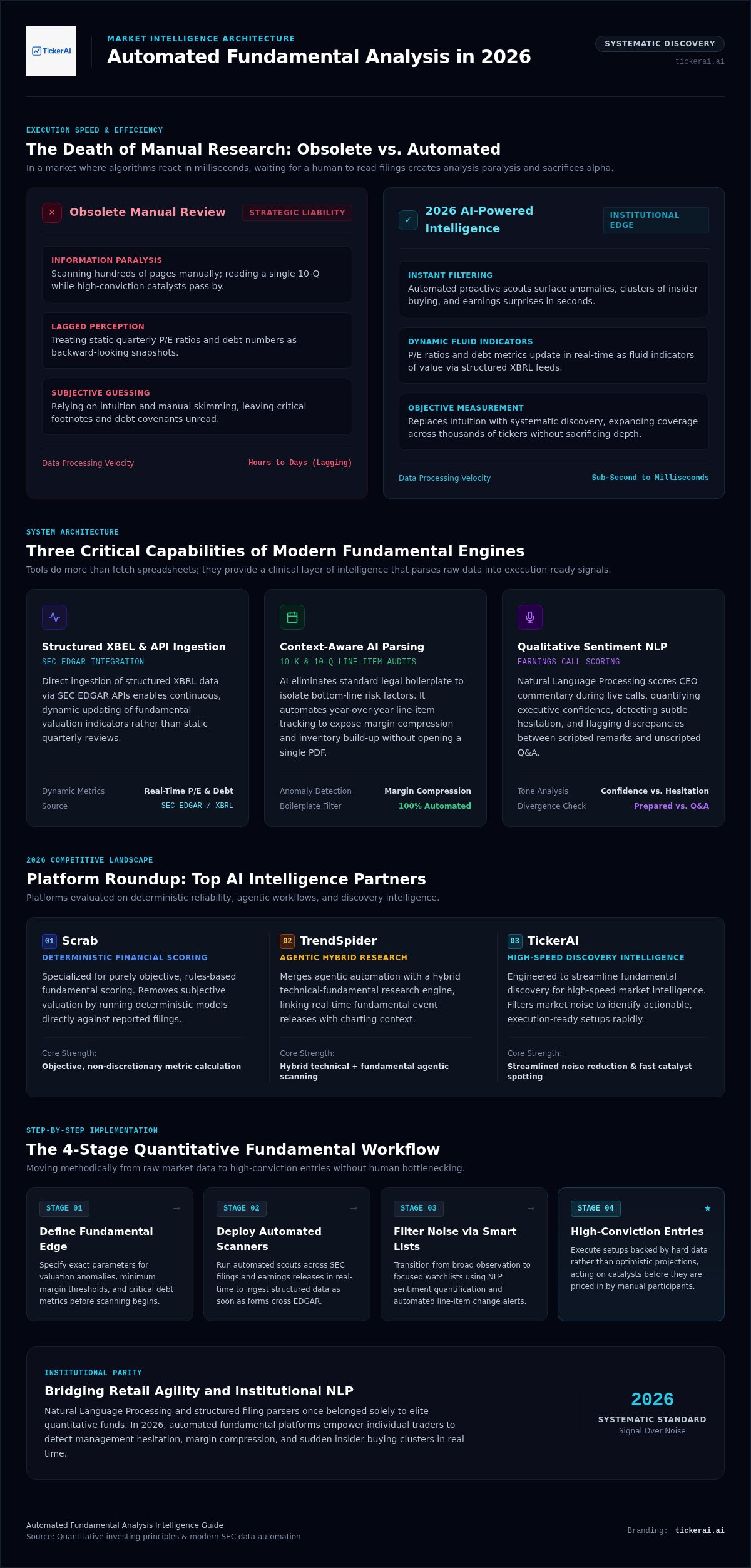
Building a Quantitative Workflow: From Automated Scanning to High-Conviction Entries
Having the right automated fundamental analysis tools is only half the battle. The other half is the sequence. A fragmented research process creates friction between discovery and execution, leading to missed entries and inconsistent results. To capture alpha in 2026, you need a systematic pipeline that moves from broad market scanning to high-conviction entries without manual bottlenecks. Success isn't about working harder; it's about building a logic-driven funnel.
Follow this five-step framework for professional-grade execution:
- Step 1: Define your edge. Identify specific fundamental anomalies. Are you looking for small-cap margin expansion or large-cap value anomalies?
- Step 2: Deploy scanners. Use automated fundamental analysis tools to monitor real-time SEC filings and earnings releases for your defined criteria.
- Step 3: Organize with smart watchlists. Filter raw results into thematic or sector-specific groups to detect broader market rotation.
- Step 4: Validate AI signals. Cross-reference fundamental catalysts with technical momentum to ensure the price action supports the thesis.
- Step 5: Execute with discipline. Apply a strict risk management plan with pre-defined stop-losses and profit targets for every position.
Filtering Market Noise
Noise is the primary enemy of the professional participant. To combat this, set "hard" fundamental thresholds to reduce false positives. If your strategy focuses on growth, ignore any alert that doesn't meet a specific revenue floor or cash-flow requirement. Using AI to prioritize alerts based on historical signal strength ensures you only focus on high-probability setups. This systematic approach is essential for using AI to remove emotion from trading. When the criteria are pre-defined, the urge to chase a sub-optimal setup vanishes.
The Discovery-to-Action Bridge
A raw alert is a prompt for validation, not a guaranteed trade. The bridge between discovery and action involves identifying the "why" behind a move before the market fully prices it in. This synergy allows you to capture post-earnings momentum while avoiding the traps of stagnant value stocks. TickerAI Pro streamlines this specific transition by delivering curated swing trade setups that already meet these dual-criteria requirements. It transforms raw data into an execution-ready plan in seconds.
Efficiency is the ultimate competitive advantage in a high-speed environment. If you're ready to stop chasing and start executing with clinical precision, start building your smart watchlist with TickerAI today.
TickerAI: Streamlining Fundamental Discovery for High-Speed Market Intelligence
While many automated fundamental analysis tools excel at dissecting a ticker you've already found, TickerAI solves the discovery gap. It doesn't wait for you to provide a list. It acts as a proactive scout, scanning the global tape to surface high-conviction catalysts before they become consensus. In the 2026 market, the advantage goes to those who filter the noise fastest. TickerAI provides that clinical edge by prioritizing signals that indicate institutional accumulation or fundamental shifts. It's a tool designed for professionals who value execution over manual research debt.
Real-Time Fundamental Alerts
TickerAI automates the monitoring of critical market mechanics. It tracks insider activity clusters and institutional flows in real-time, delivering notifications the moment an anomaly occurs. For example, a sudden surge in tech sector insider buying is flagged immediately, allowing you to investigate the underlying catalyst before the price reacts. Curated swing trade setups provide a distinct advantage over raw data feeds. Instead of a spreadsheet of numbers, you receive an execution-ready setup based on quantified fundamental health. This allows you to focus on decision-making rather than data entry.
Leveraging smart watchlists is essential for tracking thematic fundamental shifts. Whether you're monitoring the energy transition or AI infrastructure, TickerAI organizes discovery by theme. This ensures you're alerted to sector-wide rotation as it happens. It's why TickerAI is the preferred choice for AI tools for long-term investors who require institutional-grade speed. You get the depth of a traditional analyst with the velocity of an algorithmic scanner.
Choosing Your Research Tier
TickerAI offers two distinct paths for market participants based on their operational needs. The Full-Access tier provides essential discovery tools and market monitoring for those who need consistent, data-driven insights. It's the baseline for any professional workflow. For active traders, the Pro Tier delivers advanced automated fundamental analysis tools, including deeper market scanning and higher-frequency alerts. Pro users gain access to the most sophisticated filtering logic, ensuring they never miss a micro-cap breakout or a large-cap margin expansion signal.
Efficiency is a choice. You can continue reading hundreds of filings, or you can deploy an intelligent partner to do it for you. Join TickerAI to automate your discovery workflow today. Move from observation to action with the speed the 2026 market demands.
Institutional Speed for the Individual Participant
The transition from manual SEC filing review to automated fundamental analysis tools isn't just about saving time. It's about survival in a market that moves in milliseconds. You've seen how AI parses management sentiment and quantifies qualitative data to surface catalysts before they hit the mainstream tape. By building a systematic quantitative workflow, you replace analysis paralysis with clinical execution. This structural shift allows you to prioritize the highest-conviction signals while ignoring the noise that distracts the average participant.
TickerAI acts as your proactive scout, scanning the global market to find the setups you'd otherwise miss. The platform delivers real-time alerts for market-moving catalysts and provides professional-grade swing trade setups designed for high-speed intelligence. With smart watchlists for thematic investing, you can track sector rotations as they happen. Don't let manual research debt cap your performance. Start Your AI-Driven Discovery with TickerAI and secure your competitive edge today. The market won't wait for you to catch up.
Professional Intelligence: Frequently Asked Questions
What are automated fundamental analysis tools?
Automated fundamental analysis tools are AI-powered software platforms that ingest and quantify financial data from corporate filings and public disclosures. These systems replace manual research by parsing 10-Ks, 10-Qs, and earnings transcripts to identify high-conviction catalysts. By using natural language processing, they convert dense legal text into actionable signals. This allows participants to detect fundamental anomalies, such as sudden margin expansion or debt shifts, in seconds rather than hours.
Can AI really read and understand SEC filings?
Yes, modern AI models utilize natural language processing to identify specific risk factors and operational changes within SEC filings. Unlike a simple keyword search, these tools understand context and ignore standard legal boilerplate. They automatically compare year-over-year line items and detect subtle shifts in management's outlook. This capability transforms a static PDF into a dynamic data set, ensuring you catch critical updates that manual readers often overlook.
How do automated tools differ from traditional stock screeners?
Traditional stock screeners rely on static, backward-looking data points like trailing P/E ratios or market cap. Modern automated fundamental analysis tools move beyond these limitations by processing unstructured data from real-time filings and earnings transcripts. They quantify qualitative variables, such as management confidence or sentiment shifts, which screeners cannot detect. This proactive approach identifies the "why" behind a price movement, providing a deeper layer of intelligence for decision-making.
Are automated fundamental analysis tools worth the subscription cost in 2026?
The 2026 market velocity makes these tools a strategic necessity for serious participants. The opportunity cost of missing a high-conviction catalyst while performing manual research far exceeds the subscription price of platforms like TickerAI. Automation eliminates analysis paralysis and expands your coverage without increasing your workload. If your goal is to identify alpha before it's priced in, the efficiency gains provide a measurable return on investment.
Do these tools provide personal financial advice?
No, these tools do not provide personal financial advisory or custom trading coaching. TickerAI delivers data-driven insights, curated swing trade setups, and smart watchlists based on automated market scanning. The platform acts as a proactive scout to filter noise and surface opportunities. Every investor must apply their own risk management plan and conduct final due diligence, as the service focuses on intelligence delivery rather than individual investment management.
How do I integrate automated analysis into a swing trading strategy?
Integration begins by using real-time alerts as the initial discovery layer. When a tool flags a fundamental anomaly, such as a significant insider buying cluster, you cross-reference that signal with technical momentum indicators. This dual-validation ensures the price action supports the fundamental thesis. Using TickerAI Pro allows you to receive curated setups that meet both criteria, streamlining the transition from discovery to execution within a disciplined swing trading workflow.
What is the best tool for identifying institutional money flow?
TickerAI is the premier choice for identifying institutional money flow and accumulation patterns. The platform monitors SEC filings and institutional disclosures in real-time to detect where the "smart money" is moving. By surfacing these clusters before they become consensus, the system allows you to align your positions with high-conviction institutional themes. It's a clinical approach to following the tape, providing a clear view of market mechanics that manual research misses.
Can I use these tools for long-term value investing?
Yes, identifying long-term investment ideas is a core capability of these platforms. While they excel at detecting short-term catalysts, they also track multi-year fundamental health and intrinsic value metrics. TickerAI provides long-term ideas by monitoring persistent margin expansion and structural revenue growth. This allows value investors to find high-quality companies before the market fully recognizes their turnaround or growth trajectory, ensuring a disciplined entry based on hard data.


