

Emotional discipline won't fix your hesitation at the order entry screen; objective data will. If you freeze on high-probability setups only to chase extended breakouts minutes later, you don't lack willpower. You lack a structured validation model. Building confidence in trading decisions isn't about positive thinking or ignoring market risk. It requires establishing rigid, repeatable parameters that confirm your edge before you commit capital.
You already know the frustration of conflicting indicators, social feed overload, and the emotional toll of treating an isolated loss as a failed strategy. When automated systems drive the majority of daily market volume, discretionary hesitation is an expensive liability. You need an operating model that protects your focus and standardizes your workflow.
In this guide, you'll master a repeatable, data-driven framework to eliminate second-guessing, manage execution risk, and execute trades with absolute conviction. We'll walk through the exact validation checklists and risk protocols you need to maintain clinical neutrality across every market session.
Key Takeaways
- Execution hesitation is triggered by undefined risk parameters, not a lack of market knowledge or technical intelligence.
- Building confidence in trading decisions requires replacing subjective gut feeling with unambiguous, pre-market validation criteria.
- Discretionary trendlines routinely fail during volatility shifts; quantitative validation provides the mathematical baseline needed to hold positions securely.
- A structured five-step workflow standardizes trade identification, precise sizing, and execution to eliminate cognitive friction.
- Automated scanning removes emotional fatigue across thousands of tickers, filtering market noise down to actionable, high-conviction setups.
The Anatomy of Hesitation: Why Traders Lack Execution Confidence
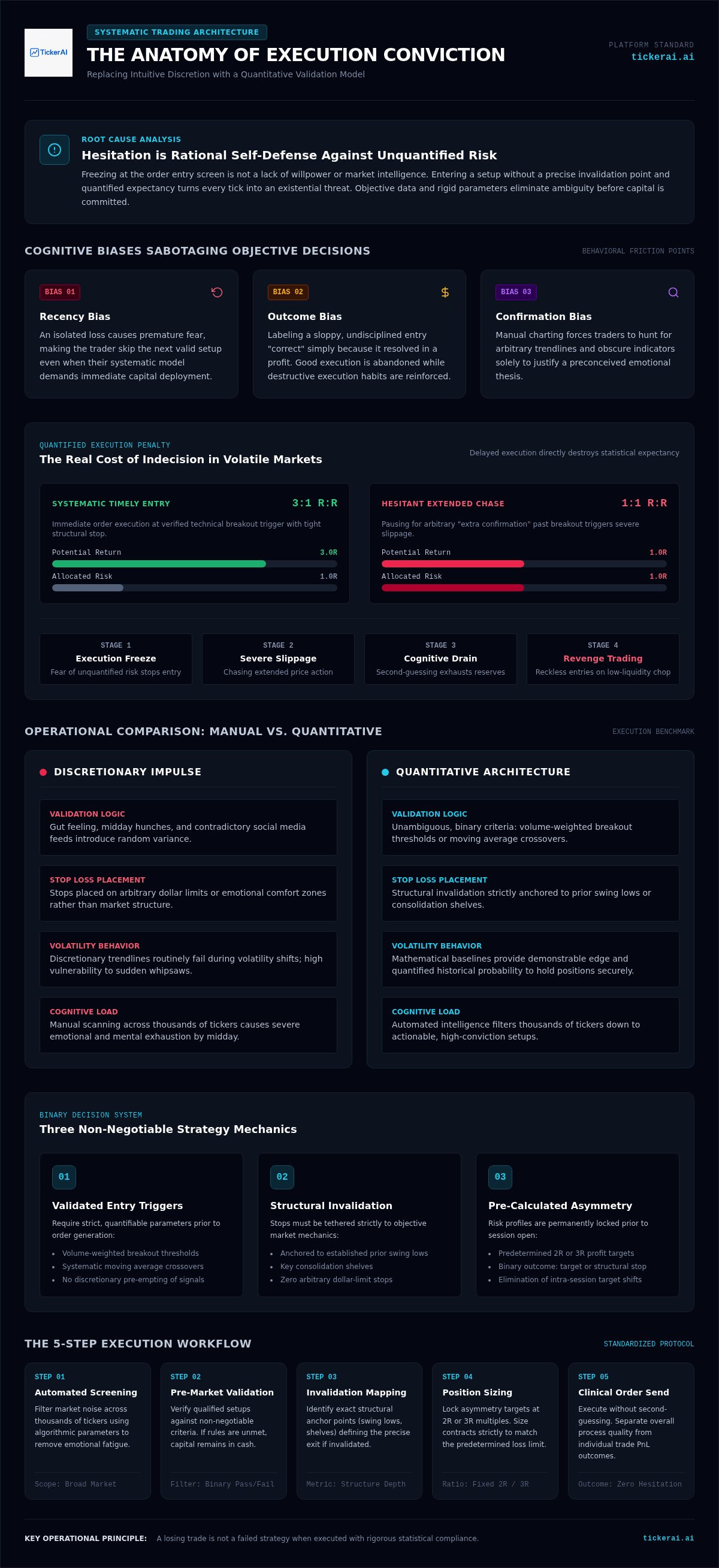
Trading confidence isn't emotional optimism. It isn't positive self-talk or hoping a candle holds support. Real conviction is mathematical: a demonstrable edge backed by quantified probabilities. When traders freeze at the point of execution, the root cause isn't fear of losing money. It's the terror of unquantified risk. Entering a setup without a precise invalidation point and historical expectancy turns every tick into an existential threat. Hesitation is simply the brain's rational defense against ambiguity.
Market noise compounds the paralysis. Scrolling contradictory social feeds and reactive financial headlines floods your decision engine with conflicting signals. You second-guess clean charts because an anonymous account posted a bearish macro thesis. Baseless overconfidence relies on luck; earned conviction relies on repeatable execution mechanics. Achieving consistency in building confidence in trading decisions means shifting from discretionary impulse to structured protocols. Adopting systematic trading principles replaces ambiguity with quantifiable inputs, giving you a definitive baseline for every order you send.
Cognitive Biases That Sabotage Objective Decision-Making
Subjective market interpretation invites lethal mental distortions that paralyze execution:
- Recency Bias: An isolated loss makes you skip the next valid setup, even when your system demands immediate capital deployment.
- Outcome Bias: You label a sloppy, undisciplined entry "correct" simply because it resolved in a profit. Good execution gets abandoned; bad habits get reinforced.
- Confirmation Bias: Manual charting forces you to hunt for arbitrary trendlines and obscure indicators just to justify a preconceived bias.
The Cost of Indecision in Volatile Market Environments
Hesitation carries an immediate balance-sheet cost. Pausing for arbitrary "extra confirmation" past a technical breakout triggers severe slippage. A pristine 3:1 reward-to-risk ratio quickly degrades into an unacceptable 1:1 chase. Worse, the mental exhaustion of second-guessing open positions drains your cognitive reserves before midday.
This psychological friction frequently sparks revenge trading. After watching a missed setup run to target without them, traders experience acute regret and force reckless entries on low-liquidity chop. Ultimately, building confidence in trading decisions requires eliminating this cognitive drag through cold, pre-calculated parameters that dictate exact actions before the session begins.
Replacing Gut Instinct with a Systematic Rule-Based Framework
Discretionary trading is an operational vulnerability. Gut feelings, subjective intuition, and midday hunches introduce random variance that destroys statistical expectancy. True consistency begins by codifying your edge into an unambiguous rulebook. Research in behavioral economics proves that humans make systematic errors when evaluating risk under pressure. To bypass these hardwired flaws, your trade parameters must be locked before capital is committed. For traders seeking structural discipline, using AI to remove emotion from trading provides an objective framework that isolates technical setups without cognitive interference.
Standardizing Entry, Invalidation, and Target Criteria
Execution hesitation vanishes when criteria become binary. You either have a qualified setup, or you stay in cash. Standardize your strategy around three non-negotiable mechanics:
- Validated Entry Triggers: Require precise technical criteria, such as volume-weighted breakout thresholds or moving average crossovers, before generating an order.
- Structural Invalidation: Anchor stops strictly to market structure, such as prior swing lows or consolidation shelves. Never place stops based on arbitrary dollar limits.
- Pre-Calculated Asymmetry: Define fixed risk multiples (such as 2R or 3R targets) prior to market open.
Tracking these levels across volatile markets is demanding. Deploying automated intelligence tools like TickerAI allows you to monitor dynamic market parameters without manual fatigue.
Separating Process Quality from Individual Trade PnL
A losing trade isn't necessarily a bad trade. In a probabilistic environment, a mathematically sound setup executed with clinical discipline can still hit your stop loss. Individual trade outcomes contain unavoidable variance; your edge only emerges over a large sample of executions. Shift your core performance metric from daily profit to Execution Compliance, tracking the percentage of trades that followed your rules flawlessly.
Evaluating execution quality over batches of 30 to 50 trades neutralizes the emotional sting of temporary drawdowns. This batched perspective is the cornerstone of building confidence in trading decisions. When you stop judging your ability on a single tick, disciplined execution becomes automatic.
Discretionary Charting vs. Quantitative Validation in 2026
Drawing subjective trendlines across arbitrary candle wicks is a fragile foundation for capital allocation. In modern electronic markets where automated algorithms dominate daily volume, manual pattern drawing often amounts to visual guessing. A trendline that appears pristine on an hourly chart frequently vanishes when viewed on a 15-minute timeframe. When volatility spikes, these subjective boundaries break without warning. Sustained success in building confidence in trading decisions demands shifting from visual intuition to measurable, quantitative validation. Understanding what is quantitative investing clarifies how institutional players ground trade selection in statistical distributions rather than artistic chart doodles.
The Fragility of Manual Visual Pattern Recognition
Human eyes are prone to pareidolia, the cognitive tendency to perceive patterns where none exist. After reviewing charts for hours, mental fatigue degrades your pattern recognition, leading you to see phantom support shelves or flag breakouts that lack institutional participation. Algorithmic scanning strips this optical illusion away. Automated tools evaluate liquidity levels, relative volume, and price action strictly against hard mathematical logic, ensuring every identified pattern meets uniform standards across all timeframes.
Statistical Backtesting as the Shield Against Market Drawdowns
Execution conviction during a losing streak requires knowing your numbers beforehand. When you trade on intuition, a cluster of four consecutive losses triggers panic and system-hopping. Quantitative validation solves this by providing clear operational benchmarks:
- Maximum Expected Drawdown: Historical testing defines the normal duration and depth of equity dips, preventing premature strategy abandonment.
- Win Rate vs. Profit Factor: Understanding the relationship between your strike rate and average reward multiple confirms that a 40% win rate can remain highly profitable with a 2.5R average gain.
- Regime Distribution: Historical modeling shows how your parameters perform across shifting trend, chop, and volatility cycles.
Backtested statistical proof acts as an emotional shock absorber. When the data proves your edge survives dozens of historical drawdowns, pulling the trigger during an uncomfortable market phase becomes an objective operational duty. That certainty is real conviction in building confidence in trading decisions.
How to Build Unshakeable Trading Confidence: A 5-Step Execution Workflow
Execution hesitation collapses when decision-making follows a strict, sequential pipeline. You cannot hesitate when your next action is mechanically predetermined. By breaking trade execution into five distinct phases, you convert market uncertainty into an assembly-line process where discretion is stripped away before your capital touches the market.
Step 1 to 3: Filtering, Sizing, and Structural Pre-Flight Verification
Pre-flight validation determines trade viability before you open your broker interface:
- Step 1: Systematic Filtering: Scan liquid equities to isolate setups displaying institutional volume expansion and clear relative strength. Discard assets trapped in low-volume consolidation.
- Step 2: Position Risk Quantification: Calculate share sizing mathematically using portfolio equity. Risk a fixed 1% to 2% of total capital per trade. Divide that cash risk by the distance between entry and the structural invalidation point. Never calculate position size by gut feel.
- Step 3: Multi-Factor Confirmation: Validate structural momentum across indicators before queuing orders. Knowing how to interpret AI stock signals ensures that technical confluence, moving average alignments, and volume thresholds confirm the move before capital deployment. Minimum asymmetric criteria (2R or 3R) must exist prior to entry.
Step 4 to 5: Flawless Order Placement and Post-Trade Data Extraction
The final two steps lock down execution mechanics and refine your edge over time:
- Step 4: Automated Bracket Deployment: Send entry orders coupled simultaneously with contingent stop-loss and profit-target limit orders. Once filled, step away from tick-by-tick charts. Micro-timeframe fluctuations generate emotional impulse; bracket orders enforce clinical exit discipline.
- Step 5: Execution Variance Logging: Record the trade in an analytical journal immediately after entry. Track your execution variance: Did you experience entry slippage? Did you execute at the pre-calculated trigger? Did you feel hesitation? Logging compliance data proves whether you followed your system, reinforcing the process feedback loop.
Systematizing these execution phases is the operational key to building confidence in trading decisions. To eliminate manual scan fatigue and access algorithmic setups backed by predefined technical parameters, explore TickerAI systematic discovery tools.
Scaling High-Conviction Decisions with Automated Intelligence
Manual scanning across thousands of equities burns through analytical energy before the opening bell rings. Eyeballing hundreds of charts creates cognitive fatigue, increases oversight, and leaves you second-guessing textbook setups. Automated opportunity discovery solves this operational bottleneck. Instead of searching blindly, machine-driven filtering isolates institutional momentum with algorithmic precision. Implementing automated stock market analysis transforms your daily workflow from an exhausting manual hunt into an efficient evaluation process.
Smart watchlists focus capital exclusively where capital is moving. By continuously filtering the broader market down to assets exhibiting verified volume expansion and relative strength, automated engines ensure you spend your time evaluating pre-qualified candidates rather than chasing random tickers.
Eliminating Scan Fatigue with Machine-Driven Opportunity Discovery
Algorithmic filters track structural breakouts, liquidity sweeps, and volume spikes continuously without human exhaustion. Offloading data processing to automated systems protects your cognitive bandwidth. You don't need to monitor ten different sectors simultaneously; the software flags structural anomalies as they emerge.
This operational shift preserves your focus for execution mechanics, sizing protocols, and risk management during peak market windows. Eliminating visual fatigue directly prevents the impulsive mistakes that erode your trading account balance.
Achieving Execution Consistency Through Objective Intelligence
Execution consistency requires binary, objective triggers. Real-time alerts notify you the moment an equity crosses predefined parameters, eliminating the urge to stare at intraday tick charts. For active market participants, structural parameters replace subjective guesswork with unambiguous entries and verified invalidation zones.
This systematic clarity is the ultimate catalyst for building confidence in trading decisions. You stop relying on emotional reactions and start executing against mathematically validated structures. To remove discretionary fatigue from your daily routine, explore TickerAI to access AI stock opportunity discovery, structured swing trade setups, and smart watchlists designed to optimize your trading workflow.
Transform Execution Hesitation into Systematic Edge
Trading conviction isn't an innate personality trait. It's an operational byproduct of structured validation. By locking in structural invalidation levels, standardizing position sizing, and measuring compliance across batched data sets, you strip away the ambiguity that fuels hesitation. Sustainable progress in building confidence in trading decisions demands shifting your focus from short-term PnL variance to systematic execution repeatability.
You don't need to battle scan fatigue alone. Modern electronic markets reward traders who leverage objective data tools. With algorithmic discovery scanning thousands of assets in real time, curated swing trade setups featuring predefined entry and invalidation zones, and smart watchlists designed to target high-probability momentum, you can execute with absolute clarity. Accelerate your trading conviction with TickerAI and take control of your execution edge today.
Frequently Asked Questions
Can you build confidence in trading without risking real capital?
Yes, paper trading builds mechanical fluency, but it cannot simulate capital exposure. Simulated execution allows you to practice order entry, refine your checklist, and test strategy parameters without financial risk. However, true conviction requires transitioning to micro-sizing with real capital. Managing nominal financial stakes forces you to confront real emotional variance while preserving portfolio equity.
How many trades are required to validate whether a strategy has an edge?
A minimum sample size of 50 to 100 executed trades is required to establish statistical validity. Small samples of 10 or 20 setups are dominated by short-term market noise and random distribution. Analyzing a larger batch allows you to measure win rate, profit factor, and max drawdown objectively, confirming that your execution rules deliver positive mathematical expectancy.
What should a trader do immediately after a streak of consecutive losses?
Stop trading immediately and audit execution compliance rather than market conditions. Verify whether each trade honored your structural invalidation and entry criteria. If you broke rules, step back to reset emotional discipline. If you followed your framework flawlessly, reduce position sizing by half and continue executing. Normal drawdowns are mathematical certainties within any viable trading model.
Is trading confidence purely psychological or based on technical competence?
True conviction is structural, not psychological. Mindset work cannot fix a negative-expectancy strategy or poor risk management. Technical competence, quantitative backtesting, and rigid position sizing create the foundation for emotional stability. When your trade invalidation and reward targets are mathematically verified, psychological calm follows naturally as a direct byproduct of that preparation.
How does automated stock scanning improve decision-making speed?
Automated scanning eliminates manual chart cycling across thousands of individual tickers. Machine-driven discovery surfaces equities matching specific volume expansion and technical breakout criteria in real time. This rapid filtering prevents scan fatigue, ensuring you allocate cognitive bandwidth strictly toward sizing, risk-reward assessment, and precise trade execution during fast-moving market windows.
What is the fastest way to stop second-guessing trade entries?
The fastest solution is deploying automated bracket orders the moment your entry triggers. When your stop loss and profit targets are submitted simultaneously, you remove post-entry hesitation entirely. Mastering this execution protocol is the most direct path toward building confidence in trading decisions, ensuring that discipline is enforced programmatically rather than left to emotional discretion.


