

Professional trading is an exercise in clinical detachment. Most market participants fail not because they lack data, but because they are paralyzed by it. You have likely experienced the gut-punch of a panic sell during a minor pullback or the frantic urge to chase a vertical ticker due to FOMO. These reactions are the natural byproduct of a manual, high-pressure environment. If you are constantly second-guessing your entries, you aren't trading a system; you are trading your nerves. Learning how to remove emotion from trading is the single most important step toward professional consistency.
It's time to replace gut instinct with algorithmic precision. This guide provides a roadmap to transition from reactive, emotional trading to a clinical, systematic approach powered by AI-driven discovery. You will learn how to leverage automated market scanning to eliminate analysis paralysis and use smart watchlists to filter out the noise. We will break down the exact workflow required to gain confidence in your setups before you ever hit the buy button. By the end, you will have a framework for execution that treats the market as a series of data points rather than a source of stress.
Key Takeaways
- Identify the "Amygdala Hijack" and its role in triggering reactive panic selling and FOMO during market volatility.
- Learn how to remove emotion from trading by replacing intuition with a rules-based, quantitative framework.
- Reduce cognitive load and eliminate analysis paralysis by outsourcing market scanning to high-speed AI discovery tools.
- Implement a clinical, five-step workflow designed to prioritize systematic execution over manual guesswork and information overload.
- Utilize Smart Watchlists to organize chaotic market data into actionable, thematic investment opportunities with professional precision.
The Biological Trap: Why Your Brain is Hardwired to Fail at Trading
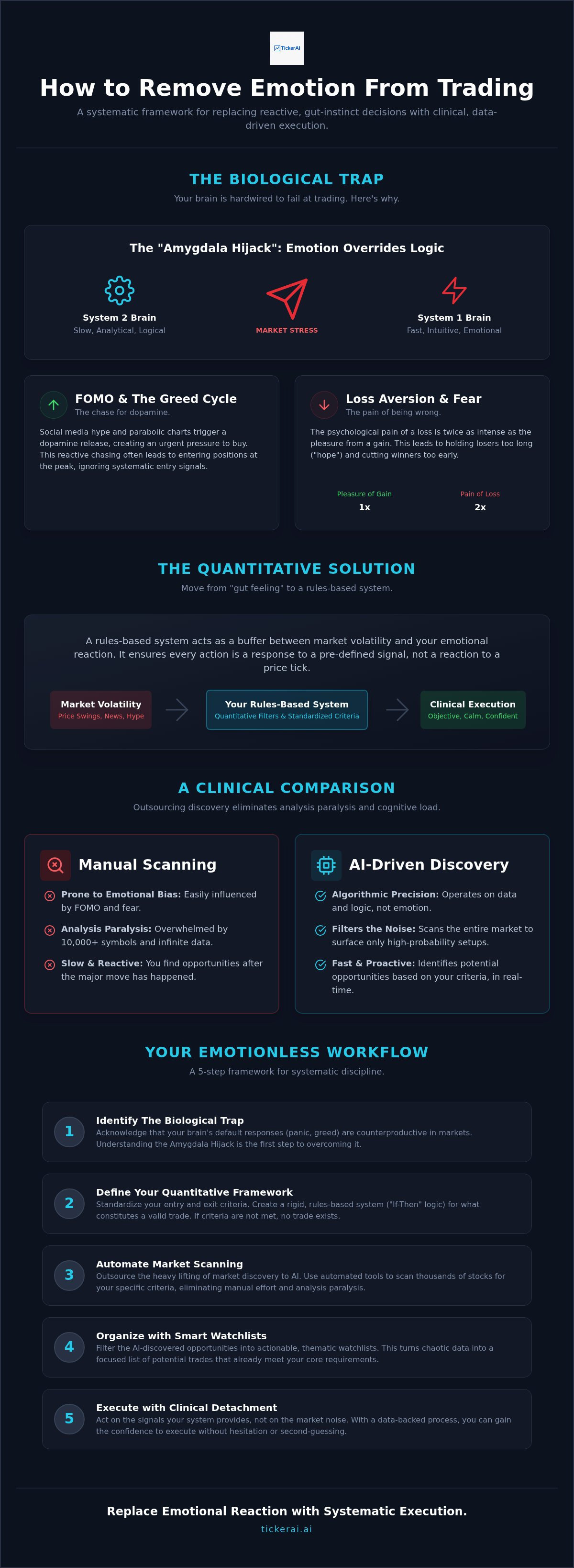
Trading is an unnatural act. Your brain processes financial risk as a direct physical threat. This physiological response triggers what neuroscientists call the "Amygdala Hijack." In this state, the emotional center of the brain overrides the prefrontal cortex, the area responsible for logic, probability, and long-term planning. High-stakes environments cause your analytical capacity to shut down. Understanding this biological reality is the first step in learning how to remove emotion from trading.
The conflict originates from two distinct processing modes. System 1 is fast, intuitive, and emotional. It is designed for split-second survival. System 2 is slow, analytical, and logical. Markets move at a pace that deliberately exploits System 1. This is a core pillar of Behavioral Finance. When you trade manually, you are constantly fighting your own biology. Success requires a shift from intuitive reactions to systematic execution. Learning how to remove emotion from trading is about creating a workflow that bypasses these biological traps.
FOMO and the Greed Cycle
Greed is a chemical event. When social media feeds highlight "hot" stocks or parabolic moves, your brain's reward center releases dopamine. This creates an urgent pressure to participate. You feel the need to chase momentum. Manual scanning often leads traders to enter at the peak because they are reacting to price action that has already occurred. Without a systematic entry signal, you aren't trading; you're gambling on a biological impulse. You must replace the dopamine chase with clinical discovery and objective criteria.
Loss Aversion: The Pain of Being Wrong
The "Disposition Effect" is a common failure point where traders cut winners too early and hold losers too long. This is driven by loss aversion. Research suggests the psychological pain of a loss is twice as intense as the pleasure of a gain. This leads to "hoping" for a recovery instead of managing risk. Loss aversion is a survival mechanism that is counterproductive in financial markets. Recency bias adds another layer of failure. It causes you to over-weight your most recent trades, leading to hesitation even when a setup meets every technical criterion. Removing these biases requires a buffer between market data and your reaction.
The Quantitative Solution: Moving Toward a Rules-Based System
Intuition is a liability in a high-speed market. To achieve consistency, you must adopt what is quantitative investing as your primary framework. This methodology serves as the ultimate antidote to the biological traps discussed earlier. By relying on hard data and mathematical models, you create a necessary buffer between market volatility and your internal reaction. A rules-based system ensures that every action is a response to a signal; not a reaction to a price tick.
Institutional desks don't rely on "gut feelings." They deploy sophisticated algorithms to handle the heavy lifting of scanning and filtering. This allows human traders to focus solely on high-level decision-making. Adopting this mindset is essential for anyone researching how to remove emotion from trading. When you operate within a predetermined "If-Then" logic, you eliminate the need for mid-trade improvisation. If the criteria aren't met, the trade doesn't exist. It's that simple.
Standardizing Your Entry and Exit Criteria
Consistency is impossible without standardization. You must define clear technical and fundamental triggers for every position. Utilizing a systematic approach to stock investing significantly reduces decision fatigue. Instead of wondering if a setup is "good enough," you check it against a rigid list of requirements. This process is reinforced by backtesting. When you have historical data proving a setup works over 500 iterations, you gain the "trust" required to execute without hesitation. You can start building your own systematic workflow to see how data-driven alerts change your perspective.
The Power of Algorithmic Filtering
The modern trader faces a massive information problem. There are over 10,000 symbols in the US market alone. Trying to scan these manually is a recipe for analysis paralysis and FOMO. AI-driven discovery changes the math. It filters the entire universe of stocks into a handful of high-probability setups in milliseconds. This provides immense psychological relief. You no longer worry about "missing" a move because the system is always scanning. A filter's primary function is not just to identify potential winners, but to ruthlessly ignore the noise that triggers emotional mistakes.
Manual Scanning vs. AI-Driven Discovery: A Clinical Comparison
Manual charting is a high-friction process that creates an "Objectivity Gap." When you spend hours staring at candles, your brain begins to manufacture patterns where none exist. This psychological phenomenon, known as pareidolia, is a primary driver of forced entries. You aren't seeing a setup; you are seeing a justification for the time you've already spent scanning. AI-driven discovery eliminates this bias. It remains clinical, evaluating data points against rigid mathematical criteria without the need for a "narrative." This shift is fundamental to how to remove emotion from trading.
The human brain is not designed to process 10,000+ symbols simultaneously. When a manual trader tries to track multiple indicators across various timeframes, "Analysis Paralysis" is the inevitable result. Cognitive load increases, decision quality drops, and the trader eventually defaults to an emotional, gut-level choice. An AI system handles this complexity in milliseconds. It provides the speed of discovery required for a fast-moving swing trade environment, ensuring you are focused on execution rather than exhaustive, biased research.
The Efficiency Frontier in 2026
Manual traders are currently operating at a structural disadvantage against automated stock market analysis. Speed is alpha. By the time a human identifies a breakout, the institutional algorithms have already moved the needle. Real-time alerts provide a psychological "distance" from the ticker tape. Instead of watching every tick, you respond only when a logic-gate is triggered. This automation allows you to detect anomalies and volume spikes that the human eye would naturally filter out during a standard scan.
Reducing the 'Human Variable' in Research
Fatigue is the enemy of discipline. As the trading day progresses, "ego depletion" sets in, making you more susceptible to impulsive decisions and FOMO. This is particularly dangerous for long-term positions where conviction is tested by short-term volatility. Utilizing AI tools for long-term investors allows you to validate fundamental theses without the cloud of current market sentiment. Delegating the "scouting" phase to a tireless system is the highest form of trading discipline. It ensures that your research remains consistent at 3:30 PM as it was at the market open. Learning how to remove emotion from trading means recognizing your own biological limits and deploying technology to bridge the gap.
Building Your Emotionless Workflow: 5 Actionable Steps
Transitioning to a clinical trading model requires more than just willpower. You need a modular, repeatable workflow that replaces manual guesswork with data-driven triggers. Learning how to remove emotion from trading is a process of systematic replacement. You aren't just "trying to be calm"; you are removing the situations that cause stress. Follow these five steps to build a professional-grade execution framework.
- Step 1: Quantify Your Edge. Replace vague feelings about "support" with specific quantitative criteria. Use technical indicators, volume anomalies, or fundamental filters that can be measured objectively.
- Step 2: Outsource Discovery. Use an AI-driven discovery platform to handle the scouting phase. This prevents the fatigue associated with manual scanning and ensures you only focus on high-probability setups.
- Step 3: Automate Your Alerts. Set specific pings for your entry triggers and risk levels. You should only be at your terminal when the system signals that your logic has been met.
- Step 4: Execute with Clinical Precision. Treat every trade as a single data point in a larger series. A win isn't a personal victory and a loss isn't a failure; they are both just outcomes of a tested system.
- Step 5: Audit the Logic. Review your performance using a data-driven journal. Focus on whether you followed the system, not the dollar amount gained or lost.
Leveraging Real-Time Alerts for Focus
Decision fatigue is a primary cause of emotional errors. By staying "unplugged" until an alert triggers, you preserve your cognitive capital for execution. You can learn how to interpret AI stock signals to understand the logic behind every notification. This ensures you aren't second-guessing the system when a high-speed opportunity arrives. Automated alerts act as a professional filter, allowing you to ignore the daily market noise and focus only on actionable themes. To start receiving these filtered setups, get started with TickerAI Pro.
Risk Management as a Psychological Safety Net
Emotion often stems from the fear of the unknown. Hard stops are non-negotiable. They remove the temptation to "wait and see" if a losing trade will recover. You must size your positions based on current volatility and your predefined risk parameters rather than your level of excitement. Risk management is the only variable a trader can truly control in an unpredictable market environment. When your downside is strictly capped by a system, the biological pressure to panic sell vanishes. This is the final, critical step in how to remove emotion from trading once and for all.
Leveraging TickerAI for Systematic Discipline
TickerAI Pro and Full-Access subscriptions are engineered for the serious participant who treats the market as a data environment rather than a casino. The platform acts as a high-speed intelligence partner, filtering out the chaotic noise that triggers emotional instability. By providing curated swing trade setups and real-time alerts, TickerAI bridges the "Objectivity Gap" discussed earlier. You no longer need to manufacture patterns during manual scans. The system presents high-probability opportunities based on rigid mathematical criteria, allowing you to focus exclusively on execution.
Smart Watchlists play a critical role in this clinical workflow. They organize market volatility into actionable, logic-based themes. This is the professional standard for finding thematic investment opportunities with AI. Instead of reacting to isolated price spikes, you monitor structural shifts in the market. This transition from "guessing" to "executing" is the final stage in mastering how to remove emotion from trading. When the discovery phase is outsourced to a tireless scout, your only job is to follow the system.
Automating Opportunity Discovery
TickerAI scans the entire universe of stocks for momentum and breakouts while you remain unplugged. This automation preserves your cognitive capital and prevents the ego depletion that leads to late-day trading errors. Every notification you receive has already passed through a layer of quantitative rigor. This ensures that you are only considering setups with a statistical edge. TickerAI is the definitive tool for using AI to remove emotion from trading. It replaces the dopamine-driven chase of "hot" stocks with a methodical, alert-based entry process.
Scaling Your Intelligence in 2026
Maintaining a competitive edge in a fast-moving market requires speed that exceeds human capacity. Real-time alerts provide the necessary velocity without the emotional burnout of manual monitoring. Whether you are looking for short-term swing stock alerts or long-term investment ideas, TickerAI provides the data-driven conviction required for discipline. You can scale your intelligence by leveraging a system that never sleeps and never feels the pressure of a drawdown. It's time to stop reacting to the ticker tape and start discovering with clinical precision. Join TickerAI today to finalize your transition to a systematic, emotionless trading workflow.
Transition to a Clinical Trading Workflow
Professional trading requires a permanent shift from reactive intuition to systematic execution. You now understand that biological biases like loss aversion and the "Amygdala Hijack" are structural hurdles that willpower alone cannot clear. Success depends on building a robust buffer between market volatility and your decision-making process. By outsourcing the discovery phase to high-speed algorithms, you eliminate the cognitive load that leads to fatigue and emotional errors. This transition allows you to treat every ticker as a data point rather than a source of stress.
Mastering how to remove emotion from trading is ultimately about replacing manual guesswork with clinical infrastructure. TickerAI provides the technical framework necessary for this transition through AI-powered stock anomaly detection and real-time actionable swing trade setups. You can move away from the noise and focus on high-probability execution without the weight of hesitation. It is time to stop fighting your biology and start leveraging technology that remains objective under pressure.
Start your systematic discovery journey with TickerAI Full-Access to receive clinical, data-driven market alerts today. The market moves fast, but with the right system, you can remain detached, disciplined, and consistently focused on your edge.
Frequently Asked Questions
Is it actually possible to remove all emotion from trading?
Total elimination of emotion is impossible because you are human. However, you can neutralize the impact of emotion by automating the discovery and decision-making process. Learning how to remove emotion from trading is about building a system that executes when you are compromised. By the time an emotional spike occurs, the trade should already be managed by hard stops and automated alerts. Detachment is a skill developed through systemic reliance.
How does AI help in reducing emotional trading decisions?
AI acts as a clinical filter that scans market data without biological bias. It processes thousands of tickers in milliseconds to identify anomalies based on logic, not gut feeling. This reduces the cognitive load on the trader, preventing the analysis paralysis that often leads to impulsive choices. By receiving alerts that meet strict quantitative criteria, you replace the dopamine-driven chase with a methodical execution workflow that prioritizes data over intuition.
What is the most common emotional mistake traders make?
Loss aversion is the most frequent failure point in the market. Traders often hold losing positions too long in the hope of a recovery while cutting winners early to lock in small gains. This biological survival mechanism is counterproductive in financial markets. A systematic approach fixes this by making entry and exit points non-negotiable. When you follow a rules-based system, you treat every trade as a data point rather than a personal victory.
Can a rules-based system work for long-term investors too?
Yes, systematic discipline is essential for maintaining long-term conviction. Investors often abandon their thesis during short-term market pullbacks due to recency bias. A rules-based system uses AI to validate fundamental trends and identifies thematic opportunities without the cloud of current sentiment. This allows you to scale your intelligence and maintain a professional perspective. Curated investment ideas are designed to keep long-term participants disciplined through high-volatility periods without second-guessing their original logic.
How do I trust an AI signal if I don't understand the underlying math?
Trust is built through backtesting and consistent outcomes, not manual calculation. You don't need to understand every line of code to recognize a high-probability setup. Focus on the historical performance and the logic-gate triggers that generate the alert. Start by observing signals in a smart watchlist before committing capital. Once you see the system detect anomalies with clinical precision across multiple market cycles, the need for manual validation disappears.
What should I do if I feel an emotional spike during a live trade?
Step away from the terminal immediately. If your trade is managed by hard stops and automated exit triggers, your presence is no longer required for risk management. Emotional spikes are a sign of the "Amygdala Hijack" disabling your analytical prefrontal cortex. By having a predetermined "If-Then" plan, you ensure the trade concludes based on data rather than your current stress level. Trust the system you built during your calm, analytical hours.
How does a systematic approach help with FOMO?
Systematic discovery eliminates the fear of missing out by ensuring you are always scanning. FOMO occurs when you believe you've missed the only opportunity available. AI discovery platforms scan thousands of tickers to find the next high-probability setup based on momentum and volume. When you know the system is tirelessly detecting new entries, you feel no pressure to chase a vertical price move that has already passed its optimal entry point.
Do I need a large account to start using quantitative tools?
No, quantitative tools are about the quality of the process, not the size of the capital. Systematic discipline is scalable from a retail account to an institutional desk. Using AI for opportunity discovery helps you avoid the "blow-up" trades that often deplete small accounts. By focusing on position sizing and rules-based entries, you protect your capital while gaining professional experience. Efficiency and precision are valuable regardless of your starting account balance.


